Saudi deployments bring Pakistan closer to a regional war
Pakistan has confirmed a substantial military deployment to Saudi Arabia as escalating Houthi attacks test two defence agreements and threaten Islamabad's relationship with neighbouring Iran. The immediate challenge is protecting Saudi territory while keeping Pakistani forces out of an expanding war in Yemen.
Contents
- Saudi deployments bring Pakistan closer to a regional war
- What the defence agreements actually say
- How the commitments became an immediate test
- Where Pakistan draws the military boundary
- Why Saudi Arabia needs help despite its vast arsenal
- Saudi money and Pakistani livelihoods
- Iran has practical interests across Pakistan's border
- Diplomacy offers another way to fulfil the promise
- Parliament and domestic security return to the debate
- Airports, oil routes and the cost of further escalation
- Key Points
The human cost already reaches Pakistani families. Saudi Arabia's General Authority of Civil Aviation put the toll from the October 10 attack on Riyadh's King Khalid International Airport at 12 dead and more than 300 injured. Another published tally put the deaths at 13. Pakistan's Foreign Minister Ishaq Dar said six Pakistani nationals were injured and directed the embassy in Riyadh to coordinate assistance.
Prime Minister Shehbaz Sharif reaffirmed support for Saudi sovereignty, security and territorial integrity during a meeting with newly appointed Saudi Ambassador Dr Rajeh Tami Albugamy. The Prime Minister's Office said the recent escalation had caused deaths and injuries, including among Pakistani nationals.
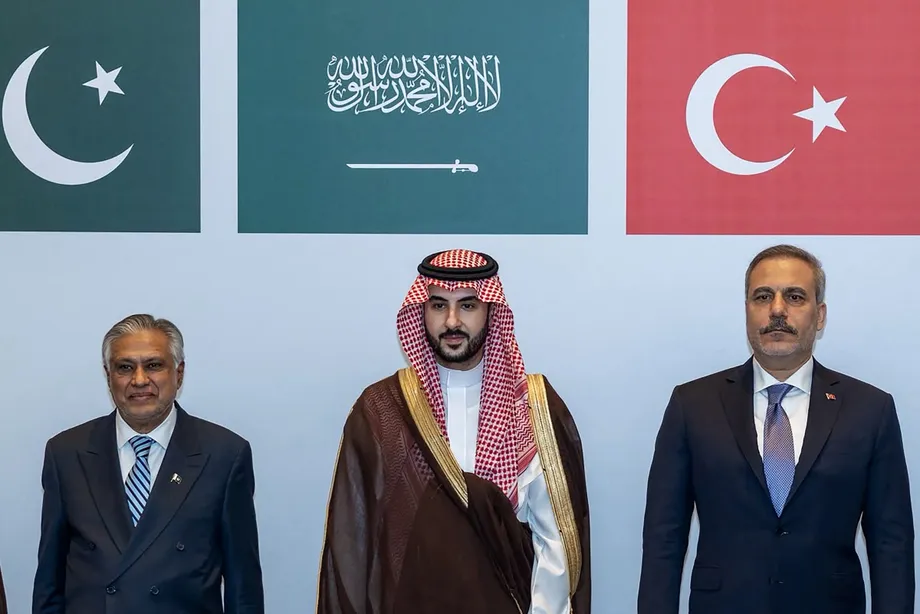
Islamabad's commitments now extend beyond expressions of solidarity. Pakistan, Saudi Arabia and Türkiye agreed on October 5 to deploy military forces and capabilities rapidly under their Makkah Joint Defence Agreement. Pakistani officials say their contribution remains defensive, with Saudi forces conducting combat operations.
Iran, which supports the Houthis, is watching those deployments closely. Pakistan relies on Tehran for border cooperation, trade and electricity in parts of Balochistan, while also serving as a diplomatic channel between Iran and the United States. Its Saudi obligations put each of those interests under pressure.
What the defence agreements actually say
Saudi Crown Prince Mohammed bin Salman and Sharif signed the bilateral Strategic Mutual Defense Agreement in Riyadh on September 17, 2025. The Saudi government's joint statement says the agreement develops defence cooperation and strengthens joint deterrence, building on a partnership extending nearly eight decades.
The statement sets out the central promise: aggression against either country would be considered aggression against both. Deterrence means trying to prevent an attack by convincing a potential attacker that the response would be costly.
The August 7, 2026, Makkah agreement added Türkiye to a collective defence arrangement using the same broad principle. At the October 5 emergency meeting in Riyadh, the three governments moved to implement those commitments. The activation of the pact included plans for rapid deployment and the appointment of retired Pakistani Lieutenant General Nauman Mahmood as its first secretary general.
The International Institute for Strategic Studies, in its defence relationship assessment, describes the bilateral agreement as introducing strategic ambiguity. In simple terms, the broad promise leaves potential adversaries uncertain about the response they might face. The institute also says a preliminary agreement was signed during caretaker Prime Minister Anwaar-ul-Haq Kakar's 2023–24 administration without being announced.
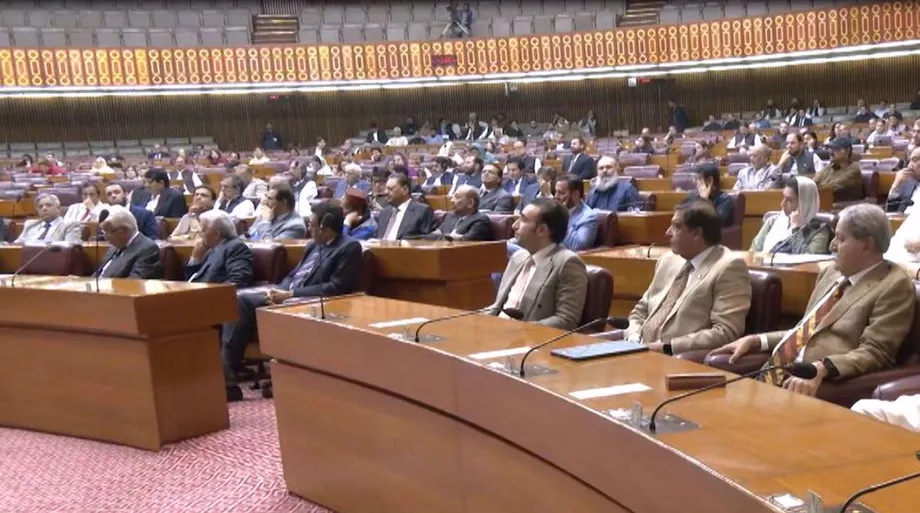
The full agreements and detailed operational rules have not been made public or presented to Pakistan's Parliament for approval. The practical decisions about missions, force levels and escalation therefore remain concentrated among the governments and military leadership involved.
How the commitments became an immediate test
October's attacks followed the collapse in July of a truce in Yemen's long conflict. Saudi Arabia supports Yemen's internationally recognised government against the Houthis, who have repeatedly targeted Saudi airports, oil installations and shipping.
The main steps show how quickly a defence partnership moved toward active military support:
- September 17, 2025: Pakistan and Saudi Arabia signed their bilateral Strategic Mutual Defense Agreement.
- August 7, 2026: Pakistan, Saudi Arabia and Türkiye signed the Makkah Joint Defence Agreement.
- September 18: Pakistan's military spokesperson, Lieutenant General Ahmed Sharif Chaudhry, described the commitment to Saudi security as unconditional.
- October 5: An emergency alliance meeting in Riyadh approved rapid deployment of agreed forces and capabilities.
- October 6–7: Attacks on airports in Riyadh and Abha reportedly killed three people and injured 36.
- October 10–11: The deadly King Khalid airport attack prompted renewed Pakistani pledges and assistance for injured nationals.
Sharif has also described threats to Mecca and Medina as a red line, linking Pakistan's response to the protection of Islam's two holiest cities. Former diplomat A M Shahid said safeguarding those sites was part of Pakistan's commitment, alongside its condolences to Saudi families affected by the strikes.
Where Pakistan draws the military boundary
Defence Minister Khawaja Asif says Pakistani and Turkish forces have a presence in the area of operations, while only Saudi troops are engaged in combat. He has described Pakistan's contribution as supportive, including reconnaissance, the gathering of information about threats and military movements.
Pakistan's Foreign Ministry has similarly said its role centres on defending Saudi territory rather than launching operations inside Yemen. The military says personnel are serving in multiple capabilities and domains. Published deployment estimates range from thousands of troops and a fighter squadron to roughly 8,000 personnel and 16 JF-17 aircraft deployed or positioned in advance during April.
Islamabad has rejected claims that Pakistani aircraft were used to strike the Houthis, calling them "fake and fabricated." The Saudi coalition said 100 aircraft took part in its latest air campaign, without identifying their nationalities. Other published claims describe Pakistani and Turkish equipment supporting Saudi operations near Bab el-Mandeb, adding to scrutiny of how assistance is being used.
Former diplomat Waheed Ahmad has defended the government's position, saying Pakistani forces are stationed in Saudi Arabia for defence rather than aggression against another country. Muhammad Amir Rana, director of the Islamabad based Pak Institute for Peace Studies, expects Islamabad to resist sending forces across the Yemeni border.
Rana described that limit directly:
Pakistan will do its best not to get involved in any incursion on Yemeni soil.
University of Southern California professor Derek Grossman argues that Pakistan will favour defensive deployments, intelligence sharing, weapons transfers and logistical assistance over direct combat. Those activities could still expose Pakistani personnel and equipment to attack, increasing pressure for a stronger response.
Why Saudi Arabia needs help despite its vast arsenal
Saudi Arabia allocated $83 billion for military expenditure in its 2026 budget and struck a $9 billion agreement with Washington for 730 Patriot missiles. Regional officials nevertheless say its stocks of interceptors, missiles used to destroy incoming weapons, are running low.
Saudi forces must protect airports, cities, oil facilities and other assets spread across a vast territory. The border with Yemen extends more than 1,300 kilometres, while Houthi weapons can reach targets more than 1,600 kilometres away. Protecting one installation leaves many others needing coverage.
The Houthis have also gained experience from repeated missile and drone attacks, including against Israel. Andreas Krieg, a professor at King's College London, says the group has learned to send enough weapons at once to overwhelm radar and interception systems. United Nations estimates put Houthi recruitment at up to 350,000 fighters by 2024, compared with 30,000 in 2015, almost twelve times as many.
Saudi authorities said debris from two intercepted cruise missiles wounded four people and damaged 15 homes in Riyadh. The coalition separately said Tuesday's attacks wounded 73 people and set oil installations ablaze in four cities. Even successful interceptions can leave people and property exposed to falling wreckage.
Michael Ratney, a former US ambassador to Saudi Arabia, expects Riyadh to combine military pressure with efforts to reduce the fighting. Analysts anticipate airstrikes and greater support for allied Yemeni forces rather than a large Saudi ground invasion. That approach would make air defence, intelligence and logistical help from partners especially useful.
Saudi money and Pakistani livelihoods
Saudi Arabia's financial role makes Islamabad's military decisions harder. Riyadh provided a $3 billion emergency loan in April and extended a $5 billion deposit at the State Bank of Pakistan by three years. Together, the $8 billion was estimated to equal about 38% of Pakistan's foreign exchange reserves.
Foreign exchange reserves are funds held mainly in foreign currencies that help a country pay for imports and meet payments abroad. Keeping Saudi deposits in place reduces the immediate pressure on Pakistan to find replacement dollars.
Pakistani workers in Saudi Arabia sent home almost $10 billion last year. Those remittances support household spending as well as Pakistan's supply of foreign currency. Attacks that disrupt work, transport or economic activity in the kingdom therefore carry direct consequences for families far beyond the Gulf.
Sharif thanked the Saudi leadership for its economic and financial support when he met Ambassador Albugamy. Dar separately met the envoy and discussed strengthening bilateral cooperation. The meetings underline how closely security, employment and financial stability are connected in the relationship.
Iran has practical interests across Pakistan's border
Iran's importance to Pakistan is equally concrete, though different in scale and form. Iranian electricity supplies parts of Balochistan, including Gwadar, where disruption would affect daily life and commercial activity.
Shuja Nawaz, a former distinguished fellow at the Atlantic Council, points to Iran's economic, political and cultural connections inside Pakistan. He warns that deteriorating relations could put electricity supplies at risk and complicate efforts to contain Baloch militancy along the border.
Iranian Foreign Ministry spokesperson Esmaeil Baqaei expressed concern about reports of a Pakistani troop deployment, saying he hoped they were a "rumour." Iranian lawmaker Ahmad Naderi has argued that Pakistan's alignment with Riyadh makes it a regional participant rather than a mediator. President Asif Ali Zardari has sought to reassure Tehran by describing the pact as defensive and not directed against any country.
Pakistan has meanwhile continued to expand commercial connections with Iran. An April transit order opened six routes for cargo travelling through Pakistan to Iranian crossings at Gabd and Taftan, reportedly easing the movement of more than 3,000 stranded containers. The two countries have also discussed the Kohak-Chedgi crossing and a direct rail connection.
Islamabad and Tehran reaffirmed a goal of raising bilateral trade from $3 billion to $10 billion. That would mean adding $7 billion, taking trade to more than three times its existing level. Pakistan consequently has reasons to keep the Iranian relationship working even as it strengthens Saudi defences.
Diplomacy offers another way to fulfil the promise
Field Marshal Asim Munir and Iranian Foreign Minister Abbas Araghchi have maintained telephone contact during the escalation. Araghchi also spoke with Saudi Foreign Minister Prince Faisal bin Farhan, while Dar has held discussions with his Saudi and Turkish counterparts.
Foreign Office spokesperson Sajjad Haider Khan dismissed suggestions that Riyadh had asked Pakistan to strike Houthi positions as hypothetical. Asked about outreach to the Houthis through Iran, he said Pakistan would continue pursuing dialogue and diplomacy for regional peace.
Pakistan's diplomatic channel has a recent foundation. The April Islamabad talks brought senior American and Iranian representatives together for 21 hours of negotiations. Those talks ended without an agreement, after Pakistan had helped secure a temporary ceasefire.
Former foreign secretary Jauhar Saleem argues that preventing a wider war could serve Saudi security better than Pakistani participation in battles. Iranian regional security analyst Javad Heiran-Nia says Tehran has substantial influence over the Houthis, while the group retains room to make its own decisions.
Iranian leaders have publicly welcomed recent Houthi gains in Yemen, complicating Islamabad's effort to secure restraint. Pakistan and Iran also exchanged military strikes in January 2024, giving both governments a recent example of how border tensions can turn into direct confrontation.
Parliament and domestic security return to the debate
Pakistan's Parliament unanimously chose neutrality in April 2015 after Saudi Arabia requested troops, ships and aircraft for the Yemen campaign. The resolution supported a diplomatic role to help end the crisis. Today's defence agreements have brought that earlier decision back into public debate.
Senate opposition leader Raja Nasir Abbas says the conditions of the Makkah pact are known only to a small circle of senior military figures. He has warned that entering the war would worsen economic distress, instability and religious division.
Defence analyst Ayesha Siddiqa, a senior fellow at King's College London, has questioned whether Munir fully assessed how soon the agreement might require Pakistan to put troops at risk. Pakistan's large Shia population adds domestic political sensitivity to any campaign against forces aligned with Iran.
Pakistan's security forces are already under severe pressure at home. The South Asia Terrorism Portal counted more than 1,200 security personnel killed by insurgents last year, the highest toll in more than two decades. Violence along the Afghan frontier and the insurgency in Balochistan compete for personnel, equipment and attention.
Grossman also points to Pakistan's need to remain prepared for confrontation with India. A prolonged deployment in Saudi Arabia would require military planners to balance resources across several potential crises at once.
Airports, oil routes and the cost of further escalation
Riyadh's King Khalid airport was expected to remain closed through at least October 17, with several airlines suspending flights. The Future Investment Initiative planned remote participation rather than bringing attendees together on site, illustrating the disruption to Saudi business and investment plans.
Houthi advances toward Bab el-Mandeb have also increased concern about shipping through the narrow entrance to the Red Sea. Brent crude rose above $107 a barrel amid fears that Saudi export routes could face pressure through both that passage and the Strait of Hormuz.
Saudi Arabia's East-West pipeline carries close to seven million barrels a day to Yanbu on the Red Sea, providing a route around Hormuz. Images appeared to show a fire along the pipeline, although Riyadh had not confirmed a strike. Disruption to that route would increase the value of protecting other energy infrastructure and shipping access.
France and the United Kingdom have offered limited defensive support to Saudi Arabia. Washington has signalled intelligence and targeting assistance without committing forces to direct strikes. Pakistan and Türkiye consequently face expectations to make their own defence promises credible while seeking to contain the fighting.
Umer Karim, a doctoral researcher at the University of Birmingham, described the obligation driving Islamabad's response:
Pakistan cannot stay idle as it has committed itself to Saudi Arabia's defense.
Pakistan's chosen response so far combines forces inside Saudi Arabia with continued contact with Tehran. The pressure on that arrangement grows with each attack on Saudi cities, each threat to Pakistani personnel and each interruption to the economic connections Islamabad needs on both sides.
Key Points
- Pakistan has deployed personnel and military resources to Saudi Arabia while describing its role as defensive.
- The bilateral agreement was signed in September 2025; the pact with Türkiye followed in August 2026.
- The three countries approved rapid military deployment on October 5.
- Saudi aviation authorities reported 12 deaths and more than 300 injuries in the King Khalid airport attack; six Pakistanis were injured.
- Saudi financial support and remittances give Pakistan strong economic reasons to protect the relationship.
- Iran supplies electricity to parts of Balochistan and remains a partner in trade, border security and diplomacy.
- Parliamentary scrutiny, domestic insurgencies and the risk of a wider war are central concerns for Islamabad.