A grand welcome, with few new agreements detailed
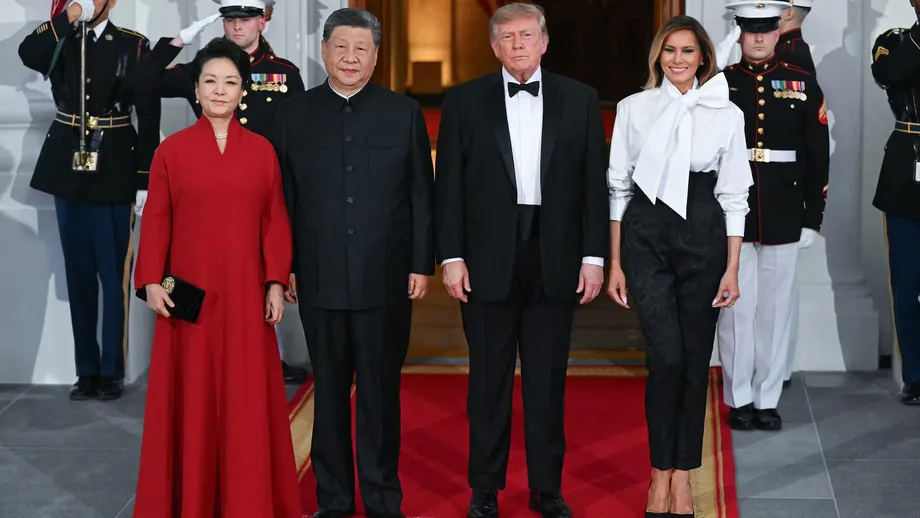
President Donald Trump hosted Chinese President Xi Jinping at a White House state dinner on September 24, 2026, bringing technology executives, senior officials and military musicians together after roughly 90 minutes of private talks. The visit ended the following day with warm public statements, a promise of further dialogue on artificial intelligence and few details of new agreements.
Contents
- A grand welcome, with few new agreements detailed
- Two days of ceremony and private discussions
- A trade pause, rather than a broader settlement
- AI talks create a channel for sharing risks
- Taiwan and Iran remain central security concerns
- Technology leaders fill the guest list
- A menu tied to the opening of relations
- Pandas and 100,000 invitations for young Americans
- Protests and a dispute over press access
- Washington and Beijing stress different results
- Key Points
Washington and Beijing had already agreed that week to extend their tariff truce for two months, giving negotiators more time to pursue a broader trade agreement. U.S. Trade Representative Jamieson Greer said the summit produced no specific new development on AI, although another meeting on the technology was expected within about a month.
Xi and his wife, Peng Liyuan, joined Trump and first lady Melania Trump in the East Room for a dinner attended by more than 130 guests. Trump praised the Chinese couple as "truly outstanding, amazing people" and said he wanted to return the hospitality he received in Beijing in May.
Xi described the private discussions as sincere and presented cooperation as a responsibility shared by two major powers. Speaking through a translator at the dinner, the Chinese president said:
This has added new substance to the constructive China-U.S. relationship of strategic stability.
The leaders held no joint news conference and issued no joint statement. Their public descriptions left the practical outcome dependent on further negotiations over trade, technology and security, even as the ceremony displayed a strong personal rapport.
Two days of ceremony and private discussions
September's visit returned the hospitality extended to Trump in Beijing four months earlier. Trump described Xi as the first Chinese leader to make a second formal state visit to the United States and linked the occasion to the 250th anniversary of American independence.
China's Foreign Ministry, in its welcome ceremony account, described national anthems, a Marine Corps performance, an honor guard inspection and a military flyover. The leaders subsequently met in the Oval Office.
- May 2026: Trump visited Beijing. Xi later said the leaders agreed there to pursue a constructive relationship based on strategic stability.
- Earlier in the week of September 24: Washington and Beijing agreed to extend their tariff truce for two months.
- September 24: Xi received a formal White House welcome, met privately with Trump and attended the East Room state dinner.
- September 25: The two couples had tea and toured the National Archives before Xi concluded his visit.
- Within about a month: Greer expected another U.S.-China meeting on AI, with the agenda still to be set.
At the National Archives, National Archivist Bradford Wilson showed the couples the Declaration of Independence and the U.S. Constitution. Asked what his meeting with Xi had accomplished, Trump answered "everything" without providing details.
A trade pause, rather than a broader settlement
Trump repeatedly pointed to American farmers and access to China's market as benefits of the relationship. At the arrival ceremony, he spoke of progress toward more balanced trade, including opportunities for farmers and ranchers. On Friday, he again predicted that farmers would welcome the visit's results.
The two countries' clearest trade step was the extension of their existing tariff truce. Tariffs are taxes charged on imported goods. A pause in further tariff increases gives businesses time to plan and governments time to negotiate, while an eventual agreement would need to spell out the rules they will face.
Washington and Beijing had not announced a broader trade deal by the visit's conclusion. No detailed new agricultural purchasing commitments, critical mineral arrangements or changes to chip export rules were publicly set out in the accounts of the summit.
Charu Chanana, an investment strategist at Saxo Markets, assessed the meeting as an effort to maintain stability rather than secure a breakthrough. Her assessment focused on the decisions businesses need: tariff changes, rare earth export arrangements, agricultural purchases and American rules governing chip sales to China.
AI talks create a channel for sharing risks
Artificial intelligence was a central subject of the visit, with leading American technology executives attending the dinner and both governments acknowledging a need to discuss its development. AI systems can generate text, write software and analyze large amounts of information. Their growing capabilities have also created concerns about safety and control.
Xi said at the welcome ceremony that China and the United States had both the ability and responsibility to develop and manage AI so that it remained under human control and served people's well-being. The Chinese Foreign Ministry's account made that shared responsibility part of his appeal for cooperation.
Greer, the U.S. trade representative, described the practical outcome more narrowly. Asked whether the leaders had achieved anything new on AI, he said:
I wouldn't say anything new.
Greer explained that the countries had established an AI dialogue, comparing it to the direct communication channel between Washington and Moscow during the Cold War. Its immediate purpose, he said, was to give either side a way to raise risks or other concerns.
Greer expected another AI meeting "in the next month or so," but said its agenda had not been set. The next concrete step is therefore a further discussion, rather than an announced common safety standard or regulatory agreement.
Taiwan and Iran remain central security concerns
U.S. Ambassador to China David Perdue said Friday that Washington's position on Taiwan had not changed. His comments followed Trump's decision not to answer shouted questions on the subject during the visit.
Perdue said the United States remained committed to its One China policy, the Taiwan Relations Act, the three communiques and the six assurances. Those documents and commitments form the framework Washington uses to manage relations with Beijing while maintaining unofficial ties with Taiwan and supporting its defense.
Beijing's description of the discussions included Xi's call for Washington to oppose Taiwan independence and handle the issue cautiously. The two governments therefore continued to express their established positions publicly, with Perdue explicitly rejecting any change in U.S. policy.
Perdue also said Trump told Xi that Chinese assistance to Iran's war effort was unacceptable. The ambassador said some intelligence and possible components had previously reached Iran directly or indirectly, and that China had assured Washington during the talks that it was not providing such support.
Trump did not discuss Iran in his dinner remarks. Perdue said the issue had been raised repeatedly over time and that Washington had seen movement toward China's stated commitment. His account supplied the clearest public description of that part of the private meeting.
Technology leaders fill the guest list
The East Room guest list brought together many of the people whose companies operate at the center of competition between the United States and China. Attendees included Jeff Bezos, Elon Musk, Mark Zuckerberg, Sundar Pichai, Michael Dell, Jensen Huang, Sam Altman, Jane Fraser and Tim Cook. AMD chief executive Lisa Su also attended.
Three Supreme Court justices and cabinet officials joined the gathering. Among more than 130 guests, 19 were members of the Chinese delegation, with no Chinese business representatives listed in that group.
Anthropic, a major AI developer, had no representative at the dinner. Whether the company received an invitation was not publicly explained. Its absence attracted attention because its chief executive, Dario Amodei, has warned about AI risks and the consequences of China taking the lead in the technology.
The concentration of executives gave the dinner a direct connection to the summit's business agenda. Chipmakers, AI developers, manufacturers and financial institutions all have interests affected by market access, export restrictions and the stability of relations between the two governments.
A menu tied to the opening of relations
Melania Trump led preparations for a dinner built around American ingredients with Chinese touches and French culinary techniques. The White House dinner announcement connected the opening toast to a defining moment in relations: President Richard Nixon's 1972 visit to China.
Guests were served Schramsberg "Blanc De Noir" in honor of the "Toast to Peace" shared by Nixon and Chinese Premier Zhou Enlai. The choice recalled the diplomatic opening that helped transform the relationship between the countries.
The first course was yellow squash velouté, a smooth soup, accompanied by wild mushrooms, crispy pancetta and scallion oil. Sesame crusted sea bass followed, with braised baby bok choy, roasted garden eggplant and a green herb sauce.
Dessert combined vanilla crémeux, a creamy preparation, with a sour cherry center and walnut frangipane, served alongside ice cream made with White House honey. Red linens and blossoms, dahlias and ranunculus decorated the room. Tables featured gilded silver from the White House collection and the Reagan State Service.
Tenor Christopher Macchio headlined the entertainment alongside Marine Corps and Army musical groups. Trump gave Xi a bald eagle sculpture that he and Melania Trump helped design, and invited dinner guests to view the White House ballroom construction site.
Pandas and 100,000 invitations for young Americans
Xi announced that China would invite 100,000 young Americans to visit for exchanges and study over the next five years. The commitment, recorded in the Chinese Foreign Ministry's ceremony account, put a numerical target on his appeal for closer connections between the two populations.
Spread evenly across five years, the invitation would cover an average of 20,000 young Americans annually. The announcement described an intended scale for exchanges, with future participation depending on the programs that carry it out.
Xi also announced that two giant pandas, Ping Ping and Fu Shuang, would soon move to Zoo Atlanta. He described the animals as envoys of friendship. Two American zoos had already received pandas in 2024.
Xi's remarks connected these exchanges to the countries' history of cooperation during World War II. At Friday's tea, he anticipated further meetings with Trump at the APEC summit in Shenzhen and the G20 summit in the United States later in the year.
Protests and a dispute over press access
Demonstrators outside the White House called for freedom for Hong Kong and Tibet, the release of political prisoners and the release of Hong Kong activist and publisher Jimmy Lai. Other demonstrations focused on China's treatment of Uyghurs in Xinjiang.
Aziz Sulayman, a protester from Virginia, said his brother Alim Sulayman, a dentist, had been arrested a decade earlier. He said he did not know his brother's location and understood that he had received a 17-year sentence without a trial or proper legal process. China has denied allegations of human rights abuses in Xinjiang.
Former House Speaker Nancy Pelosi visited demonstrators supporting Tibet. Inside Washington's political institutions, 19 of 47 members of the Senate Democratic caucus signed a statement urging immediate funding and arms sales for Taiwan and the release of Americans they described as wrongfully detained in China. That amounted to about 40 percent of the caucus.
Press access also remained contested. Journalists from three organizations barred from the White House the previous week were allowed back onto the grounds Thursday morning following a federal judge's order, but remained excluded from covering the dinner. Their restored access to the grounds came after earlier accounts had described them as still barred.
Washington and Beijing stress different results
The White House's subsequent statement focused heavily on the welcome ceremony, gifts, military displays, dinner, tea and National Archives visit. Its specific economic focus was on American farmers and access to China's market, alongside a broader claim that the visit advanced U.S. economic interests.
Beijing's account covered a wider list of policy subjects, including Taiwan, trade, AI, the Middle East, Ukraine and the Korean Peninsula. Xi presented the relationship in terms of equality, respect, mutual benefit and strategic stability, meaning a relationship steady enough to manage disagreements without a dangerous confrontation.
Trump and Xi both described the visit positively. For people whose livelihoods depend on trade, and for those concerned about Taiwan, Iran or AI safety, the next developments will be the terms negotiated after the ceremony: the planned AI meeting, talks during the two-month tariff extension and the leaders' expected encounters later in the year.
Key Points
- Trump hosted Xi and Peng Liyuan at a White House state dinner on September 24, followed by tea and a National Archives visit on September 25.
- The United States and China extended their tariff truce for two months, without announcing a broader trade settlement.
- Greer said no specific new AI development emerged, but another dialogue meeting was expected within about a month.
- Ambassador Perdue said U.S. Taiwan policy was unchanged and Trump warned against Chinese support for Iran's war effort.
- Xi announced invitations for 100,000 young Americans over five years and plans to send two pandas to Zoo Atlanta.
- The visit ended without a joint news conference or joint statement, while protests and restrictions on dinner coverage accompanied the ceremonies.