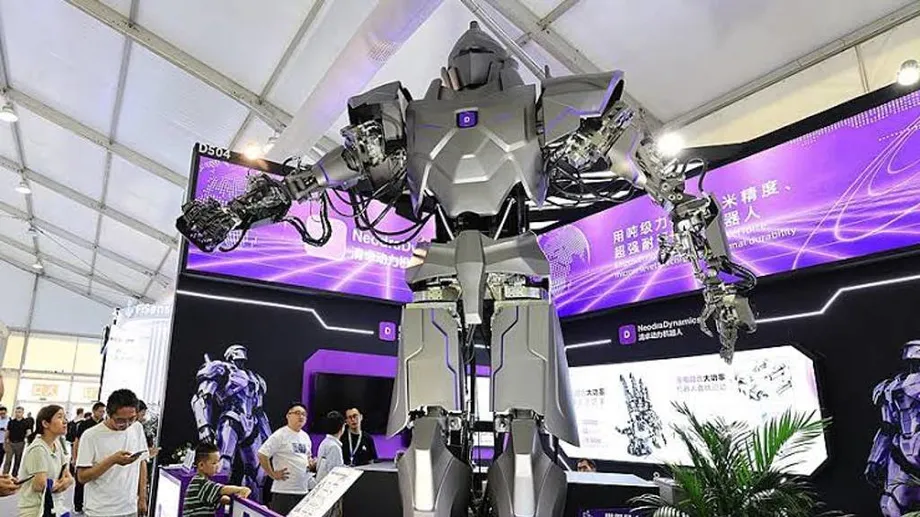
A giant robot built for heavy industrial work
NeodraDynamics has unveiled Neo1, a humanoid robot about 4 metres tall that the Chinese company says can carry a combined 500 kilograms with its two arms. Presented with JD Industrial at the 2026 China International Industry Fair in Shanghai, the machine combines 39 hydraulic joints with two electrically driven joints to target heavy assembly, cargo handling and hazardous industrial work.
Contents
- A giant robot built for heavy industrial work
- How the hydraulic and electric joints work together
- What the 500 kg payload means
- Why the precision figures need a closer look
- Where Neo1 has been presented
- Nuclear plants, ports and underwater equipment
- What JD Industrial brings to the project
- A young company pursuing greater physical capability
- Key Points
The company's announcement dated October 14, 2026, describes miniature hydraulic actuators weighing about 1 kilogram each and producing continuous thrust measured in tonnes. It also claims repeated positioning accuracy of ±0.005 millimetres, or five micrometres. Those figures put both strength and fine movement at the centre of Neo1's sales pitch.
NeodraDynamics is aiming at jobs such as moving heavy components at ports, maintaining equipment in nuclear facilities and working underwater. Its partnership with JD Industrial is intended to connect the technology with industrial customers and pilot applications. Independent performance results, named operational customers, a price and a commercial release date have not been published.
For potential buyers, the practical issue is how the entire machine performs while carrying a load through a complete working cycle. Its operating time, stability, maintenance needs and behaviour during faults will determine where it can work alongside people and expensive equipment.
How the hydraulic and electric joints work together
Neo1 has 41 active degrees of freedom across its body. A degree of freedom is an independently controlled movement, such as bending a joint or rotating an arm. More available movements can let a robot approach and position an object in different ways, although coordinating them also makes control more demanding.
Thirty-nine of those movements use miniature digital hydraulic linear actuators developed by NeodraDynamics. Hydraulic actuators use pressurised fluid to push or pull a mechanism. Linear actuators produce movement along a straight line, which a joint mechanism can turn into bending or rotation.
The remaining two joints, which rotate the forearms, use electric drives. NeodraDynamics describes this combination as a way to pair the force available from hydraulics with precise electric control where it suits the mechanism. The robot therefore uses different drive technologies within the same body.
Hydraulics can generate considerable force in compact components, but the supporting system needs careful management. Fluid pressure, seals, temperature and coordinated control all matter. Keeping a powerful actuator working reliably is part of a larger engineering task that includes supplying pressure and carrying heat away.
What the 500 kg payload means
NeodraDynamics gives Neo1 a collaborative payload of 500 kilograms across both arms. This is the combined load when the arms work together. The announcement does not provide a detailed load chart showing how capacity changes with arm reach, body position or movement speed.
An industrial robot may find a load harder to handle when it is held farther from its body. Starting, stopping or turning that load also creates forces beyond those involved in holding it still. Buyers would therefore need operating limits for the movements required by their particular assembly line, port or maintenance site.
The actuator specifications describe another level of the machine. The October announcement says an individual unit weighs about 1 kilogram and provides continuous thrust measured in tonnes. An earlier technical description gives a cylinder weight of 1.1 kilograms and a load figure of 1,000 kilograms. An actuator pushes through the robot's joint mechanism, whose geometry determines the force available at the hand.
Neo1's attraction is the possibility of combining heavy lifting with the flexible movements of arms and hands. An earlier description specifies a hand with five fingers and arms with seven degrees of freedom. That arrangement could support tasks involving different grips and approach angles, provided the complete machine can maintain control under load.
Why the precision figures need a closer look
The October announcement claims repeated positioning accuracy of ±0.005 millimetres. Repeatability describes how closely a machine returns to the same position when a movement is repeated. Absolute accuracy describes how closely it reaches the intended position. An assembly task can require both, especially when parts must fit together tightly.
An earlier description lists fingertip repeatability of ±0.05 millimetres, ten times the October figure, and repeatability of one micrometre for an individual hydraulic cylinder. These specifications refer to different measurement points or descriptions, and NeodraDynamics has not published a common test method explaining how they relate.
Five micrometres equals five thousandths of a millimetre. At that scale, flexing in joints, vibration, temperature and the weight being carried can affect the position of a robot's hand. A useful industrial test would state the load, reach, speed, measuring equipment and number of repetitions.
A customer assembling heavy parts would need repeatability data for the actual working posture and payload. The published figures leave the test conditions unspecified, making a full performance specification an important next step for evaluating a proposed installation.
Where Neo1 has been presented
The October announcement identifies the joint exhibition with JD Industrial at the China International Industry Fair as Neo1's unveiling. The Shanghai event ran from October 12 to 16, 2026. Neo1 is also described as having appeared earlier at the World Robot Conference in Beijing, followed by an announcement dated September 14. The relationship between that earlier presentation and the October unveiling remains unclear.
The presentation history spans several dates:
- August 19–23, 2026: The World Robot Conference took place in Beijing, where Neo1 is described as having been shown.
- September 14, 2026: An earlier announcement is described as setting out specifications including fingertip repeatability of ±0.05 millimetres.
- October 12–16, 2026: The China International Industry Fair took place in Shanghai.
- October 14, 2026: NeodraDynamics announced the joint Neo1 presentation with JD Industrial and a repeated positioning figure of ±0.005 millimetres.
NeodraDynamics says it conducted demonstrations of the physical robot and displayed its core hydraulic and electric components at the Shanghai fair. Detailed independent results from those demonstrations have not been published.
Nuclear plants, ports and underwater equipment
NeodraDynamics groups its intended applications under four demanding categories: dangerous, dirty, difficult and dull work. Heavy component assembly and cargo movement at industrial ports are among its proposed uses. In those settings, customers would need to match the robot's reach, lifting capacity and working speed to a specific handling task.
Nuclear work presents a different set of requirements. The company claims its hydraulic modules can resist radiation and could support nuclear fuel handling and equipment maintenance. A complete installation would also need suitable electronics, sensors, cables and control systems, together with safety arrangements matched to the facility's radiation levels and procedures.
For underwater engineering, NeodraDynamics claims its technology can withstand high external water pressure and support maintenance of subsea equipment. Operating depth, pressure exposure, sealing and corrosion protection would be practical requirements for such a deployment.
Mining and disaster response are also on the company's list, including demolition, debris clearance and work in contaminated or hazardous areas. Those environments can involve uneven ground, impacts and unpredictable loads. Field trials would need to measure mobility, remote control, stability and safe recovery after a fault. These applications remain proposed uses rather than confirmed operating deployments.
What JD Industrial brings to the project
JD Industrial's role is to help connect Neo1 with industrial supply chains and potential customer applications. NeodraDynamics says the companies plan to work on matching the technology to suitable settings, verifying solutions and carrying out pilot applications.
A pilot would give a customer a defined task against which to measure the robot. For example, a heavy assembly operation could track how consistently Neo1 positions a component, how long each cycle takes and how much maintenance is required over repeated shifts. These measures would make the benefits and operating costs easier to compare with existing equipment.
The October announcement describes cooperation on commercial deployment without setting out a delivery timetable, production volume or named customer installation. It also leaves the robot's energy source and operating time unspecified. A factory considering Neo1 would need those details to plan working hours, charging or power connections, service access and space around the machine.
A young company pursuing greater physical capability
NeodraDynamics was founded in Beijing in 2024. Its founding team is described as having backgrounds at Tsinghua University, with expertise spanning artificial intelligence, motor and servo control, and automatic control. The company develops digital hydraulic components as well as complete robot platforms.
Co-founder Yang Tao has framed the project around giving robots physical capabilities beyond those of people. In the October announcement, he explained the company's objective:
"Robots should not merely replicate human forms but surpass human physical limits to create unprecedented operational capabilities," said Yang Tao, Founder of NeodraDynamics.
That objective explains the focus on a machine much larger than a person and on jobs involving heavy loads or dangerous surroundings. NeodraDynamics is seeking a place in industrial work through its actuator technology, with Neo1 serving as a platform for demonstrating how the components operate together.
The next useful milestones are documented trials, complete operating specifications and pilot results from identifiable industrial sites. Those would show customers how Neo1 handles sustained work, how often it needs attention and what happens when power, pressure or control is interrupted. The company has not announced dates for publishing those results.
Key Points
- Neo1 is about 4 metres tall, with a company claimed combined arm payload of 500 kilograms.
- Its 41 active degrees of freedom use 39 hydraulic actuators and two electric forearm drives.
- The October announcement claims repeatability of ±0.005 millimetres; an earlier description gives fingertip repeatability of ±0.05 millimetres.
- NeodraDynamics and JD Industrial presented the robot together at the October 2026 industry fair in Shanghai.
- Proposed applications include heavy assembly, port handling, nuclear maintenance, underwater engineering and mining.
- Independent test results, named operational deployments, pricing and a commercial release date have not been published.