Digital upgrade targets a major trade gateway
The United States announced $17 million on October 16, 2026, to digitise operations at the Port of Colombo, where more than half a million containers carrying cargo to and from the United States pass each year. The project will connect the agencies and businesses that handle ships, cargo documents and regulatory clearances, aiming to reduce paperwork, waiting times and shipping costs.
Contents
The U.S. Embassy in Sri Lanka said in its October 16 announcement that the investment would support two connected platforms, the Maritime Single Window and Port Community System, in partnership with the Sri Lanka Ports Authority (SLPA). American technology will be used to develop the systems.
Colombo handles an estimated $30 billion in cargo connected to the United States annually, according to the embassy. Its wider business is much larger: SLPA Chairman Dr. Parakrama Dissanayake said the port expects to handle 9 million containers in 2026, with about 80% involving cargo transferred between ships.
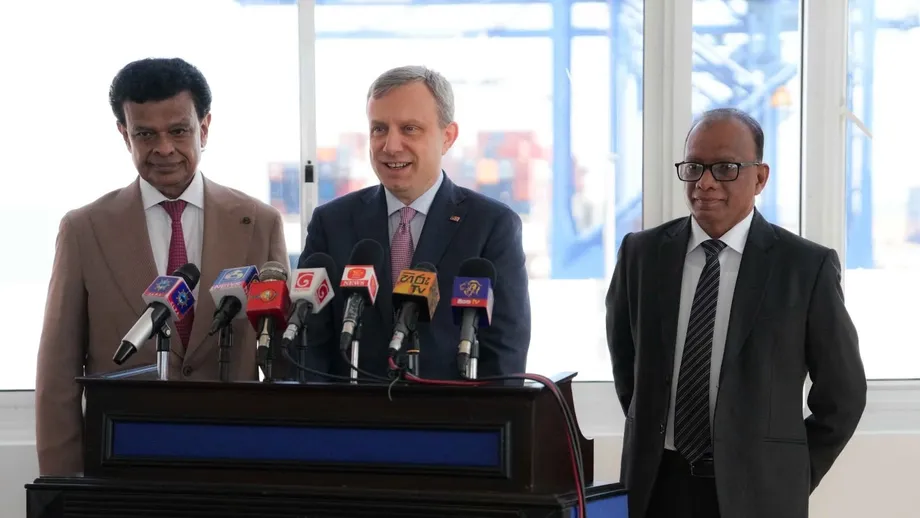
The funding was announced during U.S. Ambassador Eric Meyer's visit to the port on the morning of October 16. Ports and Civil Aviation Minister Anura Karunathilaka, who also serves as energy minister, and Dissanayake welcomed him. Ministry Secretary W. W. S. Mangala also attended the meeting.
The SLPA described the funding as a grant. The U.S. Embassy called it an investment and said an implementing partner would be chosen through an open, competitive process. The immediate focus is the information needed to move goods through the port, alongside Sri Lanka's expansion of its physical cargo handling capacity.
What the two systems will do
The Maritime Single Window and Port Community System address a practical problem: moving a container requires information to move between several organisations. Shipping companies, Customs, immigration authorities, terminal operators and other businesses all have responsibilities, and disconnected paperwork can slow their work.
A maritime single window provides a shared digital route for submitting information required by authorities. A port community system connects participants in the wider port operation so they can exchange information about ships and cargo. The Colombo project will bring these functions together to support maritime documentation, regulatory procedures and coordination.
Customs clearance is the process through which authorities check goods and authorise their movement. Vessel turnaround time means the time a ship spends at the port before departing. The planned systems aim to make the administrative work supporting both processes faster and more predictable.
The SLPA, Customs, shipping lines, terminal operators and other agencies involved in daily cargo handling are expected to coordinate through the upgrade. For a business waiting for its goods, the intended benefit is a smoother sequence of checks and decisions, with less delay between the organisations involved.
Why Colombo's transfers matter
Colombo's role extends well beyond handling goods bought or sold in Sri Lanka. It is a transshipment hub, a port where containers are transferred from one vessel to another on their journey between markets. This makes coordination between shipping schedules, terminals and authorities central to its business.
Dissanayake's forecast of 9 million containers, with about 80% being transshipment containers, implies roughly 7.2 million containers transferred between ships and 1.8 million in other traffic. The calculation shows how strongly the port depends on serving cargo moving through the wider international shipping network.
The chairman also put the value of the port's contribution to global trade through transshipment cargo at more than $250 billion. The embassy's estimate of $30 billion annually concerns cargo connected to the United States, while Dissanayake's figure describes the broader trade served by Colombo's transshipment operations.
For shipping lines using Colombo as a connection point, predictable processing helps keep cargo moving between vessels. A digital upgrade aimed at that process therefore reaches beyond the port itself, supporting the routes that connect South Asia with other markets.
How waiting at port reaches businesses and shoppers
Sri Lankan apparel shipped to American stores and American machinery, food and everyday goods moving through international supply chains are among the products affected by port delays, the embassy said. A supply chain is the series of businesses and transport connections that takes a product from its maker to its customer.
Meyer said after observing operations at Colombo that every minute a vessel spends waiting carries a cost, affecting supply chains, businesses and consumers. The project's commercial case rests on reducing those delays and making the movement of goods more reliable.
The U.S. ambassador linked the upgrade directly to the interests of American companies and households:
When goods move faster and shipping costs come down, American companies are better positioned to compete and American consumers save money.
For Sri Lankan exporters, the intended benefit is a more dependable gateway to overseas buyers. Importers and businesses using Colombo for transfers would also gain from more predictable services. The scale of any savings will depend on how much the new systems reduce waiting and administrative work in practice.
More capacity needs better coordination
Sri Lanka is expanding port capacity, and the embassy said digital infrastructure would be essential to managing larger cargo volumes. More room to handle cargo increases the amount of information that authorities, operators and shipping companies must process together.
Karunathilaka linked the project to attracting business and strengthening Sri Lanka's connections to international markets. The ports and civil aviation minister described the expected economic benefits:
This project will help Sri Lanka improve trade facilitation, attract business, and strengthen our connections to international markets. We appreciate the United States' support for a project that will contribute to Sri Lanka's long-term economic competitiveness.
Trade facilitation means making the procedures for moving goods across borders simpler and more efficient. In Colombo, the announced work concentrates on the documents, regulatory clearances and exchanges of information that support the physical movement of cargo.
Dissanayake identified closer coordination between agencies and businesses as a priority. For customers, his stated goal is more predictable service, allowing them to plan around cargo movements with greater confidence.
American firms will compete for the work
American technology companies will have opportunities to compete to supply the hardware, software and technical expertise needed for the systems. The embassy said an open, competitive process would select the implementing partner.
Meyer presented the project as a way to modernise Colombo while supporting American commercial interests. The U.S. ambassador described that connection during the port visit:
Powered by U.S. innovation and expertise, we will accelerate Sri Lanka's port modernization, strengthen U.S. supply chains, and create opportunities for American technology firms.
The United States has framed the funding around both economic and national security interests: strengthening a critical trade route, securing supply chains and reinforcing Sri Lanka's role as a maritime trading partner in the Indian Ocean. The technology contract is one part of that strategy; smoother passage for goods is the other.
What happens next
The next announced step is the competitive selection of an implementing partner, followed by development of the connected systems with the SLPA. No date was given for that selection or for the platforms to begin operating, and officials did not provide targets for reductions in waiting times or shipping costs.
Dissanayake, the SLPA chairman, set out what the authority wants the project to deliver for shipping companies and customers:
These new digital systems will help us connect the many agencies and businesses involved in port operations, reduce unnecessary delays, and provide more predictable and efficient services to shipping lines and customers.
The practical task will be to make the information exchange work across all the participating organisations. Colombo's expected cargo volumes make that coordination central to the project: the intended improvement is a port where the administrative steps keep pace with the ships and containers moving through it.
Key Points
- The United States announced $17 million on October 16, 2026, to digitise Port of Colombo operations with the Sri Lanka Ports Authority.
- The project will support the Maritime Single Window and Port Community System, connecting authorities, shipping companies, terminal operators and businesses.
- The U.S. Embassy estimates that Colombo handles $30 billion in cargo connected to the United States annually.
- The SLPA expects to handle 9 million containers in 2026, about 80% involving transfers between ships.
- American technology firms will have opportunities to compete, and an implementing partner will be selected through an open process.
- No implementation timetable or numerical targets for time and cost savings were announced.