Five sample permits leave a major trade under scrutiny
Cambodia exported more than 182,000 long-tailed macaques between 2020 and 2024, according to CITES trade data. Yet when the international wildlife trade regulator asked to examine export permits for individual animal identification numbers, Cambodian authorities supplied just five samples.
Contents
- Five sample permits leave a major trade under scrutiny
- What inspectors accepted about breeding
- Why permits and neck tags matter
- Monkeys in public places are still wild
- How the scrutiny developed
- The U.S. investigation and Cambodia's response
- A pandemic boom followed by falling shipments
- The trade extends beyond live animals
- Wild populations and competing demands
- Key Points
That limited response is among the shortcomings identified in an October 5 assessment by the CITES Secretariat, which says Cambodia has not provided enough evidence that it has fully implemented any of six recommendations issued in November 2025. A programme to replace identification neck tags with microchips has also slipped from an expected start by the end of 2026 to 2028.
The Secretariat said it "remains concerned about the limited progress achieved" and "cannot confirm or rule out the occurrence of fraud or corruption" in the trade. Its assessment comes ahead of a November 2–6 Standing Committee meeting in Geneva, where Cambodia's compliance will face further scrutiny. Countries failing to meet CITES requirements can face trade restrictions.
The latest concerns follow a more positive scientific assessment in 2025, when CITES accepted evidence that Cambodian farms could achieve their reported breeding rates. Together, the findings reveal two different problems: whether farms can produce enough monkeys, and whether authorities can track the lawful origin of every animal they export.
For Cambodia's endangered wild macaques, foreign laboratories and the officials issuing permits, the second problem remains central. A breeding operation needs reliable records connecting each animal to its parents, its facility and its export documents. Gaps in those records create opportunities to pass animals captured in the wild through a legal supply chain.
What inspectors accepted about breeding
The CITES Secretariat's November 2025 review document, prepared for the November 23 Standing Committee meeting in Samarkand, Uzbekistan, describes a June mission that visited four breeding facilities owned by three companies and an airport customs control centre. Inspectors also met companies operating nine facilities, Cambodian authorities and veterinarians involved in testing animals.
Inspectors found that inconsistent counting methods explained some apparent irregularities. Certain farms counted only females actively breeding, while others included females temporarily outside breeding programmes. Moving an existing animal from the inactive category to the active category could therefore look like the arrival of a new monkey.
Birth records also varied. Some farms registered infants at birth; others waited until weaning, when infants stopped depending on their mothers for milk. Those different methods affected both birth totals and recorded deaths, including stillbirths.
The Animals Committee eventually accepted the reported reproduction rates as plausible after reviewing detailed information about individual females. An analysis covering 1,300 female breeders showed average intervals between births of nine to 11 months. The document described early weaning and breeding arrangements involving one male with several females as factors behind higher production during strong demand.
That finding revised earlier concerns. A December 2024 assessment had questioned reported output equivalent to three offspring every two years per female at five of six facilities. After the additional evidence, the Secretariat recommended removing Cambodia from the review of animals reported as produced in captivity, while continuing to address lawful acquisition and implementation through Article XIII, the convention's compliance process.
Why permits and neck tags matter
The October assessment focuses on the systems needed to connect those breeding claims to actual shipments. Cambodia's five sample permits were insufficient for the Secretariat to determine whether individual identification numbers appeared consistently across all export paperwork.
Authorities also supplied no information showing what happened to identification neck tags after export. The tags are supposed to be destroyed to prevent reuse. A recycled identity could give a newly captured wild monkey the paperwork of an animal already exported.
The Secretariat found that tags were often loosely attached to cages during export. The delayed microchip programme would replace that identification method, but accurate records would still be needed to connect each chip to the correct animal and its history.
Cambodia also failed to demonstrate that permit totals accurately reflected the number of macaques entering or leaving the country. New requirements for monthly farm stock reports were too recent, and evidence of compliance too limited, for the Secretariat to judge whether they were working.
The regulator also said Cambodia had not brought legislation dating from 2006 into line with CITES requirements. These concerns place responsibility on both the farms maintaining animal records and the public authorities checking them before granting permission to export.
Monkeys in public places are still wild
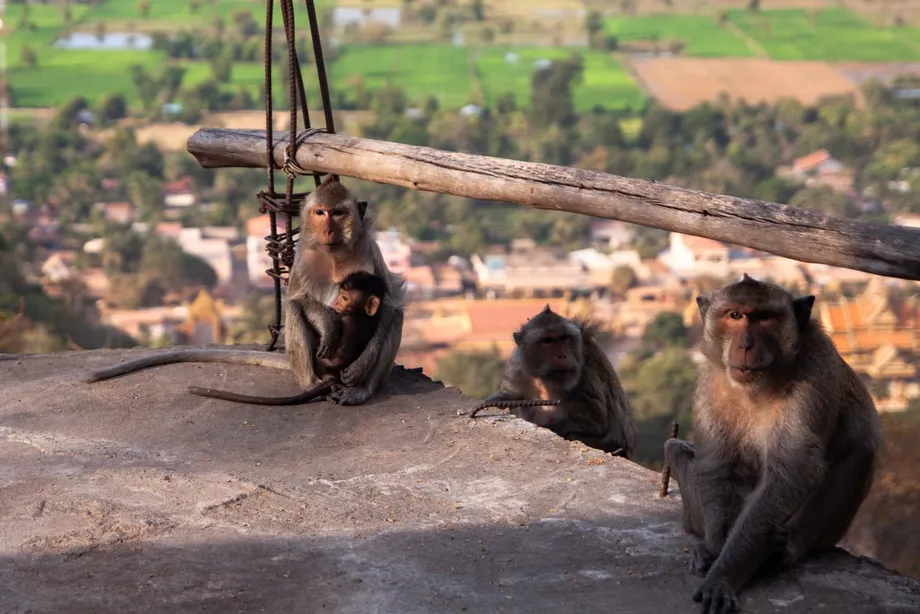
Cambodia's capture of macaques from public areas is another unresolved issue. The Secretariat said authorities appeared to treat those animals as outside the convention's definition of wild animals, despite repeated explanations that the rules still apply.
The June 2025 mission documented permits authorising the capture of 2,000 macaques in 2018 and another 1,500 in 2021. About 200 animals had been collected under the second permit at the time of that review. Cambodia described these as animals involved in conflicts with people at public places and tourism sites.
Population estimates existed for some locations. A count associated with the 2021 authorisation identified 9,246 macaques in public areas across 10 provinces. Taking the full permitted 1,500 would have removed about 16% of that local population. A 2023 estimate for the same public areas put the population at about 7,000.
CITES nevertheless found no comprehensive non-detriment finding for those more recent captures. This is the scientific assessment used to decide whether removing animals will threaten a species' survival in the wild. Counting monkeys at particular sites is one part of that assessment; authorities must also evaluate how many can safely be removed.
The official review treated older founder stock more favourably. Cambodia documented 42,640 animals taken before 2010 for four facilities, against a historical estimated population of at least 1.5 million, or about 2.84%. The Secretariat considered the assessment used at that time precautionary. For current operations, however, it said enough monkeys were already in captivity and further collection should be unnecessary.
How the scrutiny developed
Cambodia's trade has faced overlapping criminal allegations, scientific reviews and compliance checks. The main developments show how the focus moved from suspected smuggling and disputed birth rates to the practical controls needed to verify exports.
- November 16, 2022: U.S. prosecutors announced charges against people linked to Vanny Bio Research and two Cambodian officials over alleged trafficking and fraudulent export permits.
- December 2024: A CITES assessment questioned whether reported captive reproduction rates were biologically plausible.
- February 4, 2025: A CITES committee deferred a proposed trade suspension following a request from the Trump administration.
- June 2025: A CITES mission inspected Cambodian facilities and examined breeding records, capture authorisations and export procedures.
- November 2025: CITES accepted evidence supporting reproduction rates while keeping legal acquisition and implementation under a separate compliance process.
- October 5 assessment: The Secretariat reported limited implementation of six reform recommendations, ahead of the November 2–6 Geneva meeting.
The February 2025 deferral allowed shipments to continue while Cambodia was required to produce evidence supporting the captive origin of exported animals. The latest assessment returns attention to whether the country has made those safeguards work in daily practice.
The U.S. investigation and Cambodia's response
U.S. prosecutors alleged that a trafficking operation moved wild macaques into the research supply chain from late 2017 to early 2022, using documents identifying them as bred in captivity. The allegations included animals taken from national parks and protected areas.
Those charged included Vanny Bio Research owners and managers, along with senior Cambodian Forestry Administration officials. The company denied wrongdoing. The investigation did not secure convictions against those charged.
The case nevertheless disrupted commercial relationships. Charles River Laboratories was among the major U.S. companies that suspended sourcing macaques from Cambodia after the allegations became public.
Khim Finan, spokesperson for Cambodia's Ministry of Agriculture, Forestry and Fisheries, rejected speculative allegations and said the government remained committed to working with CITES. He said:
Unproven claims do not constitute fact. Rather than addressing speculative premises, our attention remains fully focused on continuing our constructive cooperation with CITES.
His response did not address the specific questions about alleged fraud and criminal conduct. Cambodia's position places its cooperation with the regulator at the centre of its defence, while the Secretariat is asking for documentary evidence that the agreed reforms operate consistently.
A pandemic boom followed by falling shipments
Long-tailed macaques are widely used in biomedical research because of their biological similarity to humans. They have been used in vaccine development, drug safety testing and research into diseases and treatments. Demand grew sharply during the COVID-19 pandemic, while China stopped exporting research monkeys to support its own research needs.
Cambodia helped fill the supply gap. CITES records show that it exported more than 33,000 live macaques in 2020, over half the recorded global total that year. Across 2020–2024, its exports exceeded 182,000.
U.S. International Trade Commission figures put American purchases from Cambodia during those five years at more than 56,000 macaques, worth almost $355 million. In 2022 alone, exports to the United States were valued at $213 million; a broader United Nations trade dataset put imports from Cambodia across destinations at about $250 million that year.
The subsequent contraction was steep. Cambodia reported 37,920 live exports in 2022 and 13,305 in 2023, a fall of about 65%. Cambodian customs figures put combined U.S. and Canadian imports during 2025 and 2026 at fewer than 10,000 animals, worth $37.7 million.
Those figures show a business that expanded quickly and then lost substantial demand. They also explain why both research organisations seeking reliable supplies and campaigners seeking an end to the trade are closely watching CITES decisions.
The trade extends beyond live animals
Cambodian macaques also enter international commerce as blood, tissue and other biological material. CITES data recorded more than 300,000 live exports and nearly 125,000 specimen exports from Cambodia between 2004 and 2023, including 1,620 skulls.
Some material travels through another country before reaching its final destination. From 2017 to 2019, Canada imported more than 26,500 millilitres of specimens originating from Cambodian macaques through the United States. Canada also directly imported more than 2,000 live macaques from Cambodia in 2020 and 2021.
Italy recorded nearly 41,000 specimen imports in 2020 and 2021, without units of measurement specified. A single animal can supply several samples, so tracing this commerce requires records that follow its origin through laboratories and subsequent exports.
Nedim Buyukmihci, an emeritus professor of veterinary medicine at the University of California, Davis, explained why the specimen business remains connected to live animal supply:
In order to get specimens, you have to have the live animal somewhere.
CITES has no investigative or enforcement arm of its own, and its trade figures depend substantially on information submitted by member governments. Reliable national records therefore matter at the first export and at every later stage involving animals or their biological material.
Wild populations and competing demands
Cambodia's wild long-tailed macaque population is estimated to have declined by 50–70% over three decades. A 2022 Wildlife Conservation Society study found a decline of 49–55% over 12 years in Keo Seima Wildlife Sanctuary, near the Vietnamese border. The species was classified as endangered by the International Union for Conservation of Nature in 2022.
Wild capture also carries health concerns because pathogens can pass between animals and people, a process called zoonotic transmission. Bringing animals from the wild into farms creates additional contact among wildlife, captive animals and workers.
Lisa Jones-Engel, chief scientific adviser for primate experimentation at People for the Ethical Treatment of Animals, said the latest assessment showed persistent weaknesses. PETA campaigns to end the macaque research trade. She said:
Wild monkeys are going into breeding farms, the risk of fraudulent reuse of identification tags has not been eliminated, and CITES says evidence that the reforms are actually working remains limited.
The National Association for Biomedical Research has presented a different view. Its November 2025 statement highlighted favourable findings about Cambodia's customs procedures, cooperation and commitment to improving traceability. The association represents institutions and companies using animals in research.
Matthew R. Bailey, the association's president, described the CITES findings as support for renewed access to Cambodian research animals:
This report affirms Cambodia's compliance and demonstrates that animal research models desperately needed in the United States may be obtained from this country.
The official CITES review accepted the scientific evidence on reproduction while assigning legal acquisition and implementation to continued scrutiny under Article XIII. The latest assessment makes those practical controls the immediate issue: complete permits, secure animal identities, dependable farm inventories and lawful decisions about any further wild capture.
Key Points
- CITES says Cambodia has supplied insufficient evidence that any of six recommended reforms has been fully implemented.
- Authorities submitted five sample export permits, and the planned microchip programme has been delayed to 2028.
- A 2025 scientific review accepted reported breeding rates as plausible, while legal acquisition and implementation remained under scrutiny.
- CITES says macaques captured in public places are wild animals and require the relevant safeguards.
- Cambodia exported more than 182,000 long-tailed macaques in 2020–2024; subsequent shipments fell sharply.
- The November 2–6 Geneva meeting will consider compliance progress, with trade restrictions possible for countries failing to meet CITES requirements.