Magill Estate leads a historic debut
Magill Estate Restaurant in Adelaide received two Michelin stars on October 14, 2026, becoming the first Australian restaurant to earn that distinction as South Australia secured the country's first Michelin restaurant selection. Ten other restaurants received one star each at the ceremony at the Adelaide Convention Centre.
Contents
- Magill Estate leads a historic debut
- What earned Magill Estate two stars?
- The 10 restaurants receiving one star
- Fire, vineyards and global influences
- Recognition beyond expensive tasting menus
- The people recognised alongside the restaurants
- Who paid to bring Michelin to Australia?
- How inspectors choose and retain stars
- Can the recognition bring lasting tourism gains?
- Key Points
The inaugural Michelin Guide South Australia 2027 recognises 77 establishments: 11 restaurants with stars, 16 with Bib Gourmand awards for good cooking at approachable prices, and 50 in the Michelin Selected category. No restaurant received three stars, the guide's highest cooking award.
Michelin's inaugural restaurant selection reaches from Adelaide dining rooms to wineries in the Barossa Valley, McLaren Vale, Clare Valley and Adelaide Hills. Its wider recommendations extend to Kangaroo Island, Port Lincoln, Mount Gambier and Hawker.
South Australia's government secured the guide through an agreement lasting five years after attempts to establish a national partnership failed. The result gives restaurants in one state access to a recognition system that Australian venues previously had no opportunity to enter.
Scott Huggins, the chef leading Magill Estate, described how far his ambitions had once stretched in pursuit of a star:
We looked at opening restaurants in France to achieve a Michelin star – that's how crazy it can be," he said. "It's come to South Australia, so extremely lucky and honoured to be the first restaurant in Australia to achieve two stars.
What earned Magill Estate two stars?
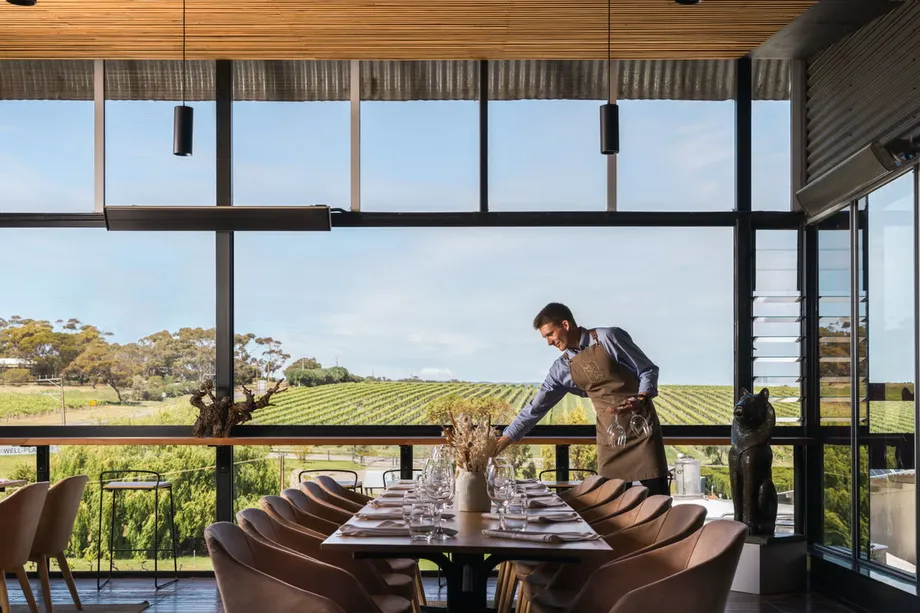
Magill Estate sits at the base of the Adelaide Hills in Rosslyn Park, overlooking the vineyards of Penfolds winery. Michelin singled out its precise cooking and Australian ingredients, presented through a tasting menu of 10 courses.
Sea urchin with snow peas and tarragon and spring lamb Wellington with kohlrabi were among the dishes inspectors highlighted. Wine is central to the experience, with an Icon pairing designed to introduce diners to the range of local winemaking.
Huggins had worked in restaurants with Michelin stars in Europe and Japan before achieving the distinction in Australia. His restaurant's reported prices are A$295 per person for the Signature Menu and A$375 for the Full Magill Estate Tasting Experience.
Two stars mean excellent cooking worth a detour. One star means high quality cooking worth a stop, while three stars signal exceptional cuisine worth a special journey. The language reflects the guide's origins as a companion for motorists deciding where to travel and eat.
Michelin's full starred selection describes Magill Estate's food alongside its setting, service and wine. The star assessment itself focuses on cooking, with hospitality professionals recognised separately through special awards.
The 10 restaurants receiving one star
Six of the 11 restaurants with stars are outside Adelaide, spreading recognition across four major wine regions. The complete list of restaurants receiving one star is:
- Anvers Restaurant, Kangarilla, Adelaide Hills.
- Aptos, Stirling, Adelaide Hills.
- Arkhé, Norwood, Adelaide.
- Aurora at ILA, Adelaide.
- Botanic, Adelaide Botanic Garden.
- Esmay, inside the Hackney Hotel, Adelaide.
- Hentley Farm, Seppeltsfield, Barossa Valley.
- LVN Restaurant at Bird in Hand, Woodside, Adelaide Hills.
- Maxwell Restaurant, McLaren Vale.
- Skillogalee Barrel House, Sevenhill, Clare Valley.
Anvers chef Connor Bishop builds his Long Story menu around ingredients including Paroo kangaroo, Murray cod, damper bread, and mushrooms and herbs grown on the estate. At Aptos, Justin James takes diners through three rooms in a renovated former church during a tasting menu lasting more than three hours.
Botanic chef Jamie Musgrave draws on the restaurant's setting in a former teahouse from the 1800s. Native ingredients including warrigal, Geraldton wax and bunya feature in a menu exploring Australian plants and produce.
Esmay chef Alanna Sapwell-Stone takes a more conversational approach, with diners seated around a central counter. Her seasonal cooking includes calamari with kohlrabi and fish sauce, while desserts make use of vegetables such as parsnip and sunchoke.
Fire, vineyards and global influences
Wood and charcoal cooking connect several winners, although their menus take different directions. At Arkhé, Jake Kellie's kitchen serves Peking duck wontons with smoked duck broth and Eyrewoolf abalone, alongside vegetable dishes such as spiced pumpkin and miso glazed eggplant.
Aurora at ILA, on the ground floor of the ILA Visual Arts Museum, combines cooking over open flames with menus that give vegetables a prominent role. Executive chef Robin Wagner includes vegan dishes and flexibility for different dietary needs.
LVN at Bird in Hand uses vegetables from the winery's garden and nearby farms, with ingredients cooked over a live fire. Chef Jacob Davey's restaurant operates for lunch only. At Maxwell, Fabian Lehmann draws on experience in Europe and the Nordic countries, bringing dishes such as spätzle and Japanese steamed eggs, called chawanmushi, into a menu shaped by McLaren Vale's seasons.
Hentley Farm serves its Discovery Tasting Menu in a former barn in the Barossa Valley. Michelin highlighted dishes including abalone with creamy tomato rice and pork with fermented blueberry jus. Skillogalee Barrel House draws on estate produce and nearby farmers in Clare Valley, where its dining room overlooks the vines.
Gwendal Poullennec, international director of the Michelin Guide, said the selection reflected both local identity and freedom to draw from different traditions:
South Australia's debut has been very impressive. It speaks to a food culture of real depth, where exceptional produce, skilled chefs and an unmistakable sense of place come together.
European, Southeast Asian and Japanese influences appear alongside native ingredients such as quandong and lemon myrtle. The combination gives visitors several interpretations of contemporary Australian cooking, rather than a single style repeated across the winners.
Recognition beyond expensive tasting menus
Sixteen restaurants received Bib Gourmand awards, Michelin's category for good cooking at approachable prices. Twelve are in Adelaide, with four others spread across regional destinations.
The Adelaide recipients are Africola, Bar Torino, Bistro Français, Golden Boy, Gondola Gondola, La Popular Taquieria, Noi Vietnamese Eatery, Pantry on Prospect, Part Time Lover, Parwana Afghan Kitchen, Stamps and Sunny's Pizza.
Outside Adelaide, the awards went to Antidote Kitchen in Clare Valley, Tirage on Kangaroo Island in Kingscote, The Salopian Inn in McLaren Vale and Fino Seppeltsfield in the Barossa. Their inclusion broadens the guide's appeal to diners seeking neighbourhood restaurants and meals outside the tasting menu format.
Another 50 establishments received Michelin Selected recognition, meaning inspectors recommended their cooking. They include Chianti, Osteria Oggi, Fugazzi, Kiin, Shōbōsho, Hardy's Verandah, Star of Greece and Magill Estate Kitchen, a different venue from the restaurant that received two stars.
Twenty two of those 50 selected restaurants are outside Adelaide, representing 44% of that category. Listings include The Fresh Fish Place in Port Lincoln, Elementary by Kirby Shearing in Mount Gambier and Woolshed Restaurant in Hawker. That reach gives travellers reasons to consider destinations well beyond the capital and its nearest vineyards.
Ben Bertei, owner and executive chef of Michelin Selected restaurant Kiin, credited the people working behind its recognition:
This recognition belongs to our whole team. They bring enormous skill, care and heart to Kiin every day, and David and I could not be prouder of them.
The people recognised alongside the restaurants
Melissa Pisanelli of Allegra Dining Room received Michelin's Service Award. She runs the restaurant with her husband, and Michelin praised her attentive welcome, leadership and ability to balance professional precision with personality. Allegra's menu focuses on plants, with Mediterranean influences and ingredients sourced close to home.
Shakaan Abillion of Shōbōsho received the Young Chef Award. Michelin described cooking shaped by his Filipino heritage, experience in Japan and skill with fire, using South Australian produce with technical control.
Maxime Martin of Hardy's Verandah received the Sommelier Award, recognising expertise in selecting and explaining wine. Originally from France, Martin gives South Australian producers a leading place in the wine program and was praised for making wine approachable to guests.
Nicola Palmer of Penobscot was also highlighted through Michelin's Mindful Voices editorial initiative. The Watervale restaurant serves diners at a counter with 10 seats in the kitchen, with menus changing around harvests from its organic and biodynamic farm. Guests can take a farm tour before eating, and drinks include mocktails made with farm fruits and herbs.
The honours extend recognition to service, wine knowledge and the work of younger cooks. All three special award recipients work at Michelin Selected restaurants, showing how individual recognition reaches beyond the venues awarded stars.
Who paid to bring Michelin to Australia?
South Australia's government funded the partnership that brought Michelin inspectors to the state. The agreement lasts five years, but its price remains undisclosed because the government cites commercial confidentiality.
Premier Peter Malinauskas said the amount was below the NZ$6.3 million New Zealand agreed to pay for three years of guide coverage. The agreements cover different periods, and South Australia has not published the figure needed to calculate its annual cost.
Tourism Australia declined a proposed national agreement worth A$40 million over five years in 2025. Michelin had first approached the national tourism body in 2016, and later discussions also failed to produce a nationwide guide.
The South Australian Tourism Commission's May partnership announcement said restaurant selection was independent and restaurants could not pay for inclusion or distinctions. Government funding brings the guide to a destination; inspectors then decide which restaurants qualify.
The main stages were:
- 2016: Michelin first approached Tourism Australia about an Australian guide.
- 2025: Tourism Australia declined a proposed agreement worth A$40 million over five years.
- May 12, 2026: South Australia announced its partnership, with inspectors already visiting restaurants.
- October 14, 2026: The inaugural selection for the 2027 guide was unveiled in Adelaide.
- October 15, 2026: Recognised venues could begin displaying their Michelin Guide plaques.
New Zealand's inaugural selection included 15 restaurants with stars, compared with South Australia's 11. New Zealand's coverage spans destinations across the country, while the Australian agreement covers one state.
How inspectors choose and retain stars
Michelin inspectors visit anonymously, book and eat as ordinary customers, and pay for their meals. Restaurants are assessed through repeated visits rather than a single announced judging session.
Five criteria guide their decisions: ingredient quality, mastery of cooking techniques, harmony of flavours, the personality expressed through the food, and consistency across the menu and over time. In simple terms, inspectors look at what a kitchen cooks, how well it cooks it and whether it can maintain that standard.
Decor, formality and service are outside the star criteria. A modest restaurant can qualify alongside a formal dining room. Stars belong to restaurants, rather than to individual chefs, even though the chefs leading those kitchens often become closely associated with the awards.
Michelin will keep reviewing restaurants during the partnership. New venues can enter the guide, and existing restaurants can gain or lose stars. The next selection date has not been announced.
Brothers André and Édouard Michelin launched the guide in France in 1900 to encourage motoring and, with it, demand for tyres. Restaurant stars followed in 1926. South Australia's debut arrived a century after that rating system began.
Can the recognition bring lasting tourism gains?
South Australia's government is seeking more spending by visitors from interstate and overseas, including benefits for hotels, transport providers, growers and wineries. Tourism Research Australia figures cited in the May announcement put international visitor spending in the state at a record A$1.8 billion.
The Tourism Commission said its visitor research ranked South Australia first nationally for good food and wine, and for wineries and wine regions. Michelin adds an international channel to that existing reputation: the government announcement cited more than 62 million annual website visitors, 3.9 million Instagram followers and 3.8 million app users.
Tourism Minister Emily Bourke described the intended benefit when the partnership was announced:
"This will support our hospitality and tourism sectors which employ thousands of South Australians and give them an advantage over other states," she said.
Africola owner Duncan Welgemoed, who previously worked in kitchens with Michelin stars, said gastronomic tourists from markets including China and the United States plan journeys around recognised restaurants. His own restaurant received a Bib Gourmand.
Regional capacity will help determine how much additional demand becomes visitor spending. A meal lasting more than three hours at Aptos, or lunch at LVN, needs to fit around transport and accommodation. Six regional accommodation properties had also received Michelin Keys, the guide's hotel distinctions, with Southern Ocean Lodge on Kangaroo Island receiving three.
Catheryn Khoo, professor of hospitality and tourism at Torrens University, cautioned that Michelin's French origins can affect how different food cultures are assessed. She also warned about pressure on restaurant teams, noting that some chefs elsewhere have returned stars because they no longer wanted to work under those expectations.
The practical test for South Australia will extend beyond restaurant reservations. More visitors need places to stay, ways to reach regional venues and hospitality teams able to deliver the consistency that Michelin rewards. The five year partnership gives the state time to turn the first ceremony's attention into repeat travel and business for its producers.
Key Points
- Australia's first Michelin restaurant selection was announced in Adelaide on October 14, 2026, for the 2027 guide.
- Magill Estate Restaurant received two stars, and 10 other South Australian restaurants received one star each.
- The guide recognises 77 establishments, including 16 Bib Gourmand recipients and 50 Michelin Selected restaurants.
- Six of the 11 restaurants with stars are outside Adelaide.
- Melissa Pisanelli, Shakaan Abillion and Maxime Martin received the service, young chef and sommelier awards.
- South Australia's government secured a partnership lasting five years but has not disclosed its cost.
- Restaurants cannot pay for recognition, and inspectors will continue reviewing venues during the agreement.