Team Zanaka claims a place in Asian Games history
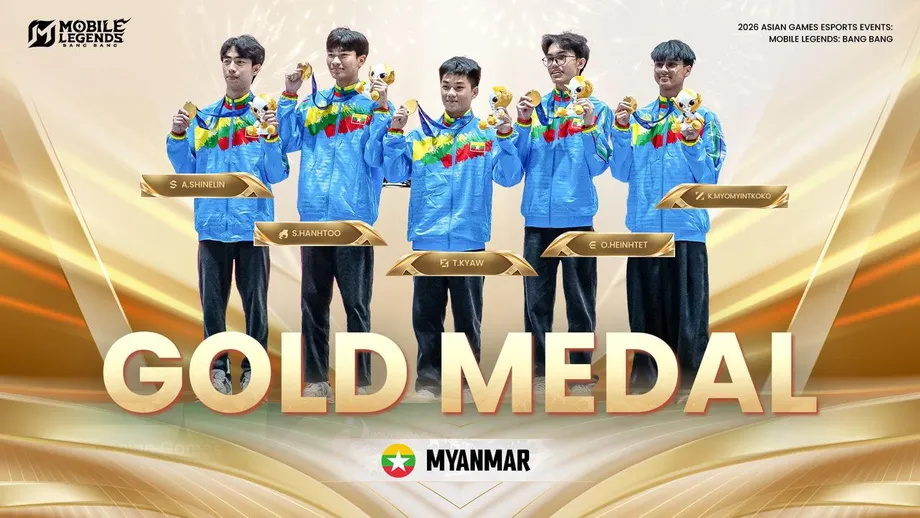
Myanmar won the first official Asian Games gold medal in Mobile Legends: Bang Bang on October 1, 2026, sweeping Indonesia 4-0 at Aichi Sky Expo in Tokoname, Japan. The victory gave Myanmar its second gold medal at Aichi-Nagoya 2026 and its first Asian Games title in esports.
Contents
- Team Zanaka claims a place in Asian Games history
- How Myanmar turned a close quarterfinal into gold
- The five players and coach behind the title
- Why 12 qualified teams became 11 competitors
- Indonesia recovered from a group defeat to take silver
- A large audience arrived before the medal match
- MLBB joins an expanded esports programme
- Future Games policy and the next global competition
- Key Points
Competing as Team Zanaka, Myanmar finished a demanding knockout campaign with its most decisive result. After beating Cambodia 2-1 in the quarterfinals and Malaysia 2-0 in the semifinals, the team won four consecutive games against Indonesia in a final that could have lasted seven.
Indonesia took silver, its eighth silver medal of the Games, while Malaysia and Mongolia each received bronze. The competition ran from September 29 to October 1, bringing national and regional teams together for MLBB's debut as an official Asian Games medal event.
MOONTON Games, the company behind MLBB, recorded the result in its official tournament announcement. Its account places Myanmar's victory within a wider competitive pathway: 22 National Olympic Committees participated in qualification, and 12 teams earned places at the main stage. Eleven ultimately competed after Iran withdrew before its opening match.
For Myanmar's players, the result turned success in a mobile game into a contribution to their country's Asian Games medal tally. For MLBB, it completed a first medal competition during the game's 10th anniversary year, with a champion from Southeast Asia and a podium extending to Mongolia.
How Myanmar turned a close quarterfinal into gold
Team Zanaka's quarterfinal against Cambodia was the closest of its three knockout matches. Myanmar won 2-1, meaning Cambodia took one game before Myanmar secured the series. Malaysia then lost 2-0 in the semifinal, putting Myanmar into the gold medal match without another game dropped.
Myanmar's government identified the national side as Team Zanaka in its account of the victory. It confirmed that the final took place on Thursday, October 1, and described the title as the country's first Asian Games gold in an esports event.
A best-of-seven final is won by the first team to take four games. Myanmar reached that target at the earliest opportunity. Across the quarterfinal, semifinal and final, the champions won eight games and lost one, while winning all three series.
The progression matters because a series victory and an individual game victory are different measures. Myanmar stayed unbeaten in knockout series, although Cambodia took a game from the eventual champion.
- September 29: The MLBB competition began at Aichi Sky Expo, with group play deciding places in the knockout rounds.
- Quarterfinal: Myanmar defeated Cambodia 2-1 to advance.
- Semifinal: Myanmar beat Malaysia 2-0 to reach the gold medal match.
- October 1: Myanmar defeated Indonesia 4-0 in the final, completing the tournament with gold.
The five players and coach behind the title
Myanmar's champion lineup consisted of Oo Hein Htet in the EXP lane, Swe Han Htoo in the jungle, Kyaw Myo Myint Ko Ko in the middle lane, Aung Shine Lin in the gold lane and Thuya Kyaw as roamer. Aung Min Htun served as head coach.
MLBB is a team game in which five players coordinate to break through an opposing team's defenses and destroy its base. The roles describe where players usually operate and how they help the team, rather than five separate contests.
The EXP and gold lanes give their players different priorities for building strength and earning resources. The middle laner operates near the centre of the map. The jungler gathers resources between lanes and contests important objectives, while the roamer moves around to support teammates and help create opportunities.
Myanmar's 4-0 final score records the team's dominance across the series. Individual statistics and detailed accounts of the final's key plays were not included in the official announcements, leaving the collective result as the clearest measure of the winning performance.
Why 12 qualified teams became 11 competitors
MOONTON said 22 National Olympic Committees entered the qualification process, with 12 teams progressing to the main stage. Iran's withdrawal before its opening match reduced the competing field to 11. The figures describe different points in the competition: qualification and actual participation.
Group play used a single round-robin format, meaning each team faced every other team in its group once. The top two teams in each group advanced to the playoffs.
The playoffs used single elimination. Once a team lost a series, it could no longer win gold. Quarterfinals and semifinals were best-of-three contests, requiring two game victories to advance. The final expanded to best-of-seven and required four.
Myanmar therefore had to handle two different demands: consistent results during group play and immediate elimination risk in the knockout rounds. Its narrow quarterfinal win over Cambodia kept its title bid alive before the successive sweeps of Malaysia and Indonesia.
Indonesia recovered from a group defeat to take silver
Indonesia reached the final despite losing 2-0 to Malaysia in their group meeting. That result gave Malaysia an early advantage in a rivalry that had already attracted a large audience during qualification.
Indonesia later eliminated the Philippines in the quarterfinals. The Philippines consequently missed the podium, while Indonesia continued to the gold medal match and secured silver.
Malaysia's campaign ended with a 2-0 semifinal defeat by Myanmar, but the team still received bronze alongside Mongolia. Malaysia's win over Indonesia in the group stage and Indonesia's deeper run show how much the knockout rounds changed the final order.
The medal result brought three Southeast Asian countries onto the MLBB podium, with Mongolia completing the group of medal winners. Myanmar finished above them all after beating two eventual medallists, Malaysia and Indonesia, in its final two series.
A large audience arrived before the medal match
MLBB's Asian Games qualifiers reached a peak of 1.278 million simultaneous viewers during Malaysia's meeting with Indonesia in June 2026, according to audience measurement service Esports Charts. The qualifiers generated about 8.91 million hours watched.
Those measurements answer different questions. Peak concurrent viewers means the largest number watching at the same moment. Hours watched adds together the time viewers spent watching throughout the competition. A person watching for two hours contributes two hours to that total.
The figures show that the qualification stage itself drew substantial attention, months before Myanmar and Indonesia met for gold. They also put the Malaysia versus Indonesia rivalry in context: a matchup that drew the qualifying audience peak returned during group play in Japan.
Fans could follow the Asian Games MLBB matches through the game's official YouTube, Facebook and TikTok channels. The qualifying audience figures cover an earlier stage of the competition; final audience totals for the medal event were not given.
MLBB joins an expanded esports programme
MLBB's debut came eight years after esports appeared as a demonstration competition at the Jakarta-Palembang Asian Games in 2018. Those demonstration medals did not count toward the official Games standings.
At the Hangzhou Asian Games, held in 2023, esports became an official medal sport. Seven titles were contested by 473 athletes representing 30 National Olympic Committees. Aichi-Nagoya 2026 expanded the programme to 11 medal events covering 13 game titles.
The difference between 11 events and 13 titles comes from the Competitive Martial Arts team event, which combines Street Fighter 6, Tekken 8 and The King of Fighters XV into one medal competition. Compared with Hangzhou's seven medal competitions, the 2026 programme added four.
Ray Ng, MOONTON Games' Head of Esports Ecosystem, described Myanmar's victory as a milestone for both the game and competitive gaming on mobile devices:
Myanmar's victory is a historic moment for MLBB and for mobile esports in Asia
Ng connected the first Asian Games gold to MLBB's anniversary and the people who helped develop its competitive scene:
MLBB's first Asian Games gold comes during our 10th anniversary year, making this a deeply meaningful milestone for everyone who has helped build the game over the past decade. What began as a mobile game enjoyed by players across the region is now creating medal-stage moments watched by fans across Asia. This shows how far mobile esports has come, and how much further it can go.
Future Games policy and the next global competition
The Olympic Council of Asia's position on future esports competitions has drawn attention alongside the medals. Its 90th Executive Board meeting unanimously approved a proposal on November 26, 2024, to remove esports after Aichi-Nagoya 2026. On September 28, 2026, the OCA publicly said esports would continue, rejecting reports of its departure.
MOONTON's announcement also said the OCA had reaffirmed support for esports development in the region. The later public position supports esports continuing at the Games, while the selection of individual game titles for future editions remains a separate decision.
MLBB's competitive calendar extends beyond national representation at the Asian Games. MOONTON pointed to qualifiers in Singapore, the MSC competition's European debut in Paris, and the MLBB Championship Tour as parts of the game's expanding tournament pathway.
The next major global destination is Istanbul, Türkiye, where the M8 World Championship Finals are set to take place. MOONTON did not give a date for those finals in its announcement. Myanmar leaves Japan with a distinct achievement already secured: the first official Asian Games MLBB title and the country's first esports gold at the Games.
Key Points
- Myanmar's Team Zanaka beat Indonesia 4-0 on October 1, 2026, to win the first Asian Games MLBB gold.
- The title was Myanmar's second gold at Aichi-Nagoya 2026 and its first Asian Games gold in esports.
- Myanmar defeated Cambodia 2-1 and Malaysia 2-0 before sweeping the final.
- Indonesia won silver, while Malaysia and Mongolia received bronze.
- Twelve teams qualified from a process involving 22 National Olympic Committees; 11 competed after Iran withdrew.
- The M8 World Championship Finals are set for Istanbul, with no date given in MOONTON's announcement.