Closure orders put forest tourism investments at risk
Bangladesh's Department of Environment has ordered 24 resorts near the Sundarbans in Khulna, Bagerhat and Satkhira to stop operating, saying they were built without the required environmental clearance in an ecologically critical area. The identified properties include 18 in Khulna, two in Bagerhat and four in Satkhira. Owners have also been instructed to remove their structures, although reports differ on whether all have 30 days or some face a shorter deadline.
Contents
- Closure orders put forest tourism investments at risk
- Different totals and deadlines need clarification
- Which resorts are affected?
- How quickly did the industry grow?
- A trade licence is not environmental permission
- Pollution concerns extend into dolphin habitat
- Owners cite investment, taxes and local work
- Employment figures show both benefits and uncertainty
- Enforcement and a proposed route to regulation
- Key Points
The dispute centres on businesses established largely outside the forest boundary, on land that owners describe as private property. Many began operating with union council trade licences, but those licences did not settle the separate requirements for environmental clearance and approval from the district administration. Owners say they invested substantial sums while trying to navigate an approval process that offered no workable route for their locations.
Khondkar Md Fazlul Haque, director of the Department of Environment's Khulna divisional office, said the department acted after notices failed to produce satisfactory responses.
"The authorities of the resorts were served notices in accordance with the law. As no satisfactory response was received, we have ordered the closure of their operations," said Khondkar Md Fazlul Haque.
The action brings together two competing accounts of tourism along the forest edge. Officials describe unapproved construction, pollution and uncontrolled access to protected waterways. Entrepreneurs describe an emerging local economy that supports workers, boat operators and food suppliers. Neither the employment claims nor demands for clearer rules resolve whether individual resorts can lawfully remain where they are.
Different totals and deadlines need clarification
The regional account identifies 24 resorts and describes a requirement to remove structures within 30 days. More detailed accounts of the Khulna district action say 10 establishments received 30 days and eight received 15 days. That distinction matters because the 18 properties under the Khulna district office are only part of the regional total.
Md Harun Or Rashid, assistant director of the Khulna district environment office, said its action covered Dhangmari, Kailashganj and Banishanta. He explained that Chila, Baidyamari and Chandpai fall within Bagerhat, so his office did not hold the information for resorts there. A separate account describes notices covering 23 resorts and cottages, rather than 24. There is no reconciled list explaining that difference.
The reported sequence is:
- September 30: applications from previously notified resorts were rejected because the requested documents had not been submitted. Eight newer resorts were separately told to relocate to acceptable locations within seven days.
- October 4: written closure directions were issued. Detailed Khulna accounts describe removal deadlines of 30 days for 10 resorts and 15 days for eight.
- October 6, 2026: a dated account described the Khulna orders and possible enforcement through mobile courts, electricity disconnection and court cases.
- After the closure notices: further reporting described continued advertising and an appeal by entrepreneurs for government intervention.
The dates require caution. Most accounts give September 30 and October 4 without a year, while one explicitly carries an October 6, 2026 publication date. The reported October 4 action also falls before a seven day period beginning September 30 would expire. These inconsistencies prevent a reliable calculation of every final deadline without the individual notices.
Which resorts are affected?
Khulna accounts consistently identify 18 resorts, concentrated in Dacope upazila. They account for three quarters of the regional total of 24. Bagerhat accounts for two properties and Satkhira for four.
- Khulna: Aronyachhaya, Aronyabari, Keoraban, Mayaban, Gahon, The Forest Retreat, Nikunja Valley, La Silva Cottage, Bonbibi, Sundari, Irawati, Bonmali, Golkanon, Piyali, Mangrove, Janglabari, Bonobas and Bonlota Eco Cottage.
- Bagerhat: Tiger Point and Badaban.
- Satkhira: Barsha Resort, Sushilan Resort, Ocean Paradise and a fourth entry rendered inconsistently as Parishad and Prasad Paradise.
There is another naming issue. Accounts of the industry's beginnings identify a resort called Tiger Point in Munshiganj, Satkhira, established by the NGO Sushilon in 2009. The regional closure list places Tiger Point in Bagerhat. It is not established whether these are separate businesses with the same name or a location error. The spelling of several resort names also varies between accounts.
How quickly did the industry grow?
Commercial resort development near the Sundarbans is traced to 2009, when Sushilon established accommodation in Munshiganj for people working with the forest, researchers, donor representatives and government officials. Barsha Resort, owned by the NGO Barsa, followed in 2011. In 2015, donor assistance supported 10 resorts in Dacope. Of that group, only Golkanon is reported to have remained open.
The recent expansion was much faster. A baseline study by two Khulna University professors recorded three eco cottages in its study area in 2018, with no increase until 2021. By 2023, it counted 12 resorts with 74 rooms and space for 260 tourists. That was four times the 2018 number of properties.
Estimated tourist visits increased from about 370 in 2018 to 7,562 in 2023, roughly 20 times as many. The study projected that 20 cottages would have capacity for 560 tourists by the end of 2024, more than double the 2023 capacity. That projection included eight new cottages with 58 rooms and another 42 rooms being added to seven existing properties. It is a forecast, not confirmation that every room was completed.
Reporting from June 2024 separately counted 14 established resorts in Khulna and Satkhira and eight under construction. Another account put the total at at least 21 operating resorts and cottages, with 10 more being built. These figures cover different stages and locations and should not be treated as a single continuous census.
A trade licence is not environmental permission
The surrounding area extending 10 kilometres from the Sundarbans boundary was declared an ecologically critical area in 1999, according to reports. An ECA is an area where environmental sensitivity warrants restrictions on activities that damage its natural condition. Being outside the forest boundary does not, by itself, put a property outside those restrictions.
The closure letters are described as invoking the Bangladesh Environment Conservation Act, 1995, amended in 2010, and its rules. Fazlul Haque stated the department's position in categorical terms.
"No resort can be operated in an environmentally critical area," he said.
Owners argue that they followed the National Tourism Policy 2010. They point to paragraph 3.2.2, which supports sustainable ecotourism around the Sundarbans and identifies facilities such as eco lodges, watchtowers and walkways, developed through coordination with the environment and forest authorities. That policy direction is not an individual environmental clearance or construction approval.
Reports also reveal differing official descriptions of the rules. Md Iqbal Hossain, identified in the June 2024 account as the Khulna environment director, said the ECA guideline barred construction within the surrounding 10 kilometres. In a later account, Khulna assistant director Parvez Ahmed said infrastructure built according to environmental law was not itself an offence, but these operators had failed to follow rules and had caused damage. No detailed legal determination establishes a route for the affected resorts to obtain approval.
Pollution concerns extend into dolphin habitat
Around 10 resorts are reported beside Dhangmari canal, a declared dolphin sanctuary used by Gangetic and Irrawaddy dolphins. Tourist boats pass through the canal, sometimes without permission, while reports describe loud music, generators, intense lighting and wastewater entering nearby waterways.
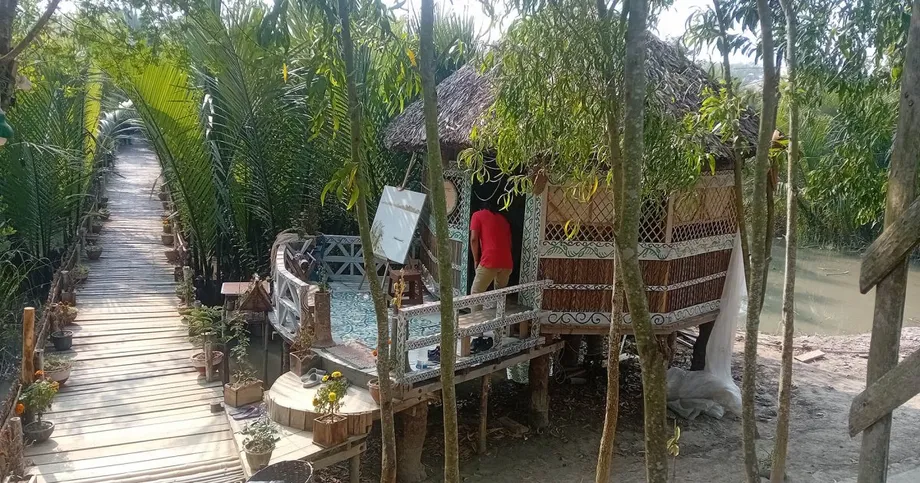
Other allegations concern tree cutting, wetland filling and construction on both private land and Bangladesh Water Development Board land. Earlier reporting described a water body being filled with sand for a resort and plastic waste being burned. Some structures marketed as eco cottages reportedly contain concrete beneath exterior bamboo, wood and golpata palm materials. The eco label alone does not establish their environmental performance.
A J D M Hasanur Rahman, divisional forest officer of the Sundarbans West Forest Division, said the Forest Department's ability to carry out direct eviction was limited because the resorts stood just outside its boundary on private property. He nevertheless described uncontrolled entry into the forest, noise, overnight lighting and plastic waste as threats to wildlife and the ecosystem.
Owners dispute parts of that account. Sudipta Gain, owner of Bonlota and Nikunja resorts, said his businesses did not undertake activities harmful to the forest or take guests inside it. Other reports allege that some operators continued forest trips during the June to August entry restriction. Those allegations should not be applied automatically to every named resort, but they make boat access and visitor conduct separate enforcement concerns from building approval.
Owners cite investment, taxes and local work
Jubair Hira, owner of Irawati and Bonmali and organising secretary of the resort owners association, said he had spent Tk 12.5 million on each property. Irawati's investment accumulated over four years, while Bonmali was less than a year old. He said some other owners had invested Tk 20 million to Tk 30 million.
Hira described trade licence charges of Tk 4,000 to Tk 5,000, a Tk 58,000 payment when applying for district administration permission, average monthly VAT payments of Tk 20,000 and annual income tax. These are his figures. Paying taxes and application fees does not establish that the separate environmental requirements were met.
He also said approval required fire and environmental licences. According to his account, the Fire Service told owners licences could not be issued in those areas, prompting them to install firefighting equipment in resorts and rooms. He said environmental officials told them clearance could not be issued within the ECA. There is no documented resolution of either issue.
Hira questioned why resorts could not receive clearance when, he claimed, facilities including Mongla EPZ and the Rampal thermal power plant were within the same 10 kilometre zone. The locations and approval conditions of those facilities are not established here, so that claim cannot demonstrate equivalent legal treatment. His broader economic argument is that resorts create alternatives to forest dependent livelihoods through employment and purchases from local shops and farmers.
Employment figures show both benefits and uncertainty
An open letter to the prime minister from Zakaria Hossain Shaon, secretary of the Resort Owners Association of Sundarbans and managing director of Janglabari Mangrove Resort, put employment at 153 people, including 135 local residents, across resorts along roughly 17 kilometres of the forest edge. On those figures, local residents make up about 88 percent of the workforce.
The letter also counted 58 related small enterprises, including shops, boat services, transport, food suppliers and poultry businesses. It said a substantial share of approximately 7,300 residents in three wards of Banishanta and Kailashganj unions were connected directly or indirectly to tourism. It did not provide a precise number of participating residents or an independent employment assessment.
Those figures differ in scale from Hira's claim that each resort needs 20 to 25 local employees. They may describe different groups or periods, but the distinction is unexplained. Multiplying his estimate across all 24 properties would therefore not produce a reliable regional jobs total.
Ownership also matters when assessing who benefits. Earlier reporting described many newer cottages as investments by outside tourism businesses, sometimes on land leased for 15 to 20 years. Golkanon was described as a different model, with income benefiting eight local families dependent on the forest. Local employment, local ownership and shared business income are distinct measures of community participation.
Enforcement and a proposed route to regulation
Continued social media advertising and discount promotions have been reported after the closure notices. Some advertisements allegedly promoted unauthorised forest access. Advertising indicates that businesses were still seeking customers, but it does not establish that every listed resort remained open or that structures had not been removed.
Somen Maitra, assistant director of the Satkhira environment office, said the district's four resorts had operated for years without valid approval or environmental clearance despite earlier notices. He said action would be taken through executive magistrates and mobile courts. In Khulna, the reported notices also warned of electricity disconnection and court cases. No completed regional closure operation or demolition total is confirmed.
Entrepreneurs are asking for sustainable ecotourism guidelines, a single service point for approvals, coordination between departments and a lawful review of existing investments. Their appeal seeks a route to regulated operation, not confirmation that the closure orders have been withdrawn.
Dr Wasiul Islam, a professor in Khulna University's Forestry and Wood Technology Department and a researcher on nature tourism, proposed assessing effects on the forest before deciding where resorts could operate. He also called for visitor carrying capacity to be determined. This means establishing how many visitors a location can accommodate without unacceptable environmental damage, rather than treating the number of available rooms as the safe tourism limit.
The industry's own association has acknowledged shortcomings. Imnul Islam, identified in earlier reporting as its general secretary, accepted that all rules had not been properly followed and identified waste management as a challenge. Taken together, the proposals point to decisions about location, wastewater, boat access and visitor limits. No adopted guideline, approval deadline or scheduled hearing is reported.
Key Points
- The regional closure account names 24 resorts: 18 in Khulna, two in Bagerhat and four in Satkhira.
- Detailed Khulna accounts give 30 days for 10 resorts to remove structures and 15 days for eight, rather than one uniform deadline.
- Reports differ on totals, some property names and the chronology of the notices.
- A university study counted 12 resorts in 2023, compared with three in 2018, while estimated visits rose from 370 to 7,562.
- Officials cite missing approvals, pollution and uncontrolled forest access. Owners dispute harmful practices and seek a regulated approval process.
- An entrepreneurs' letter claims 153 resort jobs, including 135 held by local residents, and 58 associated small businesses.
- No confirmed regional enforcement outcome, reconciled final deadline or approved route for the resorts to continue operating is reported.