

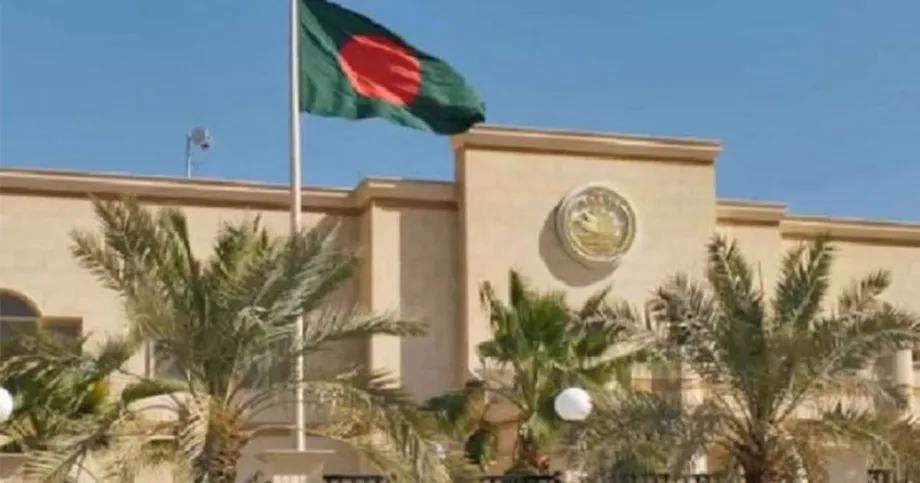
Two deaths and 24 injuries put Bangladesh at the centre of the disruption
Two Bangladeshis were killed and 24 injured in the October 10, 2026 missile attack on King Khalid International Airport in Riyadh, according to Bangladesh's embassy. The injured included 11 workers and 13 Umrah pilgrims, bringing the human cost of the attack directly into a travel corridor central to employment, religious journeys and Bangladesh's remittance income.
Contents
- Two deaths and 24 injuries put Bangladesh at the centre of the disruption
- What is known about the strike and the injured
- Emergency assistance reaches hotels, buses and another airport
- What Biman suspended and what passengers were told
- A timeline shows disruption before the fatal attack
- Dammam and airspace warnings complicate alternatives
- Remittances show the corridor's economic scale
- Bangladesh condemns the attack and seeks to return the bodies
- Other countries report injuries and issue warnings
- What remains unresolved before travel can recover
- Key Points
Saudi Arabia's General Authority of Civil Aviation put the total toll at 12 dead and 309 injured. Biman Bangladesh Airlines suspended its Dhaka to Riyadh services, BG339 and BG340, until further notice after the airport stopped accepting flights. The embassy said approximately 500 passengers arriving from Bangladesh or waiting for connections were stranded, while passengers preparing to return to Bangladesh also faced disruption.
One of the Bangladeshis killed was identified as Mufti Md Nasrullah Badrpuri, from Badrpur village in Nangalkot, Cumilla. He was travelling to perform Umrah. His family asked the authorities to arrange the return of his body. The second Bangladeshi victim was not identified in the accounts detailing the embassy's response.
The consequences extend beyond the suspended Riyadh route. Bangladesh had recently agreed with Saudi Arabia to increase permitted direct passenger services from 49 to 84 flights weekly. Saudi Arabia also accounted for $5.85 billion in Bangladeshi remittances in the 2025 to 2026 financial year, compared with $4.26 billion the previous year. An airport closure does not automatically interrupt money transfers, but prolonged disruption could delay workers taking up jobs or returning to employment.
Several important details remain unsettled. Reports differ on the time of the strike, the number and location of Bangladeshis receiving intensive care, and the scope of flight suspensions. Those differences matter for families seeking medical information and passengers deciding whether another Saudi destination offers a workable alternative.
What is known about the strike and the injured
In an update issued on October 11, the Bangladesh embassy said a missile hit Terminal 3 at approximately 3:15 a.m. on October 10. A separate account citing Saudi civil aviation figures described the attack as taking place on Saturday afternoon. The two accounts agree on the date and total casualty figures, but the precise time cannot be reconciled.
Saudi authorities listed the dead as four Saudi nationals, two Bangladeshis and one person each from the United States, Egypt, Jordan, Syria, Palestine and Sudan. The injured were taken to several hospitals, with some in serious condition.
The embassy said all 24 injured Bangladeshis had been waiting in Riyadh for onward travel to Jeddah. Its medical update identified three people in the intensive care unit at King Abdullah Hospital: Hafez Hasan from Dhaka, Kazi Nurullah from Brahmanbaria and Md Omar Faruk, a Bangladeshi worker living in Saudi Arabia. An embassy delegation visited them and described their condition as stable.
That assessment does not establish that all injured Bangladeshis were out of danger. Safkat Rahman from Naogaon, treated at National Guard Hospital, was reported unconscious. Another Bangladeshi, Md Daudul Islam from Cumilla, was receiving treatment at the same hospital. Other patients were spread across hospitals including Riyadh Medical Hospital, Prince Sultan Military Hospital and King Khalid Medical City.
An earlier briefing attributed to State Minister for Foreign Affairs Shama Obaed Islam described four Bangladeshis in intensive care at King Khalid Hospital. The later embassy account named three at King Abdullah Hospital. These are different hospital names as well as different patient counts; there is no confirmed explanation for the discrepancy. The embassy said it remained in contact with hospital authorities about treatment.
Emergency assistance reaches hotels, buses and another airport
The embassy's response combined medical coordination with efforts to move or accommodate passengers. It arranged food and accommodation for 100 people, placing them at Marriott and Radisson hotels and in dormitories at Princess Nourah University. The affected group included travellers waiting for connections to other Saudi destinations.
Another 67 passengers who had arrived from Bangladesh wearing ihram clothing for Umrah were provided with special bus transport from Riyadh to Jeddah. Ihram is the clothing and religious state associated with undertaking the pilgrimage. Moving these travellers by road offered an alternative to waiting for their interrupted flight connection.
Arrangements were also made to send approximately 400 Bangladeshis booked on a cancelled Saudia service to Dhaka home through King Fahd International Airport in Dammam. These were arrangements for onward travel, not confirmation that every passenger had departed. Two Bangladeshi workers travelling to Bahrain received assistance to continue through a land crossing in the Al Khobar area.
The passenger figures should not be added together as a confirmed total of separate individuals. The approximately 500 stranded travellers, 100 people accommodated, 67 pilgrims transported and roughly 400 passengers assigned an alternative departure describe different parts of the response. Their degree of overlap is not established.
The embassy account also uses flight number SV804 both in its description of arrivals from Bangladesh and for the cancelled service bound for Dhaka. That inconsistency leaves the precise flight identification uncertain, although the account consistently describes assistance for passengers stranded in Riyadh.
What Biman suspended and what passengers were told
Biman's announcement specifically suspended BG339 and BG340, its scheduled Dhaka to Riyadh and Riyadh to Dhaka flights, until further notice. Passengers holding bookings on those services were advised not to proceed to the airport. The carrier directed affected travellers to its call centre or nearest sales office for assistance.
The airline said further information would appear through its official website and communication channels. Its announcement promised an update on October 11, 2026, but no subsequent decision confirming a restart date is established in the reported developments.
One account described the disruption as a temporary suspension of all flights between Bangladesh and Saudi Arabia. That is broader than the routes explicitly named in Biman's announcement. The confirmed Biman measure concerns Riyadh, and should not be treated as proof that every service to Jeddah, Medina or Dammam was suspended.
Flight tracking information indicated that services bound for Riyadh were cancelled or diverted after airport operations stopped. Diversion means an aircraft lands somewhere other than its planned destination. It can keep passengers away from an unavailable airport, but creates further demands for ground transport, accommodation and connecting flights.
The distinction between a closed airport and a countrywide suspension is especially important for Bangladesh. Riyadh serves employment and transit journeys, while Jeddah and Medina are important entry points for Umrah and the annual Hajj pilgrimage. Their operating status must be assessed separately rather than inferred from the Riyadh closure.
A timeline shows disruption before the fatal attack
Problems on routes between Bangladesh and Saudi Arabia were recorded before October 10. Flight tracking records establish delays, a cancellation and a diversion, but do not independently establish the cause of each event. They should not all be attributed to attacks or airspace restrictions.
- October 3 and 4: Saudia's SV805 service from Dhaka to Riyadh recorded delays exceeding one hour.
- October 4: Rashad al-Alimi, chairman of Yemen's Presidential Leadership Council, announced a military operation against the Houthis.
- October 6: SV805 ran approximately six hours late. A Biman flight from Dhaka to Jeddah diverted to Medina before later reaching its destination.
- October 8: SV805 was listed as cancelled.
- October 9: The European Union Aviation Safety Agency expanded its advice on Saudi airspace. Saudia's SV809 service from Dhaka to Jeddah departed 42 minutes late.
- October 10: The fatal Riyadh airport attack prompted an operational shutdown and Biman's suspension of BG339 and BG340.
- October 11: Bangladesh issued its condemnation, and the embassy provided details of injuries and passenger assistance.
The October 6 diversion illustrates why a flight's changed route is not enough to identify the reason for disruption. The aircraft reached Jeddah after landing in Medina, but the reason for that intermediate landing was not confirmed.
Dammam and airspace warnings complicate alternatives
Dammam was used in plans to return stranded Bangladeshis, yet it also appeared in a separate security alert. The Saudi coalition fighting in Yemen said an attack took place near King Fahd International Airport late on Saturday. Coalition spokesman Major General Turki al-Maliki confirmed the incident.
No casualty total or detailed assessment of airport operations accompanied that account. It nevertheless matters because Dammam is a Biman destination and a principal gateway to Saudi Arabia's Eastern Province. An alternative airport cannot be assumed to be unaffected simply because it is outside Riyadh.
On October 9, the European Union Aviation Safety Agency expanded its advice following attacks in Riyadh. It recommended avoiding two defined areas of Saudi airspace, including a newly identified area in the northwest, and advised caution elsewhere in the Jeddah Flight Information Region. A flight information region is an area in which designated authorities provide flight information and alerting services; it is not just the airspace immediately above the city bearing its name.
Aviation safety organisation OPSGroup took a broader position, advising members to avoid all Saudi airspace and not use Saudi airports as diversion destinations. Its recommendation went further than the European agency's geographically limited avoidance advice. Neither recommendation, by itself, establishes that every Saudi airport was legally closed.
Houthi military spokesman Yahya Saree warned on X that Saudi airports and airspace were at risk of attack, while stating that Mecca and Medina would be excluded. That statement is not a guarantee of safe travel to either city. Pilgrims may still depend on aircraft routes, transit airports and ground journeys outside those locations.
Remittances show the corridor's economic scale
Bangladesh Bank figures put Saudi remittances at $5.85 billion in the 2025 to 2026 financial year, making the kingdom Bangladesh's largest remittance source for that period. The preceding year's figure was $4.26 billion. The increase was $1.59 billion, or approximately 37.3 percent.
These figures measure money sent home, not airline revenue or an amount automatically threatened by flight cancellations. Workers already in Saudi Arabia may continue earning and transferring money while services are disrupted. The more immediate risks concern people unable to begin employment, return from leave or meet visa and employer deadlines.
The August agreement to increase permitted direct weekly passenger flights from 49 to 84 represented an additional 35 services, an increase of approximately 71.4 percent in the agreed allowance. It did not establish that airlines had already introduced all those flights. Permissions, actual schedules and flights successfully operated are separate measures.
An August account citing the chairman of Bangladesh's Civil Aviation Authority also put the number of Bangladeshis travelling to Saudi Arabia at approximately 1.1 million, including travel beyond direct flights. No measurement period was specified, so the figure cannot reliably be presented as an annual passenger total.
For individual travellers, a delay may have immediate costs even before any effect appears in national remittance data. Some must arrive within employer or visa conditions, and others have paid for temporary accommodation before departure. Rebooking alone may not resolve those losses or obligations.
Bangladesh condemns the attack and seeks to return the bodies
Bangladesh's Foreign Ministry condemned the attack on October 11 and said its Riyadh mission was coordinating with Saudi authorities to establish details about the dead and injured and assist those affected. It called for an end to hostilities, protection of civilians and a peaceful settlement through diplomacy.
In its statement, the ministry addressed the targeting of civilian facilities directly:
Attacks endangering civilian lives and targeting civilian infrastructure are unacceptable and must cease immediately.
The statement expressed condolences to bereaved families and solidarity with Saudi Arabia. Separately, the briefing attributed to Shama Obaed Islam said the Foreign Ministry and the ministry responsible for expatriate welfare would work with Saudi authorities and, where necessary, employers to complete formalities for returning the bodies. She said the government bears the costs of repatriation in such cases.
A different account identified Humaiun Kobir as state minister for foreign affairs and attributed to him a pledge of support for protecting Mecca and Medina if needed. The accounts identify different people under the same ministerial title, and that discrepancy is unresolved. The reported pledge did not specify a deployment, timetable or concrete assistance package.
For the family of Nasrullah Badrpuri, the next practical step is the return of his body. No confirmed repatriation date was announced. Identification of the other Bangladeshi victim and updated medical information also remain outstanding.
Other countries report injuries and issue warnings
Pakistan's Prime Minister Muhammad Shehbaz Sharif said six Pakistani nationals were injured. On October 11, he said Pakistan's embassy in Riyadh was coordinating with Saudi authorities and assisting affected families. He condemned attacks on civilians and critical infrastructure and reaffirmed support for Saudi sovereignty and security under the Makkah Joint Defence Agreement.
The Philippine Department of Migrant Workers initially reported three injured Filipinos. Secretary Hans Leo Cacdac said two were recovering in intensive care as of 11 a.m. Philippine time on October 11. A subsequent department statement increased the count to at least four, with three in intensive care and one expected to be discharged. No Filipino deaths were reported.
The department advised overseas workers to avoid potential targets, follow embassy and Saudi announcements, and confirm flights with airlines before travelling to airports. It also warned against photographing, filming or posting attacks, saying violations of Saudi restrictions carry penalties.
Kazakhstan's Foreign Ministry condemned the attacks, described them as violations of international law and called for a political and diplomatic resolution. Spokesman Zhanbolat Ussenov said preliminary information indicated no Kazakh citizens among the dead or injured. The ministry affirmed Saudi Arabia's right to defend its sovereignty and security under the United Nations Charter.
The embassies of the United States, Canada, Germany and Ireland advised citizens to avoid Riyadh airport. These warnings, together with the changing national injury counts, show that the response involved both airport operations and continuing efforts to establish who had been affected.
What remains unresolved before travel can recover
Coalition spokesman al-Maliki blamed the Houthis for the Riyadh attack and said a strong response would follow. Reports also described Saudi air and missile strikes on Sanaa International Airport, areas near the Bab al-Mandeb Strait and northern Yemen. Those reported operations indicate continued escalation, but do not establish when Saudi passenger services can return to normal.
Riyadh was scheduled to host the Future Investment Initiative forum in late October, bringing corporate executives and investors to the capital. Before the attack, organisers had said comprehensive security measures would be in place. No revised arrangements or confirmed change to the event's schedule were established.
For airlines serving Bangladesh, the immediate operational questions are narrower: which airports can safely accept aircraft, which routes remain usable, and how passengers can reach their intended destinations. Longer routes or diversions can require more fuel, affect crew working hours and delay later services using the same aircraft. The extent of those costs has not been quantified.
The embassy's hotel placements, bus journeys and Dammam departure arrangements show several responses already attempted. They do not establish a comprehensive accommodation or rebooking policy for every affected passenger. The key outstanding decisions are a confirmed restart date for Biman's Riyadh services, reliable status information for other Saudi routes, updated patient assessments and the timetable for returning the two bodies.
Key Points
- Saudi civil aviation authorities reported 12 deaths and 309 injuries in the October 10 Riyadh airport attack.
- Bangladesh's embassy reported two Bangladeshis killed and 24 injured, including 11 workers and 13 Umrah pilgrims.
- Biman suspended BG339 and BG340 between Dhaka and Riyadh until further notice and told booked passengers not to go to the airport.
- Emergency assistance included accommodation for 100 people, bus transport for 67 pilgrims and planned departures through Dammam for approximately 400 passengers.
- Saudi remittances to Bangladesh reached $5.85 billion in the 2025 to 2026 financial year, up from $4.26 billion.
- The attack's precise time, some intensive care details and the scope of wider flight suspensions remain disputed or unconfirmed.
- No confirmed flight restart date or timetable for returning the Bangladeshi victims' bodies was announced.