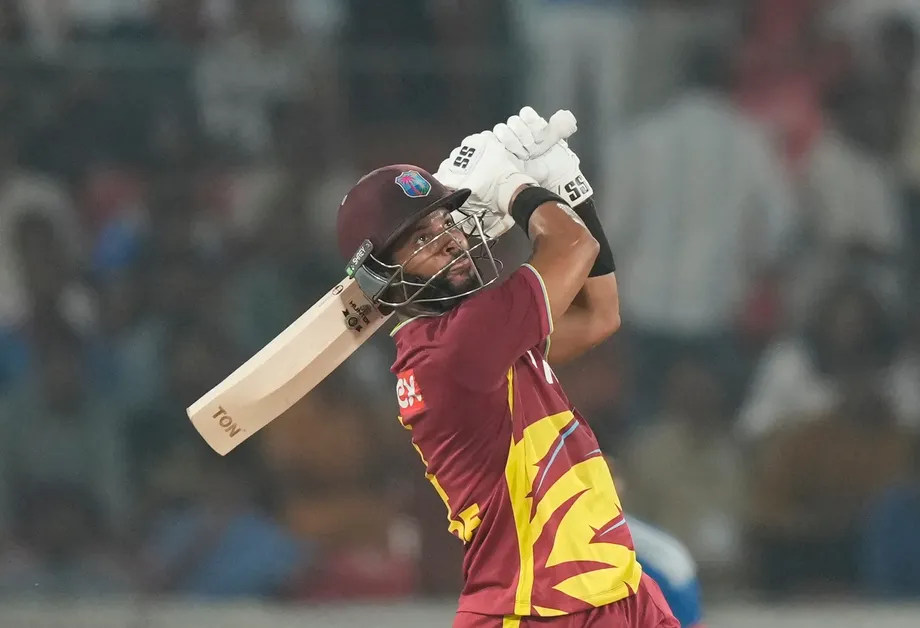
Hyderabad victory sets up a Bengaluru showdown
Shai Hope struck an unbeaten 102 from 50 balls and Keemo Paul took 5 for 41 as West Indies beat India by 24 runs at Hyderabad's Rajiv Gandhi International Stadium on October 14, 2026. The victory levelled the five match Twenty20 international series at 2-2, sending the contest to a deciding match at Bengaluru's M. Chinnaswamy Stadium on Saturday, October 17.
Contents
- Hyderabad victory sets up a Bengaluru showdown
- Hope turns a strong start into a record innings
- Rutherford and the opening burst build 247
- India's bowling costs extend beyond the boundaries
- Samson gives the chase an opening
- Tilak and Reddy revive India before Paul finishes the job
- Arshdeep's injury brings an uncomfortable ending
- Six innings above 200 put the series in perspective
- Hope's development and India's selection choices
- Key Points
Hope completed his century with a six from the final ball of West Indies' innings, taking the visitors to 247 for 3 after India captain Shreyas Iyer won the toss and chose to bowl. His third T20 international hundred established a record for a West Indies batter, while his second century of the series earned him the Player of the Match award.
India replied with 223, despite Sanju Samson's 56 from 23 balls and a late recovery led by Tilak Varma and Nitish Kumar Reddy. The chase ended with Arshdeep Singh retiring hurt after a short delivery from Shamar Joseph struck his left shoulder. The closing incident left India with an injury concern as well as a series to win.
The match account recording India's finish as 223 for 9 in 19.3 overs fits that retirement; other accounts describe India as all out, and another gives 19.4 overs. The winning margin is consistently given as 24 runs. Samson's innings is generally recorded as 56 from 23 balls, although two accounts give 65 from 23 and 56 from 22.
Hope turns a strong start into a record innings
Hope hit nine sixes and four fours, collecting 70 of his 102 runs in boundaries. He reached fifty from 28 deliveries, then needed only another 22 balls to complete his hundred. His scoring rate for the innings was 204 runs per 100 balls, the measure cricket calls a strike rate.
West Indies' captain also passed 2,000 T20 international runs, becoming the fourth batter from his country to reach that mark after Rovman Powell, Nicholas Pooran and Brandon King. His hundred was his fourth in seven innings across the one day international and T20 portions of this tour.
Hope became only the fifth batter to make more than one century in a bilateral T20 international series, a contest played between two national teams. His series average stood at 130.50, alongside a strike rate of 190.51. Those figures capture both his sustained production and the speed at which he has scored.
Arshdeep offered one pocket of resistance, restricting Hope to three runs from five deliveries. Against the rest of the attack, Hope repeatedly found room to strike straight or towards midwicket. His innings received a control rating of 92%, a measure of how often he played the ball as intended.
Hope, the West Indies captain, said the surface required adjustment even during an innings full of boundaries:
It was a bit two-paced to start with. And then with the spinners and the grippers in the back end, it was a little bit difficult to hit through the line.
A surface with varying pace can make similar deliveries reach the batter at different speeds. Hope's account helps explain why waiting for a suitable ball mattered alongside the power of his shots.
Rutherford and the opening burst build 247
Jewel Andrew helped Hope add 52 in 26 balls for the first wicket before Axar Patel trapped him lbw for 21 in the fifth over. West Indies still reached 79 for 1 after six overs, matching the highest powerplay total against India in T20 internationals. New Zealand had made the same score in Trivandrum earlier in 2026.
The powerplay is the opening six overs, when fielding restrictions leave fewer defenders near the boundary. West Indies used that period to establish momentum, then reached 100 in 7.4 overs, meaning seven completed overs and four deliveries. That matched their fastest passage to 100 against India, achieved at Lauderhill in 2016.
Shimron Hetmyer contributed 33 from 12 balls and shared a stand of 58 from 24 with Hope before Prince Yadav caught him off his own bowling. Powell added 24, leaving Sherfane Rutherford to supply the final acceleration alongside his captain.
Rutherford finished unbeaten on 49 from 26 deliveries, hitting four fours and three sixes. His unbroken partnership with Hope produced 91 from 43 balls. West Indies finished with 16 sixes, while India's attack also conceded 18 extras.
India served a penalty for a slow over rate in the final over, which cost Reddy 19 runs. Hope's six from its last delivery completed both his century and the visitors' total. Their 247 for 3 was the second highest first innings score against India in T20 internationals, behind England's 257 for 3 at Southampton earlier that year.
India's bowling costs extend beyond the boundaries
Mayank Yadav and Arshdeep each conceded 52 from four overs, an average of 13 runs per over. Axar finished with 1 for 45, while Prince's 1 for 36 made him India's most economical bowler at nine runs per over.
Prince used variations in pace and well directed yorkers, deliveries aimed near the batter's feet, to contain the scoring more effectively than his teammates. His dismissal of Hetmyer also removed a batter who was scoring at nearly three runs per ball.
Naman Dhir's only over cost 19, and Reddy conceded 39. India also gave away 13 extras in the first six overs, leaving only five more across the remaining 14. Extras are runs credited to the team rather than a batter, including wides and no balls.
Those early extras added to the pressure created by Hope and Andrew. India conceded 18 in the innings, equivalent to three sixes, while missed chances in the field further reduced opportunities to slow West Indies down.
Samson gives the chase an opening
Samson attacked immediately as India pursued 248, striking four sixes in his 56. He scored 30 from 11 deliveries against off spinner Roston Chase and helped Abhishek Sharma add 60 in 25 balls for the first wicket.
India reached 80 for 2 in the powerplay, one run ahead of West Indies at the same stage but with an extra wicket lost. The runs kept the chase moving; Paul's double strike in the fifth over changed the batting resources available to sustain it.
Paul had Samson caught at square leg with the first ball of that over, then dismissed Ishan Kishan for six three deliveries later. Iyer made 16 before falling to Shamar Springer, leaving India 97 for 3 before the halfway point.
Abhishek struggled to match Samson's pace, finishing with 29 from 24 balls. Gudakesh Motie had him caught at long off in the 12th over and then had Naman Dhir stumped for a first ball duck. India were 130 for 5, needing another 118 from 50 deliveries.
Abhishek nevertheless reached a personal milestone. His six off Springer in the ninth over took his 2026 T20 international tally to 69, passing Suryakumar Yadav's 68 in 2022 for the most in a calendar year by a batter from a full member nation.
The landmark followed Abhishek's record innings in Indore, where his 69 from 30 balls helped India win by 14 runs on October 11. Earlier in 2026, he had also made 84 from 35 against New Zealand in Nagpur and an unbeaten 68 from 20 in Guwahati.
Tilak and Reddy revive India before Paul finishes the job
Tilak and Reddy added 70 for the sixth wicket, reducing the requirement from 118 off 50 deliveries to 48 off 19. Their partnership therefore produced 70 runs in 31 balls, restoring a route to victory after India's middle order losses.
Tilak made 43 from 25, while Reddy struck 41 from 20. Reddy hit successive sixes against Joseph, and Tilak attacked Romario Shepherd before the same bowler secured the breakthrough, having him caught by Powell.
Samson, India's wicketkeeper and opening batter, identified Tilak's dismissal as the decisive moment rather than the earlier cluster of wickets:
The turning point of the match was when Tilak got out," Samson said. "We were cruising, scoring those 10-12 runs per over really nicely. Reddy and Tilak were batting really well in the pressure situation. Till that moment, I think we were in the chase.
Paul then removed Reddy, Prince for a first ball duck and Axar in the 19th over. Those three wickets completed his second haul of five wickets in T20 cricket and left India with only one wicket available for the final over.
Arshdeep's injury brings an uncomfortable ending
India needed 35 from the final six balls when Joseph began the last over, with Arshdeep facing and Mayank at the other end. A short delivery struck Arshdeep around the left shoulder and arm as he attempted a pull shot, bringing medical staff onto the field.
Arshdeep resumed batting but remained in pain. Iyer urged him from the dugout to retire, and his departure ended the innings. Samson later gave a brief update on the bowler's condition at the post-match press conference:
Arshdeep is putting ice on his shoulder," Samson said. "Hopefully he recovers soon.
The Indian team had not provided a detailed medical update. No diagnosis or decision on Arshdeep's availability for the Bengaluru match was given. His fitness matters to India after he took 3 for 44 in the preceding victory at Indore.
Shreevats Goswami, the former Bengal cricketer, criticised Joseph's continued use of short deliveries in a post on X:
What Shamar Joseph did in the last 3 balls against Arshdeep is not in the spirit of the game for me!
Joseph regularly bowls above 140 kilometres per hour and can reach 150. Goswami's criticism focused on his choice of attack against a lower order batter when the required scoring rate had become exceptionally demanding.
Six innings above 200 put the series in perspective
Ranchi, Indore and Hyderabad have produced six consecutive completed innings above 200, totalling 1,403 runs at a combined rate of 11.81 per over. Hyderabad alone featured 29 sixes.
The sequence explains why neither side could regard a large total as security. West Indies had already chased 250 at Ranchi, while India successfully defended 223 at Indore. The series has moved through these stages:
- Lucknow: West Indies were dismissed for 171, and India completed the chase with eight wickets remaining.
- Ranchi: West Indies reached 252 for 4 after India made 249 for 5, levelling the series at 1-1.
- October 11, Indore: India made 223 and restricted West Indies to 209 for 7, taking a 2-1 lead.
- October 14, Hyderabad: West Indies made 247 for 3 and won by 24 runs, restoring parity at 2-2.
- October 17, Bengaluru: The fifth match will decide the series at M. Chinnaswamy Stadium.
Hyderabad's pitch square had been relaid since India's previous T20 international there, when the hosts made 297 for 6 against Bangladesh. Before this match, former India fast bowler and commentator Varun Aaron suggested 160 to 180 could be competitive. West Indies exceeded the upper end of that estimate by 67 runs.
At the toss, Iyer said the groundsman's estimate of the pitch composition was 75% red soil and 25% black soil, citing it as part of his reason for choosing to bowl first.
Hope's comments about variable pace, Prince's comparatively economical spell and Paul's five wickets also show the specific demands within the heavy scoring. Batters needed to adjust as the ball aged, and bowlers who changed pace or found a better length could still interrupt an innings.
Hope's development and India's selection choices
West Indies head coach Daren Sammy had addressed the team's reliance on Hope before the Hyderabad match. He praised the captain's composure while pointing to contributions elsewhere in the side:
"He brings calm to the middle when he is there, and perhaps some of our other players need to emulate that calmness when the pressure is on. But he is not the only reason we win games," Sammy said.
Hope has credited his brother Kyle, franchise experience in the ILT20 and his 2024 season with Delhi Capitals for helping develop his attacking game. Sammy worked with him on striking drills, alongside batting coach Floyd Reifer. Rutherford's 49 and Paul's five wickets gave that batting progress substantial support in Hyderabad.
India have a different decision around Vaibhav Sooryavanshi, who remains unused in the series despite being in the squad of 15. He has 246 runs from eight T20 internationals at an average of 30.75, with a highest score of 81 against Zimbabwe. His recent Asian Games innings included 38 against Sri Lanka and 15 against Pakistan.
Samson's latest fifty and Abhishek's recent Indore performance give India reasons to retain their opening pair, while the deciding match leaves one remaining opportunity to select Sooryavanshi. Arshdeep's shoulder adds a separate concern to the team's preparations.
Beyond this series, the next T20 World Cup is scheduled for October 21 to November 19, 2028, in Australia and New Zealand, with 20 teams and 55 matches. The immediate task is much closer: India must contain a captain in exceptional form, while West Indies must repeat the support around Hope that turned his latest century into victory.
Key Points
- West Indies beat India by 24 runs in Hyderabad on October 14 to level the T20 international series at 2-2.
- Shai Hope made 102 not out from 50 balls, setting a West Indies record with his third T20 international century.
- Sherfane Rutherford added an unbeaten 49 as West Indies reached 247 for 3.
- Keemo Paul took 5 for 41 despite Sanju Samson's 56 and a recovery led by Tilak Varma and Nitish Kumar Reddy.
- Arshdeep Singh retired hurt after being struck on the left shoulder in the final over.
- The series decider is scheduled for October 17 at M. Chinnaswamy Stadium in Bengaluru.