A phone from 2017 helps power a walking humanoid
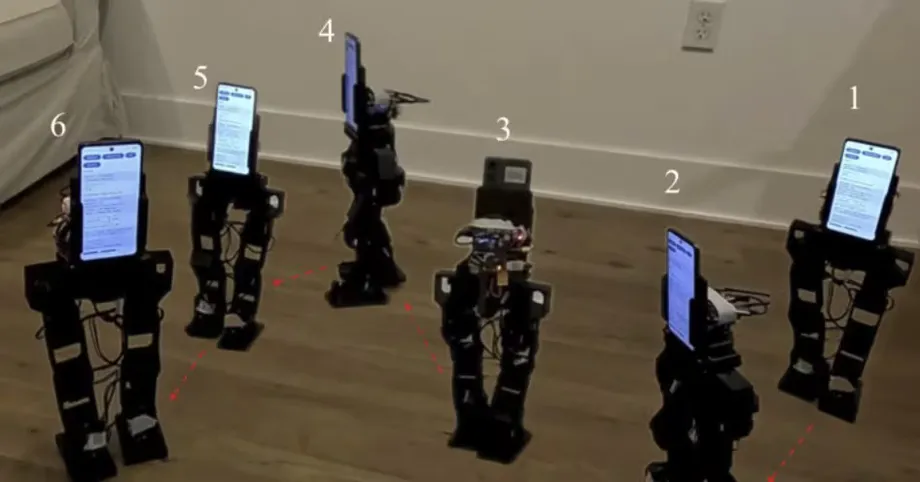
A UCLA research team has developed a humanoid robot that stands about 48 centimeters tall, weighs 1.8 kilograms and costs roughly $400 to build, excluding its smartphone. Called PhoneBot, it can walk on two legs, follow a person with its camera and stand up from a position lying face down. Among the four phones tested was a Huawei Honor 9 released in 2017.
Contents
- A phone from 2017 helps power a walking humanoid
- How the handset controls 13 joints
- Four phones worked, with one mapping limitation
- Walking began in a simulated world
- A small training change made the gait more balanced
- What the $400 price includes
- Conversation works through a laptop
- Open designs give students a starting point
- Old phones are finding other computing jobs
- Key Points
The research, submitted to arXiv on October 6, 2026, comes from Ruochen Hou, Quanyou Wang, Daniel Koh and Dennis W. Hong. Hong is a professor of mechanical and aerospace engineering at the University of California, Los Angeles, where the project was developed in the Robotics and Mechanisms Laboratory, known as RoMeLa.
The team's PhoneBot research paper, titled PhoneBot: A Low-Cost Open Humanoid Robot Platform Reusing Smartphones, describes a robot that borrows its main computing and sensing capabilities from an ordinary handset. The authors say its hardware and software designs are fully open source, allowing others to reproduce and adapt the platform.
PhoneBot tackles a practical problem for classrooms and laboratories: small humanoid robots can require expensive motors, separate cameras, motion sensors and computers. A smartphone already combines several of those components in one compact device. Reusing it leaves fewer separate electronic parts to purchase and connect.
The results also reveal where the approach currently stops. Walking and vision run on the phone, while conversational processing uses an external laptop. PhoneBot has no arms, and its walking controller was trained for flat ground. Its immediate purpose is education, research and experimentation.
How the handset controls 13 joints
PhoneBot carries its smartphone in a mount above the hips. The camera watches the surroundings, while the phone's inertial measurement unit, or IMU, measures motion and orientation. An IMU combines sensors that help estimate how a device is moving and tilting, giving the robot information it needs to stay balanced.
A custom Android application runs the movement and control neural networks using TensorFlow Lite, software designed to run machine learning models on devices such as phones. The handset calculates movement commands and sends them over Wi-Fi to a small onboard computer, which passes the instructions to the motors.
The robot has six powered joints in each leg and one joint that rotates the torso. Each hip has three joints, each knee has one and each ankle has two. This gives the lower body 12 degrees of freedom, meaning 12 independently controlled ways for its joints to move.
All 13 joints use DYNAMIXEL XL430-W250-T servo motors. A servo is a motor that can be commanded to move to a particular position, making it useful for controlling a knee, ankle or other robot joint.
The torso joint gives the camera another useful movement. PhoneBot can turn its upper body to follow a person while keeping its feet planted. That reduces the need to move the entire robot every time it needs to look sideways. The wireless connection also makes replacing the handset easier because the phone does not need a dedicated wired connection to the body.
Four phones worked, with one mapping limitation
The researchers tested the Huawei Honor 9, Samsung Galaxy A16 5G, Motorola Moto G 2024 and Motorola Moto G 2025. All four handled the core functions, including motion sensing, walking control and image processing. The three newer budget phones were bought for approximately $50 to $80 each.
The Honor 9 provides the clearest example of hardware reuse: a phone introduced nine years before the paper's release could still perform the robot's central walking and vision tasks. The newer inexpensive models also gave the team alternatives to a premium handset.
The Honor 9 had a specific software limitation. It could not run the onboard mapping function because the required Google services were unavailable on the tested device in the United States. That function uses simultaneous localization and mapping, usually shortened to SLAM. In simple terms, it helps a robot build a map while working out where it is within that map.
For someone choosing a handset, both its hardware and installed software matter. The tested Honor 9 supported walking and human detection, while mapping required services it lacked. Compatibility with additional Android models remains to be tested.
The project's development spans several generations of consumer hardware:
- 2017: Huawei released the Honor 9, the oldest phone used in the tests.
- 2024 and 2025: Motorola introduced the two Moto G generations tested alongside the Honor 9 and Galaxy A16 5G.
- October 6, 2026: The UCLA authors submitted the PhoneBot preprint to arXiv.
Walking began in a simulated world
PhoneBot's walking controller learned first in simulation, using reinforcement learning. This method lets software try actions and receive scores for useful behavior. For PhoneBot, training rewarded movements such as maintaining the requested pace, alternating steps and remaining upright, while penalizing behavior such as dragging its feet.
The simulation included physical restrictions that would matter on the real robot. Its inexpensive motors have limits on their strength and speed, and their gears have some play, meaning a small amount of looseness between parts. Accounting for those details helps the controller learn movements the actual mechanism can execute.
Training presented another problem: a body built symmetrically did not automatically learn a balanced walking pattern. In some runs, the left foot stayed forward while the right leg carried much of the load. That put uneven demands on the joints and motors.
The researchers addressed this with sagittal mirroring. They duplicated training examples with the left and right sides reversed, so the controller could learn from both versions of a movement. The technique supplied extra learning examples without requiring an additional physics simulation step for each mirrored example.
A small training change made the gait more balanced
The team compared five independent training runs using mirrored examples with five runs without them. Mirroring improved learning speed and consistency in simulation and distributed motor loads more evenly between the legs.
One reported measure of the difference between left and right joint angles fell from 0.254 radians to 0.003 radians in simulation. That is a reduction of about 98.8 percent, calculated from those two values. Radians are a way of measuring angles; here, the smaller number indicates that the movements of the two sides became much more alike.
The controller was then transferred to the physical robot, where the team demonstrated walking, following a person and getting up from lying face down. The numerical comparison describes the simulated gait, while those demonstrations show the behaviors achieved on the hardware.
This part of the work matters because affordable components create limits that software must respect. A phone can calculate commands quickly, but the motors still need to execute them. PhoneBot's training approach links the controller's decisions to the strength and mechanical behavior of its body.
What the $400 price includes
The researchers estimate PhoneBot's hardware cost at about $400, with the smartphone excluded. Its reported weight of 1.8 kilograms includes the phone and battery. A builder who already owns a compatible handset can reuse it; someone buying one must add that expense to the robot's hardware budget.
The small research humanoids listed for comparison cost approximately $3,500 to $13,800. Against those figures, PhoneBot's $400 hardware estimate is about 88.6 percent lower than the least expensive platform and about 97.1 percent lower than the most expensive.
The comparison robots have different capabilities, which matter when choosing equipment. PhoneBot's current design has no arms, uses inexpensive motors with limited carrying capacity and focuses on walking on level ground. A laboratory requiring object handling or more demanding movement would need to weigh those requirements alongside the purchase price.
An earlier smartphone robotics platform, OpenBot, developed by researchers at Intel's Intelligence Systems Lab, used a wheeled body costing approximately $50. PhoneBot brings the same broad idea of reusing a phone to a body that must maintain its balance on two legs. Its hardware estimate is eight times OpenBot's cited body cost, reflecting a different mechanical task.
Conversation works through a laptop
The PhoneBot paper describes conversational interaction, filming and mobile telepresence alongside walking and human following. Telepresence means using a remotely controlled device to see and communicate from another location. A phone supplies a camera, microphone, speaker and wireless connection that can support those activities.
Spoken interaction currently divides the work between devices. The phone handles audio input and output, but speech recognition and language processing run on a nearby laptop reached over Wi-Fi. Walking control and vision processing run on the handset itself.
The team plans to explore running suitable language models directly on the smartphone. It also proposes planning software that could combine spoken instructions with visual information to select robot actions. Those additions would reduce dependence on the external computer and extend what users could ask the robot to do.
PhoneBot's physical limits remain straightforward. Without arms, it cannot pick up or move objects. Its walking controller was trained on flat terrain, and its small motors restrict the weight it can carry and the forceful movements it can perform.
The researchers plan to investigate lightweight arms and walking on uneven ground. No completion dates were given for those upgrades or for moving conversational processing onto the handset. For now, the demonstrated platform centers on movement, sensing and interaction within its current hardware limits.
Open designs give students a starting point
The UCLA authors describe PhoneBot as an affordable, reproducible platform for education, research and rapid prototyping. Publishing both the hardware design and software gives students and researchers a starting point they can assemble, inspect and modify.
A class could use the platform to study how camera input affects movement, how balance depends on sensor readings or how a controller performs on different supported phones. Researchers could build on the existing structure when testing new perception or interaction functions. These uses follow directly from the platform's combination of accessible electronics and an editable robot design.
The $400 hardware estimate could make it easier for a laboratory to build more than one unit, subject to its assembly and equipment needs. Multiple robots would let teams compare changes using similar bodies, while the shared design could make experiments easier to reproduce.
PhoneBot also exposes an important engineering lesson: hardware cost is only part of making a robot usable. The team still had to train walking software, correct an uneven gait, account for motor limits and check handset compatibility. Open designs make those decisions available for others to study and improve.
Old phones are finding other computing jobs
Google is also pursuing a project with the University of California, San Diego, to use approximately 2,000 unused Pixel phones as a small data center. That effort and PhoneBot put existing smartphone processors to work in different settings: one groups devices for computing, while the other places a handset inside a moving machine.
The interest in reuse comes as investment in AI data centers increases demand for high performance memory and adds pressure to component budgets for other electronics manufacturers. PhoneBot's specific cost reduction comes from using a handset's existing camera, motion sensors, processor and wireless connection instead of buying those functions separately.
The UCLA experiments give that approach a concrete result. Four tested Android models, including one released in 2017, supplied enough computing and sensing capacity for the robot's core tasks. The mapping limitation on the Honor 9 also shows why reuse requires checking software support as well as processor performance.
PhoneBot gives an aging smartphone a useful role in a research tool, with a body and control system designed around what that phone and inexpensive motors can do. The next development goals are equally specific: add lightweight arms, learn to walk on uneven terrain and bring more conversational processing onto the handset.
Key Points
- UCLA's PhoneBot stands about 48 centimeters tall and weighs 1.8 kilograms, including its smartphone and battery.
- Its estimated hardware cost is $400, excluding the phone.
- All four tested Android phones supported core walking, sensing and vision functions, including the Huawei Honor 9 from 2017.
- The Honor 9 lacked the Google services required for onboard mapping.
- Mirrored training examples improved the simulated gait and balanced demands on the two legs.
- PhoneBot currently has no arms, was trained to walk on flat ground and uses an external laptop for conversational processing.
- The authors say the hardware and software designs are fully open source.