A $790 million township takes shape in Noonu Atoll
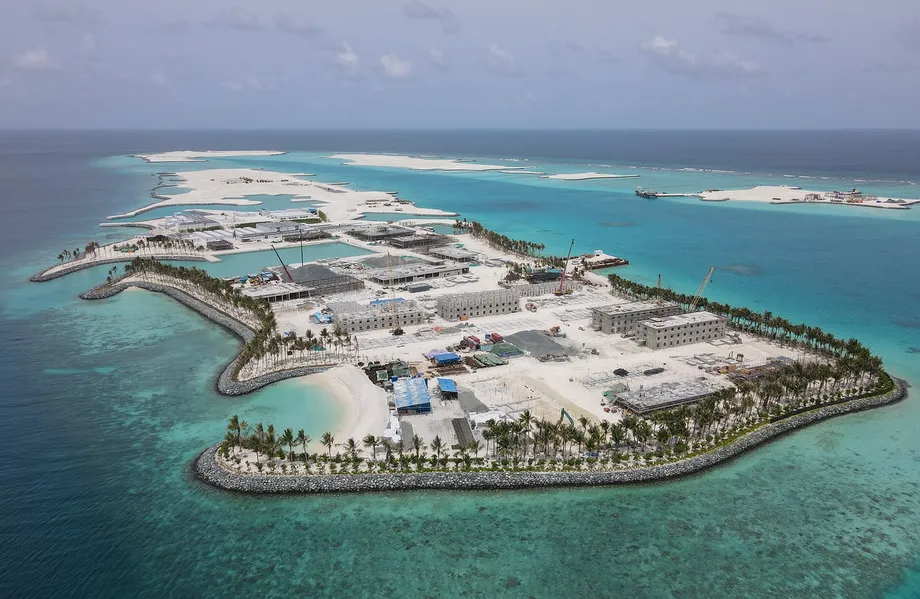
The Maldives is building a new route for wealthy foreigners to live in the country through Project Ayla, a development valued at more than $790 million that combines artificial islands, luxury homes and a planned investment residency programme. President Mohamed Muizzu officiated its groundbreaking on January 29, 2026, in Noonu Atoll, about 188 kilometres north of the capital, Malé. The township is expected to begin operating in part toward the end of 2028.
Contents
- A $790 million township takes shape in Noonu Atoll
- From a resort proposal to a place to live
- What would investors receive?
- Why the government wants wealthy residents
- Who controls the money and property?
- How would applicants be screened?
- Henley's role and the unanswered contract questions
- What the reef monitoring shows
- A broader change in how the Maldives uses land
- Key Points
The project brings the lagoons of Dhekenanfaru and Dhigufaru and the island of Kuramaadhoo within one special economic zone. Such a zone is an area where the government offers different business rules and tax incentives to attract investment. Here, foreigners would be able to purchase leases lasting 99 years, giving them long access to property while the constitution continues to bar foreign land ownership.
The government's groundbreaking announcement identifies Crystal Holdings Pvt Ltd and BluRock Group as the principal investors and developers. It promises more than 1,200 jobs, healthcare, vocational education and modern agriculture, with more than 60 percent of energy needs met through renewable sources.
The development is advancing faster than the residency rules attached to it. Henley & Partners, the firm's partner in designing the Maldives Pearl Residence programme, now lists its launch for the second half of 2026. Investment thresholds have not been published, while critics are pressing for stronger checks on applicants, clearer ownership records and answers about damage to the surrounding reefs.
Ayla brings several national choices together: how to attract money without adding public debt, how much control to give foreign residents over scarce land, and how to protect the marine environment that draws visitors to the Maldives in the first place.
From a resort proposal to a place to live
Dhigufaru lagoon and Dhekenanfaru were leased to a Swiss investor in late 2022 for a resort planned across 11 reclaimed islands. The project later developed into a township intended for people who stay, rather than simply visit. Earlier descriptions envisaged 25 artificial islands and islets and more than 70 luxury dwellings; more recent marketing under the name The Laurel describes 96 properties on 13 islands.
The lagoon covers about 745 hectares, with reclamation covering 152 hectares, roughly one fifth of that area. Construction involves more than six million cubic metres of sand dredged from the seabed. Moving that much material changes both the land available for development and the underwater habitat around it.
The government's investment agreement announcement records the SEZ permit issued on December 9, 2025, followed by the agreement with Crystal Holdings on December 31. Minister of Economic Development and Trade Mohamed Saeed signed for the government, while Project Ayla chief executive Petar Krstic signed for the company. The agreement established the contractual framework for implementation.
The ministry's December agreement statement describes that agreement as the final formal stage before practical implementation. Both statements connect Ayla to Muizzu's Vision 2040, the government's programme for economic diversification and longer term development.
The key milestones show how the construction project and residency programme have developed alongside each other:
- Late 2022: The lagoon and island were leased for an earlier resort proposal.
- July 2025: The government signed its Pearl Residence partnership agreement with Henley & Partners in Singapore.
- December 9, 2025: Ayla received its SEZ permit.
- December 31, 2025: The government and Crystal Holdings signed the investment agreement.
- January 29, 2026: Muizzu officiated the groundbreaking.
- Second half of 2026: Henley now lists the planned Pearl Residence launch.
- Late 2028: Ayla is expected to become partially operational.
What would investors receive?
Pearl Residence would give qualifying investors the right to live in the Maldives. Henley's programme page describes it as the country's first residence by investment programme and gives the second half of 2026 as its launch window. Saeed had announced an April 2026 launch at a conference in London on November 3 and 4, 2025.
The final minimum investment, eligible investment categories, residency duration, renewal arrangements and associated conditions are still being developed. Those details matter because they determine what an applicant must buy, how long the right to stay lasts and what obligations continue after approval.
Foreigners have been able to buy leasehold resort villas since at least 2010. Under that arrangement, buyers remain visitors, their lease cannot outlast the resort's lease, and resort management operates the villa when they are away. Ayla's residential model would create a different relationship with the country, combining a home with a route to longer residence.
Kristin Surak, author of The Golden Passport: Global Mobility for Millionaires, explained why residency carries different rights from citizenship:
Visas can be revoked, they're not passed down in the family, and they bring a more limited range of possibilities.
A property lease and permission to live in the country are therefore two separate arrangements. The lease governs use of the home; immigration rules govern the resident's ability to stay. Buyers will need clear terms for both.
Why the government wants wealthy residents
The Maldives faces severe pressure from public borrowing. The International Monetary Fund has projected gross debt at around 130 percent of gross domestic product. GDP measures the value of goods and services produced in an economy over a year. At that ratio, public debt would equal about $130 for every $100 of annual economic output.
Saeed has cited estimates that Pearl Residence could bring more than $1 billion in direct and indirect inflows. The ministry says that estimate comes from preliminary modelling, with no specified period for those inflows. Direct inflows could include qualifying investments; indirect inflows could arise from residents spending money and businesses serving them.
Ayla's investment value, residency inflows and government revenue describe different things. Construction capital pays for development, while taxes and fees support public finances. Spending that reaches local workers and suppliers is another benefit, whose size will depend on hiring, purchasing and the terms of the zone.
The government promises more than 1,200 jobs with a focus on local employment and skills development. The initial permit also required Crystal Holdings to submit feasibility, infrastructure, engineering and environmental studies within 180 days, alongside business proposals covering real estate, healthcare, renewable energy and staff welfare.
Fodhdhoo residents are watching for practical benefits. Abdulla Abbas, a guesthouse manager on the neighbouring island, described what residents had heard about the development:
What we've heard is that some of the wealthiest people in the world are investing in this place,
The wider distribution of gains matters in a country where the World Bank estimates that the richest fifth receives 38.5 percent of national income and the poorest fifth receives 8.9 percent. The richer group's share is more than four times the poorer group's share. Local employment, access to training and business opportunities will help determine who benefits from the new investment.
Who controls the money and property?
Crystal Holdings holds the SEZ permit, and Dubai based BluRock Group is another principal developer. Their underlying investors, equity partners and ultimate beneficial owners have not been made publicly available. Neither company responded to requests for comment about those ownership arrangements.
A beneficial owner is the person who ultimately owns or controls an asset or company, even when another company appears on the paperwork. The Maldives Companies Act identifies beneficial owners through a threshold of at least 25 percent of shares, voting rights or dividends. There is no publicly searchable register.
The SEZ Act gives the zone framework precedence over 15 other laws in matters concerning the zones under Section 79. The framework also allows tax exemptions or reduced rates, including on capital gains and import duties, and permits offshore banks to provide services for trusts. A trust is an arrangement in which someone holds and manages assets for beneficiaries.
Rules governing offshore banks restrict disclosure of beneficial ownership information about customers and the banks themselves without a court order or the owner's consent. Ahmed Ahid Rasheed, the Maldives' former information commissioner, called for publicly searchable beneficial ownership and land ownership registers within the zones:
There is no principled reason that these [pieces of] information should not be publicly accessible. Us citizens have a right to know who is buying property in our country.
Public registers would let citizens connect a company name to the people behind it. For regulators, accurate ownership records also help trace where investment money comes from and identify links between applicants, businesses and public officials.
How would applicants be screened?
The Asia/Pacific Group on Money Laundering has raised concerns about unclear rules for trusts in the Maldives. It also cites the government's risk assessment describing real estate as highly vulnerable to money laundering, the process of making money from crime appear legitimate.
Investment residency programmes can attract lawful capital while also drawing applicants seeking to conceal assets, avoid law enforcement or move illicit proceeds. The Financial Action Task Force has warned about those risks. A spokesperson for its secretariat explained how safeguards affect the outcome:
The balance ultimately depends on the programme's design and oversight, as well as the strength of the jurisdiction's wider legal, regulatory and institutional framework,
The economic development ministry says Pearl Residence will use international screening, financial and reputational assessments, and checks by national security and regulatory agencies. Henley describes a similar process that also includes independent background verification reports. The ministry says Ayla remains subject to applicable laws, including requirements against money laundering and terrorism financing.
Fayyaz Ismail, a former economic minister and opposition politician, put his concern directly:
What I'm concerned about is whether the safeguards are in place or not,
Opposition lawmaker Ahmed Shamheed sought an immediate suspension of Pearl Residence and disclosure of related agreements through a parliamentary resolution submitted in July and rejected in August. He has also warned that the country has limited resources to supervise financial activity associated with wealthy residents and offshore banks.
Azza Mohamed, governance manager at Transparency International's Maldives chapter, points to the corruption scandal involving improper island leases to tourism developers in 2014 and 2015. Senior politicians pocketed tens of millions of dollars in proceeds. She says preventing similar abuses requires ownership transparency, independent oversight of procurement and approvals, and enforcement capable of tracing, freezing and recovering illicit funds across borders.
Henley's role and the unanswered contract questions
Henley & Partners proposed Pearl Residence to the government, which formalised it as a proposal initiated by the private sector. The ministry withheld the partnership agreement under a right to information exemption for commercially confidential information whose release would damage a third party's business interests.
Henley says its role will cover application processing, administration and preparing recommendations. The Maldivian government will decide applications. The firm also says it will receive no fees or remuneration from public funds for designing, marketing or operating the programme, although it may charge clients separately for application assistance.
The ministry says applicant fees may fund the Programme Office, including payment for service providers involved in implementation and management. That arrangement places particular weight on clear oversight of who handles applications, who receives fees and who makes final decisions.
The European Parliament has warned about possible conflicts when a private firm advises governments on investment migration schemes while also preparing applications. Henley has faced scrutiny over work in other jurisdictions, including applications in St. Kitts and Nevis involving prominent politicians and alleged criminals or fugitives. The firm disputes previous allegations and says it takes due diligence seriously.
Christian Kälin, Henley's chairman, said in December 2025 that he hoped many Israelis would buy homes in the Maldives. Israeli passport holders have been barred from entering the country since April 2025, creating a practical conflict between that marketing ambition and the country's entry rules.
What the reef monitoring shows
Ayla's environmental concerns are already measurable. Monitoring from July through September 2024 found that 74 percent of sediment readings exceeded the daily limit of 15 milligrams per square centimetre. Reef conditions remained poor to fair by October 2025.
Sediment consists of particles stirred into the water during dredging and construction. When those particles settle, they can cover coral and other marine life. Cloudier water also reduces the light reaching organisms beneath the surface. The project area includes habitat for protected parrot fish and nurse sharks.
Humaida Abdul Ghafoor, an environmental activist with Save Maldives, described how reclamation affects more than the seabed where sand is removed:
It also changes the currents, water movements, the hydrology. It also generates sediment, which becomes a killer,
Muizzu says the government's aim is to keep the effects of essential reclamation works to a minimum and balance development with environmental programmes, including coral spawning and planting. In a podcast produced by the president's office, he set out that position:
We want to carry out development intertwined with the environment. We are shaping the future of our nation, and in doing so, we want to protect our environment and become an example for other nations,
Ayla's renewable energy target addresses how the completed township will operate. Sediment controls and reef monitoring address the effects of building it. Both will matter when assessing the government's description of the project as a sustainable township.
A broader change in how the Maldives uses land
The Maldives has nearly 1,200 islands, about 80 percent of them less than one metre above sea level. Nearly half its population of just over half a million lives in Malé, an island of about two square kilometres. Reclamation has become a response to overcrowding as well as a means of expanding tourism and residential investment.
Rasmalé, a much larger artificial island development near the capital, shows the scale of that shift. The government has a target of 35,000 foreign residents there, while Abu Dhabi's Eagle Hills plans 8,800 properties on nearly half the reclaimed land. Proposed leases that reset after sale or inheritance have prompted debate about how much practical control foreigners could gain.
Infrastructure Minister Abdulla Muththalib says buying a Rasmalé property would never lead to permanent residency or citizenship, although buyers would be eligible for the corporate residence visa introduced in 2015. Rasmalé and Pearl Residence therefore involve different immigration arrangements.
Governance specialist Salma Fikry has warned that leases lasting decades can confer exclusive possession, transferability, inheritance rights and extensive economic control. Ayla's next tests will be concrete: publication of Pearl Residence rules, the programme's planned launch in the second half of 2026, delivery of local benefits, and progress toward partial operation in late 2028.
Key Points
- Project Ayla is a development valued at more than $790 million in Noonu Atoll, with partial operation expected in late 2028.
- Pearl Residence is now scheduled to launch in the second half of 2026, later than the previously announced April date.
- Minimum investment requirements and final residency conditions have not been published.
- The government promises more than 1,200 jobs and renewable energy supplying more than 60 percent of the township's needs.
- Critics want public ownership registers, stronger financial supervision and disclosure of programme agreements.
- Monitoring found 74 percent of sediment readings exceeded the daily limit during July to September 2024.
- The government says applicant screening and existing laws against illicit finance will apply.