A tiny gene controls a major developmental choice
A gene encoding a peptide just 76 amino acids long can determine whether common carp develop testes or ovaries, according to research published in Science Advances. Named pangu, it sits within a 1,487 base pair stretch of DNA on the Y chromosome. Disabling it caused genetically male carp to develop ovaries; introducing it into genetically female carp caused them to develop testes.
Contents
- A tiny gene controls a major developmental choice
- Why finding the switch was difficult
- From 101 fish to a small Y chromosome insertion
- Pangu becomes active before testes take shape
- Removing and adding the gene reversed development
- Blocking an ovarian pathway helps explain the effect
- How far does the finding extend beyond Yellow River carp?
- A 2009 marker was an earlier clue, not proof of a master gene
- What remains unresolved
- Key Points
The discovery establishes the first experimentally validated master sex determination gene in Cyprinidae, a large and widely distributed family of freshwater fish. The strongest evidence comes from experiments in Yellow River common carp, with further functional tests in Red carp and Koi. It does not establish that every species in the family uses the same gene.
Professor Hu Wei of Shanghai Ocean University led the collaboration with the Institute of Hydrobiology of the Chinese Academy of Sciences and other institutions. The work followed more than a decade of investigation. The researchers named the gene after Pangu, the primordial creator in Chinese mythology who separated heaven and earth, reflecting its role in initiating male development.
The Science Advances study, titled A helix-loop-helix gene orchestrates male fate in common carp, appears in volume 12, issue 41. Journal metadata gives October 9, 2026, as the publication date, while announcements describe publication on October 10 in Beijing time. Those dates are consistent with a time zone difference.
Why finding the switch was difficult
Common carp have an XX/XY system of genetic sex determination, with females usually carrying two X chromosomes and males an X and a Y. Knowing that arrangement, however, did not identify the gene that directs the developing reproductive organ toward a testis rather than an ovary.
Before this work, the published common carp genomes described in the paper were from XX females. That left researchers without a male reference genome containing the Y chromosome sequence they needed to examine. Repeated DNA sequences and the species' duplicated genome made the search harder.
Common carp are allotetraploid: their genome combines two ancestral chromosome sets, designated A and B, brought together through hybridization. The paper places the divergence of those ancestral lineages at about 23 million years ago and their merger at about 12.4 million years ago. Similar copies of genes and DNA regions can complicate attempts to identify a sequence associated specifically with males.
The gap was striking because sex determination genes were already known elsewhere in fish. The study's introduction lists at least 28 distinct genes across roughly 140 teleost species in about 20 families. Pangu fills a missing part of that picture in cyprinids, rather than establishing a universal rule for fish.
From 101 fish to a small Y chromosome insertion
The team first assembled a male Yellow River carp genome spanning 1.67 billion DNA bases across 50 chromosome sequences. They then resequenced 50 male and 50 female siblings, together with their female parent, giving a comparison group of 101 fish.
By comparing the representation of DNA fragments in males and females, the researchers initially identified 428 candidate fragments specific to males. They selected two strong candidates for further validation. One confirmed fragment, 847 base pairs long, proved to lie inside a larger insertion near the end of chromosome B25.
Cloning and sequencing established that this larger region contained 1,487 base pairs specific to males. An independent analysis of DNA coverage also pointed to the same chromosome interval. Tests across geographically diverse common carp populations supported the sequence's association with males.
Chromosome imaging provided another check. A probe targeting the sequence produced signals in XY and YY males, but not XX females. YY fish showed twice as many signals as XY fish, consistent with the sequence being carried on the Y chromosome. These tests established where the candidate lay, but functional experiments were still needed to show what it did.
Pangu becomes active before testes take shape
Within the Y chromosome insertion, the team identified a gene producing a transcript 447 bases long, with a coding sequence of 231 bases. That sequence encodes the 76 amino acid Pangu peptide. Searches against a major protein database found no significant similarity to previously annotated genes.
Pangu contains a helix loop helix domain, a structural feature that can help proteins interact with other proteins involved in regulating gene activity. The analysis did not find strong evidence for the adjacent basic region commonly associated with direct DNA binding in some proteins of this class. That distinction matters when considering how Pangu might control its downstream targets.
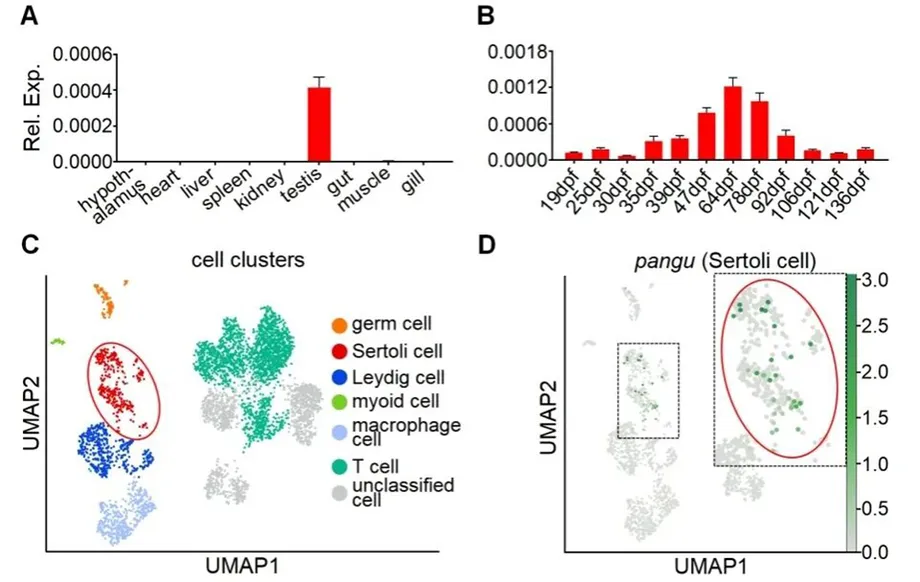
The gene's timing also fitted a role in directing sex development. Its transcripts were detected from 19 days after fertilization, before the reported onset of visible sex differentiation at 35 days. Expression peaked at 64 days and declined after 92 days.
Analysis of individual cells placed the strongest expression in a subset of cells identified as putative Sertoli cells. These are supporting cells associated with testis development, rather than the germ cells that eventually produce sperm. Tissue imaging also supported expression associated with Sertoli cells. Other established regulators reached their expression peaks later, consistent with Pangu acting near the beginning of the developmental sequence.
Removing and adding the gene reversed development
The decisive experiments tested both directions of the proposed switch. Using CRISPR editing, the researchers disrupted pangu in XY carp. From 35 days after fertilization, the developing gonads formed an ovarian cavity and followed an ovarian developmental pattern, eventually producing ovaries with evidence of egg development.
The changes extended beyond tissue appearance. The female differentiation gene foxl2 became more active, while the male differentiation genes amh and dmrt1 became less active. Protein measurements followed the same pattern. Testosterone and 11 ketotestosterone levels fell, while estradiol increased, resembling the hormone profile of females.
A separate experiment in YY carp left one functional copy of pangu intact. Those fish retained normal male gonadal development, supporting the finding that a remaining working copy could sustain the male pathway under the conditions tested.
For the reverse experiment, the team introduced a DNA construct containing pangu and surrounding sequence into XX fish. Those genetically female carp developed testes, with evidence of sperm formation and male patterns of gene, protein and hormone expression. Adding pangu also restored testis development in XY mutants lacking a working copy.
Together, the experiments show that pangu is necessary and sufficient for male sex determination in the tested common carp: removing its function redirects development toward ovaries, while adding it can redirect development toward testes. The chromosomes themselves are not converted from XX to XY or vice versa; the developmental outcome changes.
Blocking an ovarian pathway helps explain the effect
The study identifies cyp19a1a as an early downstream target of Pangu. This gene encodes ovarian aromatase, an enzyme involved in producing estrogens. Its activity helps support ovarian differentiation, making it a plausible route through which an early male determining signal could redirect development.
Differences in cyp19a1a activity were already visible at 19 days after fertilization. Its expression increased in XY fish with disrupted pangu and decreased in XX fish carrying the introduced gene. Several other genes associated with sex differentiation did not show comparable early changes.
In experiments using human laboratory cells and a cell line derived from Koi fins, Pangu reduced activity from the regulatory regions of both cyp19a1a copies. A mutant Pangu without an intact helix loop helix domain lost that ability, linking the peptide's structure to its regulatory effect.
The strongest test took place in the fish themselves. Disrupting cyp19a1a in XY pangu mutants restored testicular development, despite the loss of the proposed male switch. This genetic rescue places cyp19a1a downstream of pangu: blocking the ovarian pathway can bypass the absence of the upstream signal. The evidence supports a mechanism in which Pangu promotes male development at least partly by suppressing cyp19a1a, without yet establishing every molecular step involved.
How far does the finding extend beyond Yellow River carp?
The researchers detected pangu in males from representatives of both major common carp subspecies. These included Yellow River carp, Red carp and Koi from the East Asian group, and German mirror carp from the European group. They also identified a sequence specific to males in another species in the genus, Cyprinus acutidorsalis.
Red carp and Koi underwent further functional testing. Removing and adding pangu produced sex reversal in opposite directions, matching the results in Yellow River carp. These experiments provide stronger evidence of a shared function than detecting the DNA sequence alone.
The distinction limits how broadly the results should be read. The paper describes a conserved male switch across the genus Cyprinus, while the detailed reciprocal sex reversal experiments concern Yellow River carp, Red carp and Koi. Detection in German mirror carp and Cyprinus acutidorsalis extends the genetic evidence, but does not amount to the same set of functional tests.
Likewise, being the first validated master sex determination gene in the family Cyprinidae does not mean Pangu determines sex throughout that entire family. The discovery establishes a starting point for testing which related fish share the switch and which use different mechanisms.
A 2009 marker was an earlier clue, not proof of a master gene
A 2009 marker study, published in Molecular and Cellular Probes, had already identified a DNA fragment specific to male common carp. Researchers screened 220 random primers and found that primer S2107 produced a fragment 909 base pairs long in males.
The pattern was observed in 30 fish from three common carp stocks. Further amplification and hybridization tests supported its association with males. The fragment showed low similarity to a repetitive sequence in zebrafish, and no hybridization signals were detected in grass carp.
That work proposed the sequence as a tool for identifying the genetic sex of Yellow River carp. A marker, however, can travel with a sex chromosome without causing male development. The new study goes further by identifying an expressed gene and demonstrating that removing or adding its function changes gonadal development. The evidence described here does not establish that the 909 base pair marker and the newly defined 1,487 base pair region are the same sequence.
The research milestones are separated by years, while the publication dates describe the same release in different time zones:
- October 2009: The earlier study reported a 909 base pair DNA marker associated with male common carp.
- October 9, 2026: Science Advances lists publication of the pangu study in volume 12, issue 41.
- October 10, 2026, Beijing time: Announcements place publication of the new findings on this date.
- October 11, 2026: A public account described the discovery and more than a decade of investigation.
What remains unresolved
The evidence for Pangu's developmental role is stronger than the current explanation of its exact molecular action. The study shows suppression of cyp19a1a activity and a genetic rescue that connects the two genes. It does not yet establish whether Pangu directly binds the relevant regulatory DNA or acts through other proteins.
The authors also identify a question about the cells expressing pangu. Its low and restricted expression may reflect activity in a rare or temporary population of developing Sertoli lineage cells. Determining whether those cells represent an early progenitor state would help explain how a small initiating signal leads to testis formation.
Chen Kuangxin, a postdoctoral researcher at Shanghai Ocean University, and Chen Ji, an associate researcher at the Institute of Hydrobiology, are the joint first authors. The corresponding authors are Hu Wei, Zhu Zuoyan, Ge Chutian of Zhejiang Wanli University, and Vance L. Trudeau of the University of Ottawa. Chinese Academy of Sciences academician He Shunping and other specialists provided guidance and assistance.
No timetable is given for the next experiments. The central result is already supported by chromosome localization, early expression and reciprocal functional tests. The unfinished work concerns how Pangu carries out that role and how widely the mechanism is shared beyond the carp groups tested.
Key Points
- Pangu is the first experimentally validated master sex determination gene identified in Cyprinidae.
- It encodes a 76 amino acid peptide within a 1,487 base pair region on the common carp Y chromosome.
- Disrupting pangu caused XY carp to develop ovaries; introducing it into XX carp caused testes to develop.
- Disrupting the ovarian pathway gene cyp19a1a restored testicular development in pangu mutants.
- Functional tests in Red carp and Koi support a shared role, but the findings do not establish a universal mechanism across the family.
- The exact molecular route by which Pangu suppresses cyp19a1a remains unresolved.