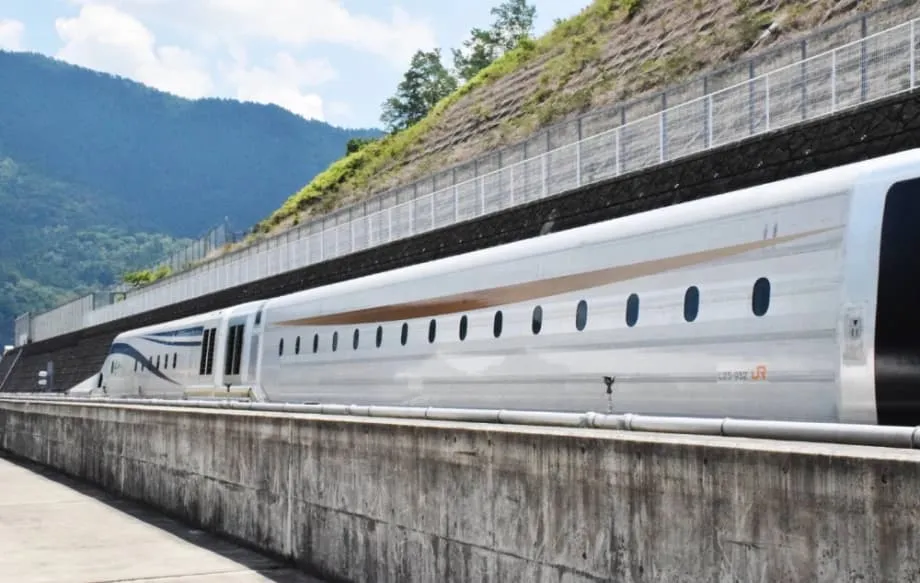
A speed record without a passenger route
Japan's superconducting maglev can carry people at 603 km/h, or 375 mph, yet its working world remains a 42.8 kilometer test line in Yamanashi. The train holding the world speed record for a crewed train runs back and forth through the countryside while the railway intended to bring it into everyday service waits on difficult tunnels, environmental approvals and rising costs.
Contents
- A speed record without a passenger route
- How magnets replace wheels at speed
- The river dispute holding up a mountain tunnel
- Why building the route is so expensive
- What happens during a Yamanashi test run
- New surfaces, seats and warning sensors
- The energy cost of going faster
- China pursues speed on steel rails
- Different views on value and overseas expansion
- What a second route would mean for travelers
- The milestones and a place to see the train
- Key Points
As of November 30, 2025, Central Japan Railway Company, known as JR Central, expects the first stage of the Chuo Shinkansen to open around 2035 at the earliest. Its original target was 2027. The expected delay of at least eight years separates a train that company engineers say is ready for commercial use from a route that still faces major construction obstacles.
The planned railway would connect Tokyo's Shinagawa Station with Nagoya in 40 minutes, using a cruising speed near 500 km/h. A later extension to Osaka would bring the planned journey from Tokyo to just over an hour. The ambition is to change how people travel across central Japan while providing another major route alongside the Tokaido Shinkansen.
For now, observation decks and ridgelines around the Yamanashi line offer a view of the silver train flashing past. Limited demonstration rides are available to invited guests and people selected through lotteries. Those journeys show what the technology can do, but ordinary passengers still cannot use it to travel between cities.
The budget has grown to roughly 11 trillion yen. Much of the challenge lies underground: about four fifths of the Tokyo to Nagoya alignment runs through tunnels, including deep passages beneath crowded urban districts and long bores through mountains.
How magnets replace wheels at speed
Japan's SCMaglev uses superconducting magnetic levitation. Magnets carried by the train induce electrical currents in coils built into the guideway as the vehicle moves. Those currents produce magnetic fields that lift the train and keep it aligned. Engineers call this electrodynamic suspension.
The train begins its journey on retractable rubber tires. Above about 150 km/h, magnetic forces support it roughly 10 centimeters above the guideway, removing physical contact with the track. The tires lift clear as speed increases.
A linear synchronous motor provides propulsion. Switching magnetic fields along the track attract the magnets on the train and pull it forward. Instead of relying on wheels gripping rails, the vehicle moves through a carefully controlled sequence of magnetic forces.
The experience inside differs from a conventional bullet train. Without contact between wheels and rails at cruising speed, there is less of that familiar rattle. Riders instead hear more of an aerodynamic rush and a steadier hum. Engineers have spent years reducing vibrations, lowering cabin noise and adjusting the train's shape to manage airflow at extreme speeds.
The river dispute holding up a mountain tunnel
Shizuoka Prefecture is the immediate obstacle to completing the route. JR Central needs to excavate about 8.9 kilometers of tunnel beneath the Southern Alps mountains there, but local leaders have objected to work that would divert water feeding the Oi River.
The river supplies communities and agriculture downstream. Concerns about its flow have kept opposition firm, and construction of that tunnel segment has not begun. The project's need for a continuous route makes this relatively short section consequential: a train cannot provide the planned Tokyo to Nagoya service while a necessary part of its path is missing.
National officials are trying to mediate. JR Central is continuing construction on sections where work can proceed, alongside testing in Yamanashi. The unresolved permitting dispute leaves the company without a completed corridor, even as the train itself continues to develop.
No firm opening date has been settled. The expectation of around 2035 at the earliest places the first stage well beyond the original 2027 target, while the later Osaka extension remains part of the wider plan.
Why building the route is so expensive
The Chuo Shinkansen is one of Japan's largest infrastructure projects, and its extensive tunneling helps explain the cost. Underground construction requires ventilation, removal of excavated material and controls to manage groundwater. Those tasks become especially demanding beneath mountains and densely built urban areas.
JR Central's roughly 11 trillion yen budget reflects the growing scope and complexity of the work. Environmental approvals, construction challenges and politics have all slowed progress. Resolving the Shizuoka dispute would address an immediate blockage, while the rest of the route would still require substantial engineering work.
Company engineers say the trainset is ready for commercial use. Their testing priorities now include reliability over long distances, the behavior of air in tunnels at very high speeds and maintenance arrangements for superconducting equipment.
The Yamanashi line remains the proving ground for those tasks. Its role is to prepare a complete operating system, including vehicles, equipment and maintenance routines, for daily service once the infrastructure is finished.
What happens during a Yamanashi test run
The Yamanashi Maglev Test Line opened in 1997. Since then, the program has accumulated millions of test kilometers and passed several speed milestones, culminating in the 603 km/h record. A typical day produces about 2,000 kilometers of trial running.
Engineers use the line to study conditions that passengers may barely notice but equipment must withstand repeatedly. Tests examine travel through long tunnels, exposure to crosswinds and the forces created when two trains pass at a combined relative speed exceeding 1,000 km/h.
Public ride days follow a controlled process resembling a small airport. Guests check in, pass security and board in an organized flow. The train then accelerates briskly, reaching 320 km/h in roughly a minute and 500 km/h within three minutes.
A demonstration holds that cruising speed for a short stretch and covers the full 42.8 kilometers in about eight minutes. Riders often describe an unusual sensation of speed, while some find the ride more rugged than a conventional shinkansen. Engineers use that feedback to refine suspension settings, seats and aerodynamics.
The acceleration can be described as adding roughly half a kilometer per hour to the train's speed each second. The brief runs make that increase visible, but the test program also examines whether the cabin can stay quiet and comfortable through repeated journeys at much higher speeds than conventional rail travel.
New surfaces, seats and warning sensors
Japan's development program progressed from early prototypes such as the MLX01 to the L0 Series and then an improved L0. Each stage incorporates lessons from the test line, with recent changes addressing airflow, passenger comfort and maintenance.
The newest test vehicles include an unpainted exterior covered with a film resembling sharkskin. Its microscopic surface shapes airflow to reduce drag. Developers say the aerodynamic changes lower air resistance compared with earlier versions, helping reduce energy use and interior noise.
Inside, seats now have fixed backrests. This simplifies their mechanisms and saves weight. Cabin materials have also been changed to reduce the transmission of vibration at top speed, complementing earlier work on suspension tuning and seat design.
Tests have included two trains passing at a relative speed of 1,026 km/h. Engineers use these encounters to investigate pressure pulses and shock waves. The combined speed describes how quickly the trains approach and pass each other, with both vehicles contributing to that closing speed.
New sensors look for tiny changes in vibration that could indicate equipment fatigue before an incident occurs. Work also continues on extending the life of superconducting magnets and making maintenance simpler. These less visible changes matter to a railway expected to operate reliably for decades.
The energy cost of going faster
Researchers who have studied the system argue that maglev uses much more electricity than the current Tokaido Shinkansen at typical operating speeds. Some estimates put consumption at four to five times as much. That comparison sits at the center of the debate over whether the promised time savings justify the energy demand.
Air resistance is a major part of the explanation. Aerodynamic drag rises with the square of speed and becomes the dominant force above 300 km/h. A faster train must push harder against the air, even when it has removed friction from contact between wheels and rails.
The system also needs electricity for coils along extensive stretches of guideway and for ventilation in mountain tunnels. The route's underground design therefore affects both construction costs and the resources needed to operate it.
Supporters argue that shifting passengers away from short flights could reduce emissions, especially as Japan's electricity grid becomes cleaner. The potential environmental benefit depends on changes in travel choices as well as the power used by the railway.
JR Central's testing also examines aerodynamic noise, electromagnetic fields and vibration. Those efforts aim to measure and reduce the system's environmental footprint, while the water concerns in Shizuoka remain a central issue for the route itself.
China pursues speed on steel rails
China is developing faster conventional trains and its own maglev technology. Recent CR450 tests saw a passenger train running on steel wheels and rails reach near 280 mph, about 450 km/h. The program seeks shorter journeys on existing corridors and a stronger domestic industry producing trains and control systems.
Zhao Hongwei of the China Academy of Railway Sciences described the years of preparation behind the CR450 program and the point at which its technical goals became a formal project.
We started planning the CR450 back in 2018. It took three years to nail down the top technical specifications, and we commenced the project officially in 2021.
China's work highlights two approaches to faster rail travel: increasing the speed of trains that retain steel wheels and rails, and developing systems that use magnetic levitation. Japan's Chuo Shinkansen follows the second approach, with superconducting magnets at its core.
Zhenhua Chen, a professor at The Ohio State University who researches high speed rail worldwide, described the technology that distinguishes the Japanese project.
Japan's is based on a superconducting magnetic levitation system.
Chen sees the possible benefits as linked to cost control and changes in travel patterns when a much faster and reliable service becomes available. He expressed an optimistic view of that potential.
It will be a major shift, simply because it's going to be much faster, much more reliable and much more green.
Different views on value and overseas expansion
Rick Harnish, cofounder of the High Speed Rail Alliance, argues that conventional rail is often the more practical option. His view reflects concerns that the expense of maglev can outweigh its benefits when passenger demand or funding falls short.
Maglev is something that's talked about a lot. But really, when it comes down to it, a conventional train running steel wheels and steel rails is the best way to go.
The United States has studied a maglev connection between Washington and Baltimore, with federal money allocated for planning. Japanese institutions, including the Japan Bank for International Cooperation, have indicated interest in financing.
JR Central has promoted its technology overseas for years. The Yamanashi test line serves as a showcase for prospective partners as well as an engineering facility. Its demonstrations give visitors a chance to experience the system while the Japanese commercial route remains unfinished.
What a second route would mean for travelers
A 40 minute journey between Tokyo and Nagoya would change the practical reach of business trips and visits across central Japan. The eventual Tokyo to Osaka journey of just over an hour would similarly reshape day trips and business schedules.
The new railway would also relieve pressure on the Tokaido Shinkansen, a corridor carrying more than a million passengers per day. Supporters see the inland alignment as a second route capable of keeping people moving after a major earthquake or coastal storm.
Coastal storms, tsunamis and seismic events are part of the case for additional capacity away from the existing corridor. The aim is to combine faster journeys with greater resilience, giving central Honshu another major connection when disruption affects coastal transport.
Japan's bullet train has been part of the country's identity since 1964. Moving from steel wheels to magnetic levitation represents a further technological leap built on decades of laboratory work and field trials. In Yamanashi, the L0 demonstrates that the system can operate repeatedly at extraordinary speeds. Turning those runs into everyday transport requires a completed railway.
The milestones and a place to see the train
The project brings together a long history of Japanese rail development, decades of maglev testing and a commercial opening that has moved further into the future. The key dates also show how China's conventional rail program has developed alongside it.
- 1964: The bullet train begins its place in Japanese transport and national identity.
- 1997: The Yamanashi Maglev Test Line opens.
- 2018: Planning begins for China's CR450 program.
- 2021: The CR450 project formally starts after three years spent settling its top technical specifications.
- 2027: JR Central's original target for opening the Tokyo to Nagoya maglev section.
- November 30, 2025: The maglev remains on its test line, with the Shizuoka tunnel segment awaiting construction.
- Around 2035 at the earliest: JR Central's expected opening period for the first stage.
Visitors unable to obtain a demonstration ride can still explore the Yamanashi Prefectural Maglev Exhibition Center beside the test track. It has hands on displays explaining superconductivity, retired maglev vehicles and elevated viewpoints where the train passes at full speed.
Access information and opening hours are available through the official Maglev Exhibition Center website. The museum and public demonstrations keep the technology visible while engineers continue testing and officials work through the construction dispute.
Key Points
- Japan's superconducting maglev holds the crewed train speed record at 603 km/h and operates on a 42.8 kilometer test line in Yamanashi.
- The Chuo Shinkansen would connect Tokyo's Shinagawa Station and Nagoya in 40 minutes at a cruising speed near 500 km/h, followed by an extension to Osaka.
- The first stage is expected around 2035 at the earliest, at least eight years after the original 2027 target.
- The budget has risen to roughly 11 trillion yen, with about four fifths of the Tokyo to Nagoya route in tunnels.
- A planned 8.9 kilometer tunnel in Shizuoka has not begun because of concerns about water feeding the Oi River.
- The train levitates roughly 10 centimeters above its guideway above about 150 km/h, using magnetic fields for lift, guidance and propulsion.
- Testing continues on comfort, aerodynamics, equipment monitoring and maintenance, while engineers say the trainset is ready for commercial use.
- Energy demand, passenger demand and construction costs remain central to the debate, alongside potential benefits from replacing flights and adding an inland route.
- China's CR450 program is pursuing higher speeds with conventional wheels and rails, while maglev planning has also attracted interest in the United States.