A robot guardian makes a dramatic entrance
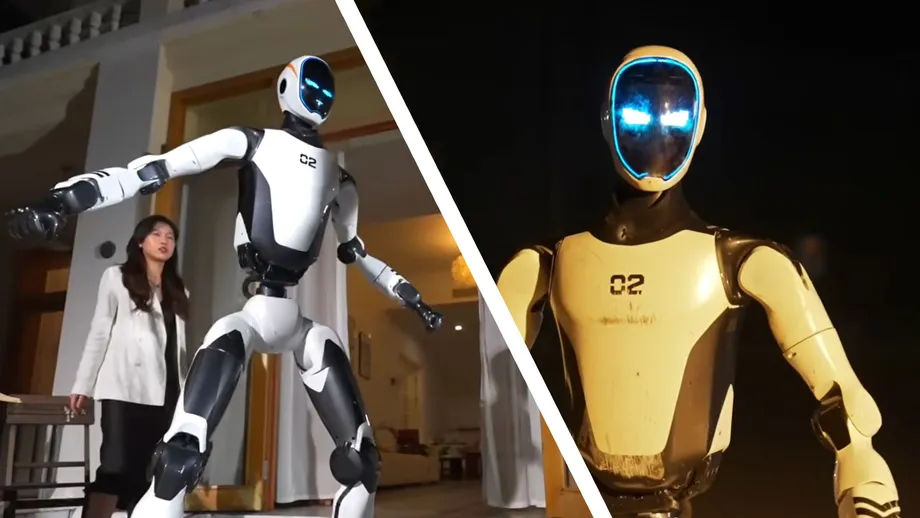
Unitree unveiled its H2-X Kung Fu Legend Guardian on October 21, 2026, showing a humanoid robot dropping from a platform about four metres high, striking cars and taking part in staged protection and rescue scenes. The Hangzhou company is presenting the machine for security, patrol and emergency response, extending its martial arts demonstrations into tasks involving people in danger.
Contents
- A robot guardian makes a dramatic entrance
- What happens in the demonstration?
- Eight hours standing, with testing details still missing
- The H2 platform behind the new model
- How does a robot lift the front of a car?
- Autonomous fighting and autonomous rescue are different tasks
- How Unitree reached the guardian concept
- A growing business faces pressure to deliver useful work
- What would change for people working beside it?
- Key Points
The most striking sequences show the robot lifting the front of a car so a trapped mannequin can be pulled free, then lunging to push another mannequin away from an approaching vehicle. The rescue scenes use props, with the vehicle route and the positions of the mannequins arranged in advance.
Unitree's headline endurance figure is approximately eight hours, but the video caption describes standing time. That detail matters for anyone imagining a robot walking patrols or carrying out repeated rescues throughout a working day: standing, walking and explosive movements place different demands on a battery.
The company has not announced the H2-X's price, full specifications, release date or sales arrangements. It also has not explained, sequence by sequence, whether the movements were remotely controlled, programmed beforehand or performed autonomously. Its immediate safety advice is concrete: people should stay at least two to three metres away while the robot operates.
What happens in the demonstration?
The launch video combines a scrapyard obstacle course with staged confrontations and rescues. The H2-X leaps over a sedan, kicks a car door and strikes a bonnet with its elbow. Other footage shows a high drop from a shipping container, recovery after landing and successive kicks requiring rapid changes in balance.
The protection scenes place the robot between a person and an armed attacker. Descriptions of the encounters include an attacker carrying a stick and another carrying a knife. The central idea is the same: Unitree is showing a machine moving into danger rather than simply performing martial arts in open space.
The car rescue requires a different kind of movement. The robot plants its feet, presses upward against the vehicle and creates room for a worker to remove the mannequin. In the approaching vehicle sequence, it moves the mannequin out of the vehicle's path, is knocked down and gets back up.
These demonstrations bring together balance, strength and timing. In a working rescue system, those physical actions would need to operate alongside detection of people, assessment of danger and decisions about where and when to move.
Eight hours standing, with testing details still missing
The H2-X's stated standing endurance of about eight hours compares with roughly three hours reported for the standard H2. Numerically, eight hours is about 2.7 times three hours, an increase of five hours.
Unitree has not published matching test conditions for the two figures, including battery configuration, carried load and movement during testing. The useful comparison for a future buyer would be how long each machine can perform the same job under the same conditions.
A robot waiting upright consumes power to run its computers, sensors and balance controls. Walking adds repeated joint movements, while jumping, pushing and lifting demand bursts of power. An eight hour standing figure therefore describes a waiting state; the duration of an actual patrol would depend on its route, pace, stops and tasks.
For a security operator, time spent waiting could still be valuable. A robot stationed at an entrance might remain mostly still before moving briefly. An emergency response assignment could involve a very different pattern, with sustained movement, heavy exertion and fewer opportunities to recharge.
The H2 platform behind the new model
The H2-X belongs to Unitree's H2 family, whose standard model stands 1.82 metres tall and weighs about 70 kilograms including its battery. The standard H2's listed standing dimensions are 1,820 by 456 by 218 millimetres, making it roughly the height and mass of an adult person.
The H2 has 31 degrees of freedom. In robotics, that means 31 independently controlled directions of movement across its joints: six in each leg, seven in each arm, three at the waist and two in the head. Coordinating them lets the machine shift its weight, turn its torso and move its arms while staying upright.
Reference specifications for the standard H2 list peak joint torque of 360 newton metres in the legs and 120 newton metres in the arms. Torque is turning force at a joint, similar to the force applied when using a spanner. The arms have a stated peak load of about 15 kilograms and a rated load of about seven kilograms.
The platform uses aluminium suitable for aerospace applications, titanium alloy and strong engineering plastics. Its listed equipment includes local air cooling, WiFi 6 and Bluetooth 5.2. Computing configurations reach up to 2,070 TOPS, or trillion operations per second, a measure of processing capacity for certain artificial intelligence calculations.
The standard H2 starts at $29,900, with an Nvidia Jetson AGX Thor module available in a developer configuration. Those are reference details for the existing platform; Unitree's eventual H2-X specification sheet will determine its own dimensions, components, performance and price.
How does a robot lift the front of a car?
The lifting scene attracts attention because the standard H2's arm load figures are far smaller than a car's mass. The action shown is a coordinated push against the front of the vehicle, with the robot using its legs, torso and arms together.
A car being tilted remains partly supported by its wheels and the ground. The force needed at the lifting point depends on where the robot pushes, how the vehicle's weight is distributed and how far it rises. Vehicle mass alone cannot supply the lifting force for that particular setup; measurements of the arrangement are needed.
Unitree has not given the vehicle's measured load at the contact point, the amount of assistance or preparation involved, or the force recorded during the manoeuvre. Those details would help rescue planners judge what size of opening the robot could create and how steadily it could hold that position.
The staged rescue also includes a human worker pulling the mannequin free. A practical deployment would require coordination between the machine and nearby responders, especially while a heavy object is being held above someone. Unitree's recommended separation distance makes that close working arrangement an important part of any future safety assessment.
Autonomous fighting and autonomous rescue are different tasks
Unitree introduced its UnifoLM-X2-1.0 action model in September, before the H2-X announcement. The company described that earlier demonstration as fully autonomous humanoid combat, with punches, blocks, evasive movements and transitions between attack and defence performed without external remote control or preset scripts.
Autonomous operation means a robot uses its sensors and software to choose actions as events unfold. Remote control means an operator directs it, while a programmed sequence supplies movements prepared beforehand. A single robot can use different combinations of these methods for different tasks.
The H2-X video leaves the control method for its rescue and protection scenes unspecified. A robot reacting to an opponent in a defined fighting exercise faces a different assignment from a machine deciding how to move a person near a vehicle.
A rescue requires the machine to locate the person, understand the surrounding space, choose a safe direction and control contact with a vulnerable body. Security work adds decisions about who is threatening whom and whether intervention might injure a bystander. Those judgments are central to the job Unitree is proposing.
Useful operating results would include how often a task succeeds, how frequently the robot makes mistakes and what happens when sensors lose sight of a person or an obstacle blocks its route. The launch presentation provides movement examples rather than those deployment measurements.
How Unitree reached the guardian concept
The H2-X follows a series of public demonstrations involving different Unitree machines. The company has used martial arts both to display coordinated movement and to give its humanoids recognisable roles on stage.
- October 20, 2025: Unitree introduced the H2 platform, including a face with humanlike features.
- October 2025: The smaller G1 appeared in demonstrations featuring spinning kicks and flips.
- February 2026: Unitree robots performed martial arts at Spring Festival Gala events, including an H2 carrying a sword and another portraying the Monkey King above a platform formed by B2W robots.
- April 2026: Shipping of the standard H2 reportedly began.
- Computex 2026: Unitree, Nvidia and Sharpa announced an H2+ robotics blueprint collaboration.
- September 2026: Unitree presented UnifoLM-X2-1.0 and its autonomous combat demonstration.
- October 21, 2026: Unitree unveiled the H2-X guardian demonstration.
The H2+ collaboration involves Nvidia training data and a Jetson AGX Thor T5000 chip. It is a distinct project from the H2-X presentation, which concentrates on physical movement and proposed protection roles.
Unitree's wider range includes the smaller G1, at about 1.32 metres and 35 kilograms, and the R1, at about 1.23 metres and 25 kilograms. The H2 family gives the company a larger body for demonstrations requiring reach, force and coordination across the whole machine.
A growing business faces pressure to deliver useful work
Unitree says it shipped more than 5,500 humanoid robots in 2025, representing roughly 39% of the global market by its own count. Its reported revenue rose from 392 million yuan in 2024 to 1.7 billion yuan in 2025, about 4.3 times the earlier figure. Humanoid sales reportedly overtook its established business in robots with four legs.
The company listed on Shanghai's STAR Market on August 19, 2026, at an issue price of 150.80 yuan per share. Its first trading day ended at 845 yuan. Later trading included a fall of about 55% from its peak, followed by renewed sharp gains.
On October 20, the day before the H2-X unveiling, Unitree disclosed that its shares had met an abnormal trading threshold: their cumulative closing price deviation exceeded 30% across three consecutive trading days. The measure concerns movement relative to a market benchmark.
The underlying abnormal-trading announcement, numbered 2026-003 for stock code 688836 and dated October 21, 2026, identifies the three trading days as October 16, 19 and 20. It classifies the movement as abnormal under the Shanghai Stock Exchange Trading Rules and the exchange's STAR Market rules for real-time monitoring of abnormal stock trading.
Unitree said that its own checks and verification with its controlling shareholder and actual controller found no material information that should have been disclosed but had not been, and no media reports or market rumours requiring clarification. Recent operations were normal, with no major changes, and no mergers, restructurings, share issues or other material transactions were being planned. Its directors, senior executives, controlling shareholder, actual controller and parties acting in concert with them did not trade the company's shares during the abnormal-trading period.
As of October 20, 2026, Unitree's trailing price-to-earnings ratio was 388.25, compared with a latest one-month industry average of 39.51 for general equipment manufacturing, using data published by China Securities Index Co.
The company also warned that humanoid robotics remains at an early stage of commercial development. Its warning identified uncertainty around technical maturity, customer demand and the supporting supply chain, with a risk of valuations falling if commercial deployment disappoints.
The H2-X sits directly within that business challenge. A security or rescue customer would need repeatable performance, maintenance arrangements, operating limits and a workable safety plan alongside the machine's physical abilities. Unitree has not announced industrial or military plans for this model.
What would change for people working beside it?
Unitree's advice to keep two to three metres away is particularly relevant to a robot advertised as a guardian. Protection and rescue can require close contact, while fast limbs and a body weighing around 70 kilograms on the reference platform create substantial forces nearby.
The company also warns people against dangerous modifications and imitating extreme demonstrations. A scrapyard drop or a kick against a vehicle belongs in a controlled test setting, with space to manage a fall or an unexpected movement.
For guards and emergency workers, the practical question is how a robot would fit into existing procedures: who controls it, when it may approach a person, how it stops and how colleagues recover it after a failure. The H2-X launch introduces that proposed role without setting a timetable for deployment.
Key Points
- Unitree unveiled the H2-X Kung Fu Legend Guardian on October 21, 2026, showing martial arts, high drops and staged protection and rescue tasks.
- The advertised endurance of about eight hours refers to standing time. Comparable battery test conditions have not been published.
- The car rescue sequences use mannequins and prepared scenarios, including a vehicle route arranged beforehand.
- The standard H2 reference platform stands 1.82 metres tall, weighs about 70 kilograms and starts at $29,900.
- H2-X pricing, full specifications, sales timing and the control methods behind individual demonstration scenes remain undisclosed.
- Unitree recommends keeping at least two to three metres away during operation and warns against imitating dangerous tests.