Four letter changes, with a gradual transition
Uzbekistan will introduce a revised Latin alphabet on April 22, 2027, under a law signed by President Shavkat Mirziyoyev on October 21, 2026, Uzbek Language Day. Four familiar written forms will change, while existing documents, national currency and securities will remain valid.
Contents
- Four letter changes, with a gradual transition
- Which letters will change?
- Existing documents and money will stay valid
- Signs and public buildings will change in stages
- Schools face a transition through 2031
- Why digital use is part of the reform
- A writing reform shaped by decades of revisions
- From the Jadids conference to the new timetable
- Key Points
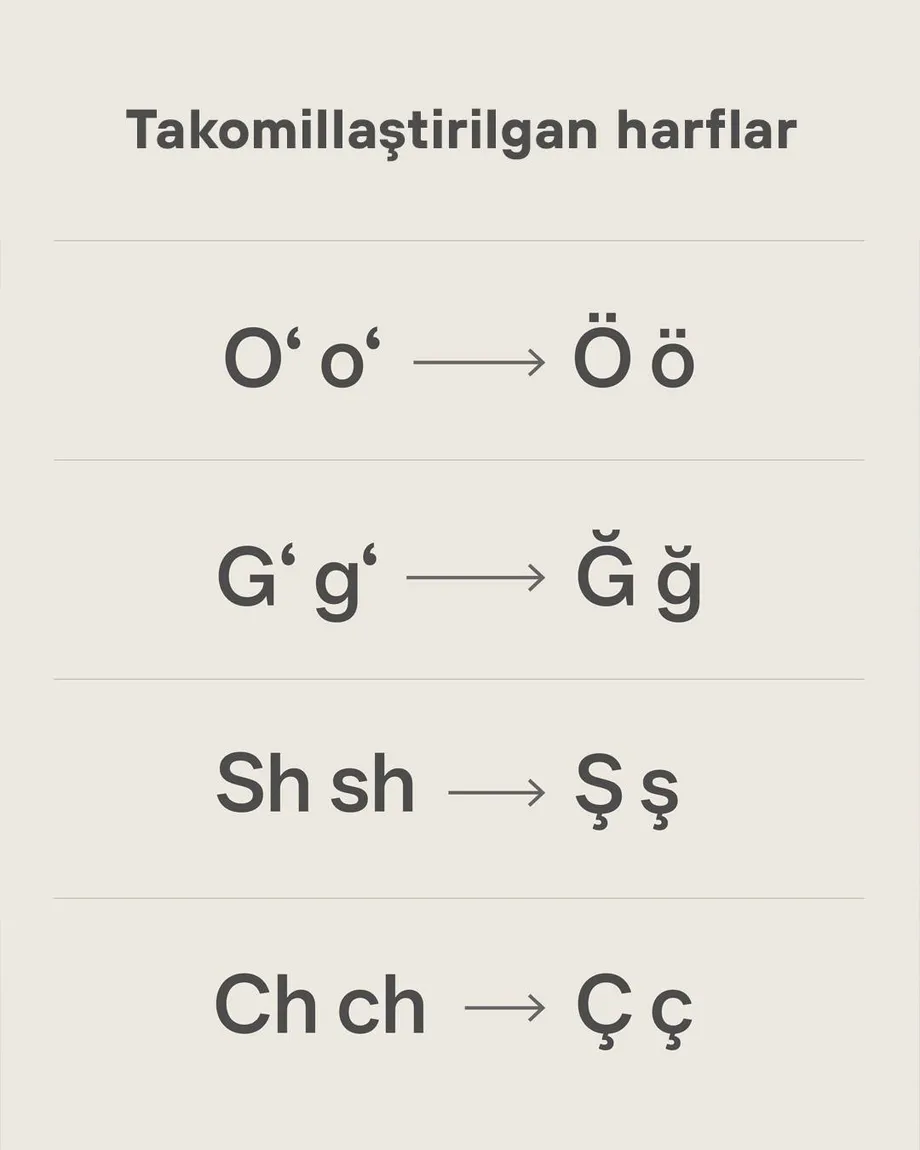
The revised alphabet will contain 28 letters and an apostrophe, also called the tutuq sign. The letters Ö, Ğ, Ş and Ç will replace Oʻ, Gʻ, Sh and Ch respectively. Ng will cease to count as a separate letter in the alphabet.
For families, schools and businesses, the transition will take place over several years rather than through an immediate replacement of everything printed in Uzbek. School textbooks are scheduled to begin changing in 2027, starting with first graders, with the transition across all grades planned for completion by 2031.
Saida Mirziyoyeva, head of the Presidential Administration, announced the signing and linked the changes to years of public debate about the writing system. She said the revision was intended to address shortcomings in the existing alphabet, improve literacy among young people and strengthen the use of Uzbek in digital communication.
The government must develop and approve an implementation programme within two months. That programme will help determine how public institutions move to the revised alphabet, including the deadlines for replacing some existing signs and other items.
The law brings together two different schedules: a legal starting date in April 2027 and a longer practical transition for books, signs and public displays. Readers will therefore continue to encounter older letter forms while replacements are introduced.
Which letters will change?
The revision changes how four letters are written, in both their capital and lowercase forms. Two changes replace pairs of letters with single letters carrying marks; the other two replace letters written with an accompanying mark.
- Oʻ and oʻ become Ö and ö.
- Gʻ and gʻ become Ğ and ğ.
- Sh and sh become Ş and ş.
- Ch and ch become Ç and ç.
The marks attached to the new letters are called diacritics. They distinguish one letter from another. For example, O and Ö will both appear in the revised alphabet, as will G and Ğ.
The complete alphabet will be A, B, D, E, F, G, Ğ, H, I, J, K, L, M, N, O, Ö, P, Q, R, S, Ş, Ç, T, U, V, X, Y and Z. The tutuq sign will remain alongside those 28 letters.
The previous alphabet contained 26 letters and three letter combinations. Removing Ng as an independent alphabet entry changes that inventory, while replacing Sh and Ch with Ş and Ç gives each of those entries a single written character. The retained tutuq sign and the new letters with diacritics have separate places in the revised system.
Existing documents and money will stay valid
Documents issued before the law takes effect will remain valid even when they contain the previous letter forms. The same protection applies to national currency and securities, financial instruments that represent ownership or a claim to payment.
Mirziyoyeva addressed the concern that a new alphabet would force people to replace documents at their own expense. In her announcement, she explained the approach chosen by the authorities:
Will all documents now have to be replaced? Not at all. We have chosen an approach that keeps costs to a minimum: all existing documents, the national currency, and securities will remain valid, while textbooks, signs, and signposts will be replaced gradually as they reach the end of their service life
For residents, the central reassurance is straightforward: an older spelling on an existing document will remain acceptable under the transition rules. Currency already issued will also be able to remain in circulation.
Signs and public buildings will change in stages
Government bodies and organisations may continue using existing symbols and insignia containing older letter forms. The transition provisions also cover relief images of the state emblem on buildings, signs and nameplates identifying geographical places.
Those items may remain in use until they wear out or until a deadline set by the implementation programme. The Cabinet of Ministers will specify other items covered by the arrangements.
The programme therefore matters beyond the date when the law begins to operate. It will set out how institutions handle the physical work of changing the alphabet in public spaces, where lettering can be printed on a small plate or built into the surface of a building.
Mirziyoyeva presented gradual replacement as a way to keep costs down. Replacing a sign when it already needs renewal allows the new lettering to be introduced during work that would otherwise be necessary. A programme deadline could also require replacement before an item wears out.
No total transition budget has been announced in the details made public. The next practical step is approval of the government programme within the required two months.
Schools face a transition through 2031
School textbooks will begin switching to the revised alphabet in 2027. First graders are scheduled to receive the new versions first, with all grades expected to complete the change by 2031.
The education timetable stretches across five calendar years, from 2027 through 2031. It is longer than the interval before the law takes effect, giving the textbook transition its own schedule within the wider reform.
Children will encounter the revised forms in new learning materials while older books and public signs remain in use during the transition. Teachers will need to explain the relationship between familiar forms such as Sh and Ch and their replacements, Ş and Ç.
Mirziyoyeva said the revised alphabet would help improve literacy among young people. That is an educational goal of the reform; the immediate task for schools is to introduce the new forms through the planned sequence of textbook changes.
Why digital use is part of the reform
Uzbekistan's authorities have tied the alphabet revision to the practical demands of writing, searching for information and processing Uzbek text on computers. Supporters of the changes say the new forms will simplify those tasks.
A computer stores text as a sequence of characters. Sh, for example, is written using two letters, while Ş is a single letter. Oʻ and Gʻ also require an accompanying mark in their current forms. The revision gives each of these four alphabet entries a distinct letter form.
Consistent spelling matters when people search for names or when software compares text. If a word is entered using different character forms, a search system needs to recognise the alternatives to connect them. The reform's digital ambitions concern this everyday relationship between the written language and the tools people use to communicate.
The transition will also require attention to both old and new spellings. Documents remain valid in the earlier alphabet, while books and signs will change gradually. Organisations updating digital records and search tools will therefore have to account for the period when both sets of forms are in circulation.
The stated aim is easier use of Uzbek in the digital environment. The concrete changes announced so far concern the alphabet, its legal starting date and the arrangements for introducing it.
A writing reform shaped by decades of revisions
Uzbekistan's latest revision follows several changes of script. Latin writing officially replaced Arabic script in 1929. A switch to Cyrillic followed between 1940 and 1942, during the Soviet period.
After independence, parliament adopted the law introducing a Latin alphabet for Uzbek on September 2, 1993. That version contained 33 letters and an apostrophe, including letters with diacritics. Changes in 1995 replaced several marked letters with the forms Sh, Ch, Oʻ and Gʻ, and removed C.
The new alphabet brings back Ş, Ç and Ğ, which appeared in the original version adopted in 1993. For the letter now written Oʻ, the revised form will be Ö; the 1993 version used Õ.
Completion of the transition from Cyrillic to Latin was originally planned for 2000. Both scripts have continued to be used in Uzbekistan. The 2026 signing comes 33 years after the 1993 law and 26 years after that original completion target.
President Mirziyoyev signed a decree in October 2020 on developing the Uzbek language and improving language policy that envisaged completing the move to Latin writing. The latest law revises the Latin alphabet within that longer process.
From the Jadids conference to the new timetable
Mirziyoyeva proposed refining the alphabet on December 11, 2023, at a conference devoted to the legacy of the Jadids. The Jadids were Central Asian Muslim reformers and educators, and she connected the revision to their educational aspirations.
The Senate approved the revised legislation on September 10, 2026. Mirziyoyev signed it on October 21, a date chosen for its connection with Uzbek Language Day. The law takes effect six months after official publication, with April 22, 2027, identified as its starting date.
- September 2, 1993: Parliament adopts the law introducing a Latin alphabet for Uzbek.
- 1995: Revisions introduce several forms used in the current alphabet.
- October 2020: A presidential decree envisages completing the transition to Latin writing.
- December 11, 2023: Mirziyoyeva proposes refining the alphabet at the Jadids conference.
- September 10, 2026: The Senate approves the revised legislation.
- October 21, 2026: Mirziyoyev signs the law on Uzbek Language Day.
- April 22, 2027: The revised alphabet is due to take effect.
- 2027 to 2031: School textbooks are scheduled to move to the revised forms.
Mirziyoyeva acknowledged that changes to a writing system can cause concern, while describing the decision as a step in the development of the national language. Mirziyoyev also marked Uzbek Language Day with a greeting calling for greater respect for Uzbek internationally and a larger role for the language in international dialogue.
The immediate work now falls to the government programme and the institutions responsible for introducing the new forms. Its central challenge is practical: putting the revised alphabet into everyday use while keeping existing documents valid and replacing printed materials in stages.
Key Points
- The revised Uzbek Latin alphabet is due to take effect on April 22, 2027.
- Ö, Ğ, Ş and Ç replace Oʻ, Gʻ, Sh and Ch.
- The alphabet will contain 28 letters and a tutuq sign; Ng will no longer be a separate letter.
- Existing documents, national currency and securities will remain valid.
- Signs and public symbols may remain until worn out or until a programme deadline.
- The government must approve an implementation programme within two months.
- School textbooks will begin changing in 2027, starting with first graders, with completion planned by 2031.