Two new machines take on trees and heavy railway equipment
West Japan Railway Company is introducing two maintenance robots with different strengths: one can grip equipment weighing up to 120 kilograms, while the other reaches 15 metres above railway tracks to cut back trees. The machines are intended to reduce dangerous work at height and help maintenance crews complete jobs with fewer people.
Contents
- Two new machines take on trees and heavy railway equipment
- A lighter humanoid reaches three metres farther
- The single arm handles heavier components
- What a 30% staffing target means
- Human operators remain in control
- Safety is the main operational goal
- From the first robot to deployment on operating lines
- Tree clearance connects maintenance with reliable services
- More tools and possible work beyond railways
- Key Points
JR West announced the expansion of its ZIZAI programme on October 16, 2026. A robot with one arm is scheduled to begin work in the Kinki region during October, followed in November by a smaller, lighter humanoid machine, initially focused on the Chugoku region of western Japan.
The company's October 16 announcement sets a target of reducing the personnel needed for relevant tasks by about 30%. JR West also wants to prevent falls and electric shocks, reduce physical strain and make maintenance work accessible to employees across different ages and genders.
The new equipment builds on a humanoid railway maintenance machine that entered service in July 2024. Both new robots remain under continuous human control, with operators using camera views to guide work from the ground.
A lighter humanoid reaches three metres farther
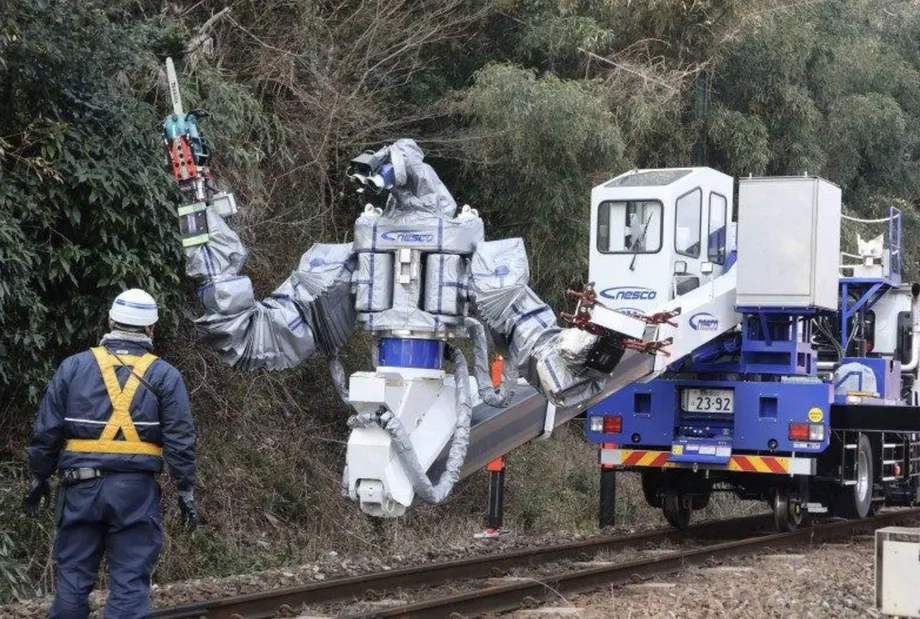
The new humanoid, identified as the ZX-3, weighs about 300 kilograms, roughly half the weight of its predecessor. Its supporting boom, the extending structure that positions the robot above the railway, has grown from 12 metres to 15 metres.
Those figures represent a 50% reduction in the robot's weight and a 25% increase in reach. JR West has also made components smaller and improved the machine's rigidity, allowing it to work in tighter spaces and tackle more precise tasks.
The robot has two arms and a head fitted with cameras. For tree work, one arm can hold vegetation while the other uses a chainsaw attachment. Its reported gripping capacity is 20 kilograms per arm.
Interchangeable tools allow the humanoid to take on other work, including painting. The immediate deployment is aimed at trees and branches that interfere with train operations, giving crews a way to reach vegetation that would otherwise require people to work high above the tracks.
The single arm handles heavier components
The second machine, identified as the ZX-2, is mounted on the deck of an aerial work vehicle. Its single arm can grip a load of up to 120 kilograms and assist workers handling heavy parts around overhead electrical equipment.
Overhead wires supply electricity to trains and must remain properly supported and positioned. Replacing their fittings can involve lifting substantial components while keeping other equipment temporarily supported. The robot can take over lifting, lowering and temporary support duties that would otherwise demand considerable physical effort from workers.
A demonstration in Suita, Osaka Prefecture, on October 14 showed the single arm machine replacing a movable bracket, a device that supports the overhead wire system. Three workers completed the simulated replacement in about 30 minutes, compared with five workers for the manual method.
The completion time was approximately the same as for manual work. The practical gain in that demonstration was doing the job with two fewer people while transferring heavy handling to the machine.
What a 30% staffing target means
JR West's ambition is to reduce the number of people required for relevant maintenance tasks by about three in ten. Actual crew requirements depend on the job, the equipment and the conditions at each site.
The bracket replacement demonstration reduced the crew from five people to three, a 40% reduction. For tree cutting with the new humanoid, the expected change is from four workers to three, a 25% reduction. Those examples show why a single company target can cover tasks with different staffing needs.
Earlier applications of the original humanoid also produced different crew arrangements. Painting posts supporting overhead wires required three workers instead of five, while a tree cutting task required two instead of three. The newer four to three estimate concerns the planned work with the updated machine.
The 30% figure remains JR West's target for the programme. The company has not published results covering sustained operation of both new models across its maintenance network. For crews, the immediate change is a redistribution of work: people continue to operate the machinery and manage the site, while robotic arms undertake cutting or heavy handling.
Human operators remain in control
Both new machines use teleoperation, meaning a person controls their movements in real time from another position. Cameras let the operator see the work area from the robot's perspective, including equipment or branches high above the track.
The earlier humanoid used a headset to show the camera view and a specially designed joystick to move its arms. The joystick conveyed the sensation of holding a heavy object, giving the operator feedback about the load being handled.
The approach combines human judgement with mechanical strength and reach. A worker directs the task while the robot carries the tool or component into position. Neither new machine operates independently.
Developer Jinki Ittai has previously described autonomous operation as a possibility as artificial intelligence develops. The October and November deployment instead centres on machines controlled continuously by people, making operator training a central part of their introduction.
Safety is the main operational goal
JR West identifies falls and electric shocks as specific risks it wants to reduce by mechanising work at height. Railway maintenance can place workers above ground near electrical equipment while they handle tools and heavy parts.
The robots move some of those demanding actions away from workers' bodies. A robotic arm can hold a component during replacement, while the humanoid can carry a cutting tool to a branch above the line. Workers still have to direct the operation and coordinate the maintenance task.
When the earlier humanoid was introduced, JR West President Kazuaki Hasegawa described the safety benefit the company expected:
It will be a huge help in preventing work-related accidents that involve workers getting electric shocks or falling (from heights), and thereby improve safety,
The 2026 announcement carries that objective into the expanded programme. It also connects lighter physical workloads with a broader pool of employees able to participate in maintenance, rather than making strength or the ability to perform demanding work at height the deciding requirement.
From the first robot to deployment on operating lines
JR West developed the machines with partners including robotics company Jinki Ittai, based in Kusatsu in Shiga Prefecture, Nippon Signal and railway vehicle manufacturer Toyo Sharyo. The name ZIZAI refers to freedom or flexibility of movement.
The machines are carried on vehicles that can travel on roads and enter railway tracks. JR West plans to introduce one of each new model during October and November, using them progressively for maintenance on operating railway lines.
- July 2024: JR West introduced the first ZIZAI multifunctional railway maintenance machine.
- October 14, 2026: A demonstration in Suita showed the new single arm robot replacing an overhead wire support bracket.
- October 16, 2026: JR West formally announced the two new models.
- October 2026: The single arm robot is scheduled to start work in the Kinki region.
- November 2026: The production humanoid is scheduled to begin work, mainly in the Chugoku region.
The initial humanoid deployment had focused on the Keihanshin area, covering Kyoto, Osaka and Kobe. The new schedule extends the programme geographically while adding a machine designed specifically for heavier equipment.
Tree clearance connects maintenance with reliable services
JR West lists the removal of obstructing trees as part of its effort to maintain safe and stable train services. Vegetation extending into the space needed by trains or railway equipment creates work that must be addressed along the line.
The new humanoid's longer reach is directly tied to that task. An extra three metres allows crews to reach higher branches, while the smaller body helps position the machine in confined locations. The chainsaw attachment turns that reach into a tool for clearing vegetation.
The programme also responds to labour shortages. Completing a tree cutting job with three people instead of four can reduce the staffing required for that operation, while the single arm machine offers a similar benefit for equipment replacement. JR West is pursuing both safer work and more manageable staffing demands as it expands use of the robots.
More tools and possible work beyond railways
JR West plans to continue developing dedicated tools and widen the range of railway jobs the machines can perform. Interchangeable attachments are central to that approach: a robot that can change tools can be assigned more than one kind of maintenance task.
Motohiro Yuasa, a manager in JR West's electrical engineering operations, has said the company wants workers to improve their operating skills through practical use at maintenance sites. Experience with positioning, gripping and tool handling will help determine which jobs can be added.
JR West President Shoji Kurasaka has also outlined an ambition to take the technology into maintenance of tunnels, roads and other infrastructure, with the possibility of creating a new revenue source. Earlier plans included lending or selling robots for railway work, replacing roadside traffic signals and cleaning tunnel ceilings.
The company's formal announcement commits to expanding applicable tasks and developing specialised tools, while using railway experience to contribute to wider infrastructure maintenance. JR West also places the initiative under United Nations Sustainable Development Goals 8 and 9, covering decent work and economic growth, and industry, innovation and infrastructure.
Key Points
- JR West announced two new ZIZAI railway maintenance robots on October 16, 2026.
- The single arm ZX-2 can grip up to 120 kilograms and is scheduled for deployment in Kinki during October.
- The humanoid ZX-3 weighs about 300 kilograms and reaches 15 metres, compared with 12 metres for the earlier model.
- The humanoid is scheduled to begin work in November, mainly in the Chugoku region, clearing trees that obstruct railway operations.
- Both machines remain continuously controlled by human operators.
- JR West targets about 30% fewer personnel for relevant tasks, alongside reduced physical strain and risks of falls and electric shocks.
- Further development will focus on additional tools, more railway applications and possible work on other infrastructure.