Fifteen organizations join a push to turn AI plans into working systems
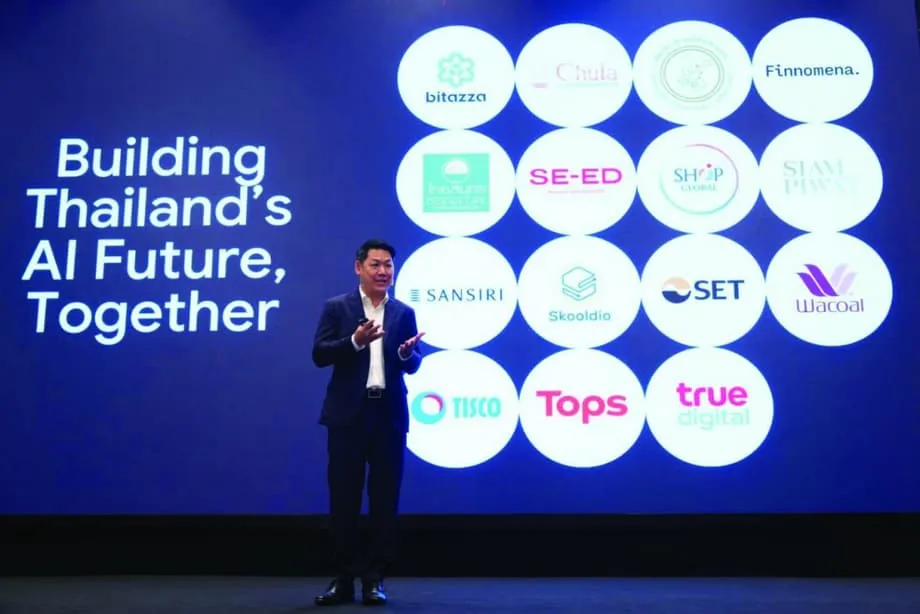
Google Cloud has launched PanyaThAI with 15 Thai organizations to speed the adoption of agentic artificial intelligence across finance, retail, education, manufacturing, media and real estate. The flagship program brings corporations, a university and consulting partners together to move AI projects from trials into everyday business operations.
Contents
- Fifteen organizations join a push to turn AI plans into working systems
- What makes an AI agent different?
- The models and tools behind the program
- Who is taking part, and who will help deliver it?
- SE Education puts intent at the center of search
- Thai Wacoal prepares a new way to create product media
- Trust, usable data and skills are the main obstacles
- Returns depend on how work changes
- Local infrastructure and the dates to watch
- Key Points
The opportunity is substantial. Research by Public First estimates that effective use of AI could add about 730 billion baht, or around US$21 billion, to Thailand's economy by 2030. PanyaThAI aims to help capture that opportunity and position Thailand as a regional leader in putting AI to practical use.
SE Education already offers an example of what that can mean for a business. Its online marketplace introduced an AI search agent that understands what shoppers are looking for, rather than simply matching words. Early results show its conversion rate, the share of visits that lead to a purchase, rising from 12 percent to 27 percent.
Thai Wacoal is pursuing a different application: generating realistic apparel images and videos from a single base photography session. Its creative agent is planned to go live in the first quarter of 2026, supporting faster product launches and a shift toward production based on customer orders.
As of November 28, 2025, the initiative sits alongside Google's US$1 billion investment in a Thai data center and a new cloud region, as well as support for the TalayLink subsea cable connecting Thailand and Australia. More than 50,000 people in Thailand have completed Google supported AI training, and 3,000 free online AI classes are available to widen access.
PanyaThAI combines these strands through practical support: choosing useful business problems, building systems around company data, training employees and measuring results. Its central challenge is to make AI dependable enough for organizations to use beyond a demonstration.
What makes an AI agent different?
Agentic AI describes a system that can plan steps, use tools and take actions toward a goal. A conventional interaction might involve asking an AI system a question and receiving an answer. An agent can carry that work through several connected tasks.
A sales agent, for example, could search a product catalog, write a summary, draft an email, update a customer relationship management system, or CRM, and schedule a follow up. An operations agent might reconcile documents, check inventory and initiate a purchase order.
Company rules and controls are central to these workflows. Agents need guardrails, meaning limits on what they can do, and governance, meaning clear arrangements for oversight and accountability. Teams also need to trace how a result was produced and whether an action followed company policy.
PanyaThAI provides a transformation blueprint with practical support. Participants jointly develop AI roadmaps, select business uses with high potential value and build open, interoperable solutions on Google Cloud. Interoperability means that systems can connect and work together, allowing an agent to use information and tools across enterprise applications.
Google Cloud's approach puts responsible AI, security and clear performance measures at the center of this work. Leaders can use those measures to track results and decide which applications should expand. The aim is to connect an organization's knowledge of its own industry with the technical ability to build and operate AI.
The models and tools behind the program
PanyaThAI members gain access to Google Cloud's full technology stack. Vertex AI provides tools to build and run models, while Gemini supports multimodal reasoning, or working with different forms of information rather than text alone.
The available tools include Gemini 2.5 Computer Use for calling tools, Gemini 3 and Gemini 3 Pro Image for image and text tasks, and Veo 3.1 for advanced media generation. These capabilities support applications ranging from searching business information to creating visual content.
Google Workspace and Customer Engagement Suite help organizations bring AI into daily collaboration and customer interactions. The technology stack is designed to let agents read company documents, connect to enterprise applications and produce outputs grounded in verified business data.
Grounding gives an AI system a factual reference for its work. Instead of relying only on information learned during its development, an agent can draw on company records relevant to the task. PanyaThAI combines that technical capability with security and operating rules so organizations can decide how information is accessed and used.
Who is taking part, and who will help deliver it?
The 15 launch members cover major parts of Thailand's economy. Their participation brings retail and manufacturing projects into the same initiative as financial services, education, digital businesses and real estate.
- Bitazza
- Chulalongkorn University
- Dhipaya Group Holdings
- Finnomena
- Ocean Life Insurance
- SE Education
- Shop Global E Commerce
- Siam Piwat
- Sansiri
- Skooldio
- The Stock Exchange of Thailand
- Thai Wacoal
- TISCO Financial Group
- TOPS
- True Digital Group
Accenture, Deloitte, Digithun Worldwide, HoriXonT8, MFEC, NTT DATA, Skooldio and Tridorian will support implementation and skills development. Their role includes helping organizations turn business priorities into working systems and preparing employees to use them.
NTT DATA plans to certify 300 more Thai professionals in data analytics, AI, cybersecurity and application modernization. The last area involves updating existing applications so they can work with newer technologies and business requirements.
Chulalongkorn University and the Stock Exchange of Thailand bring participation from academia and capital markets. Universities and research centers are training the next generation of practitioners, while major enterprises are setting the pace with early production systems in commerce, finance and manufacturing.
SE Education puts intent at the center of search
SE Education rebuilt product discovery on its online marketplace with a generative AI search agent developed with Digithun Worldwide. The system searches a large library of books and study materials by interpreting the shopper's intent, rather than depending only on exact keywords.
The agent uses Gemini Embeddings and Gemini 2.5 Flash to understand conceptual queries and return relevant results. Embeddings help connect a query with material that has a related meaning, making the search closer to asking a librarian for guidance than checking whether identical words appear in a catalog.
Early figures show conversion rates rising from 12 percent to 27 percent, an increase of 15 percentage points. The new rate is 2.25 times the earlier rate. Bounce rates, which track visits that end without further engagement, and cart abandonment also decreased.
SE Education's experience illustrates a specific business use for AI: helping people find suitable content faster. The agent acts as an AI librarian, connecting what a shopper means with the books or learning materials that may meet that need.
Thai Wacoal prepares a new way to create product media
Thai Wacoal is rolling out a creative agent that generates photorealistic apparel images and videos showing products through 360 degrees. Developed with Tridorian using Google Cloud's generative media models, the system can produce multiple color versions from a single base photography session.
The agent grounds its output in Thai Wacoal's own color standards to support accuracy. For apparel, that connection matters because the generated media must reflect the colors the company uses for its products.
Thai Wacoal expects the approach to reduce repeated photography sessions and speed up online product launches. It also supports a move toward making products to order, connecting the creation of product media with a broader change in how the manufacturer serves demand.
The planned launch is in the first quarter of 2026. As of November 28, 2025, SE Education's reported search results and Thai Wacoal's scheduled deployment represent different stages of the program's practical applications: an operating retail tool and a manufacturing capability being prepared for release.
Trust, usable data and skills are the main obstacles
Thai organizations face three recurring problems when adopting AI. Leaders want factual, trustworthy responses; many businesses lack data that is clean, structured and accessible enough for AI to use; and there is a shortage of workers with suitable data and AI skills.
PanyaThAI addresses these problems by combining technology with governance and training. Its approach calls for grounding model outputs in verified company data, applying strict access controls and maintaining full traceability.
In practice, an agent retrieves current facts from corporate systems, cites its sources and follows business rules before drafting an answer or taking action. Connecting AI to an organization's records reduces hallucinations, the term for plausible sounding but incorrect outputs, while helping build confidence and making audits easier.
Google supported training has already reached more than 50,000 people in Thailand. Alongside the 3,000 free online AI classes, partners will provide practical courses through platforms including Google Skills and ChaiyoGCP.
Consulting teams will help technology departments and business units jointly design processes. Models, data pipelines and policies need to fit the way a company operates. A data pipeline is the process that moves and prepares information for use by another system.
The workforce goal is to develop people who understand both their industry and AI. That combination allows staff to identify useful applications, work with technical teams and judge results, supported by a growing local community of certified professionals.
Returns depend on how work changes
Google Cloud says companies using its AI stack have achieved an average return on investment of 727 percent over three years, with an average payback period of eight months. Return on investment compares the benefit of an investment with its cost; the payback period describes how long it takes to recover that cost.
Separate surveys show many executives reporting revenue growth of 6 to 10 percent from enterprise AI deployments. Budgets are increasingly concentrating on unified agentic platforms that can coordinate several business uses, rather than isolated trials.
Accenture Thailand's research finds that organizations can unlock productivity improvements ranging from 3 to 77 percent with AI. Reaching the higher end requires redesigning workflows from beginning to end, including supply chain and vendor management.
Companies therefore need to map how agents pass work to employees and other systems, then measure the resulting changes in quality, speed and cost. An improvement in one task becomes more useful when the surrounding process can carry it through to a business result.
Leadership commitment also shapes adoption. True Corporation's strategy centers on using data to make fast decisions based on evidence. MFEC's leadership stresses helping organizations harness AI while retaining control over how it is used.
TISCO Financial Group has deployed AI coaches to help employees improve sales performance. The example shows how a focused agent can support daily work, alongside the broader ambition to coordinate AI across departments.
Local infrastructure and the dates to watch
Google's US$1 billion investment in a Thai data center and new cloud region provides another part of the foundation for adoption. A cloud region supplies computing resources from a particular location. Local capacity can shorten response times and support availability for important systems.
AI training and inference, the process of running a model to produce a result, benefit from low latency and high bandwidth. Low latency means less delay; high bandwidth means more data can move through a connection. These qualities matter for services such as AI search and generative media.
A Thai cloud region can also support data residency controls, allowing organizations to manage where their information is stored or processed in line with expectations from some regulators and company boards.
TalayLink will create a new subsea route between Australia and Thailand through the Indian Ocean. New connectivity hubs in Western Australia and South Thailand will connect to Google's global network, adding capacity and resilience for international data flows. Local computing and additional routes aim to make demanding AI workloads easier to run and provide faster responses across Southeast Asia.
Thailand's digital strategy is also pushing toward stronger cloud adoption and public services prepared to use AI. As infrastructure and skills expand, small and medium sized businesses are positioned to benefit from existing solutions adapted to their needs. Responsible AI practices, sound data governance and clear measurement remain central to expanding successful applications and correcting those that fall short.
The schedule combines an immediate program launch, a named product deployment target and a longer economic horizon:
- November 28, 2025: PanyaThAI brings together 15 launch members, consulting partners and existing Google supported training efforts.
- First quarter of 2026: Thai Wacoal plans to put its creative agent into operation.
- The following 12 to 18 months: The pace of moving agentic AI projects from trials into production will be a focus across Thai industry.
- 2030: Public First's estimate places the potential economic contribution from effective AI use at about 730 billion baht, or US$21 billion.
No completion dates were given for the Thai cloud region or TalayLink. The next developments to watch include expanded partner certifications, adoption among the 15 charter members, further projects in retail, banking and insurance, and a shift from agents handling individual tasks to enterprise platforms coordinating work across departments.
Key Points
- PanyaThAI brings 15 organizations into a Google Cloud program to move agentic AI into everyday business operations.
- Public First estimates that effective AI use could add about 730 billion baht to Thailand's economy by 2030.
- SE Education's early conversion rate rose from 12 percent to 27 percent after introducing AI search.
- Thai Wacoal plans to launch its creative agent in the first quarter of 2026.
- Google is investing US$1 billion in a Thai data center and cloud region and supporting the TalayLink cable.
- More than 50,000 people have completed Google supported AI training in Thailand, with 3,000 free online classes available.
- NTT DATA plans to certify 300 more Thai professionals across data, AI, cybersecurity and application modernization.
- Trustworthy responses, usable company data, employee skills and measurable results are central to the program.