At least 20 Japanese events disrupted as tensions grow
At least 20 Japanese concerts, live performances and fan meetings have been canceled or postponed across major Chinese cities in recent weeks, as a dispute over Taiwan spreads into entertainment, tourism and trade. As of November 28, 2025, several Japanese film releases have also been delayed, and new approvals appear to be on hold.
Contents
- At least 20 Japanese events disrupted as tensions grow
- Why Takaichi's Taiwan remarks triggered a confrontation
- How the dispute reached audiences
- Japanese films face delays after a strong start
- The 168.9 billion yuan merchandise market
- Why the Korean entertainment freeze matters
- Seafood imports become another pressure point
- Travel warnings bring cancellations and spending risks
- Online debate narrows as fans react
- What could happen next
- Key Points
For fans of Japanese singer and songwriter Kokia, the disruption became personal on November 19. Her Beijing concert was canceled just as the audience expected it to begin. Fans waited outside the venue before learning that the performance would not go ahead. One Beijing office worker booked a flight at the last minute to Guangzhou to attend a weekend performance instead.
The cancellations follow remarks by Japanese Prime Minister Sanae Takaichi that an attack on Taiwan could pose an existential threat to Japan, potentially opening the way for a deployment of Japan's Self Defense Forces. Beijing condemned the remarks and demanded that she withdraw them.
China has announced no formal nationwide ban on Japanese entertainment. Fans and businesses are instead facing a series of abrupt decisions affecting individual concerts, cinema schedules and permissions. Some performances that had passed months of content review have still been stopped shortly before they were due to begin.
The disruption reaches into a substantial consumer market. Research firm iiMedia estimates that China's market for merchandise associated with anime, comics and games reached 168.9 billion yuan in 2024, more than 40 percent above its 2023 level. Beyond Japanese artists and studios, Chinese promoters, cinema operators, shops and workers depend on that spending.
Why Takaichi's Taiwan remarks triggered a confrontation
Takaichi's comments in early November departed from the caution Japanese leaders had previously shown when discussing a possible Taiwan conflict. That approach, known as strategic ambiguity, left uncertain precisely how Japan might respond.
Japan's security law allows the use of force in collective self defense when a situation threatens the country's survival. Collective self defense means using force to help defend another country under the conditions set by that law. By describing a severe Taiwan crisis as a possible threat to Japan's survival, Takaichi connected such a conflict to that legal threshold.
Beijing considers Taiwan part of China and denounced her statement. The confrontation comes as Japan deepens defense cooperation with the United States and strengthens missile defenses near sensitive waterways.
Japan's recent deployment of missiles with medium range capability to Yonaguni, the Japanese island closest to Taiwan, has also drawn concern. Chinese officials argue that Japanese leaders' statements and new defense moves risk destabilizing the Taiwan Strait.
Travel warnings, import measures and event cancellations have widened the dispute beyond diplomatic exchanges. Cultural businesses are particularly exposed because concerts and film releases depend on permissions that can be tightened or withdrawn quickly, sometimes with little public explanation.
How the dispute reached audiences
November's developments have unfolded across diplomacy, live entertainment and discussions about wider cultural exchange. The main events and reference points include:
- In 2016, China's restrictions on Korean entertainment began after the deployment of a US missile defense system in South Korea.
- In early November 2025, Chinese and South Korean leaders indicated that they would explore more cultural cooperation.
- Also in early November, Takaichi described a severe Taiwan crisis as a possible threat to Japan's survival, prompting Beijing's condemnation and demand for a retraction.
- On November 19, Kokia's Beijing concert was canceled just as fans expected the performance to start.
- By November 28, at least 20 Japanese concerts, live performances and fan meetings had been canceled or postponed across major Chinese cities in recent weeks.
Promoters describe disruptions ranging from small club performances to concerts of a moderate size. In Beijing, a Japanese jazz group's performance was stopped during sound check after a plainclothes officer visited the club, according to organizers. The venue then cited police instructions.
Club managers later described the cancellation as force majeure and offered refunds. Force majeure refers to circumstances outside an organizer's control that prevent an event from taking place. Kokia's Beijing concert had been called off the night before.
Christian Petersen Clausen, a concert agent who arranges shows across China, described the message he received inside a venue as cancellations spread:
After less than one minute, the venue owner came to me and said the police told him all concerts with Japanese people are canceled, and there is no discussion.
Clausen said some performances had already completed months of content review before being halted. Organizers say this uncertainty is discouraging international bookings and could cool investment in live events.
Japanese films face delays after a strong start
Chinese cinema schedules are also changing. Industry trackers say authorities have paused new approvals for Japanese films and delayed several titles that had already cleared earlier stages of the release process.
New entries from Crayon Shin Chan and Cells at Work have been pulled from cinema listings. Organizers have also mentioned the Detective Conan feature The Time Bombed Skyscraper among postponed projects. Fans expecting Japanese releases this winter are finding films absent from schedules or waiting without a new date.
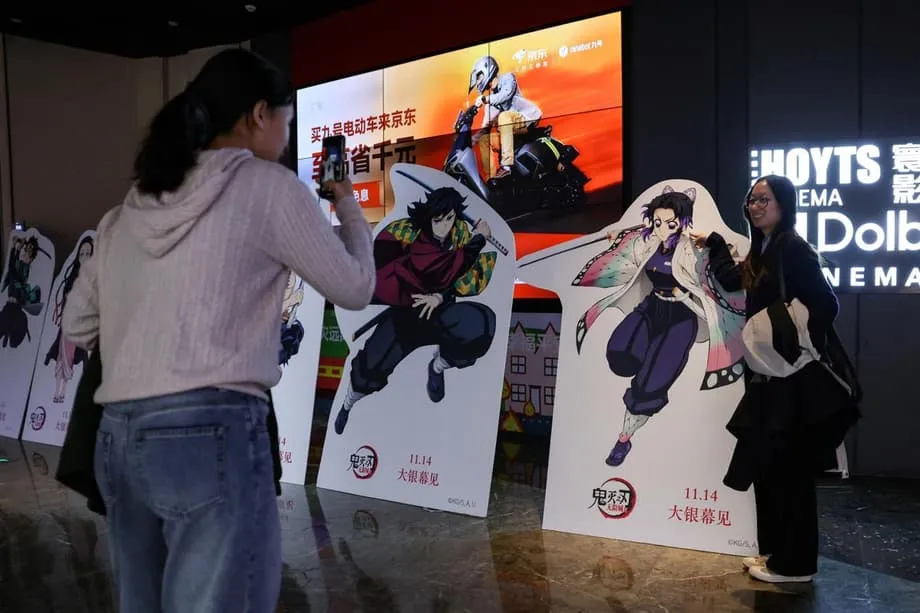
The interruptions follow what initially looked like a strong year for Japanese content in China. Demon Slayer Infinity Castle packed cinemas in Guangzhou and recorded one of the strongest openings by a foreign title this year.
Japanese anime became an important source of foreign entertainment in China after Korean entertainment faced sustained restrictions. Japanese studios, distributors and holders of licensing rights, including Sony and Sanrio, have looked to Chinese audiences for growth beyond Japan's shrinking domestic market.
Cinemas and distributors now describe an unpredictable approval process. A release that once appeared secure can stall, leaving businesses unable to plan ticket sales, advertising or related merchandise with confidence.
The 168.9 billion yuan merchandise market
China's appetite for Japanese culture extends well beyond cinema tickets and concerts. Young consumers buy collectible acrylic stands, badges, themed clothing and cards linked to anime, comics and games. These purchases support retailers, licensing businesses and events built around familiar characters.
iiMedia puts the value of this goods market at 168.9 billion yuan in 2024, with growth of more than 40 percent from 2023. Its projections place the market above 300 billion yuan by 2029. Those figures help explain why restrictions on cultural events matter to businesses far removed from the stage or screen.
Malls in major cities have used temporary anime shops and themed events to attract visitors. Shanghai has become a major center for performances and exhibitions involving Japanese creators. A popular film or visiting artist can therefore support spending across several businesses at once.
Film delays can force licensing companies and retail partners to postpone products tied to new characters and story developments. Fewer concerts and fan meetings also mean less work for stage crews, translators, promoters and nearby vendors.
Small and midsize performances support local stagehands, drivers, caterers and ticketing teams. When a show is canceled, those workers can lose shifts along with the artist losing a performance and the audience losing an evening out.
Many fans fear more than missing a particular release. Their concern is that access could gradually narrow until a familiar part of everyday life becomes difficult to enjoy. The office worker who flew from Beijing to Guangzhou to see Kokia reflects how far some are already willing to travel to keep that connection.
Why the Korean entertainment freeze matters
China's restrictions on Korean entertainment began in 2016 after the deployment of a US missile defense system in South Korea. Most Korean television dramas and films subsequently stopped clearing Chinese broadcast reviews, while large concerts largely disappeared from mainland schedules.
The restrictions operated through a strict review environment rather than a single law. Industry figures in both countries continued to describe only limited openings for artists years later, with opportunities appearing when the broader political relationship improved.
That experience offers a relevant comparison for Japanese entertainment businesses now facing delayed approvals and canceled performances. Decisions taken through reviews and permissions can restrict access for a long time, even without a widely announced ban.
Chinese and South Korean leaders indicated in early November that they would explore greater cultural cooperation. Those signals show how entertainment ties can become part of diplomatic efforts to improve relations after a prolonged freeze.
For Japan's cultural industries, the Korean experience points to two possibilities: restrictions can outlast the immediate dispute, and they can ease when political leaders see a reason to restore exchanges. Businesses trying to plan future releases and tours must account for both.
Seafood imports become another pressure point
Beijing has also reimposed a suspension on imports of Japanese seafood. Officials cited the need for further monitoring related to treated water from the Fukushima nuclear plant, while criticism of Japanese leaders over Taiwan formed the political backdrop.
Chinese Foreign Ministry spokesperson Mao Ning addressed the market environment for Japanese aquatic products at a press briefing:
There is no market for Japanese seafood in the current climate.
The seafood suspension places trade alongside cultural exchange and tourism among the areas affected by worsening relations. Each involves businesses that rely on access to consumers across the two countries.
Japanese companies now face uncertainty over several kinds of demand at once: purchases of imported food, visits by Chinese tourists, and spending on entertainment and licensed products. Chinese businesses that distribute those products or serve those audiences are also exposed.
Travel warnings bring cancellations and spending risks
China's embassy in Japan has advised Chinese citizens to avoid visiting for now. Major airlines have offered full refunds and free changes for flights to Japan through the end of the year, making it easier for travelers to cancel or postpone their plans.
Airlines and travel platforms have recorded a wave of cancellations. Industry tallies indicate that more than half a million tickets to Japan were canceled after the warnings. Shares linked to tourism in Tokyo fell following the news.
Analysts estimate that reduced travel by Chinese visitors could cut spending in Japan by at least $500 million before the end of the year. The loss could exceed $1.2 billion if the trend continues.
Chinese travelers are among the highest spending visitors in many Japanese cities and regions. Hotels, restaurants and retailers can feel the effects quickly when tour groups and cruise stops disappear. Delayed business trips can add to the decline.
Economists differ on the potential size of the wider economic loss. One investment house estimated that worsening tensions could reduce Japan's gross domestic product by around 0.29 percent. Gross domestic product measures the value of goods and services produced in an economy.
Other estimates, drawing on past disputes, suggest that canceled group tours, postponed business travel and weaker retail spending could together produce losses running into trillions of yen. The immediate problem for businesses is the speed of the change, as travel plans and expected customer spending fall away.
Online debate narrows as fans react
Chinese social platforms have removed posts that do not align with official guidance. Users who wrote about canceled trips to Japan, or questioned whether politics should stop ordinary travel between the countries, found their posts deleted.
Videos showing disappointed fans outside postponed concerts have also vanished. Platforms are enforcing rules against content viewed as harmful to national interests, while authorities call for unity over disputes involving Taiwan.
Nationalist sentiment is visible among users who support measures targeting Japanese cultural exports. They argue that Japanese politicians crossed a red line. Other fans say they intend to keep enjoying Japanese art and entertainment privately, even if live performances become difficult to attend.
The removal of posts narrows the public discussion. Gauging how many people favor tougher restrictions and how many prefer normal cultural exchange becomes harder when some expressions of disappointment or disagreement disappear.
For fans, the practical response varies. Some are looking for performances in other cities, as the Kokia audience member did. Others are preparing to continue their interests privately while waiting for public events and releases to resume.
What could happen next
Specialists in China and Japan relations describe the outlook as more fragile than it was a few months ago and expect restrictions on live performances and film releases to continue in the short term. Whether these measures develop into a lasting system resembling the Korean entertainment freeze is undecided. No timetable for a broad resumption has been announced.
Military and diplomatic developments around Taiwan will be central to how the dispute develops. Political leaders' willingness to reduce tensions will also shape the environment for cultural exchange.
Consumer boycotts of Japanese brands could grow if patriotic campaigns expand, although widespread boycotts have not yet emerged. Further trade measures could take the form of product safety reviews or regulatory investigations.
Restrictions on rare earth exports are often discussed as a possible source of bargaining power in disputes. Sweeping limits would also impose costs on Chinese producers and global supply chains. Japan is diversifying its supply lines and strengthening security ties with allies, steps that can reduce its exposure over time.
The effects within China remain uneven. Beijing has experienced more abrupt cancellations than some coastal cities. Small and midsize concerts face heavier scrutiny, while a few larger performances have proceeded.
Ticketing platforms, mall operators and other entertainment businesses are adjusting plans in case the disruption lasts into 2026. For now, audiences face canceled performances and uncertain cinema schedules, while businesses on both sides of the relationship face losses that extend well beyond Japanese artists alone.
Key Points
- At least 20 Japanese concerts, live performances and fan meetings have been canceled or postponed across major Chinese cities in recent weeks.
- The disruption followed Prime Minister Sanae Takaichi's remarks about a possible Japanese military response to a severe Taiwan crisis.
- Several Japanese films have been delayed or removed from listings, and new approvals appear paused. No formal nationwide entertainment ban has been announced.
- China's merchandise market associated with anime, comics and games reached 168.9 billion yuan in 2024, according to iiMedia.
- Beijing has reimposed a suspension on Japanese seafood imports and advised Chinese citizens to avoid travel to Japan for now.
- Industry tallies indicate that more than 500,000 tickets to Japan were canceled after the travel warnings.
- Analysts estimate at least $500 million in lost Japanese visitor spending before the end of the year, potentially exceeding $1.2 billion if the decline continues.
- Restrictions remain uneven, with some larger shows proceeding while smaller performances and film schedules face disruption.