A construction pause with global consequences
China's proposed Circular Electron Positron Collider, a ring stretching roughly 100 kilometers, has been left out of the country's next national five year plan, covering 2026 to 2030. As of December 3, 2025, officials and senior scientists describe the decision as a pause, not a cancellation. Design work and research continue, but there is no construction timeline.
Contents
- A construction pause with global consequences
- What scientists wanted from CEPC
- One tunnel, two stages of research
- The design milestones already reached
- Why the budget became harder to secure
- Europe has an opening, not an approval
- Japan and the United States have other options
- Research continues during the pause
- The pause reaches careers and suppliers
- Electricity and the environment shape the decision
- Other experiments can keep the field moving
- What to Know
The project, known as CEPC, was intended to become a Higgs factory, producing large numbers of Higgs bosons so scientists could measure their properties with exceptional precision. Its delay changes the competition to build the next flagship particle accelerator. Europe now has an opportunity to set the pace if CERN's proposed Future Circular Collider, or FCC, wins approval.
Chinese project leaders plan to keep their collaboration active and resubmit CEPC in 2030. They also say China would consider joining FCC if Europe approves its project first, rather than pursuing two parallel programs. The decision therefore concerns more than the location of a tunnel. It could reshape where scientists, engineers and international funding gather for the next major collider.
Rising construction and material costs, pressure from local government debt limits and a tighter economy have made the Chinese project harder to fund. National priorities have shifted toward semiconductors, satellites, space and other technologies expected to deliver practical returns sooner. Europe faces a similar challenge: a strong scientific case still needs political backing and financial commitments before construction can begin.
What scientists wanted from CEPC
Particle physicists hoped CEPC would provide a decade of precise measurements of the Higgs boson and the associated quantum field that gives mass to elementary particles. The aim was to examine how the Higgs interacts with other particles, test the electroweak sector with high accuracy and set tight limits on possible new physics.
CEPC would bring electrons and positrons into direct collision at energies chosen to produce large numbers of Higgs bosons. A positron is the counterpart of an electron used in these collisions. By collecting millions of Higgs events, scientists could measure key properties with accuracy at the level of one percent or, for some measurements, better than one percent.
The choice of particles matters. In proton machines such as the Large Hadron Collider, colliding protons break apart into showers of quarks and gluons. Those busy events make precise measurements harder. Electrons and positrons behave as point particles, giving researchers cleaner collisions that are simpler to interpret.
A Higgs factory would let scientists study Higgs couplings, meaning the strengths of the Higgs boson's interactions with other particles, much more precisely than proton colliders can. It would also examine the electroweak interaction, the part of particle physics that connects electromagnetism and the weak interaction. Small departures from expected measurements could guide the search for physics beyond existing explanations.
CEPC's scientific case developed alongside a growing collaboration and increasingly settled technology choices. The pause comes after that work matured, illustrating the difficulty of turning a detailed scientific proposal into a funded construction program when governments face competing demands.
One tunnel, two stages of research
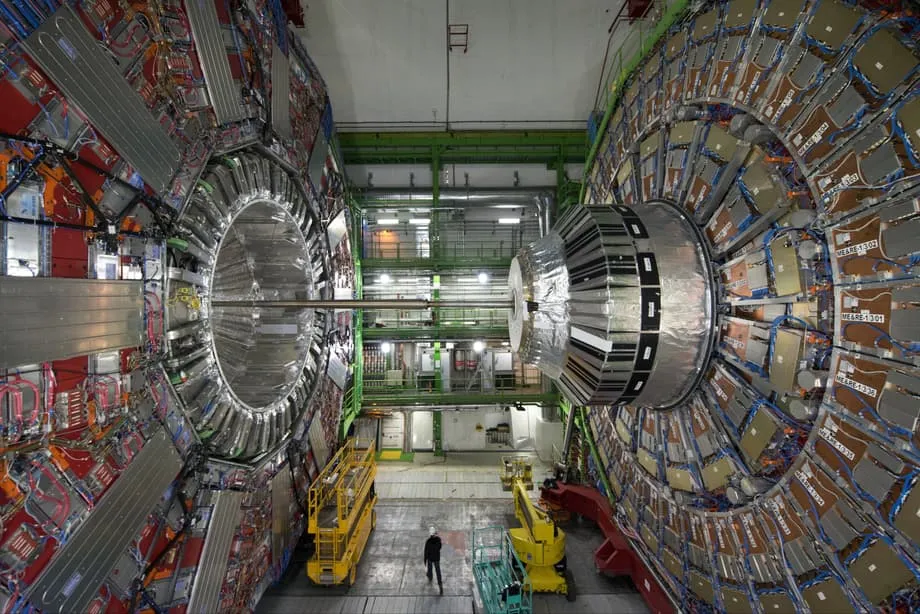
The proposed CEPC layout includes a tunnel of roughly 100 kilometers, two interaction points where particle beams would collide, injector accelerators, cryogenic systems and a new generation of detectors. The injectors would prepare particles for the main accelerator, while the detectors would record what the collisions produce.
A long Higgs run near 240 GeV would be central to the program. GeV is a unit used to describe particle energy. CEPC could also operate at several other energy settings, allowing scientists to study different particles and interactions using the same machine.
Dedicated running periods at the Z boson peak and the WW threshold would map the electroweak interaction with unprecedented statistics. These settings target energies suited to studying Z bosons and producing pairs of W bosons. Large samples would help researchers make more precise comparisons between measurements and theoretical predictions.
The tunnel was also intended to support a later proton collider, often called the Super Proton Proton Collider. That second machine would extend the search for new particles far beyond the reach of the Large Hadron Collider. Europe's FCC follows a similar roadmap: begin with an electron positron collider, then potentially use the same tunnel for a proton machine.
The design milestones already reached
CEPC has moved through several major design stages. A conceptual design report appeared in 2018, followed by the accelerator technical design report in 2023. In 2025, the study group released a reference detector report, adding detailed proposals for the equipment that would measure collision products.
The detector proposal includes an electromagnetic calorimeter made from orthogonal crystal bars and a hadronic calorimeter using scintillating glass divided into many small sensing elements. Calorimeters measure the energy deposited by particles. The different designs help researchers record different components of a collision.
A proposed tracking system uses low gain avalanche diode sensors to combine spatial precision of about 10 micrometers with timing of about 50 picoseconds. Spatial precision describes how closely a detector can locate a particle's passage; timing precision describes how accurately it can record when that passage occurs.
A readout chip built using 55 nanometer technology aims to reduce power requirements by roughly two thirds while improving resolution and integration. These specifications show how much of the project now concerns practical engineering choices, from recording signals accurately to keeping electricity use manageable.
The project's main milestones and next proposed step span more than a decade:
- 2018: CEPC's conceptual design report appeared.
- 2023: The accelerator technical design report followed.
- 2025: The study group released its reference detector report.
- 2026 to 2030: CEPC is absent from China's next national five year plan.
- 2030: Project leaders intend to resubmit the proposal.
Why the budget became harder to secure
Early estimates for CEPC ranged from about $5 billion to figures near $10 billion once civil works, power systems and detectors were included. A collider of this scale needs reliable funding for more than a decade, making the decision larger than a single annual budget allocation.
Prices for advanced materials and civil construction rose over the past decade. Higher borrowing costs and friction in global supply chains also pushed projections upward. These pressures affect both the accelerator itself and the infrastructure needed to build and operate it.
Local government debt limits have reduced the room for large spending commitments at the start of a project. At the same time, national and provincial leaders are directing money toward strategic industries. Semiconductors, satellites and space projects compete with major science facilities for public investment.
CEPC consequently became harder to place on a firm schedule with funding promised across several years. Its advocates have a mature research case, but national planners are also weighing industrial policy and technologies with a faster expected payback. The resulting pause leaves scientists preparing the project without the certainty that construction will follow soon.
Europe has an opening, not an approval
CERN's Future Circular Collider would begin with a circular electron positron machine focused on Higgs and electroweak studies. A later stage could install a proton collider in the same tunnel. Its proposed circumference is similar to CEPC's, although the plans and costs differ.
A recent FCC estimate runs into tens of billions of dollars. CERN's member states are examining public support, environmental feasibility and electricity supplies over the project's lifetime. The European Strategy for Particle Physics process is expected to frame recommendations around the middle of the decade, with a decision on FCC closer to 2028.
China's pause gives Europe more room to lead, but FCC still needs political and financial commitments. The European proposal faces the same basic task as CEPC: align ambitious science with a budget, a host location and public acceptance.
Chinese project leaders' willingness to consider joining FCC reflects the international nature of particle physics. Large accelerators need partners, and a decision to host one machine can encourage other countries to contribute to it instead of building a parallel facility. European approval could draw participation from both Asia and North America.
Japan and the United States have other options
Japan has studied the International Linear Collider but has not moved into construction. Its proposal remains part of the wider discussion about how to deliver the next major program of collider research.
The United States particle physics community has endorsed a strong program of research and development on a muon collider. It also supports American participation in a Higgs factory if one is built abroad. These positions leave room for international cooperation while work continues on another collider approach.
The next few years will help determine where the field concentrates its resources. If Europe commits to FCC, it is likely to attract international partners. If Europe also hesitates, scientists may continue with smaller projects while waiting for economic and political conditions to improve.
Research continues during the pause
CEPC scientists say the pause does not end technical progress. The design reports provide a mature blueprint, and research continues on glass that produces large amounts of light when particles pass through it, silicon sensors covering large areas and readout chips that use less power.
An international review panel examined the detector concept through several review cycles. It concluded that the design is coherent and reaches the required physics performance. The next work centers on integrated prototypes, system tests and engineering design, with the aim of being ready to move quickly if funding becomes available.
Some of those technologies have possible uses beyond a collider. Fast timing sensors can feed into medical imaging. Developments in cryogenic, vacuum and power systems can help energy and aerospace industries, while software developed for large detectors can improve data science.
Advocates point to practical benefits from earlier particle physics work, including the web at CERN, hadron therapy for cancer, superconducting wire and advances in magnet technology. They expect a Higgs factory to add to that record. Such benefits form part of the funding argument when national leaders ask what a large research facility could deliver outside its main scientific mission.
The pause reaches careers and suppliers
Young physicists need projects likely to produce data during the early years of their academic careers. A construction delay changes that calculation, particularly for researchers deciding where to devote years of training and experimental work.
Industrial engineers also depend on predictable orders before investing in tooling for cryomodules, magnets and detector components. Without a construction start, some scientists and suppliers will turn their attention to programs with nearer schedules.
Chinese institutes have already seen shifts toward semiconductors, quantum testbeds, satellites and other national priorities. Those moves reflect the practical need to keep careers, teams and technical capacity active while the collider's future remains unsettled.
Contracts, land use permits, tenders for tunnel boring and hiring commitments over several years will be important signs of progress toward construction. For researchers and suppliers, those steps provide the schedule and demand needed to plan work.
Electricity and the environment shape the decision
A Higgs factory would require hundreds of megawatts of electricity at peak demand. Power costs and national carbon targets therefore matter alongside the price of construction. A host country would need to consider how the facility fits its energy supply and environmental goals.
CERN is studying ways to recover waste heat, connect facilities with district heating and time electricity use according to grid conditions. Similar efforts would be necessary for a collider in China. District heating offers a way to use heat from a facility in a wider local heating network.
Environmental reviews also examine the geology along the planned tunnel, groundwater and infrastructure at the surface. Lessons from earlier projects have brought greater attention to efficient radio frequency systems, which transfer energy to particle beams, and to magnets that consume less electricity.
These engineering and environmental decisions are central to public acceptance. Even with a completed scientific design, a new collider needs a workable plan for its land, power and surrounding communities.
Other experiments can keep the field moving
Neutrino experiments, cosmic surveys and smaller precision experiments can continue answering different questions while major collider proposals wait. Neutrino projects examine a part of particle physics where the Standard Model leaves open questions. Cosmic surveys test gravity and dark energy on the largest scales.
Tabletop experiments and quantum sensors search for ultralight dark matter and tiny violations of expected symmetries. Each approach probes a different part of the puzzle. As in space exploration, a mix of flagship projects and smaller missions can keep researchers active and sustain public support.
The next collider will depend on which host can bring science goals, financing and public acceptance together. Europe has a chance to lead through FCC if it resolves the technical, financial and environmental questions. China could return with CEPC if conditions improve after 2030.
Either route would deliver the Higgs factory that many theorists and experimentalists regard as the most urgent tool for precise tests. Until a host commits to construction, the work is to keep the scientific case sharp, the technology ready and the international community engaged.
What to Know
- China has paused CEPC after leaving it out of the 2026 to 2030 national five year plan; officials describe the move as a pause rather than a cancellation.
- The proposed collider would use a tunnel of roughly 100 kilometers to study Higgs bosons and the electroweak interaction, with a possible proton collider later.
- Design and research continue following reports released in 2018, 2023 and 2025 and a positive international review of the detector concept.
- Rising costs, local government debt limits and competing technology priorities weighed on the funding decision.
- Project leaders intend to resubmit CEPC in 2030 and would consider joining Europe's FCC if it receives approval first.
- A decision on FCC is expected closer to 2028, while Japan's International Linear Collider has not entered construction and the United States supports muon collider research.
- Scientists and suppliers face planning difficulties, while electricity demand and environmental assessments remain central to any future construction decision.
- Neutrino experiments, cosmic surveys, tabletop experiments and quantum sensors can continue research while the next flagship collider waits.