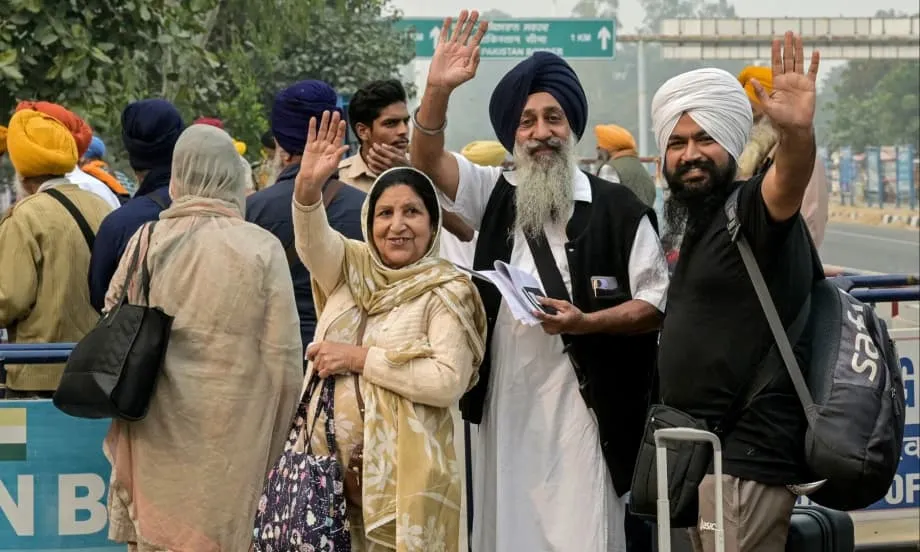
About 2,000 pilgrims cross a border closed for months
About 2,000 Sikh pilgrims from India entered Pakistan on November 4, 2025, to mark the 556th birth anniversary of Guru Nanak, the founder of Sikhism. Pakistan issued more than 2,100 visas for the occasion, allowing a major group of visitors through the Wagah Attari crossing near Lahore for the first time since deadly fighting between the two countries in May.
Contents
- About 2,000 pilgrims cross a border closed for months
- Why this anniversary draws pilgrims across the frontier
- A ten day itinerary links four major shrines
- Flowers and a welcome at Wagah Attari
- How the April attack led to months of restricted travel
- Why Wagah Attari matters beyond this pilgrimage
- Kartarpur remains closed as a separate route
- The 1974 protocol keeps religious visits possible
- A limited opening during a wider diplomatic freeze
- Key Points
Officials welcomed the arrivals with flowers as border guards guided orderly lines on both sides. Many pilgrims walked across with luggage and gifts. Some traveled with relatives making the journey for the first time, bringing families to sacred places that have remained difficult to reach during months of suspended travel.
The crossing was the largest civilian movement at the frontier since the four days of fighting in May, when more than 70 people were reported killed. That confrontation was the worst between India and Pakistan since the Kargil conflict of 1999. Regular travel subsequently froze, leaving pilgrims, divided families and other travelers with fewer ways to cross.
The November opening was a special exception for a religious festival. The land border remained closed to general traffic, while the separate Kartarpur Corridor, normally available to Indian Sikhs visiting a major shrine without a Pakistani visa, also remained shut. Permission for this group to enter through Wagah Attari left those wider restrictions in place.
The visitors were scheduled to spend ten days at shrines across Pakistan. Their central destination was Nankana Sahib in Punjab, Guru Nanak's birthplace, where ceremonies take place at Gurdwara Janam Asthan. The journey also included sites in Lahore, Hasan Abdal and Kartarpur, connecting several important places in Sikh religious life within one organized visit.
Why this anniversary draws pilgrims across the frontier
Guru Nanak Gurpurab, the celebration of Guru Nanak's birth, is one of the most important dates in the Sikh calendar. Sikh communities in India, Pakistan and the global diaspora mark it with hymn recitation, processions and communal kitchens known as langar. Those kitchens provide shared meals as part of the religious gathering.
For Sikhs living in India, the anniversary carries a particular reason to travel: several of their faith's most revered places lie in present day Pakistan. Visiting them means crossing an international border, even when the shrine itself is closely connected to a family's religious life and history.
Nankana Sahib is the centerpiece of this pilgrimage because it is Guru Nanak's birthplace. At Kartarpur, Sikh tradition holds that he spent his final years. Worship at these places connects the anniversary celebration with locations associated directly with his life.
The journey also has a personal meaning for families whose ancestral towns were separated by the 1947 partition that created India and Pakistan. For some visitors, prayers at a gurdwara, a Sikh place of worship, accompany a return to places remembered through family stories. Devotion and family history can therefore be part of the same trip.
A ten day itinerary links four major shrines
The pilgrims' schedule combines prayers, visits to religious sites and cultural events over ten days. The principal destinations are:
- Gurdwara Janam Asthan in Nankana Sahib, Guru Nanak's birthplace.
- Gurdwara Dera Sahib in Lahore.
- Gurdwara Panja Sahib in Hasan Abdal.
- Gurdwara Darbar Sahib in Kartarpur, associated with Guru Nanak's final years.
These shrines mark important chapters in Guru Nanak's life and the early growth of Sikhism. Their locations on the Pakistan side of the frontier make travel between the two countries a practical part of religious observance for many Indian devotees.
Pakistan's Evacuee Trust Property Board and Ministry of Religious Affairs coordinate arrangements on the Pakistan side. Sikh bodies in India help assemble the delegations. Moving a large group among several towns requires transport, accommodation, security and an agreed timetable, all organized around the festival.
Flowers and a welcome at Wagah Attari
Pilgrims queued early on the Indian side under the watch of the Border Security Force. Many wore saffron and navy turbans, and some carried luggage on their heads. After crossing, they were met by officials from Punjab's minority affairs department and the Evacuee Trust Property Board, who offered flower garlands and rose petals.
Nasir Mushtaq, a senior official at Pakistan's Ministry of Religious Affairs, said reopening the crossing for the festival showed respect for religious minorities and a wish to keep cultural connections alive despite political disputes. His remarks placed the visit within Pakistan's stated effort to maintain religious access during a difficult period in relations.
Pakistan's High Commission in New Delhi said the decision to issue visas supported religious freedom and cultural understanding. The diplomatic mission described its purpose in these words:
The decision to grant visas was consistent with efforts to promote interreligious and intercultural harmony and understanding.
A Sikh pilgrim who spoke to reporters after crossing into Pakistan expressed both comfort with the welcome and a hope that visitors traveling in the other direction would receive similar treatment. The pilgrim was not named:
It does not feel like we are in another country. I hope visitors from Pakistan receive the same welcome in India.
The greetings gave the arrivals a personal welcome at a checkpoint where movement had been severely restricted. For families making the journey together, the crossing was the beginning of a long anticipated visit to shrines they may previously have known through photographs and stories.
How the April attack led to months of restricted travel
The crisis began after an April 22 attack in Pahalgam, a town in Indian administered Kashmir, killed 26 tourists. New Delhi accused Islamabad of backing the assailants. Pakistan denied that allegation and called for an investigation.
In early May, India and Pakistan exchanged artillery fire, drone strikes and limited missile attacks over four days. More than 70 people were reported killed. The fighting became the most dangerous confrontation between the neighbors since the 1999 Kargil conflict, with consequences extending beyond the areas under attack.
U.S. President Donald Trump later said he had brokered a ceasefire to stop the escalation. A ceasefire is an agreement to halt fighting; travel restrictions can continue after weapons fall silent. Wagah Attari was shut to travelers for months, and the Kartarpur Corridor stopped operating. Embassies scaled back services, while dialogue in other areas stalled.
The main events leading to the pilgrimage opening were:
- April 22, 2025: An attack in Pahalgam killed 26 tourists, prompting Indian accusations against Pakistan and a Pakistani denial.
- Early May 2025: Four days of artillery fire, drone strikes and limited missile attacks left more than 70 people reported dead.
- After the May fighting: Regular travel remained frozen, with Wagah Attari shut to travelers and the Kartarpur Corridor closed.
- November 4, 2025: About 2,000 Indian Sikh pilgrims entered Pakistan through Wagah Attari for Guru Nanak's 556th birth anniversary.
The November 4 movement took place under permission tied to the religious calendar. General border traffic remained suspended as the pilgrims began their visit.
Why Wagah Attari matters beyond this pilgrimage
Wagah Attari links Lahore in Pakistan with Amritsar in India and is the only active land crossing for travelers between the two countries. It is a tightly controlled area, normally used by diplomats, people traveling for medical care, officially approved groups and limited movements of goods.
Families living on opposite sides of the border lose one of their few channels for direct contact when travel through the gate stops. A closure therefore affects more than tourism. It can interrupt visits between relatives and journeys organized for a specific medical or religious purpose.
The scale of this week's movement made the opening unusual. About 2,000 people passed through a frontier that had been closed to ordinary travelers for months. Border guards and officials on both sides had to coordinate the flow of arrivals while keeping the visit within its approved purpose.
The pilgrimage also required planning beyond the checkpoint. Organizers and security agencies had weeks to prepare routes, housing and crowd control so that the visitors could continue to their destinations and take part in worship.
Kartarpur remains closed as a separate route
The Kartarpur Corridor opened in November 2019, creating a dedicated route from Dera Baba Nanak in India to Gurdwara Darbar Sahib in Kartarpur, Pakistan. Indian citizens can normally apply online for a permit and visit the shrine for the day without obtaining a Pakistani visa.
The route follows a short, fenced track across farmland directly to the shrine complex, and the visit ends at sunset. It gives devotees access to a place only a few kilometers away, including elderly pilgrims for whom the shrine had been out of reach for decades.
The corridor became a symbol of religious access in a region divided by a hard border. Its arrangement is different from the ten day pilgrimage through Wagah Attari: the corridor provides a visit for the day, while the festival delegation travels with visas to several places inside Pakistan.
Kartarpur has remained closed through that dedicated route since the May fighting. The closure has pushed more demand toward the limited visas issued for organized pilgrimages at particular festivals. The current itinerary includes Kartarpur, but the visitors reach Pakistan through Wagah Attari under the group travel arrangement.
As of November 7, no date had been given for reopening the corridor or restoring general travel through Wagah Attari. The religious visit therefore remained a limited opening within the wider suspension.
The 1974 protocol keeps religious visits possible
The 1974 India Pakistan Protocol on Visits to Religious Shrines provides the framework for this kind of journey. It sets out an annual schedule of group visits for Hindus, Muslims and Sikhs, helping communities reach sacred places that ended up across the border after partition in 1947.
Under the protocol, pilgrims travel as registered groups with specific visas rather than as ordinary tourists. Host officials escort them, and accommodation is arranged at gurdwaras or rest houses. The arrangement gives each visit a defined religious purpose and an organized structure.
Pakistan's Evacuee Trust Property Board manages Sikh and Hindu religious sites and arranges lodging, security and transport. Its responsibilities include travel to and from shrines such as Nankana Sahib, Panja Sahib and Katas Raj. The Ministry of Religious Affairs also helps coordinate the pilgrimage arrangements.
In India, Sikh institutions such as the Shiromani Gurdwara Parbandhak Committee often help prepare lists of travelers and support those making the journey. Those tasks connect the visa process with the practical needs of a large delegation.
The protocol has continued through long periods of strained relations because its focus is access to religious places. This week's visit follows that pattern: a defined group travels for a defined festival while most restrictions remain in force.
A limited opening during a wider diplomatic freeze
India and Pakistan's cooperation over the pilgrims represents a small easing around a religious occasion. Trade remains restricted, high level talks are quiet and the Kartarpur Corridor is still paused. The immediate task is to complete the ten day program of worship and shrine visits.
Practical cooperation at Wagah Attari nevertheless creates contact between officials who must resolve everyday problems together. Arrivals need to be processed, groups guided and onward journeys arranged. Those exchanges keep a channel of communication working during a period when many others have stalled.
Small steps involving faith and culture can keep contact alive through a diplomatic freeze. If the festival passes without incident, officials could consider reopening the Kartarpur Corridor, increasing the numbers allowed on future pilgrimages, or reviving limited travel for medical patients and divided families. Those are possible steps beyond the current visit.
For the pilgrims, the immediate importance is more personal: reaching places central to their faith and, for some, their family history. The welcome at Wagah Attari and the visits that follow renew human connections that have continued through changing political relations.
Key Points
- About 2,000 Indian Sikh pilgrims entered Pakistan on November 4, 2025, the largest civilian crossing since the May fighting.
- Pakistan issued more than 2,100 visas for Guru Nanak's 556th birth anniversary under the 1974 religious visits protocol.
- The ten day itinerary includes Nankana Sahib, Lahore, Hasan Abdal and Kartarpur.
- Wagah Attari opened for the pilgrimage while general travel remained shut.
- The Kartarpur Corridor remained closed, with no reopening date given as of November 7.
- The April 22 Pahalgam attack killed 26 tourists; more than 70 people were later reported killed during four days of fighting in May.
- Pakistani officials presented the pilgrimage permission as support for religious freedom, cultural understanding and connections between communities.