A coastal industrial base reaches 235.7 billion yuan
Changxing Island near Dalian in Liaoning province generated 235.7 billion yuan in petrochemical output in 2023, accounting for more than half of Dalian's petrochemical output and roughly a quarter of the city's industrial output from enterprises above the designated size threshold. A coastal cluster that grew from a single plant starting production in 2012 has become a major center for refining, plastics ingredients and advanced materials.
Contents
- A coastal industrial base reaches 235.7 billion yuan
- How the island's expansion unfolded
- Why the location and new roads matter
- Hengli connects oil refining to finished materials
- Advanced materials become the next investment focus
- Water savings and the demands of cleaner production
- More capacity brings pressure on profits
- Ethane changes the cost calculation
- Relocation connects new factories with new infrastructure
- Shipbuilding broadens the regional economy
- What to Know
In 2023, the Dalian Changxing Island petrochemical base, also identified with its adjoining Xizhong Island area, entered China's top 30 chemical industry parks ranked for high quality development. It ranked third nationwide among chemical parks by economic output. Its expansion illustrates how clear policy direction, sustained national and local support, and rapid investment by private companies have helped China build its chemical industry strength.
Hengli Group anchors the Changxing Island area, where investment exceeds 240 billion yuan. Its annual production capacities include 20 million tons of oil refining, 4.5 million tons of aromatics, 11.6 million tons of purified terephthalic acid, or PTA, and 1.5 million tons of ethylene. These chemicals feed connected manufacturing chains rather than leaving the island only as separate raw materials.
Xizhong Island is the planned core site for another integrated refining and chemical complex, including the relocation and upgrade of PetroChina Dalian Petrochemical Company. Plans call for 20 million tons of refining capacity and connections across several product chains, including ethylene streams from refineries around the Bohai Rim.
By November 7, 2025, the island's story combined rapid industrial growth with a tougher commercial challenge: China had built so much capacity in some chemical products that prices and profit margins were under pressure. Changxing Island's response was to connect production more closely, improve resource efficiency and expand into more specialized materials.
How the island's expansion unfolded
Changxing Island's growth has taken place through successive investments in chemicals, utilities, manufacturing and transport. Several milestones show how quickly the cluster developed:
- 2012: The first plant began production, opening the way for a larger concentration of chemical factories.
- 2019: Hengli Petrochemical's refinery and chemical complex reached full operation with annual refining capacity of 20 million tons.
- Early 2023: Hengli's shipyard became fully operational after the group acquired the former STX Dalian yard.
- 2023: The petrochemical base entered China's top 30 chemical parks for high quality development, ranked third by economic output and recorded 235.7 billion yuan in petrochemical output. The development zone also received National Green Industrial Park status.
- 2024: Construction began on Liaoning Dingjide's POE project, involving investment of more than 12 billion yuan.
- 2024 to 2026: Chinese producers were adding capacity for ethylene production using ethane, creating demand for more imports, storage and specialized ships.
- 2025: China reduced its ethane import tariff to 1 percent, while Hengli was constructing more than 30 vessels during the year.
These milestones connect several parts of the same industrial strategy. Refineries supply chemical factories, chemical factories supply materials producers, and ports and shipyards support the movement of feedstocks and finished goods. Local infrastructure investment helps each new project connect to the existing network.
Why the location and new roads matter
Changxing Island lies on the Bohai Sea northwest of Dalian, facing busy shipping routes to South Korea and Japan. Its coast supports berths for vessels with deep drafts carrying crude oil, liquefied hydrocarbons and chemicals. Access to Northeast Asian markets shortens export journeys and helps factories receive imported feedstocks, the raw materials used in production.
Local authorities have expanded roads, electricity supplies and storage alongside factory construction. The 18 kilometer Petrochemical Avenue is fully connected across Xizhong Island. For a warehousing project associated with PetroChina's planned relocation, 361 households were moved from an area of two square kilometers in about two weeks. Crews opened four roads in less than a month and accelerated site work to bring seven fine chemical enterprises closer to operation.
A new port terminal is intended to anchor an energy hub focused on hydrogen. It includes a berth for liquefied hydrocarbons rated at 10,000 tons and a berth for liquid chemicals and oil with the same rating. Dalian Xizhong Island Development Group, COSCO Shipping Investment Dalian and Dalian Menglian Petrochemical are backing the project.
Once operating, the terminal will serve the Dingjide new materials complex, COSCO Shipping logistics projects, power sector ventures and other businesses in the Xizhong Island petrochemical park. Dedicated docks and storage give manufacturers a route between overseas supplies, local production and export customers.
Hengli connects oil refining to finished materials
Hengli Group's operations extend from refining and aromatics to PTA, polyester materials and textiles. Aromatics are chemical building blocks, while PTA is an ingredient used in making polyester. Connecting these stages allows one plant's output to become another plant's input within the same industrial base.
Company managers said Hengli's refinery and chemical complex, fully operating since 2019, could convert 20 million tons of crude oil into 14 million tons of chemicals. That is 70 percent of the crude input by weight. Advanced hydrocracking, a process that breaks oil into more useful components, raises crude utilization by about 5 percent, according to the company's account.
The complex produces 4.5 million tons of aromatics annually, helping address earlier shortages in domestic supply. Hengli's five PTA lines on Changxing Island provide annual capacity of about 11.6 million to 12 million tons, putting the operation among the largest in the world.
Hengli New Material Science and Technology Industrial Park entered full production after trial operations. Its first phase targets annual production of 1.6 million tons of high performance resins, 2.6 million tons of functional polyesters and 600,000 tons of butanediol. Resins and polyesters are materials used in manufacturing, while butanediol is a chemical ingredient for further processing. Hengli expects the first phase to generate about 110 billion yuan in annual output value once production is fully ramped up.
Factories located together can move materials between production stages with less transport and smaller inventories. Shared utilities, hydrogen networks and central wastewater treatment also reduce operating costs. This integrated model helps explain the island's influence beyond the sheer size of its plants.
Advanced materials become the next investment focus
Liaoning Dingjide's project, which began construction in 2024 with investment exceeding 12 billion yuan, is part of the push from bulk chemicals toward materials with higher potential margins. Its planned annual POE output is 400,000 tons when fully built.
POE stands for polyolefin elastomer, a flexible plastic material used in automotive parts, photovoltaic encapsulants and cable insulation. Photovoltaic encapsulants are protective materials used around components in solar panels. Locating production beside feedstock suppliers and export docks can shorten the journey from manufacturing to delivery.
Hengli's new materials park is another part of this shift, adding high performance resins and functional polyesters to increase the share of specialty products. Battery related chemicals are also entering the island's industrial mix. Officials said the Huayi lithium battery materials project moved from groundbreaking to trial production in about 16 months.
A fine chemical engineering innovation park has attracted 36 companies working on process intensification, catalysts and new chemistries. Process intensification means making production steps more efficient; catalysts help chemical reactions take place. Smaller businesses can connect to the large cluster's utilities and logistics rather than building every supporting service independently.
A biopharmaceutical park has also been launched to broaden the tenant base and expand industries that depend on specialized knowledge. Energy storage and hydrogen related ventures remain in planning, linked to the region's development of greener energy. Together, these projects widen the island's activities beyond basic chemical ingredients and fibers.
Water savings and the demands of cleaner production
Changxing Island's development zone received National Green Industrial Park status in 2023 for work on energy efficiency, circular water systems and integrated waste management. Hengli presents environmental engineering as part of its industrial model, using wastewater treatment within the complex so that gray water can be reused.
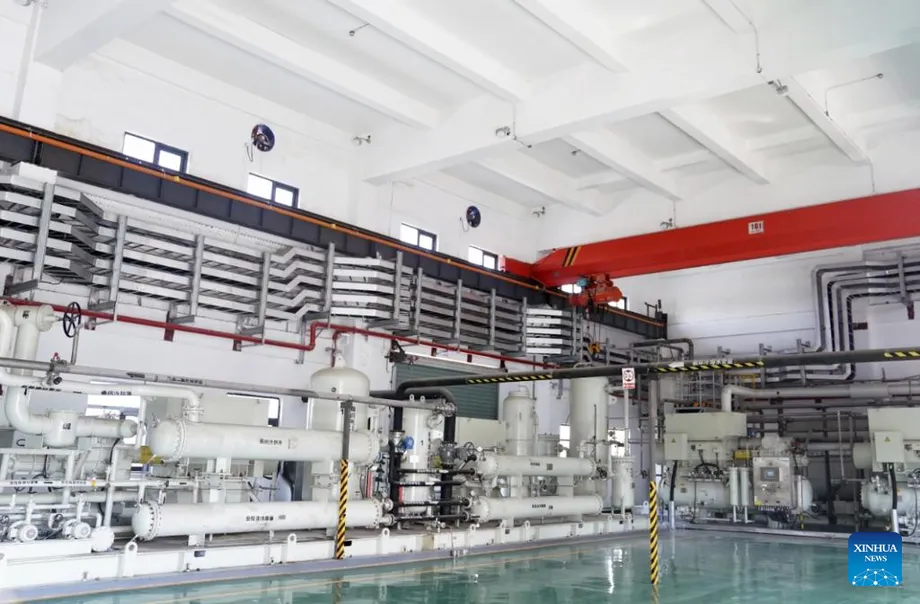
Seawater provides cooling, avoiding large conventional cooling towers. Engineers also capture low temperature waste heat from production units to support desalination, which removes salt from seawater. This reduces the need to withdraw fresh water. At full startup, Hengli reported that desalination and process improvements could save up to 40 million tons of fresh water annually. The desalination scheme was also described as reducing freshwater demand by an amount comparable to the annual needs of around 100,000 households.
Green belts and shelterbelts are intended to limit dust and noise, and landscaping covers large areas within the PTA plant site to improve the working environment. Chen Jianhua, chairman and president of Hengli Group, described the company's approach as combining economic contribution with environmental management:
We aim to be economically significant in the region where we establish a factory while striving to minimize our environmental footprint and achieve the best possible outcomes for the local environment.
Local plans include logistics and production bases for green ammonia, green methanol, green aviation fuels and liquefied petroleum gas products. Officials describe a hydrogen based energy corridor linking Northeast China and parts of Eastern Inner Mongolia, with Changxing Island serving as a port hub for imports, storage and distribution. Such projects could lower emissions across the life of fuels used in shipping, heavy transport and some industrial processes.
Industrial expansion still requires continuous air emissions monitoring, strict water quality management and tighter controls on volatile organic compounds, chemicals that can escape into the air. Centralized utilities and environmental controls can make compliance easier to monitor when standards are rigorously enforced. The island's growth makes consistent oversight a practical requirement for protecting surrounding communities and water resources.
More capacity brings pressure on profits
China's Ministry of Industry and Information Technology has convened producers of PTA and bottle grade PET chips to address overcapacity and intense competition that erodes margins. PET is a polyester material used in bottles and other products. The ministry requested detailed information on capacity, production, demand, profitability and projects under construction to guide its response.
Industry consultancy estimates put China's PTA capacity at more than 90 million tons annually, roughly double the level in 2019. PET chip capacity has also approximately doubled, reaching around 22 million tons. When factories can make much more than customers need, producers compete harder for sales and profits come under pressure.
Even advanced PTA plants have recently recorded slight average losses per ton, while older units face much deeper losses. Trade tensions and tariffs on downstream textiles and apparel in some export markets have added pressure to profits. For a cluster with large PTA and polyester operations, those conditions make cost control and product choice central business concerns.
Changxing Island's manufacturers are pursuing specialty polymers, POE, high performance resins and battery related chemicals that can earn better margins than basic monomers and fibers. Monomers are the small chemical building blocks joined together to make polymers, including plastics. Integration lowers transport, inventory and utility costs, while a broader product range offers several sources of revenue.
A more disciplined pace of investment, retirement of older production units and greater attention to higher value products will be needed to bring supply and demand into better balance. Moving into specialized materials is one response to crowded markets, alongside keeping existing operations efficient.
Ethane changes the cost calculation
Chinese chemical producers are also changing the raw materials they use. Naphtha, obtained from crude oil, has long been a standard feedstock for ethylene and downstream plastics. Ethane, separated from natural gas streams, can produce ethylene at lower cost when market conditions are favorable. A cracker is the industrial unit that breaks feedstock molecules into smaller chemicals such as ethylene.
Companies adding ethane cracking capacity between 2024 and 2026 plan to import more ethane. Analysts expected China to buy an even larger share of United States ethane exports in 2025 as new crackers, storage facilities and ships entered service. Estimates indicate that ethane crackers can generate several hundred dollars more per ton of ethylene than naphtha plants during favorable market periods.
Specialized shipping is essential. Very large ethane carriers transport the cargo over long distances, and at least six vessels are needed to support each million tons of annual ethane cracking capacity. Terminal capacity at both ends of the trade route is tight, making expansion by pipeline and export operators important. China's reduction of the ethane import tariff to 1 percent for 2025 helps keep input costs low.
For Bohai Rim producers, including those clustered on Changxing Island, deep water berths and an experienced maritime workforce create an option to import ethane where investment makes commercial sense. Aromatics, polyester intermediates and specialty polymers give the island other revenue streams as the relative costs of feedstocks change.
Relocation connects new factories with new infrastructure
Dalian has long planned to move and upgrade older refining units away from urban areas. Xizhong Island is the intended destination for PetroChina Dalian Petrochemical Company's relocation, bringing refining and chemical production together beside dedicated berths, storage tanks and pipeline corridors.
The plan targets 20 million tons of refining capacity and connections to several product chains and ethylene resources across the Bohai Rim. No completion date for the relocation was given. Petrochemical Avenue, warehousing projects and new logistics facilities are being developed to support the movement of crude oil, refined products and polymers.
Dalian's development companies, port operators and energy firms are collaborating on docks and storage for liquefied hydrocarbons, chemicals and hydrogen related cargoes. The development zone also promotes rapid electricity grid connections and accelerated road construction to shorten the time before factories start operating, while retaining planning and safety reviews.
For residents, industrial development brings jobs, training opportunities and tax revenue. Concentrating production in a defined industrial area also concentrates environmental risk, making strict standards and transparent oversight essential parts of the relocation strategy.
Shipbuilding broadens the regional economy
Hengli Group says it has invested around 280 billion yuan in Dalian over the past decade and a half, covering chemicals, materials and equipment manufacturing. Its acquisition of the former STX Dalian shipyard adds maritime manufacturing to a business network already dependent on ports and industrial logistics.
The yard became fully operational in early 2023 and subsequently booked dozens of orders worth more than $5 billion. Orders include bulk carriers and other commercial vessels connected to the group's energy and materials logistics. Hengli was constructing more than 30 vessels in 2025, with management targeting deliveries of about 60 ships annually once production reaches full scale.
Shipbuilding complements petrochemicals through shared logistics skills and capital goods supply chains. Bulk carrier deliveries add another industrial activity to the island's role in Northeast China's economic revitalization, alongside advanced polymers, battery materials, equipment manufacturing and port services.
Smaller and midsize businesses can supply catalysts, packaging, automation equipment and maintenance services to the larger operations. Universities and vocational schools in Dalian and the wider region have new reasons to expand training in process engineering, safety management and materials science. The mix of industries gives the cluster a broader base for handling swings in individual product markets.
What to Know
- Changxing Island's petrochemical output reached 235.7 billion yuan in 2023, more than half of Dalian's petrochemical total.
- The base entered China's top 30 chemical parks for high quality development in 2023 and ranked third by economic output.
- Hengli's island investment exceeds 240 billion yuan, with annual refining capacity of 20 million tons.
- Hengli's new materials park targets annual output value of about 110 billion yuan once its first phase is fully ramped up.
- Dingjide's project involves more than 12 billion yuan and targets 400,000 tons of POE annually.
- Hengli reports potential freshwater savings of up to 40 million tons a year through desalination and process improvements.
- National PTA and PET capacity growth has squeezed margins, prompting industry ministry action.
- China reduced its ethane import tariff to 1 percent for 2025 as producers expanded ethane cracking capacity.
- Xizhong Island is the planned relocation site for PetroChina's Dalian operations, supported by new roads, storage and docks.
- Hengli's shipyard targets about 60 annual vessel deliveries at full scale, broadening the island's industrial base.