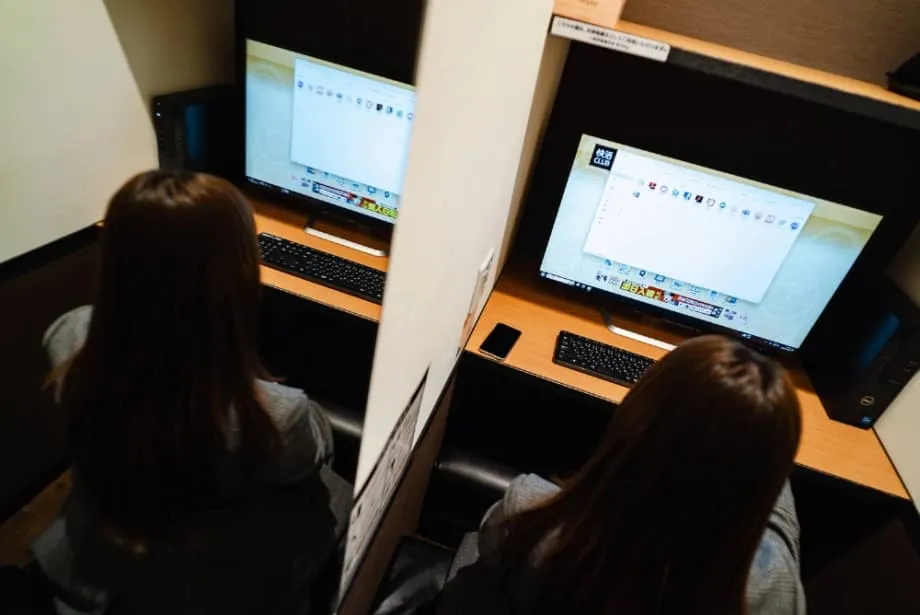
A smaller industry finds new reasons for people to stay
Japan's internet cafe industry shrank from 1,916 locations in 2014 to 1,063 in 2024, yet its biggest operator found room to grow. Kaikatsu Club's sales rose from 48.57 billion yen in the fiscal year ending March 2021 to 72.58 billion yen in the year ending March 2025 as private rooms, reliable Wi-Fi and places to rest gave customers reasons to return.
Contents
- A smaller industry finds new reasons for people to stay
- How manga cafes became internet hubs
- Safety concerns and smartphones changed the business
- Why Kaikatsu Club gained ground
- What customers find inside a modern branch
- How much does a room cost?
- Workers, students and travelers share the space
- Competition comes from offices and overnight stays
- Changing an old reputation remains part of the task
- What a first visit involves
- Why regular customers keep returning
- Key Points
For Mio Suhara, a blogger aged 54 who lives with family in Saitama Prefecture, those changes have made a cafe near Tokyo part of her weekly routine. She visits two or three times a week, usually arriving around midday and choosing a package lasting six hours. A small private room gives her the quiet she struggles to find at home.
Suhara writes for hours, with free refills of coffee and soda and a soft serve machine nearby. She also plans motorcycle trips around Kaikatsu Club branches where she can spend the night in a lockable room for less than a budget hotel. The familiar setting serves as both an office and an escape.
Suhara, a regular customer who spends many hours each week writing in private booths, explained why she keeps returning:
This is basically my second home. I mostly write blog posts here because I cannot really focus at home.
As of November 4, 2025, her routine captures the industry's change. Venues once associated with smoke, neon and rows of public computers now sell comfort, privacy and flexibility. The market is smaller, but surviving businesses increasingly serve as mobile offices, entertainment spaces and inexpensive places to stop overnight.
Smartphones weakened the old reason to visit: access to a computer and the internet. Operators responded by selling something customers could not always find on their phones or at home, a place of their own for a few hours.
How manga cafes became internet hubs
Japan's manga kissa began in Aichi Prefecture in the 1970s. The name is short for manga kissaten, meaning a cafe built around Japanese comics. Early owners found that a substantial library encouraged customers to settle in with coffee and read for longer.
Customers paid for time rather than individual purchases. They could choose a seat or booth, read for hours and often receive unlimited soft drinks within the price. That approach made a long visit part of the business model, rather than a problem for the owner.
Packages ranged from blocks of 30 minutes to several hours or an overnight stay. The arrangement encouraged repeat visits and gave operators a predictable stream of fees. Showers, printers and small meals later broadened what customers could do during their booked time.
Public internet access became another draw in the 1990s. Cafes installed PCs while keeping the same billing system, and the terms manga cafe and internet cafe became almost interchangeable as computers and Wi-Fi spread. Reading, gaming, web access and casual dining could all happen in one place.
By 2001, the industry had a trade group, the Japan Complex Cafe Association (JCCA), and national chains were expanding. Venues operating around the clock added attractions such as darts, karaoke and large manga collections, becoming entertainment centers as well as places to get online.
The industry's development unfolded over several decades:
- 1970s: Manga kissa emerged in Aichi Prefecture, combining coffee with libraries of comics.
- 1990s: Internet access and public PCs became major attractions.
- 2001: The sector had the Japan Complex Cafe Association, while national chains expanded.
- 2008: A fire at a video booth facility in Osaka killed 16 people and brought safety concerns into focus.
- 2018: Kaikatsu Club introduced lockable private rooms.
- 2021: Kaikatsu Club achieved nationwide coverage.
- 2024: Industry figures counted 1,063 cafes, down from 1,916 in 2014.
- March 2025: Kaikatsu Club's annual sales reached 72.58 billion yen.
Safety concerns and smartphones changed the business
Internet cafes faced problems alongside their early growth. Anonymous terminals made it easier for people to run online scams or distribute illegal content. Operations lasting 24 hours also attracted people without stable housing, bringing the phrase net cafe refugees into public discussion.
The 2008 Osaka fire highlighted another concern: the danger of cramped, divided interiors with complicated escape routes. The blaze occurred at a video booth facility and killed 16 people, putting scrutiny on safety in spaces where customers occupied small compartments.
Smartphones and home broadband brought a different challenge in the 2010s. Customers increasingly had their own means of checking email, reading news and playing games. A public PC was no longer enough to keep them coming through the door.
Operators upgraded interiors and focused on quiet, cleanliness and privacy. Lockable rooms and simple food menus replaced the smoky atmosphere associated with older venues. Smaller chains struggled to pay for or keep pace with those changes, and closures followed. The pandemic accelerated the contraction.
Industry figures show a loss of 853 locations between 2014 and 2024, equivalent to about 45 percent of the 2014 total. Sales across the sector also fell during that decade. The surviving businesses had to find uses beyond the internet access that had once defined them.
Why Kaikatsu Club gained ground
Kaikatsu Club is operated by Kaikatsu Frontier, a subsidiary of Aoki Holdings. Its introduction of lockable rooms in 2018 positioned the chain to meet demand when remote work spread. Customers could finish reports, join video meetings or relax between appointments in an enclosed room with stable internet and power outlets.
The chain increasingly presented itself as a practical lounge for work and rest. By early autumn 2025, it had 496 outlets nationwide, roughly half the country's internet cafe locations. Many branches added showers separated by gender, laundromats and small relaxation areas.
Kaikatsu Club operates entirely through company owned stores rather than franchises. Managers can visit branches that perform well, copy successful practices and introduce improvements across the network. That structure supports consistent service as the chain changes its format.
After achieving nationwide coverage in 2021, Kaikatsu Club shifted attention toward compact branches near major train stations. These locations are often about 200 square meters and contain only lockable private rooms, matching the needs of commuters and people working alone.
Annual sales increased by 24.01 billion yen between the fiscal years ending March 2021 and March 2025, a rise of about 49 percent from the earlier figure of 48.57 billion yen. The growth contrasts with the wider industry's decline over the decade.
What customers find inside a modern branch
A central Tokyo branch illustrates the modern layout. Customers check in at a reception desk or automated kiosk. First time visitors show photo identification and create a membership that they can then use throughout the network.
Beyond reception, rows of small booths sit alongside shelves of comics and magazines. Drink machines, a microwave and restrooms are nearby. Soft lighting and tidy rooms replace the dim, dusty setting that some longtime customers remember.
Lockable private rooms may occupy an upstairs floor. Some branches also have a floor for darts or billiards. The layout brings work, reading and recreation together, although the facilities vary from one store to another.
A private booth typically includes a PC, headphones, Wi-Fi, power outlets and either a reclining chair or a padded mat. Customers can use the room to work, nap or watch films. They can also connect their own devices rather than rely on the supplied computer.
Unlimited soft drinks are standard, and many locations provide free soft serve. Showers are available at many branches and are separated by gender. Some stores supply free towels and toiletries, while others include coin laundries for travelers.
Food from the drink bar is often restricted in private rooms under safety rules guided by police, so customers eat in designated areas. Some locations sell light meals or breakfast sets. The exact combination of food, showers and other services depends on the branch.
How much does a room cost?
Kaikatsu Club's prices vary by location and package. At a central Tokyo branch near Akihabara Station, a private room usually starts at around 950 yen for the first hour, followed by roughly 160 yen for each additional 10 minutes.
Longer packages change the calculation. The same location offers about six hours for 2,970 yen or a stay lasting 24 hours for around 7,720 yen. Customers choosing between a brief visit and an extended stay therefore need to compare the package prices, rather than simply multiply the initial hourly charge.
Across Tokyo, typical short packages cost around 1,000 to 1,600 yen for a few hours. Overnight bundles often fall between 3,000 and 3,500 yen. Showers may be free or carry a small charge, depending on the store.
The appeal is flexibility. A person who needs a desk for two or three hours pays for that period, while someone who misses the last train can choose a longer stay. The same premises can serve both without requiring the customer to book a hotel room or commit to a full day at an office.
Workers, students and travelers share the space
Office workers use internet cafes between meetings to prepare slides or join a quick video call. Freelancers book rooms to write, edit or code. Students study alone with noise kept low or use larger rooms for group projects.
Remote work created steady demand for rooms with doors that lock. Business travelers and sales staff can use branches near stations as temporary offices, with reliable Wi-Fi, charging and access to printing or scanning. An enclosed booth suits a video conference better than a crowded cafe.
Hourly pricing also makes a short working visit easier to justify than a day pass at a premium coworking business. On weekends, the same rooms become places for manga, streaming and games. A room's purpose can change with its next customer.
Tourists use manga and internet cafes as a backup after missing the last train or when seeking an inexpensive overnight option. A passport serves as identification for membership registration. Residents typically present a driver's license or residence card.
Staff may speak limited English, although basic communication usually works. Foreign visitors account for roughly 2 percent of customers at some urban branches. The venues remain primarily part of local routines rather than businesses built around tourism.
Suhara, recalling older manga cafes as dim and not very clean, described the difference she now sees:
In terms of comfort, today's spaces are far better. Kaikatsu Club changed the image, making bright, welcoming net cafes the norm.
Competition comes from offices and overnight stays
Internet cafes compete with different businesses depending on what a customer needs. Premium coworking brands sell offices and full meeting rooms at higher prices. They serve teams and clients, provide conference facilities and target companies whose employees mainly work in offices.
Capsule hotels and simple business hotels compete for overnight customers. They offer proper beds and quieter nights, often at prices similar to a private booth. As internet cafe prices move closer to capsule hotel rates, the choice increasingly turns on the purpose of the visit.
A net cafe combines a desk, drinks, showers and access around the clock, with time sold by the hour. Walk in visits make it useful for solo workers, students and travelers needing somewhere to work, freshen up or stop after trains have finished running.
Within the industry, rivals such as DiCE, Aprecio and Jiyu Kukan also promote sleek interiors, private rooms and extensive manga libraries. Many add darts, karaoke or gaming PCs to attract customers with different interests.
Similar facilities create a risk of sameness. Location, cleanliness and consistent service become the most visible differences between chains. Kaikatsu Club's presence near stations, quick room turnover and reputation for tidy premises have helped it maintain its lead.
Changing an old reputation remains part of the task
Internet cafes still carry an image shaped by earlier concerns about unsafe or seedy premises and wrongdoing behind anonymous computer terminals. People who have not visited since the 2000s may associate the businesses with that period rather than their current interiors.
Modern stores use identification checks, surveillance cameras in common areas and strict rules for private rooms. Safety measures include showers separated by gender, clear evacuation routes and restrictions on food or hot drinks in small rooms.
Kaikatsu Frontier wants to raise the female share of its customers from 24.5 percent to 35 percent, an increase of 10.5 percentage points. It also targets occupancy of 60 percent at urban locations. Occupancy describes how much of the available capacity is in use.
Brighter lobbies, clear signs, automated check in, better air filtration and regular cleaning cycles form part of the effort to attract more women and casual visitors. The chain continues testing small branches beside stations that contain only lockable rooms.
Those customer and occupancy figures are goals. Kaikatsu Frontier has not given a date for reaching them. Its challenge is to make the upgraded spaces familiar to people whose expectations were formed by older cafes.
What a first visit involves
A new customer can walk in, register with identification and choose a package by time. An open booth offers the lowest price, while a private room provides more quiet. Reading manga, streaming shows and working are all possible, either on the room's PC or a personal device connected to Wi-Fi.
Unlimited soft drinks are usually included. Some branches add snacks, breakfast sets or free extras such as soft serve, and many provide showers. Checking the individual store's facilities matters because the same services are not available everywhere.
For an overnight visit, an eye mask and earplugs can help because complete quiet is not guaranteed. Customers planning to work can request a room with extra monitors where available. A reclining chair or padded mat offers a different sleeping arrangement from a hotel bed.
A capsule hotel provides a bed and a calmer night. An internet cafe offers flexible timing and access to drinks, showers and a desk throughout the day and night. For a late arrival or early departure, the ability to choose the length of a stay can decide which option fits better.
Why regular customers keep returning
Branches beside major stations in Tokyo and other cities make rooms accessible at short notice. Membership brings small perks, and frequent customers can reach premium tiers with additional points or discounts. Predictability matters to people using the spaces regularly.
Suhara spends more than 10,000 yen a month on visits. She uses the same chain for writing near home and for overnight stops during motorcycle trips. A familiar room and a familiar routine reduce the need to find a different workspace or place to rest each time.
Suhara, explaining why she plans trips around Kaikatsu Club and prefers its private booths to a crowded cafe or noisy living room, summed up her attachment:
For me, this place is like a vacation home. I do not think I will ever stop coming here.
Japan's internet cafes have survived by changing what customers pay to use. Computers and comics remain, but privacy, comfort and convenient locations now carry much of the appeal. Kaikatsu Club's growth shows how one operator expanded while the industry around it became smaller.
Key Points
- Japan's internet cafes grew from manga kissa that emerged in Aichi Prefecture in the 1970s.
- The sector fell from 1,916 locations in 2014 to 1,063 in 2024, a decline of about 45 percent.
- Kaikatsu Club introduced lockable rooms in 2018, achieved nationwide coverage in 2021 and operated 496 branches by early autumn 2025.
- Annual sales rose from 48.57 billion yen in the fiscal year ending March 2021 to 72.58 billion yen in the year ending March 2025.
- Typical Tokyo packages cost around 1,000 to 1,600 yen for a few hours, with overnight bundles often priced at 3,000 to 3,500 yen.
- Modern branches combine workspaces, manga, entertainment, drinks and, at many locations, showers.
- Identification checks, cameras in common areas and safety rules are part of efforts to change the industry's older image.
- Kaikatsu Frontier targets 60 percent occupancy at urban sites and a female customer share of 35 percent, up from 24.5 percent.