Nearly 16,000 aircraft turn the sky into a moving picture
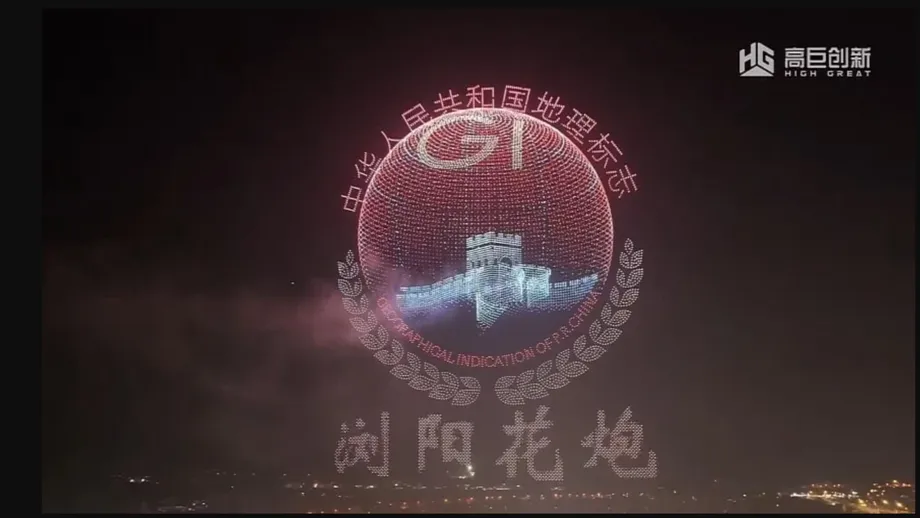
A total of 15,947 illuminated quadcopters rose above Liuyang in Hunan Province for a performance that combined enormous moving pictures with airborne fireworks. The show, titled A Firework Belonging to Me, earned two Guinness World Records: the most drones simultaneously launched and controlled by a single computer, and the most fireworks carried by a drone formation in flight, with 7,496 pyrotechnic units attached and fired during the performance.
Contents
- Nearly 16,000 aircraft turn the sky into a moving picture
- What the two records measure
- How thousands of drones follow one choreography
- Why ordinary GPS accuracy would fall short
- Keeping the radio network connected
- Adding fireworks changes the engineering task
- The record climb from Guangzhou to Liuyang
- A larger fleet also means more work on the ground
- Safety lessons behind the spectacle
- What happens when a connection or battery weakens
- Why cities want pictures as well as fireworks
- Skills that reach beyond entertainment
- Highlights
Liuyang is famous for fireworks, making the combination especially fitting. Its centuries of pyrotechnic tradition met a form of entertainment in which software directs thousands of aircraft to become points in a picture. Each quadcopter, an aircraft lifted by four rotors, contributed light and movement to a much larger design.
The display moved through a towering Sky Tree, a double helix, a seed that appeared to sprout and bloom, and cascades of petals and butterflies. The double helix consisted of two winding strands, while the growing seed turned a familiar natural process into an animation suspended above the city.
Liuyang's riverbanks and festival grounds became the viewing area for a vast aerial storyboard. The formations held their shapes before changing together into the next scene, combining the precision of a digital image with the scale of a public fireworks celebration.
The performance also showed how much work sits behind an apparently effortless spectacle. Thousands of aircraft had to share accurate position information, maintain reliable communications and follow a common schedule. Those carrying fireworks added another demand: their movement and ignition had to fit the same carefully planned sequence.
What the two records measure
Guinness World Records recognizes several categories for drone displays because a large formation can be measured in different ways. Liuyang pursued records for unified control and airborne pyrotechnics, bringing two demanding capabilities into the same performance.
The first record counts drones simultaneously launched and controlled by a single computer. Aircraft counted during adjudication must meet standards for position, duration and reliability. Liuyang's ground control station took responsibility for all 15,947 aircraft, making the size of the fleet only part of the achievement. The system also had to keep them operating together.
The second record counts individual fireworks carried and successfully fired by a drone formation during flight. Liuyang reached 7,496 pyrotechnic units, with the fireworks segment synchronized to musical cues and the choreography of the lights.
The record for the largest aerial image formed by drones uses a different measure: a particular picture created in the sky. Liuyang's two titles centered on managing a huge fleet through one ground system and integrating fireworks into its flight.
Clips of the performance spread rapidly across social platforms. Shares from prominent accounts brought the festival to a wider international audience. For the organizers, the record totals reflected the ability of positioning equipment, radio links and coordination software to keep a sky full of aircraft moving with little visible drift or delay.
How thousands of drones follow one choreography
Every aircraft in a display of this size needs to know its present position, its next destination and the speed at which it should travel. The planned routes must also preserve enough space between neighboring drones as the pictures change.
A tree canopy, a rotating spiral or a rising layer of lights creates different movement demands. Hundreds of nearby aircraft may turn while others climb through another part of the formation. Timing and geometry have to work together throughout these transitions.
The ground control system therefore has to compute and send thousands of trajectories while detecting errors as they develop. A trajectory is the route an aircraft follows through space over time. A shared clock keeps the fleet on the same schedule, so a turn or descent happens on cue instead of spreading unevenly across the picture.
Why ordinary GPS accuracy would fall short
Liuyang's formation used real time kinematic positioning, known as RTK, to improve satellite navigation accuracy. The technique uses a local base station to provide corrections to the aircraft, allowing much finer positioning than everyday GPS.
Satellite measurements can be affected by small timing errors, atmospheric delays and the geometry of the satellites being used. RTK correction data compensates for these effects. When communication links are clean, the system can provide precision measured in centimeters.
The fleet receives a steady stream of corrections as the pictures develop. This helps keep the individual points of light in their intended places, preserving the edges, curves and spacing that make a large formation recognizable.
The ground team also needs to anticipate where each drone will be a fraction of a second later. Precise measurements support those predictions, which matter when neighboring aircraft rotate, rise or spiral at the same time. Errors can appear as drift, gaps or distorted shapes.
Positioning and timing solve related problems. RTK helps each aircraft occupy the right place, while the centralized clock helps it arrive there at the right moment. Together, they allow thousands of small movements to read as one continuous animation.
Keeping the radio network connected
Large drone fleets often use mesh networking, in which aircraft can act as repeaters for one another. A message can travel through several drones to reach its destination, giving the network routes around areas with poor reception.
The ground system monitors the health of communication links. It can reroute data packets, reduce update traffic in stable parts of a formation and devote more bandwidth to aircraft carrying out a transition that needs frequent instructions.
Radio planning becomes harder in crowded urban environments. Buildings reflect signals, and other equipment competes for usable frequencies. Teams examine local interference, divide communications across channels and choose antenna locations carefully.
Offline rehearsals in simulation help reveal communication bottlenecks before a public flight begins. These preparations lower the chance that lost packets, the small bundles of data moving through the network, will disrupt a critical moment in the performance.
Adding fireworks changes the engineering task
Liuyang's drones carried pyrotechnic payloads that ignited on cue, weaving sparks through the patterns made by their LED lights. The display connected the city's traditional craft with aerial robotics at a scale few cities have attempted.
Fireworks follow a predictable burning sequence, but ignition and ejection still involve small delays. The aircraft also make tiny movements while holding position. The control system built these delays into the script so the chemical light of the fireworks and the graphical light of the drones remained in step.
The show synchronized its effects to music with timing measured in milliseconds. That precision depended on matching the flight sequence, lighting sequence and pyrotechnic sequence, rather than treating them as independent parts of the celebration.
Payload weight was matched to the capacity of the motors and batteries so the extra mass would not compromise maneuvering. Fire resistant materials separated ignition lines from components needed to keep the aircraft flying.
Safety corridors and areas that aircraft were forbidden to enter were planned beneath segments carrying greater risk. The landing sequence also kept drones with spent fireworks from crossing paths with aircraft whose pyrotechnics were still active. Close coordination served both the appearance of the show and the need to limit unpredictable contact between hot particles and nearby aircraft.
The record climb from Guangzhou to Liuyang
Drone displays have grown rapidly from performances involving about a thousand aircraft to fleets numbering well into five figures. The progression involves several record categories, including control by a single computer and the size of an aerial image.
- 2017: A synchronized show featuring 1,000 drones in Guangzhou set a new benchmark at the time.
- After 2017: Teams in China pushed fleet sizes beyond 3,000 and eventually into five figures.
- 2024: A Shenzhen display controlled more than 10,000 aircraft from a single computer during National Day celebrations.
- Months later: A performance in Ho Chi Minh City reached 10,518 drones.
- June 2025: A show over Chongqing documented 11,787 synchronized aircraft for the largest aerial image category.
- By November 3, 2025: Liuyang's A Firework Belonging to Me had reached 15,947 drones and 7,496 airborne pyrotechnic units, earning its two record titles.
Liuyang's fleet contained nearly 16 times as many drones as the 1,000 aircraft used in Guangzhou in 2017. That comparison shows the growth in operating scale over eight years, while the different record categories explain why the performances were judged on different achievements.
A larger fleet also means more work on the ground
Every increase in fleet size adds demands beyond the flight software. Thousands of aircraft need staging space, charged batteries, reliable antenna coverage and crews with defined responsibilities. Emergency procedures must grow with the formation.
The rise in record attempts has driven changes in logistics, software and radio design. An animation may last only part of an evening, but its preparation requires coordination across equipment handling, communications, flight planning and safety.
Cities have adopted drone performances to promote culture and tourism while supporting the growing low altitude economy. This term describes economic activity involving aircraft operating closer to the ground, including the aerial services and entertainment brought into urban life.
Liuyang's place in that growth is rooted in its existing industry. A city closely associated with fireworks manufacturing now holds records for both unified drone control and the integration of airborne pyrotechnics.
Safety lessons behind the spectacle
A fleet of thousands can be affected by a problem that starts small. A software fault can spread across aircraft following the same system. Lost positioning fixes can leave holes in an image, while a sudden gust can threaten spacing if nearby drones cannot recover quickly enough.
Liuyang has experienced malfunctions at previous events in which drones caught fire and fell toward the crowd. Those incidents make the safety demands of combining public displays, aircraft and pyrotechnics particularly tangible.
Wind shear, rain and turbulent layers of air complicate planned movements. Buildings can also reflect radio waves and satellite signals. When a navigation receiver picks up reflections as well as a direct signal, the extra paths can distort its position estimate.
Ionospheric conditions can temporarily reduce navigation accuracy too. The ionosphere is a region of the upper atmosphere that can affect satellite signals traveling toward receivers on the ground.
Teams plan around these conditions by setting thresholds for whether wind and precipitation allow a show to proceed. They place base stations to reduce errors from reflected signals and design formations that can tolerate small positioning errors without losing their visual shape.
What happens when a connection or battery weakens
Public Wi Fi, private networks and mobile devices make urban airwaves busy. Spectrum scans before a show identify likely sources of interference, while supervisors watch signal quality during the flight for signs of congestion.
Available responses include adjusting transmission power, changing channels or temporarily reducing update rates. Combining these measures helps keep a portion of the formation from losing its communications at a critical moment.
Flight safeguards commonly include geofencing, altitude limits and designated corridors. Geofencing creates virtual boundaries that restrict where an aircraft can go. A staged response to a lost link may involve pausing, climbing, returning or landing, depending on the aircraft's position relative to spectators.
Battery monitors warn controllers when the remaining margin is shrinking too quickly. Affected aircraft can leave the formation for predefined landing pads instead of risking a loss of electrical power over the display area.
Crews rehearse emergency routes and keep fallback paths clear before spectators arrive. Transparency about cancellation criteria, several layers of backup protection and conservative staging have improved safety outcomes as fleets have grown. A formation that steadies itself after a gust reflects extensive testing, including flights canceled when conditions or calculations were unsuitable. Public performances involving pyrotechnics still carry risk.
Why cities want pictures as well as fireworks
Traditional fireworks leave smoke, paper and spent casings. Large shells can disturb pets and wildlife and sometimes start fires. Drone light shows produce little debris and allow brightness to be adjusted for sensitive locations near hospitals or habitats.
Multirotor aircraft still make noise, and charging batteries and transporting the fleet carry environmental costs. Liuyang's combination also retained fireworks as part of the display. Organizers weigh these tradeoffs against the creative control offered by programmable aircraft.
A drone formation can create recognizable logos, portraits and landscapes, holding them for as long as battery capacity permits. Animations can be coordinated with music and projections on the ground, turning a skyline into a sequence about a city's history, industries or a holiday.
Liuyang's growing seed, Sky Tree and moving petals showed how that storytelling differs from a sequence of shells. The aircraft could preserve a recognizable shape, transform it and connect it to the next image. Fireworks added another layer of light to the same narrative.
Skills that reach beyond entertainment
Formation control, accurate positioning and reliable radio networking have uses beyond public celebrations. Techniques used in large displays are relevant to mapping, temporary communication relays and distributed sensing, in which many devices collect information across an area.
Public safety agencies experiment with coordinated search grids. Surveyors combine drone data into detailed models of terrain and structures. Researchers work on swarms that can keep their formations around obstacles or divide tasks without placing excessive demands on the network.
Defense planners also study coordinated fleets. Aircraft that maintain formation while their network responds to interference have value for training and testing. Countries investing in the low altitude economy see commercial opportunities in exporting the equipment, services and software that make these operations possible.
Better automation, safer batteries and onboard algorithms that detect and correct drift before it becomes visible can improve the commercial side of drone operations. Greater reliability lowers costs and can open venues where local rules have been cautious. Liuyang's spectacle brought these technical capabilities together in a public performance shaped by its fireworks tradition.
Highlights
- Liuyang, Hunan, staged A Firework Belonging to Me with 15,947 illuminated drones.
- The show earned Guinness World Records for simultaneous launch and control by one computer and for 7,496 fireworks carried and fired by a formation in flight.
- The choreography included a Sky Tree, a double helix, a growing seed, petals and butterflies.
- RTK positioning, synchronized timing and resilient communications support precise movement across large fleets.
- Airborne fireworks require careful management of payload weight, ignition timing, flight separation and landing routes.
- Drone displays grew from 1,000 aircraft in Guangzhou in 2017 to Liuyang's fleet of nearly 16,000 by November 3, 2025.
- Weather limits, interference monitoring, virtual boundaries and emergency landing plans are central to managing public display risks.
- The same coordination skills have applications in mapping, communications, public safety and defense research.