Cloud seeding brings no measurable rain to the capital
Delhi's attempt to wash pollution from the air with artificial rain produced no measurable rainfall in the capital on Tuesday, while the citywide air quality index remained in the very poor category at around 304 to 306. Scientists reported cloud humidity of only 10 to 20 percent, far below the 50 to 60 percent that usually gives cloud seeding its best chance of producing rain.
Contents
- Cloud seeding brings no measurable rain to the capital
- What happened during Tuesday's flight?
- What the pollution readings showed
- How particles released into clouds can produce rain
- What other programs and environmental concerns show
- Why Delhi's winter air becomes trapped
- Scientists warn that any relief will be brief
- What the trials cost and how they will be assessed
- Delhi's other measures target the pollution itself
- Lasting improvements depend on action across the region
- What to Know
By October 29, 2025, authorities had conducted three attempts under a project budgeted at about 3.21 crore rupees for five trials. More flights were planned when suitable clouds appeared, and officials were considering a longer program through February, depending on the results and the weather.
The operation involved scientists from the Indian Institute of Technology Kanpur and a small aircraft releasing silver iodide and sodium chloride flares into clouds. The aim was to trigger a shower that could carry soot and dust out of the air, bringing relief to a metropolitan region with more than 20 million residents.
Delhi entered its peak smog season with pollution already thickening after the Diwali holiday period. Officials described the flights as a measured trial to guide a broader plan if conditions cooperated. The effort combines an experiment in weather modification with an emergency response to a recurring public health crisis.
Government sensors showed modest declines in particle pollution at some test locations, although the city average remained very poor the following morning. Scientists involved in the project and researchers questioning its value agreed on a central limitation: rain may briefly clear the air, while continuing emissions allow pollution to build up again.
What happened during Tuesday's flight?
A Cessna aircraft took off from Kanpur carrying eight flares containing silver iodide and salt crystals. It seeded patches of cloud for roughly half an hour over parts of north and northeast Delhi, where haze had thickened.
The India Meteorological Department recorded no measurable rain in the capital through Tuesday evening. Nearby Noida received a trace shower of about 0.1 millimeters, while Greater Noida recorded about 0.2 millimeters.
Officials said rain following seeding can arrive anywhere between 15 minutes and four hours after an operation, depending on how the cloud develops. Tuesday's low moisture levels were a central obstacle: cloud seeding needs water already present in clouds to work.
The capital has a long but intermittent history of such experiments. Earlier attempts were aimed at drought relief, while the current project focuses on smog.
- 1957: Delhi saw an early cloud seeding attempt for drought relief.
- 1972: Another attempt took place, also for drought relief.
- 2023: A proposed seeding operation did not advance amid delays involving approvals and weather.
- Tuesday, before October 29, 2025: The latest trial seeded clouds over Delhi, but the capital recorded no measurable rain through the evening.
The current trials are the first major attempt in more than five decades to use cloud seeding for smog mitigation in the capital, and the first operation of this kind for pollution control there in decades.
What the pollution readings showed
The Delhi government reported that particle readings fell at selected monitoring locations after the operation. In Mayur Vihar, PM2.5 readings dropped from roughly 221 to 207. Karol Bagh recorded a decline from about 230 to 206, while Burari's reading fell from around 229 to 203.
PM10 readings also edged down in those test neighborhoods. Officials are using those local changes to support further trials when moisture levels improve, and plan to study the measurements more closely.
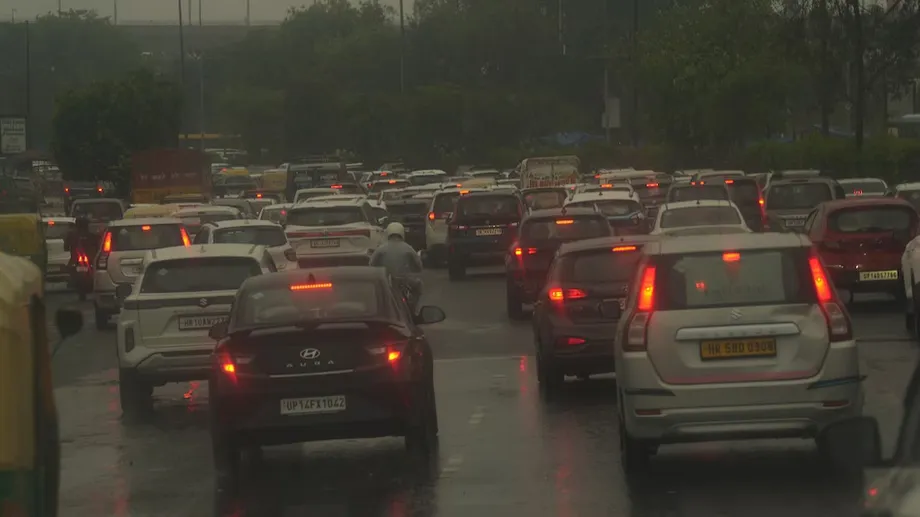
Delhi's citywide air quality index stayed near 304 to 306, in the very poor category, and remained very poor the next morning. The neighborhood readings and the city average describe different scales: one tracks changes at particular locations, while the other describes conditions across the capital.
Air at those levels is unhealthy for all groups and can worsen respiratory and heart conditions. During winter, Delhi and its surrounding region regularly experience particle concentrations many times above World Health Organization guidelines.
For residents, the practical concern is both the depth and duration of any improvement. A temporary fall in pollution offers a short period of relief, while the continuing flow of smoke, dust and exhaust determines how quickly the air worsens again.
How particles released into clouds can produce rain
Cloud seeding changes processes taking place inside an existing cloud. Many clouds contain supercooled droplets, meaning liquid water that remains unfrozen despite being very cold. Those droplets may need a trigger before they grow into particles large enough to fall.
Silver iodide has a crystal structure that encourages ice to form. When released into suitable cold clouds, it provides tiny surfaces around which water can gather and freeze. The growing particles can collide with others and eventually become heavy enough to fall as precipitation.
Sodium chloride and other salts work differently. They attract moisture and can help droplets grow in warmer clouds. The Delhi aircraft carried flares containing both silver iodide and salt crystals.
Cloud seeding cannot create clouds in a clear sky. It can increase precipitation only when clouds already contain enough moisture and have a suitable temperature profile. Tuesday's reported humidity of 10 to 20 percent left the trial well below the 50 to 60 percent range associated with better chances of rain.
Scientists therefore face a weather constraint even before a flight begins. An aircraft, chemicals and an approved flight plan still require a suitable cloud at the right place and time.
What other programs and environmental concerns show
Cloud seeding programs around the world have produced mixed results. Independent evaluations in the western United States have found precipitation gains ranging from single digit percentages to the low teens when conditions were favorable.
The United Arab Emirates reports higher increases during particular missions. Chinese authorities have long used cloud seeding for weather control around major events. Results vary with cloud conditions, and researchers face difficulty measuring exactly how much additional rain an intervention produces because no two clouds are identical and natural variation can mask small changes.
The chemicals used in seeding are released in small amounts and spread over large areas, with their use regulated during flight planning. Some scientists have nevertheless raised concerns that repeated operations could allow salts or silver compounds to accumulate in soil or water.
Evidence about environmental effects over long periods remains limited. Researchers advise monitoring material deposited on the ground and conducting periodic checks around the areas beneath seeded clouds, particularly if flights become frequent.
For Delhi, that makes the proposed duration of the program relevant. A small number of trials and a program continuing through February would involve different levels of repeated activity, making environmental checks part of the evaluation alongside rainfall and air quality measurements.
Why Delhi's winter air becomes trapped
Vehicle exhaust, industrial emissions, construction dust, garbage burning and smoke from crop residue fires in nearby states all contribute to Delhi's haze. Winter weather helps keep that mixture close to the people breathing it.
As temperatures fall, cool, dense air settles near the ground and acts like a lid. Pollution from tailpipes, chimneys, construction sites and trash fires collects underneath it. In late October and November, weaker winds reduce the movement of polluted air, while farm fires add smoke during a narrow harvest period.
PM2.5 and PM10 are categories of small airborne particles. They scatter sunlight and reduce visibility, helping create the thick haze associated with Delhi's smog season.
PM2.5 particles are particularly concerning because they can travel deep into the lungs and enter the bloodstream. Exposure is linked to a greater risk of asthma attacks, heart disease and strokes.
Rain can remove some particles from the air, and a change in wind can carry pollution away. When the weather becomes stagnant again, emissions continuing across the city and surrounding region can cause air quality to deteriorate within days.
Scientists warn that any relief will be brief
Manindra Agarwal, director of IIT Kanpur and a key scientific adviser to the project, said cloud seeding could provide temporary relief when clouds cooperate. He explained that continuing emissions would bring pollution back:
If it rains, pollution comes down, but it will rise again because the source has not gone. Whenever the cloud cover is there, one has to repeat the process.
Supporters see artificial rain as an additional tool for reducing peak pollution and improving visibility without imposing sweeping shutdowns. Government scientists say the pilot is intended as a limited intervention during uncommon weather windows, alongside deeper cuts in emissions.
Krishna Achuta Rao, a professor at the Indian Institute of Technology in New Delhi, argued that weather modification could not substitute for stronger pollution control rules:
Cloud seeding is ineffective for reducing air pollution. It may move the numbers for a day or two. Strong laws that cut emissions from all sources are the only way to clean the air.
Anumita Roychowdhury of the Centre for Science and Environment also called for investment in measures that reduce the pollution being produced:
The impact lasts hours to a couple of days, then the haze returns. Investment should target real reduction of emissions on the ground.
The disagreement concerns how useful that brief improvement might be and how much should be spent to obtain it. Officials point to the particle declines at selected locations as a reason to continue testing. Researchers questioning the approach focus on its short duration and the need to control emissions across the wider region.
What the trials cost and how they will be assessed
Delhi has budgeted about 3.21 crore rupees for five trials, equivalent to roughly 64 lakh rupees per flight. With three attempts conducted so far, officials plan additional sorties in the coming days if suitable cloud cover appears.
A longer program through February is under consideration, subject to the results and available weather windows. No decision on that extension had been announced as of October 29.
Environment officials expect opportunities to arise during western disturbances, weather systems that occasionally bring winter rain to the plains. Flight planners intend to choose target sectors according to wind direction, increasing the chance that any resulting rain falls over Delhi rather than drifting elsewhere.
Each sortie is to be followed by comparisons of precipitation and particle levels in areas where clouds were seeded and areas where they were not. Those measurements are intended to help assess the effect of the operation.
Scientists and civic groups are calling for clear standards for success, independent evaluation and public reporting of flight paths, chemical loads and observed outcomes. They also want checks for measurable deposits on farmland or in groundwater if seeding continues.
Consistency, cost and the amount of relief delivered during severe pollution episodes are the central tests. Rainfall is one measure; the size and duration of any improvement in the air people breathe are others.
Delhi's other measures target the pollution itself
Local and regional authorities activate a graded response as pollution worsens. Measures include stopping most construction and demolition, restricting diesel generators, deploying water sprinklers and vacuum sweepers, and curbing some truck movements.
These steps can reduce dust and soot at the margins, although emissions continue from other activities. Delhi has also tried odd even restrictions on private cars during severe episodes in previous seasons.
The wider campaign covers transport, industry, construction and waste. Policies include stricter vehicle inspections, faster adoption of cleaner fuels and electric buses, tighter controls on emissions from industrial stacks, and shutdown orders for older coal units around the capital.
Crews sprinkle water at large building sites, cover loose materials and operate vacuum sweepers along busy roads. Compliance gaps remain, and enforcement varies across the region.
Cleaner public transport, better connections for the final part of a journey and road dust control throughout the year are among the measures city agencies can expand. Continuous monitoring and transparent reporting can help direct effort toward the largest pollution sources.
Lasting improvements depend on action across the region
Many measures needed to reduce Delhi's smog extend beyond the city's boundaries. Smoke from farm fires requires practical alternatives for handling crop residue, including decomposition in the field and affordable access to balers and mulchers.
Truck pollution calls for stronger inspection systems and cleaner freight corridors across states. Power generation and industry require consistent enforcement of emission limits, continuous monitoring and predictable penalties.
Cloud seeding operates on a different timescale. A successful shower could remove some pollution already in the air during a particular episode. Transport, industrial, power, waste and dust controls determine how much new pollution enters it afterward.
Delhi's next flights therefore depend on favorable clouds, while the larger task remains reducing emissions across the capital and neighboring areas. Scientists involved in the debate agree that sustained cuts at the source are necessary for lasting relief, whether or not later trials succeed in producing rain.
What to Know
- Tuesday's cloud seeding trial produced no measurable rain in Delhi. Noida recorded about 0.1 millimeters and Greater Noida about 0.2 millimeters.
- A Cessna carrying eight silver iodide and salt flares seeded clouds for roughly half an hour over parts of north and northeast Delhi.
- Reported cloud humidity was 10 to 20 percent, below the 50 to 60 percent associated with better chances of rain.
- Delhi's citywide air quality index remained very poor at around 304 to 306, despite reported particle declines at selected locations.
- The project budget is about 3.21 crore rupees for five trials, or roughly 64 lakh per flight. Three attempts had taken place by October 29.
- More flights depend on suitable weather. A program continuing through February is under consideration.
- Scientists say any relief would be temporary while pollution continues from vehicles, industry, power generation, dust and burning.
- Researchers and civic groups want independent evaluation, public reporting and environmental monitoring alongside further trials.