A 40 minute limit could reshape preschool English education
South Korean lawmakers are considering legislation that would ban certain academic lessons for children under 36 months and limit instruction for children ages 3 to 7 to 40 minutes a day. The proposal could force English immersion institutes commonly called English kindergartens to close, setting off a dispute over childhood stress, family spending and parental choice.
Contents
- A 40 minute limit could reshape preschool English education
- Why English kindergartens face disruption
- Entrance tests bring competition into early childhood
- What the proposed restrictions would cover
- Supporters point to children's needs and household costs
- Parents fear fewer choices and a wider education gap
- Earlier restrictions shape the legal and political debate
- Why families feel pressure to start so young
- The ministry is pursuing oversight alongside legislation
- Language exposure and academic pressure are different choices
- Lawmakers must decide where the limits belong
- At a Glance
Rep. Kang Kyung sook and nine other lawmakers introduced the bill to amend the Act on the Establishment and Operation of Private Teaching Institutes and Extracurricular Lessons. It targets academic instruction aimed at admission preparation or globalization, covering both private institutes and tutors. Regional superintendents of education could order classes suspended, close operations or revoke registrations for violations.
As of October 10, 2025, the proposal had been discussed in a parliamentary education committee and referred for further review. It was not yet law. During the public comment period before parliamentary consideration, more than 10,000 comments were submitted, with only a small fraction supporting the measure.
The Education Ministry's latest survey window found that 47.6 percent of children under 7 received some form of private education, with participation rising sharply as children grew older. A separate government figure put total private education spending in 2025 at 32.5 trillion won. Supporters of the bill see an urgent need to reduce pressure on children and household budgets. Opponents fear that restrictions would remove accessible options while leaving wealthy families able to pay for alternatives.
Why English kindergartens face disruption
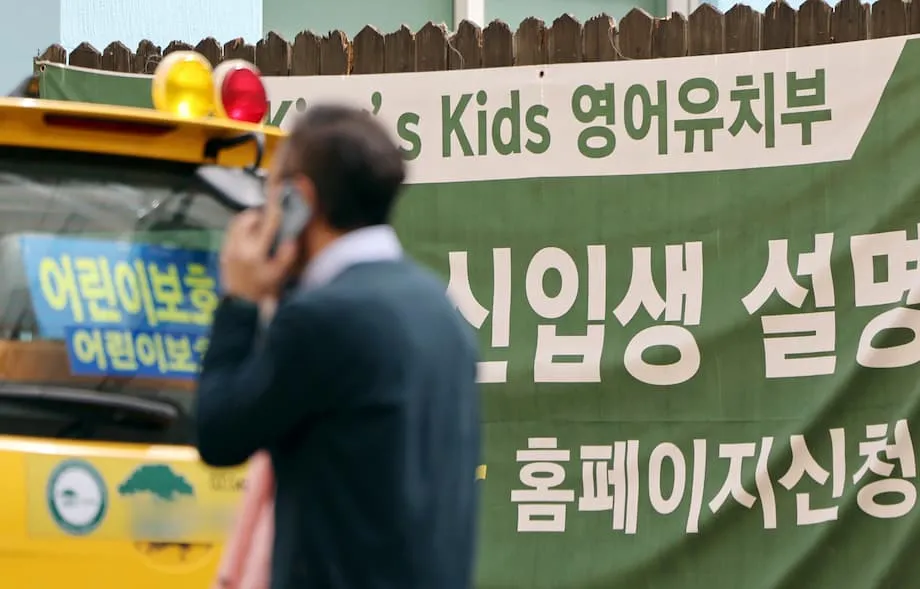
English kindergartens are private teaching institutes, not kindergartens governed by the Early Childhood Education Act. Their familiar name can obscure that legal difference. They combine childcare with English immersion, typically offering programs that last a full day and cost much more than ordinary kindergarten or daycare.
Children spend many hours in classrooms where English is used through songs, books and structured activities. Providers market these programs as an early route toward bilingual fluency and stronger performance later in school. Demand is especially visible in neighborhoods where educational status matters strongly, while the fees draw criticism from advocates concerned about unequal access.
Ms. Hwang, a Seoul mother who moved her child from a private kindergarten into an English immersion program, described why some families accept the financial burden.
Even though the tuition is nearly five times higher, I still recommend English kindergartens.
A 40 minute daily ceiling on the academic instruction covered by the bill would challenge the way these institutes operate. Their appeal rests partly on children spending much of the day using English. Whether particular activities fell within the restriction would therefore matter to their ability to continue offering existing programs.
Entrance tests bring competition into early childhood
Competition for places has produced admissions practices that resemble the examination culture associated with older students. Parents describe level tests for children ages 5 to 7 and interviews used to screen applicants. Some families seek tutoring even for toddlers to prepare them for entry.
The phrase gosi for 4 year olds captures parental frustration with this early competition. Gosi refers to the demanding examination tradition associated with civil service recruitment. Applied to preschoolers, it describes the feeling that children must begin preparing for selection before they have entered formal schooling.
The Education Ministry identified 23 institutions nationwide that administered admissions tests and urged providers to replace them with consultations or lotteries. Critics say that figure understates the practice, pointing to surveys that found many more schools using testing before enrollment.
The ministry's advice cannot itself be enforced. Inspections can address advertisements for tests, but parents report that informal screening remains common. For families who believe admission depends on prior English skills, the incentive to begin lessons early persists even when a provider changes its stated admissions procedure.
What the proposed restrictions would cover
The bill draws its main boundary at 36 months. Below that age, it would prohibit academic lessons aimed at admissions preparation or globalization. For children ages 3 to 7, instruction of that kind would be limited to 40 minutes each day.
Private tutors would be covered alongside institutes operating for profit. The proposal therefore reaches beyond businesses using the English kindergarten label. Regional education authorities would have powers to suspend classes, shut operations or cancel registrations when they found violations.
Supporters want to reduce incentives for intensive programs built around tests and admission preparation from the toddler years. They also want early education to give more space to play and activities suited to children's development, while bringing a rapidly expanding private market under closer oversight.
The meaning of academic lesson, admission preparation and globalization would need to be made clear in practice. Regulators would have to distinguish restricted teaching from permitted activities, including play involving English. Those definitions would affect both what families could purchase and how institutes would organize a child's day.
Supporters point to children's needs and household costs
Early childhood experts and many teachers argue that formal academic English lessons do not fit the way very young children learn. Their concern is that long periods of study can displace play and social development while adding stress for children and parents.
A large share of early childhood educators surveyed by a civic group opposed private education for toddlers. Supporters of restrictions also point to uneven instructor qualifications and the absence of standardized curricula across these programs. They see the bill as a response to both educational pressure and gaps in oversight.
An official in Rep. Kang's office connected the proposal to the scale of household spending on private education.
In a situation where such expenses exceed more than half of the national defense budget, it is necessary for the Assembly to find ways to help parents who are struggling with these costs.
Advocates argue that formal English study can begin in elementary school without damaging outcomes over the longer term. They say children can still encounter English through activities at home or in their communities, without families entering an expensive contest for an early advantage.
The financial argument extends beyond individual tuition bills. When parents believe other children are advancing through paid lessons, they may feel pressure to buy similar instruction even if the cost is difficult to manage. Supporters hope restrictions would weaken that pressure.
Parents fear fewer choices and a wider education gap
Opponents describe the proposal as excessive state control over family decisions. Parents give several reasons for seeking early English exposure: easing pressure later in school, supporting children in multicultural families and combining structured care with language learning.
Many worry that eliminating legal options at moderate prices would push demand toward more expensive arrangements. Families able to afford private tutors or small groups might retain access, while others would lose programs they currently use.
A mother in Gimpo who sends two children to local programs described her concern about unequal access.
This could end up widening the education gap between the rich and poor. It would be ironic if the ban ends up limiting access for most families but not the wealthy.
Parents also expect providers to adapt. Some anticipate smaller tutoring groups; others expect programs to present themselves as centered on play while continuing similar instruction. A change in business names or marketing could leave families facing the same competition through less visible channels.
The disagreement is therefore partly about which policy would reduce inequality. Supporters want to restrain a costly race that starts too early. Opponents fear that restricting established providers would make the remaining routes harder for ordinary households to afford.
Earlier restrictions shape the legal and political debate
South Korea's experience with private education controls gives the current proposal a legal backdrop. A broad ban on private tutoring introduced in 1980 was struck down by the Constitutional Court in 2000. The court stressed limits on state control and the need to leave room for parental wishes.
Lawyers watching the new bill say those principles could support a challenge if the final restrictions are too sweeping or vaguely defined. The proposed age limits and lesson ceiling would therefore need to be considered alongside the constitutional questions raised by government control of private education.
A more recent attempt to limit early English education also met resistance. In 2018, a government effort to curtail English lessons in public kindergartens and daycare centers was postponed after strong parental opposition, while demand flowed toward private academies.
The key events leading into the current debate are:
- 1980: A broad prohibition on private tutoring was enacted.
- 2000: The Constitutional Court struck down that prohibition.
- 2018: Restrictions on English lessons in public kindergartens and daycare centers were postponed after parental backlash.
- October 10, 2025: The current bill remained under further parliamentary review after discussion in an education committee.
The 2018 experience matters to parents who fear that restrictions in one part of the education system can redirect demand elsewhere. The current proposal covers private institutes and tutors, making its reach broader across the paid lessons families might choose.
Why families feel pressure to start so young
South Korea combines strong educational achievement with intense competition. Families spend heavily to improve access to desirable schools and, eventually, leading universities. That pressure reaches preschool years when parents fear that an early gap will become difficult to close.
English has a particular place in those calculations. Parents associate proficiency with opportunities to study abroad, enter sought after secondary schools and secure desirable jobs. English immersion programs sell an early start toward those goals, at fees that can be many times those of public kindergartens.
Government surveys put average monthly private education spending per preschooler in the hundreds of thousands of won. Participation among children aged 5 exceeds 80 percent. That is more than four in five children at that age, compared with fewer than half across the broader group of children under 7.
The difference helps explain why the debate becomes more urgent as children approach school age. Private education is already common across early childhood, but it becomes much more widespread among older preschoolers. Parents making decisions for one child are also responding to what they believe other families are doing.
International bodies have flagged the stress that can arise when children's learning becomes a contest with major perceived consequences too early. The policy dispute centers on how to ease that pressure without simply moving spending into another part of a private market that often grows faster than regulatory efforts.
The ministry is pursuing oversight alongside legislation
The Education Ministry has established a temporary task force to examine the rise of private education for young children and propose ways to reduce pressure. Officials have signaled support for closer oversight of programs that combine care and instruction without meeting standards expected of schools.
A ministry official involved in early childhood policy described the purpose of the legislative review.
To curb side effects like the so called gosi for 7 year olds, we are reviewing possible legislation.
The ministry has also urged fairer admissions, asking institutes to abandon entrance testing and avoid marketing aimed at toddlers. These steps address the practices that encourage families to prepare children for selection at increasingly young ages.
Regulators have separately discussed joint inspections with other agencies covering facility safety, pricing rules and correct use of the word kindergarten in business names. Those measures would complement any framework adopted by the National Assembly.
Enforcement would require more than a formal rule. Regional education offices would need to oversee many businesses with limited staff, while identifying tutoring groups or other arrangements that are harder to monitor. Clear definitions and sustained inspections would shape whether providers changed their teaching or mainly changed their labels.
Language exposure and academic pressure are different choices
Linguists generally find that early exposure can help children become comfortable with unfamiliar sounds and support pronunciation. That potential benefit can exist even when formal academic study begins later. Exposure through conversation, songs, stories and games differs from extended lessons designed around tests.
Short daily contact with English is unlikely to hamper development of a child's mother tongue when Korean remains widely used at home and in the community. Many studies find that the mother tongue remains dominant in early childhood and supports later learning of another language.
Child development specialists focus on the conditions in which learning happens. Young children benefit from play, social interaction and rich language input in both their home language and any second language. Long lessons, repeated drills and preparation for admissions can add stress without producing large gains over the longer term.
This helps explain why some experts support limits on academic English instruction for preschoolers while accepting playful exposure. The central issue is the child's experience: how much time is spent learning, what activities fill that time and whether the child faces pressure to perform for entry into another program.
Lawmakers must decide where the limits belong
The National Assembly must weigh parental opposition, constitutional concerns and demands to protect children from early academic pressure. Negotiations could refine the definitions, adjust the 40 minute ceiling or consider exceptions for multicultural families and public programs that meet strict standards.
As of October 10, no date had been given for a final decision. The practical details also remained unsettled, including how inspectors would measure lesson time, what records institutes would keep and how admissions preparation would be identified.
Education offices would need staff and budgets to oversee thousands of providers. Clear guidance would be necessary for families and businesses to understand which activities remained permitted and which would trigger penalties.
Parents are watching both access and price. If established options at moderate prices disappear, more expensive alternatives could take a larger role. Supporters are watching whether any final law meaningfully reduces pressure on children. The outcome depends on the restrictions lawmakers approve, the resources available to enforce them and the response of the private education market.
At a Glance
- A bill would ban certain academic lessons for children under 36 months and cap covered instruction for ages 3 to 7 at 40 minutes daily.
- Rep. Kang Kyung sook and nine other lawmakers introduced the proposal, which covers private institutes and tutors.
- English kindergartens are registered as private teaching institutes, rather than kindergartens under the Early Childhood Education Act.
- Violations could bring class suspensions, closures or cancellation of registrations.
- More than 10,000 public comments were submitted, with only a small fraction supporting the bill.
- The Education Ministry found private education participation of 47.6 percent among children under 7; participation among children aged 5 exceeds 80 percent.
- Supporters cite childhood stress and household costs. Opponents cite parental choice and the risk of wider inequality.
- The ministry has formed a task force, urged alternatives to entrance tests and considered further legislation and inspections.
- The bill remained under parliamentary review on October 10, 2025, with definitions, enforcement arrangements and constitutional concerns still unresolved.