A border fraud empire faces its harshest reckoning
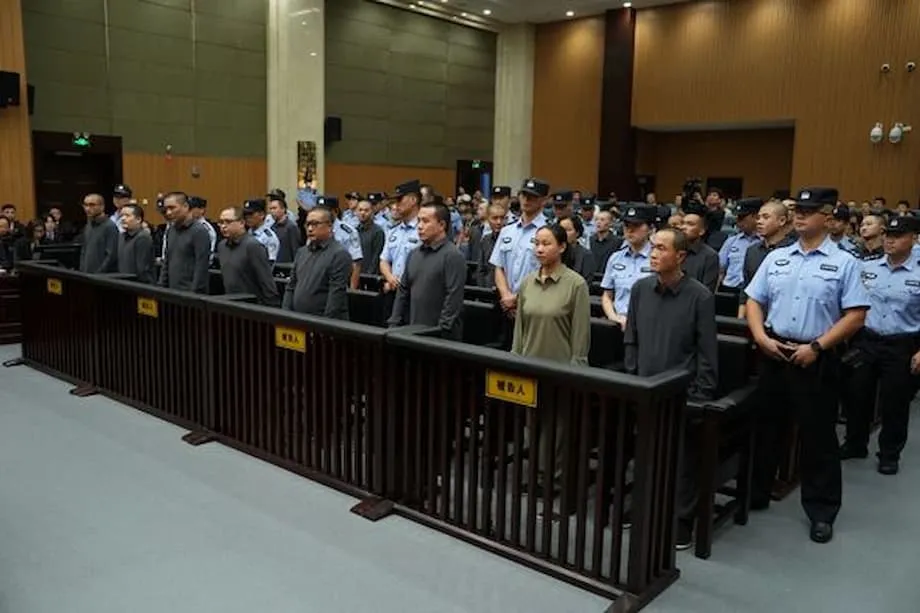
A court in eastern China has sentenced 11 members and associates of the Ming family to death for running a vast criminal network in northern Myanmar that combined online scams and gambling with armed confinement, violence and killings. The Wenzhou Intermediate Peoples Court in Zhejiang province attributed at least 10 deaths to the group, including four people killed in a shooting at a scam compound in October 2023.
Contents
- A border fraud empire faces its harshest reckoning
- What the court found inside the Ming network
- How Laukkaing became a center of the business
- How an online relationship became a financial trap
- Where the money went
- The violence and crackdown of late 2023
- The people trapped behind the screens
- Why returnees could be treated as suspects
- Why China tried the case and what the sentences mean
- Pressure closes compounds while networks seek new bases
- Key Points
Five other defendants received death sentences with a reprieve of two years, while 12 were sentenced to prison terms ranging from five to 24 years. The different penalties distinguish between those facing immediate execution, those whose death sentences may be reduced, and those given fixed prison terms.
The court found that the network controlled compounds in Myanmar's Kokang region and operated telecommunications fraud, illegal casinos, organized prostitution and drug trafficking. Prosecutors said workers who tried to escape or disobey orders were among those killed. Armed guards and the threat of punishment helped keep the operation running.
The verdict named leading figures including Ming Guoping, a key figure in the Kokang Border Guard Force, his relative Ming Zhenzhen, and associate Zhou Weichang. Other convicted family figures had ties to the force and to prominent compounds in Laukkaing, the Kokang capital near China's Yunnan border.
The family patriarch, Ming Xuechang, died in custody in late 2023 after Chinese authorities issued arrest warrants. The sentences against his relatives and associates mark one of the harshest outcomes yet in China's campaign against fraud networks operating beyond its borders.
What the court found inside the Ming network
The criminal enterprise began building its network of scam parks and casinos in 2015. According to the verdict, its leaders recruited financial backers and hired armed enforcers, creating an organization that could raise money, house large numbers of workers and use force to maintain control.
Charges covered fraud targeting the public at large, illegal detention, violent assaults and the killing of people attempting to escape. The prosecution described an operation in which online deception depended on physical control: people inside the compounds worked at phones and computers, while guards restricted their movement.
At its peak, the Ming organization had a workforce of up to 10,000 across its compounds. Crouching Tiger Villa became the most infamous site, associated in survivor accounts with harsh discipline and relentless production targets. Workers who failed to meet quotas faced beatings, fines or transfer to supervisors who treated them more severely.
Managers trained recruits to use false identities, build extended online relationships and direct targets toward fraudulent trading platforms and investment schemes. Passports were confiscated, movement was tightly restricted and armed guards prevented escapes. The compounds provided the buildings, equipment and coercion needed to keep large numbers of people contacting potential victims.
The network's businesses also extended beyond fraud. Casinos, prostitution and drug trafficking formed part of the criminal enterprise described by the court, placing the scam operations within a wider system of illicit income and armed authority.
How Laukkaing became a center of the business
Kokang lies in Myanmar's northern Shan State, a rugged frontier shaped by prolonged conflict, porous borders and close economic connections with China. Laukkaing developed from a relatively obscure outpost into a casino town illuminated by neon, with sprawling compounds where thousands worked on phones and keyboards.
Money laundering accompanied the gambling business. Casinos and other channels helped move criminal proceeds through an economy in which local power, militia activity and commercial interests were closely connected.
The Ming family was one of the so called four families of northern Myanmar. These families became influential power brokers, with roles in local administration and militia forces aligned with Myanmar's ruling military junta. The Ming network's links to the Kokang Border Guard Force placed members close to armed structures as well as commercial operations.
The location mattered to the people caught inside the compounds. Laukkaing stood near China, yet armed control and restrictions on movement could make escape extremely difficult. Deep economic links across the frontier helped the town grow, while conflict and weak border controls gave criminal businesses room to operate.
How an online relationship became a financial trap
Scam teams contacted people through messaging apps, dating platforms and social networks, sometimes launching hundreds of conversations a day. Their method relied on social engineering, which means manipulating someone's trust and emotions to persuade them to hand over money or information.
Workers were trained to learn a target's habits, fears and financial position. One of the most lucrative methods combined a supposed romantic relationship with investment advice, a scheme often called pig butchering. An operator would build trust over time, then introduce an apparently safe investment website.
The platform might display small early gains to encourage confidence. The target would then be pressed to transfer larger sums. When the person tried to withdraw money, the platform demanded invented taxes or fees, or disappeared altogether. What looked like a growing investment was a mechanism for extracting further payments.
Managers used scripts and technology to make these approaches convincing. Fake investment dashboards resembled legitimate brokerage services. Automated translation allowed workers to contact people in other languages, while artificial intelligence increasingly helped produce believable photographs, profiles and replies.
Voice cloning and manipulated video could support impersonation scams, and bots sent bulk messages to speed up initial contact. Human handlers still made crucial decisions: they sorted targets into categories, judged when to request money and used emotional pressure. When someone hesitated, operators could stage interventions by fake customer support staff to keep payments moving until accounts were drained.
Where the money went
Fraud proceeds moved through cash couriers, cryptocurrency wallets and businesses used as fronts. Multiple transfers helped hide the route between the person who lost money and the people receiving it. Casinos and underground banking channels then helped move the proceeds back into the formal financial system.
The scale extended far beyond a single family or town. A recent assessment by the United Nations Office on Drugs and Crime put annual proceeds from cyber scams across Southeast Asia in the tens of billions of dollars. Research groups estimated annual victim losses across East and Southeast Asia at roughly $40 billion to $43 billion.
Those regional figures describe a much larger criminal economy than the Ming organization alone. Targets now stretch from East Asia to Europe and North America, allowing operators based in Southeast Asian compounds to seek money from people living thousands of kilometers away.
For investigators, the movement of funds creates a practical challenge. A victim may send money through one service, while the proceeds pass through wallets, intermediaries and businesses in several places. Private messaging and cryptocurrency platforms complicate the work of tracing assets and assembling evidence across borders.
The violence and crackdown of late 2023
October 2023 brought both a deadly incident inside the Ming operation and a wider military offensive against the centers of power around it. Prosecutors described a shooting during an attempted transfer of captive workers after the group learned that police planned to raid a compound.
Armed members tried to move the workers under guard. When people resisted, gunmen opened fire, killing four. The court included the shooting in its account of the violence used to preserve control as pressure on the operation increased.
An alliance of ethnic armed groups also launched a broad offensive against Myanmar's military across northern Shan State in October 2023. Rebel leaders publicly presented attacks on Laukkaing and nearby hubs as an effort to shut down large scam centers that preyed on people across the region.
Analysts widely assessed that Beijing had signaled support for action that would disrupt the scam economy along its frontier. China had long pressed for measures against fraud operations harming Chinese nationals. Within weeks, Chinese authorities intensified their campaign against telecommunications fraud, focusing on criminal networks operating across borders in the Golden Triangle.
The main developments unfolded over several years, with the sharpest acceleration in late 2023:
- From 2015: The Ming enterprise developed its network of scam parks and casinos, recruited backers and hired armed enforcers.
- October 2023: Four people were killed during an attempted transfer of captive workers. An alliance of ethnic armed groups launched its offensive across northern Shan State that month.
- November 2023: Chinese police issued warrants for leading Ming family figures and offered public rewards for information.
- Late 2023: Ming Xuechang died in custody. By the end of the year, authorities reported that more than 53,000 Chinese suspects and trafficked victims had been returned from northern Myanmar for screening and investigation.
- By October 3, 2025: The Wenzhou court had imposed death sentences on 11 members and associates, death sentences with reprieves on five others, and prison terms on another 12.
The November warrants concerned suspected fraud, murder, trafficking and illegal detention. Joint pressure from China, Myanmar and Thailand also led to prominent raids along the Thai border with Myanmar and the mass release of detained workers.
The people trapped behind the screens
International organizations estimate that more than 100,000 people, many of them Chinese citizens, have been lured into scam centers across Myanmar, Laos and Cambodia in recent years. Recruitment often begins with advertisements promising well paid sales or technology jobs.
Applicants are guided through airports or across land borders. On arrival, they can find themselves confined in guarded buildings, forced to work long hours and punished for missing targets. Survivors describe electric shocks, beatings and stress positions. Families receive ransom demands tied to supposed debts for training or housing.
The Kokang compounds followed this pattern. Dormitories, cafeterias, training halls and surveillance systems made them function like company towns, except workers could be prevented from leaving. Some were traded between gangs, increasing their supposed debts and cutting them off further from help.
Crouching Tiger Villa became a symbol of fear among recruits and prompted repeated complaints from families across the border in Yunnan. Accounts of torture and reported killings used to deter escape fueled public anger in China and demands for decisive action.
The human harm ran in two directions. People outside the compounds lost savings through deception, while people inside could be forced to carry out that deception under threats of violence. Investigations therefore had to examine both the fraud committed and the conditions under which individuals participated.
Why returnees could be treated as suspects
Chinese police often classify people returning from scam compounds as suspects because they took part in fraudulent activity, even when coercion brought them into the operation. Investigators then seek to distinguish organizers, recruiters and violent enforcers from people forced into lower ranking roles.
People found to have suffered trafficking or illegal detention can receive assistance or lighter penalties. Planners, managers and armed guards face severe punishment. For an individual returning from a compound, the assessment can determine whether the authorities focus on their exploitation, their criminal responsibility or both.
Human rights groups and legal scholars caution that rapid operations create a risk of misclassifying victims. Detailed screening and access to victim services are therefore crucial, especially when large groups are transferred at once.
The figure of more than 53,000 returnees from northern Myanmar included both Chinese suspects and trafficked victims. Screening and investigation were needed to establish individual circumstances within that large group.
Why China tried the case and what the sentences mean
Chinese law permits prosecution of certain crimes committed abroad when the offender is a Chinese national or when the crime targets Chinese citizens and national interests. Many victims of the Kokang scams were Chinese, and investigators connected the operations to fraud cases and money flows affecting communities across China.
The capture and transfer of leading suspects from Myanmar into Chinese custody enabled a domestic trial in Wenzhou. Courts in provinces handling large numbers of related cases sometimes bring complex prosecutions together to concentrate investigative resources.
China applies capital punishment to a set of grave offenses, including violent crimes and leadership of large criminal enterprises responsible for deaths. The Wenzhou judgment combined immediate death sentences for core leaders with reprieved death sentences for others considered somewhat less culpable.
A death sentence with a reprieve of two years is different from an immediate death sentence. During the reprieve, the prisoner has an opportunity to qualify for a reduced punishment. If the person commits no intentional offenses during that period and meets the other conditions, the sentence is typically reduced to life imprisonment or a fixed prison term.
Courts may use this penalty in serious cases involving cooperation or remorse, or where they reserve the possibility of reducing the sentence. The approach in Wenzhou fits recent prominent cases involving violent organized crime and telecommunications fraud, combining severe punishment with the possibility of commutation where the law allows it.
The judgment forms part of a broader government campaign against networks that combine cybercrime, money laundering and physical violence in conflict zones and border enclaves. No date for the executions was given.
Pressure closes compounds while networks seek new bases
Operations against Kokang and hubs along the Thai border with Myanmar have disrupted many compounds. Criminal networks have responded by moving toward other locations, including parts of Cambodia and Laos, or spreading staff across apartments and rural facilities rather than concentrating everyone in large compounds.
The Golden Triangle Special Economic Zone in Laos and coastal cities in Cambodia have experienced cycles of growth and official pressure. When controls tighten in one place, recruiters can redirect workers toward another border town or develop new groups operating online.
Artificial intelligence reduces the effort needed to create convincing profiles and outreach messages. At the same time, cryptocurrency platforms and private communications make financial tracing and evidence collection more difficult. Closing a physical compound addresses one part of an operation whose recruitment, communications and payments can reach across many countries.
The response described by the crackdown requires continuing cooperation between police and financial intelligence units, faster action by banks and exchanges to freeze suspicious funds, and stronger oversight of employment in special economic zones. Victims also need sustained assistance.
Families need safe ways to report suspected trafficking, and trapped workers need routes out without fear of retaliation. Military action and courtroom penalties sit alongside prevention, public education and cooperation across borders in the effort to stop the business from rebuilding elsewhere.
Key Points
- The Wenzhou court sentenced 11 Ming family members and associates to death over a criminal network based in Myanmar's Kokang region.
- Five others received death sentences with reprieves of two years, while 12 received prison terms of five to 24 years.
- The court attributed at least 10 deaths to the group, including four people killed in an October 2023 shooting.
- The network began developing its operations in 2015 and employed up to 10,000 people at its peak.
- Ming Xuechang died in custody in late 2023 after Chinese authorities issued arrest warrants.
- More than 53,000 Chinese suspects and trafficked victims had been returned from northern Myanmar by the end of 2023 for screening and investigation.
- Reprieved death sentences are typically reduced if prisoners commit no intentional offenses during the reprieve and meet other conditions.
- Crackdowns have disrupted compounds, while networks have sought other locations and more dispersed operations.