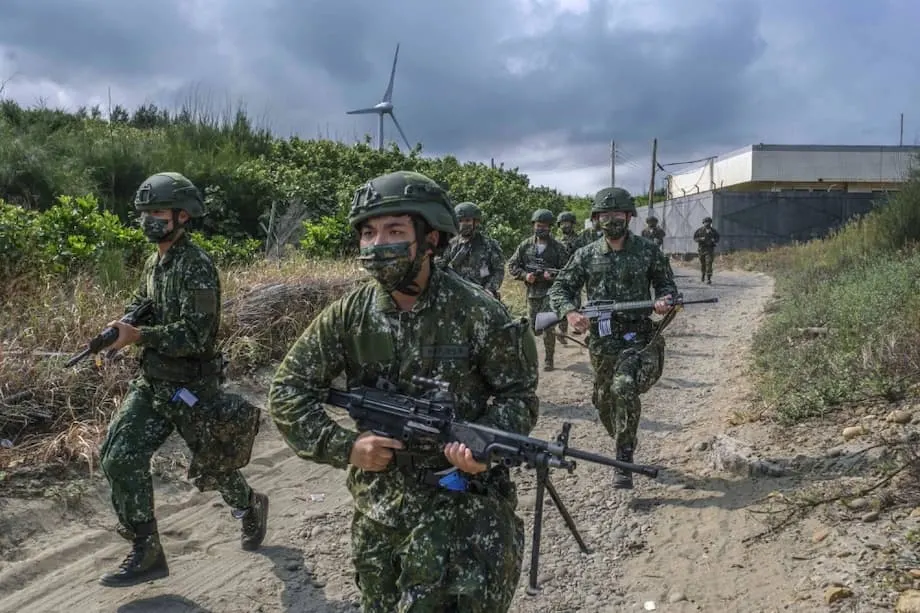
More military power, no easy route to victory
A crossing of roughly 130 kilometers, a limited number of usable landing sites, and the need to supply hundreds of thousands of troops would stand between China and a successful occupation of Taiwan. As of September 24, 2025, Beijing has more ways to pressure the island, but an invasion would still require one of the most complex and punishing military operations of the modern era.
Contents
- More military power, no easy route to victory
- Why the strait and shoreline favor Taiwan
- Getting ashore would only begin the supply problem
- How Taiwan aims to slow and survive an assault
- Pressure without a landing
- What Washington and regional allies could do
- The economic costs would reach far beyond Taiwan
- What drills and war games reveal
- Political triggers and the reasons for restraint
- At a Glance
China's military buildup and frequent exercises around Taiwan have intensified discussion of an imminent attack. Speculation that unification is a central legacy goal for President Xi Jinping has added to that concern. The most alarming argument is that the military balance has shifted decisively toward Beijing. Yet greater firepower does not solve the problems of crossing the strait, capturing territory, keeping an army supplied, and controlling a population with little appetite for rule by Beijing.
The People's Liberation Army (PLA) would need to coordinate operations in the air, at sea, on land, in cyberspace, and in space, while using electronic warfare to disrupt enemy communications and sensors. Each part would depend on the others. Ships would need protection from aircraft and missiles, troops would need supplies, and commanders would need reliable information while defenders tried to break those connections.
Taiwan's geography, its defensive preparations, and the possibility of foreign intervention would all complicate that task. Economic damage would extend beyond the island, reaching China's trade dependent economy and the global companies that rely on Taiwanese chips and regional shipping routes.
Beijing can punish, disrupt, and coerce Taiwan without occupying it. Converting that pressure into lasting control is a much larger undertaking. The possibility of failure remains a restraint even as China's military options expand.
Why the strait and shoreline favor Taiwan
The Taiwan Strait is about 130 kilometers wide at its narrowest point. Strong currents, frequent storms, long swells, and shallow areas make it a difficult route for a large invasion fleet. Safer crossing windows are limited, most often occurring in late spring and early autumn.
A large armada moving during those windows would be difficult to conceal. Amphibious ships, civilian ferries, and supply vessels would spend hours exposed to attack while sailing within range of Taiwanese forces and potentially allied forces. Sea mines, naval drones, submarines, and aircraft carrying missiles designed to strike ships could threaten the formation.
China's escorts would have several jobs at once: suppressing missile launchers on Taiwan, defending the transport fleet, and keeping their own air defenses functioning under sustained attack. Even strong protection would leave a large, relatively slow convoy vulnerable.
Taiwan's coastline further narrows the choices. Steep cliffs and deep water line much of the east coast. The west coast has shallow approaches and mudflats, with only a handful of beaches and ports suitable for landing heavy equipment. Those locations are well mapped, mined, and covered by sensors and defensive fire.
Heavy vehicles could become stuck on mudflats or on stretches of shore whose accessibility changes with the tide. Once inland, an invading force would face rivers, mountains, and a limited number of road and rail corridors. Taipei lies in a basin surrounded by heights, with access through choke points that defenders could block or demolish.
Normandy offers a useful comparison of the demands involved. The Allied landing required absolute superiority in the air and at sea, elaborate deception, and artificial harbors to sustain troops. An assault on Taiwan would involve greater crossing distances, faster modern weapons, and persistent surveillance. Its scale would dwarf famous amphibious assaults of the past, while giving defenders repeated opportunities to interrupt the operation.
Getting ashore would only begin the supply problem
The PLA has expanded its capacity to transport troops with large amphibious transport docks and assault ships. Those vessels alone, however, cannot carry the mass needed for a rapid conquest. Civilian ferries that allow vehicles to drive aboard and drive off are expected to supplement military shipping.
Such ferries can transport troops and vehicles quickly, but they are large and lightly protected. They also depend on functioning ports or safe places to unload. Capturing a beach would therefore leave China with another urgent task: creating a dependable route from ships offshore to forces fighting inland.
China appears to be experimenting with modular water bridge vessels that connect into floating causeways. These would act as temporary roads between ships and the shore, echoing the temporary harbor concept used during World War II. In theory, civilian ferries could use them to unload tanks and trucks without a port.
Assembly would take time, and the connected structure would be difficult to defend against missiles, artillery, drones, and special operations forces. A well aimed strike on the section closest to shore could break the route and leave ships stranded offshore.
Hundreds of thousands of troops and their equipment would also require continuing deliveries after the initial crossing. Intense combat consumes fuel, ammunition, spare parts, medical supplies, and replacement personnel rapidly. Each ton delivered would have to move from beaches or makeshift piers onto roads vulnerable to strikes, landslides, and destroyed bridges.
Landing areas would become concentrated targets because both troops and supplies would pass through them. Without secure ports and airfields on Taiwan, the supply network behind the invading army would be fragile. A successful first landing could still leave forces unable to maintain the pace of their advance.
How Taiwan aims to slow and survive an assault
Taiwan has shifted from trying to match China in conventional battles toward a porcupine model of defense. The idea is to make an attack too painful to complete: survive the opening strikes, continue firing accurately, and prevent the PLA from quickly expanding the territory it controls.
Layers of sensors, mobile missile launchers, sea mines, small fast attack craft, and dispersed air defenses support that approach. Territorial units trained for guerrilla tactics could keep fighting in smaller groups rather than depending entirely on large formations or fixed bases.
Along the shoreline, concrete obstacles, spikes intended to obstruct landings, and planned minefields would complicate movement. Mobile batteries armed with Harpoon and Hsiung Feng missiles can move, fire, and hide. Short range air defenses and portable missiles such as Stinger would threaten aircraft flying low and helicopters trying to insert troops.
Taiwan's air force would face a difficult fight for control of the skies. Preserving aircraft, using decoys, and keeping runways usable would help it return to action when opportunities appeared. Hardened shelters, rapid runway repairs, and dispersed command posts would improve the chances of surviving the first attacks.
Cities and mountains would create another layer of resistance. In urban areas, small mobile teams could use ambushes and improvised obstacles to slow mechanized forces. Intersections could be covered by defensive fire, stairwells trapped, and streets blocked with wreckage. Even a modest resistance force could greatly slow an advance through a city of millions.
Mountain terrain would restrict attacking columns to roads, where ambushes and artillery from concealed positions could strike them. Civil defense training, reserve mobilization, and mission command would help sustain resistance if central command facilities were disrupted. Mission command means giving local leaders enough authority to keep acting toward a shared goal when detailed instructions cannot reach them.
Taiwan's objective would be to deny a quick victory. Every delay would give losses, supply shortages, and political pressures more time to weaken the invading force's momentum.
Pressure without a landing
Beijing has options between routine pressure and an invasion. A quarantine led by law enforcement agencies could slow or inspect shipping near major Taiwanese ports under the stated purpose of enforcing safety or customs rules.
China's coast guard, the world's largest, often operates alongside a maritime militia that blurs the boundary between civilian activity and state action. A quarantine would seek cooperation from shipping companies and insurers without declaring a formal blockade. It would be less escalatory than closing the strait outright, while still imposing economic costs on Taiwan.
Beijing has also constructed a domestic legal framework for possible action. The 2005 Anti Secession Law sets out conditions for force if Taiwan moves decisively toward permanent separation or if Beijing considers peaceful unification impossible. Chinese state messaging presents Taiwan as an internal matter beyond outside interference.
Chinese officials frequently invoke the law when describing red lines. The statute authorizes force under specified conditions, with its position expressed in the following wording:
Chinese state law authorizes the use of non-peaceful means and other necessary measures if possibilities for a peaceful reunification are completely exhausted.
Laws giving maritime agencies broad authority to regulate activity in waters China claims reinforce that approach. Temporary exclusion zones announced during military exercises also allow Beijing to restrict activity while presenting the measures as part of domestic administration.
A campaign framed as policing would complicate decisions for foreign navies and coast guards. Shipping firms would have to weigh alternative routes against the risks of refusing inspections or restrictions. This gray zone approach, meaning coercion below the clear threshold of war, could steadily increase pressure without producing a single obvious trigger for an outside military response.
What Washington and regional allies could do
The United States maintains strategic ambiguity over Taiwan, leaving uncertainty about precisely when and how it would intervene. The Taiwan Relations Act of 1979 commits Washington to provide defensive arms and maintain the capacity to resist coercion, but it creates no formal defense treaty.
The act nevertheless places coercion against Taiwan within America's security concerns. Its statement of United States policy says:
The United States regards any effort to determine the future of Taiwan by other than peaceful means, including by boycotts or embargoes, a threat to the peace and security of the Western Pacific area and of grave concern to the United States.
A limited quarantine could bring diplomatic pressure, sanctions against officials, assistance to Taiwan's coast guard, and increased patrols by allied navies. A blockade or invasion would likely bring a wider range of military options into consideration.
Possible measures include intelligence sharing, cyber operations, early deliveries of critical ammunition, and strikes against Chinese naval assets if ordered. American stealth bombers, attack submarines, and aircraft carrying missiles against ships are designed to operate in heavily defended regions. New systems such as the B 21 bomber are intended for penetrating strikes and attacks launched from a distance, further complicating Chinese planning.
Japan and the Philippines would face consequential choices over access and support. Japan controls routes important for resupply and has developed doctrine and missile forces for defending remote islands. The Philippines has expanded access for United States forces at key locations facing the Taiwan Strait and the South China Sea.
Australia, South Korea, and European partners could contribute logistics, coordinated sanctions, and a maritime presence. United States laws, military posture, and alliances point toward a response if coercion becomes war, yet the form of that response would depend on decisions in each capital. Allied intervention is not guaranteed; domestic politics, willingness to accept risk, and economic exposure would shape those choices.
The economic costs would reach far beyond Taiwan
Taiwan is a center for advanced semiconductor production, including chips made by the world's most advanced manufacturers. Interruptions would affect phones, servers, cars, and medical devices. The economic consequences would reach businesses and households far from the fighting.
Shipping through the strait and surrounding waters carries a large share of global trade. Vessels forced to take alternative routes would spend more time at sea and incur higher costs. Insurance premiums would rise as companies assessed the danger to ships and cargo.
China would face its own exposure because its economy is deeply connected to global markets. Sanctions on banks, restrictions on access to critical technologies, and informal boycotts could weaken growth. Energy imports would face additional strain if insurers limited coverage or naval disruption spread beyond the immediate conflict area.
Taiwan would suffer immediate damage, while China would also pay a heavy economic price. Market uncertainty could discourage investment. A prolonged confrontation could push companies to diversify away from Chinese supply chains more quickly, extending the costs beyond the duration of the fighting.
For Beijing, these risks sit alongside the military problem. An invasion would have to achieve its political objective while China absorbed disrupted trade, financial pressure, and possible sanctions. Raising pressure without attempting occupation offers more room to adjust the scale of action.
What drills and war games reveal
China has conducted frequent air and sea exercises around Taiwan, including large displays of force that simulate encirclement. Such operations demonstrate an ability to apply pressure and send political messages. A real campaign would also have to overcome weather, supply demands, and sustained enemy fire.
Taiwanese residents often continue daily life while alerts and international headlines intensify. That difference in reactions reflects the gap between exercises that can be scaled for messaging and the demands of an invasion whose course would be shaped by resistance.
Taiwan tests its preparations through the annual Han Kuang exercise cycle. Tabletop simulations and field drills examine command resilience, backup communications, and coordinated responses to both gray zone harassment and intense warfare.
Practical tasks include relocating command posts after strikes, keeping aircraft dispersed and flying, and coordinating coastal defensive fire during electronic attacks. The purpose is to find weaknesses and correct them rather than achieve a scripted victory.
Civil organizations in Taipei have also hosted operational tabletop exercises involving retired generals from Taiwan, Japan, and the United States. These examine possible Chinese actions through 2030, often beginning with harassment, escalating to attacks on outlying islands, and then progressing to an attempted landing on Taiwan itself.
The exercises reinforce the central military problem: a rapid knockout would be unlikely. Taiwan's defenders would aim to survive successive stages and complicate China's plans at each step. A landing would be followed by the separate challenges of expanding control, maintaining supplies, and sustaining an occupation.
Political triggers and the reasons for restraint
Chinese leaders connect Taiwan to sovereignty and national rejuvenation, while also signaling patience when the costs of action appear high. Dates frequently discussed in public debate, including 2027, are planning benchmarks rather than fixed deadlines. No invasion date is given.
A formal Taiwanese declaration of independence could push Beijing toward force. A domestic crisis that increases the appeal of nationalist mobilization, or a catastrophic miscalculation during an encounter at sea or in the air, could also raise the risk.
Beijing can instead continue isolating Taipei diplomatically, imposing targeted economic restrictions, and conducting frequent patrols that wear down Taiwan's defenses. Announcing straight baselines, which define the starting points used to measure maritime claims, or extending law enforcement jurisdiction can seek to create a sense of inevitability without launching a formal war.
Each such move tests international resolve and makes a larger Chinese presence near Taiwan more routine. Taiwan and its partners can respond with sustained defense investment, visible patrols supporting navigation rights, and clear statements that coercion will carry costs.
Coercive measures short of invasion remain the most likely risks in the near term. The danger of a direct assault would rise if political triggers or miscalculation overtook the reasons for restraint. China has more tools to apply pressure, but geography, vulnerable transport, difficult supply lines, resistance, possible intervention, and economic losses still make occupation an uncertain bet.
At a Glance
- The PLA would need to coordinate a complex campaign across a strait roughly 130 kilometers wide at its narrowest point.
- Weather, limited landing sites, mudflats, mountains, and urban choke points would obstruct a rapid conquest.
- China would need civilian ferries to supplement military transport, while experimental floating causeways would be vulnerable to attack.
- Taiwan's defenses combine mobile missiles, mines, dispersed air defenses, and preparations for resistance in cities and mountains.
- A quarantine using law enforcement agencies could pressure shipping and insurers without beginning with a formal blockade.
- The 2005 Anti Secession Law sets conditions for Chinese force; the 1979 Taiwan Relations Act treats coercion as a grave United States concern.
- Outside responses could include sanctions, intelligence, resupply, maritime patrols, and military strikes if ordered. Intervention is not guaranteed.
- Conflict would disrupt advanced chip supplies, regional shipping, and China's economic connections with global markets.
- Han Kuang exercises and civilian tabletop games test survival, communications, and responses to escalation, including scenarios through 2030.
- 2027 is a planning benchmark, not a fixed invasion deadline. Political triggers and miscalculation could increase the risk of war.