A naval defense built for hundreds of small attackers
Chinese naval researchers have proposed a digital Great Wall at sea linking satellites, aircraft, warships and weapons to defend fleets against coordinated drone attacks. A team led by Professor Guo Chuanfu at the PLA Navy's Dalian Naval Academy published the framework in late August in the journal Command Control & Simulation. Its central concern is that drones costing a few thousand dollars each could exhaust defenses built around expensive missiles.
Contents
- A naval defense built for hundreds of small attackers
- Why a swarm is more than a crowd of drones
- Finding the right targets above the waves
- Disrupting the swarm before shooting it down
- Lasers, airburst rounds and missiles with different jobs
- What the parade and industry displays revealed
- Jiu Tian shows the other side of the contest
- What changes in the Taiwan Strait
- Other navies are pursuing similar defenses
- The limits are power, ammunition and reliable decisions
- Which tests would show progress at sea?
- Key Points
The proposal combines electronic attack, high power microwaves, lasers, rapid firing guns and missiles with long reach. Software would connect sensors and weapons so they could share information and change assignments during an attack. Instead of relying on one ship's equipment, the defense would draw on a wider network that could keep functioning when individual components were jammed or damaged.
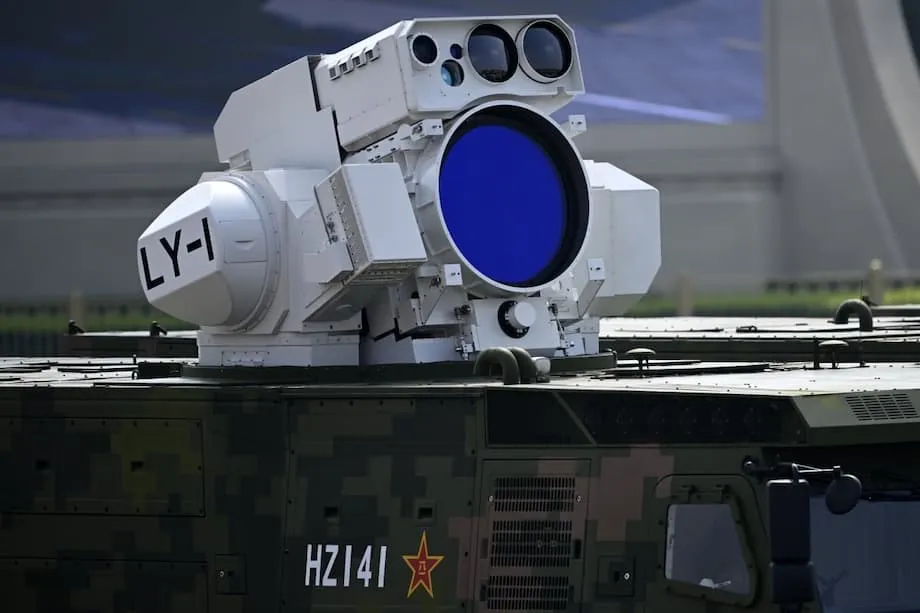
China's September 3 military parade displayed several systems that fit this approach, including microwave weapons, the LY 1 laser and missiles presented as counters to airborne launch platforms. The research and displays describe a direction for development. How effectively the components can operate together aboard ships remains an open question.
Small uncrewed aircraft have already tracked ships, harassed convoys and, in some cases, struck valuable assets in recent conflicts. Cheap quadcopters and drones with fixed wings can fly low, use simple autopilots and blend into the radar reflections produced by waves, known as sea clutter. One may be manageable. Hundreds or thousands arriving together create a much harder problem.
The financial imbalance is central: an attacker spends little while forcing a defender to spend much more. A ship that repeatedly fires expensive interceptors at inexpensive drones can run short of ammunition even while successfully destroying its targets.
Why a swarm is more than a crowd of drones
A drone swarm coordinates routes, heights, timing and tasks. Its members can adjust to jamming and search for gaps in defenses. Some may carry warheads, while others act as decoys, jam defensive systems or scout for missile seekers, the sensors that guide missiles toward their targets.
Ships face particular difficulties because drones flying close to the water can remain below the radar horizon until they are relatively near. Long distances and harsh weather complicate detection and interception. Attacks can approach from several directions, including the sea surface or aircraft carrying smaller drones.
Traditional layered air defense uses different weapons at different distances, often relying on a limited stock of costly interceptors. Coordinated groups of small targets can saturate radar tracking and defenses near the ship. Navies are therefore seeking better sensors, faster decisions and cheaper weapons able to sustain repeated engagements.
Guo's team proposes a dynamic kill net: a changing network that assigns sensors and weapons as conditions develop. Software defined networking would allow software to redirect information between connected systems. Automation and cooperation between people and machines would shorten the time between detecting a threat and acting against it.
If a radar were jammed or another part of the network damaged, surviving components would take over its tasks. Satellite information would guide maritime patrol aircraft, which would pass tracking information to ship radars, infrared cameras and passive radio receivers. The aim is continuous custody, meaning that the defense keeps track of a threat as responsibility passes between sensors.
Finding the right targets above the waves
Satellites would provide broad surveillance and direct patrol aircraft toward areas needing closer inspection. Ship radars, including sets using short wavelengths to detect small radar signatures, would search near the water. Infrared sensors would look for heat from motors and batteries.
Passive radio receivers would listen for control signals without transmitting their own signals. Acoustic sensors on the sea surface could detect nearby propeller noise. Artificial intelligence would combine these observations into one tracking picture, reducing the need for operators to switch between displays while following small, fast and unpredictably moving objects.
Classification would be as important as finding a possible target. A small quadcopter flying in a merchant ship's wake can resemble wave clutter on radar. Comparing observations from several sensor types would help reduce false alarms and distinguish friendly, neutral and unknown objects.
Identifying each drone's role early would also help commanders choose a response. A jammer, a decoy and a drone carrying explosives present different problems. Accurate sorting could preserve the most capable weapons for the most dangerous targets instead of spending them on distractions.
The architecture follows a sequence familiar to other navies: find, track and classify the threat; disrupt its guidance and communications; then destroy what survives. Several tools support each function so that losing one component does not interrupt the entire defense. The Chinese proposal places particular weight on connected sensors and effects that disable drones without striking them with projectiles.
Disrupting the swarm before shooting it down
Electronic attack units would jam control links and satellite navigation signals, including GPS. Deception equipment could send false coordinates or create phantom targets, causing drones to turn away or waste time. Breaking coordination could reduce the pressure on weapons tasked with destroying individual aircraft.
High power microwave weapons would add bursts of energy intended to disrupt or burn out electronics in several drones within a sector. They could be redirected quickly as a group moved and would not consume physical ammunition with each engagement.
Microwaves and powerful jammers still require substantial electrical power and create heat that ships must remove. Without suitable shielding and coordination, their emissions can interfere with friendly electronics. Commanders also need rules for when to switch to physical destruction because disruption may leave some attackers flying, and assessing electronic damage during an attack can be difficult.
The proposal places these disruptive tools early in the engagement sequence to reduce the swarm before guns, lasers and other weapons deal with survivors. This approach is often called soft kill, meaning interference or disabling rather than destruction by direct physical impact. Microwave effects can also damage electronics permanently.
Lasers, airburst rounds and missiles with different jobs
The LY 1 laser is intended to burn optics and airframes at short distances. Its attraction is a shot powered by electricity rather than an expensive interceptor. Lasers require a clear line of sight, however, and rain, fog, smoke or dust can weaken their effect.
A laser must hold its beam on a target long enough to cause damage. That requires precise tracking as a drone maneuvers. Within those limits, shipboard lasers could handle many engagements near the vessel that would otherwise use missiles.
Rapid firing guns provide another layer. China's arms industry has presented Bullet Curtain, a concept using programmable 35 mm airburst rounds. Each round releases numerous smaller projectiles at a selected point, creating a cloud of fragments in the path of incoming objects rather than relying on a single direct hit.
Radar and optical tracking would guide firing patterns and rates of fire. A related concept using multiple barrels and electronically fired, preloaded ammunition, sometimes called Metal Storm, seeks extremely high firing rates. Replacing barrels already packed with ammunition is intended to speed reloading.
Missiles would retain a role, with greater attention to destroying the aircraft or ships carrying drones before they could release them. Reports of a CJ 1000 hypersonic cruise missile fit the broader interest in fast weapons with long reach for attacking launch platforms. Destroying a carrier early could reduce the number of drones reaching the ship and preserve ammunition for survivors.
Each weapon addresses a different part of the problem. Lasers depend on visibility and tracking time. Guns consume stored ammunition and scatter projectiles. Missiles provide reach but remain costly. The proposed network would choose among these options as the threat changed.
What the parade and industry displays revealed
China's September 3 parade provided a public view of microwave systems, LY 1 laser equipment associated with vehicle and ship applications, and missiles presented as counters to airborne launch platforms. State defense companies have also promoted systems that use dense gunfire instead of guided interceptors.
Bullet Curtain is presented as an economical means of clearing small drones and even some cruise missiles from defended airspace. Developers say modular mounts and containerized ammunition arrangements would support rapid reloading and installation on ships, vehicles and fixed sites.
The public sequence leading to the September 20 account includes two dated developments:
- Late August 2025: Guo Chuanfu's team published its proposed naval defense framework in Command Control & Simulation.
- September 3, 2025: China's military parade displayed systems matching several elements of the proposed approach, including microwave weapons, laser equipment and missiles with long reach.
The framework describes how such equipment could work together. Turning that design into fleet practice requires ship combat systems to coordinate sensors, electrical power, firing decisions and ammunition use during a moving attack.
Jiu Tian shows the other side of the contest
China has also showcased Jiu Tian, a large drone carrier aircraft intended to fly high and release many smaller drones. Those aircraft would spread out, descend toward targets and use autonomous coordination to organize their attack.
A carrier could extend the reach of small drones and release a large group together. It would also be a large target in contested airspace. Keeping the group coordinated across Pacific distances would depend on reliable autonomous behavior and communications.
Early versions could serve as platforms for testing algorithms and deployment methods even if their ability to survive combat were limited. Lessons could later be transferred to carriers better able to operate under attack. Jiu Tian therefore connects two parts of the same competition: launching swarms at greater distances and stopping the platforms that carry them.
What changes in the Taiwan Strait
Chinese military writings in recent years describe swarms as tools for controlling or denying access to the sea, especially during a blockade or amphibious assault. They also call for defenses against enemy swarms, repeatedly identifying detection, soft kill, physical destruction and camouflage as necessary functions.
For ships, that would mean spreading sensors across an area, maintaining tracks, disrupting incoming groups with electronic attack and microwaves, then destroying survivors with guns, lasers and missiles for nearby targets. Decoys, reduced transmissions and measures to make ships harder to detect would protect the defenders themselves.
Autonomy and machine learning could shorten reaction times far below traditional command cycles. Defensive actions, such as launching many interceptor drones or activating powerful jammers, might appear offensive to an opponent. A civilian looking drone boat could act as a sensor in one situation and a weapon in another.
In the crowded strait, mistaken readings of intent and automated responses could leave less time for diplomacy. Reliable communications and clear command rules would be needed to preserve human judgment during rapid engagements.
Maritime conditions also complicate swarm operations. Drones face long flights over water, salt corrosion and difficult weather. They need navigation that continues when GPS is jammed and communications that remain useful when terrain or a ship's hull blocks the direct signal path.
Long range missiles attacking ships would remain central to many naval battles. Swarms would likely accompany them, distracting sensors, confusing operators or drawing defensive fire. Better defenses against drones would give ships more time and more chances to engage, within a wider contest involving missiles, submarines and aircraft.
Other navies are pursuing similar defenses
The United States has sought to deploy large numbers of autonomous systems in the air and at sea while addressing software, safety and connections with existing fleets. Trials of uncrewed surface vessels have shown promise alongside collisions and control problems. Reliable autonomy at sea requires more than a successful prototype.
The US Navy is adding intercept drones such as Coyote and Roadrunner M to carrier groups. These small aircraft powered by jet engines can launch, wait in the air and home in on incoming drones at a cost below that of a standard ship missile. Some variants can return for refueling and reuse.
Compact radars able to detect small targets would support those interceptors, expanding the number of threats a force could engage before running out of weapons. Naval laser testing similarly aims to destroy threats within a few kilometers at a lower cost per engagement.
Swedish field tests allow soldiers to control dozens of uncrewed aircraft at once. Germany, the United Kingdom and other countries are developing architectures for mixed swarms across land, air and sea. Across these efforts, the defensive sequence is similar: detect early, disrupt the attack and destroy surviving threats economically.
The limits are power, ammunition and reliable decisions
Ships cannot treat lasers and microwaves as unlimited weapons simply because they use electricity. Generators, cooling equipment and other ship systems must share available capacity. A weapon that draws substantial power or creates too much heat can limit how often it fires.
Programmable gun ammunition costs less than missiles but still requires storage, transport and reloading at sea. The attacker's aim is to exhaust these resources. The defender's aim is to keep each engagement affordable and repeatable for as long as the attack lasts.
Connected sensors and weapons also create more opportunities for cyberattack and electronic interference. Software can reroute information around damaged components, but the resulting network is complex and requires training. Artificial intelligence needs sound data and careful validation to reduce false tracks and avoid firing on friendly forces.
A defense that works on one ship must also share information and coordinate across a task group under jamming and in heavy seas. Friendly interference becomes a practical concern when several ships, aircraft and electronic attack systems operate together.
Neutral shipping and people nearby introduce further constraints. Barrage fire near ports or busy sea lanes can endanger civilian traffic. Microwave use requires controls to protect friendly equipment and people on deck. Lasers need precise targeting to prevent unintended eye injuries or hazardous reflections. Legal compliance, doctrine, testing and realistic exercises must accompany the hardware.
Which tests would show progress at sea?
Integrated sea trials would show how lasers, microwaves and rapid firing guns function with ship combat systems, beyond demonstrations of individual weapons. Exercises in which a sensor or communications link is lost or jammed would test whether the network can reassign tasks and maintain tracking.
Trials combining defenses against swarms with missile attacks on aerial launch platforms would indicate the priority given to destroying carriers before release. Exports of such defensive equipment to partners could also signal confidence in its maturity.
Electrical shortages, cooling demands and slow ammunition replacement would shape how many systems ships could carry and how commanders used them. The practical test is whether the fleet can sustain detection, decisions and repeated engagements under realistic conditions, with clear rules governing the use of force.
Key Points
- A team led by Professor Guo Chuanfu published a naval defense framework in late August 2025 linking satellites, aircraft, ships and weapons.
- The proposed network would redirect sensing and firing tasks when components were jammed or damaged.
- Electronic attack and microwaves would disrupt swarms before lasers, guns and other weapons engaged survivors.
- Bullet Curtain uses programmable 35 mm airburst rounds, while missiles with long reach would target drone carriers before launch.
- China's September 3 parade displayed equipment matching several parts of the proposed architecture.
- Jiu Tian illustrates China's parallel interest in carrying and releasing large groups of small drones.
- Power, cooling, ammunition, communications, human control and civilian safety remain practical challenges for deployment.
- Integrated sea trials and exercises under jamming would show how effectively the proposed defenses work together.