From agricultural research to a busy market stall
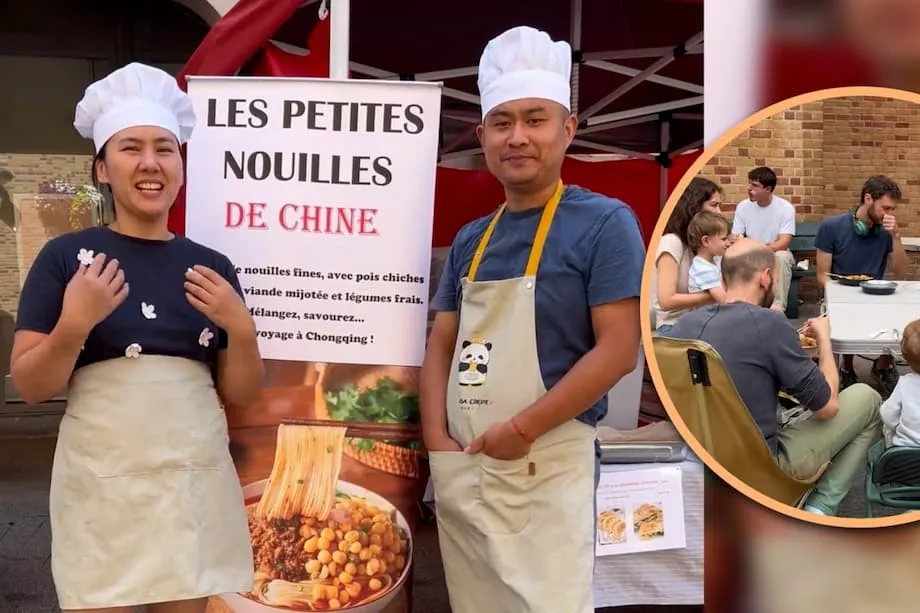
More than 1,000 euros in takings on the busiest days, bowls priced at 7 to 9 euros, and more than 78,000 followers on Chinese social media: a Chinese couple selling Chongqing spicy pea noodles have found an enthusiastic audience in Belgium. Their stall operates about twice a week, serving a regional Chinese dish adapted to local tastes.
Contents
- From agricultural research to a busy market stall
- A family balancing research and a new business
- A hometown dish adjusted for Belgian customers
- Preparation keeps the queue moving
- Why the dish fits a Belgian market
- Customers find something new in the bowl
- What 1,000 euros in sales means
- Online attention extends beyond the market
- Food safety shapes the working day
- Wang sees practical work, not a dramatic departure
- A regional flavor becomes part of local life
- At a Glance
Behind the counter are Ding, a 37-year-old agricultural researcher from Jiangsu province, and his wife, Wang, who grew up in Chongqing. Ding specialized in soil management and crop production and published around 30 academic papers. He later moved to Belgium for postdoctoral research, a period of research work undertaken after earning a doctorate.
The couple settled in Belgium in 2015 and had a child there. When stable employment beyond research proved difficult to find, they looked for another way to support their family. Wang had long wanted to run a stall serving the noodles she knew from home. In May, they began selling the dish at local markets.
By September 20, 2025, their combination of chewy noodles, tender peas and savory pork sauce had attracted queues, returning customers and widespread attention online. Peak daily revenue was reported at more than 1,000 euros, about US$1,200. Much of the appeal lies in a straightforward meal: filling, quickly assembled and gently adjusted for people less accustomed to Chongqing's heat.
The couple's change of work also became part of the attraction. A researcher with a substantial publication record was now helping serve noodles, while Wang was turning a familiar hometown flavor into a family business. Their story drew attention, but preparing the food and keeping customers satisfied remained the daily task.
A family balancing research and a new business
Ding's academic training focused on how soil systems support crops and how agricultural production can be managed. After his doctorate, he continued his research career in Belgium. His record of around 30 papers reflected years spent in a demanding, specialized field.
Research careers often depend on grants and contracts that last for a limited period. A postdoctoral position allows a researcher to continue developing expertise, but moving from those appointments into permanent employment can be difficult. Competition is intense, and openings are limited.
Ding and Wang met at university. During their years in Belgium, they raised their child and developed ties to local communities. As they considered how to provide for their household, Wang's ambition to sell Chongqing noodles offered a practical option.
The stall has not necessarily closed the door on Ding's academic or other professional work. He continues looking for suitable roles while helping run the business. Trading on set market days leaves room for that search, although food preparation extends the work beyond the hours customers see.
A hometown dish adjusted for Belgian customers
Wang grew up eating Chongqing spicy pea noodles. Sometimes called pea stew noodles, the dish brings together noodles, softened peas and a savory sauce that can include minced pork. The peas supply body and a gentle sweetness, balancing the chili oil and the richness of the meat.
Chongqing is widely associated with hot pot and numbing peppercorns, but its noodle dishes include a broader range of sauces and textures. In spicy pea noodles, split peas are cooked until they begin to break down, then combined with broth or sauce. Soy sauce, aromatics and chili oil can deepen the flavor.
The noodles are usually made from wheat. Their chewy texture contrasts with the soft peas and helps carry the sauce. Scallions, and sometimes pickled vegetables, provide a fresher finishing note.
Wang reduced the heat for Belgian customers while retaining the peas, pork, fragrant oil and texture that give the dish its identity. She and Ding tested spice levels with European diners as they refined the recipe. Customers who enjoy stronger heat can ask for more.
A bowl that feels comfortably spicy in Chongqing may be too hot for someone trying the cuisine for the first time. Adjusting that balance gives newcomers room to enjoy the other flavors, while keeping the hometown dish recognizable.
Preparation keeps the queue moving
The couple typically trade twice a week. Before each market session, they simmer peas until tender, prepare sauces, portion seasonings and arrange toppings. Each bowl is finished to order, but much of the cooking has already been completed.
Orders can then be assembled in minutes. That matters at a market, where customers may be browsing several stalls, carrying shopping or looking for a meal without a lengthy wait. A smooth sequence of cooking, topping and serving helps the couple handle busy periods.
A few chairs give customers the option of sitting down, although many eat while on the move. The compact setup also makes the preparation visible: shoppers can see the peas, the noodles and the final bowl coming together.
Their timeline shows how a family already established in Belgium moved into market trading:
- 2015: Ding and Wang settled in Belgium, where Ding pursued postdoctoral research and the couple later welcomed a child.
- May: They began serving Chongqing spicy pea noodles at local markets.
- By September 20, 2025: Their stall was attracting queues, peak daily takings above 1,000 euros and more than 78,000 followers on Chinese social media.
Trading on only a couple of days each week can also build anticipation. Customers have limited opportunities to buy the noodles, while the couple can concentrate preparation around a predictable market schedule.
Why the dish fits a Belgian market
Belgium's weekly markets and food fairs bring shoppers into city squares and neighborhood events. Customers expect variety and quality, giving a stall with a clear identity a chance to stand out. Ding and Wang have built theirs around one signature dish rather than a broad menu.
At 7 to 9 euros, the noodles offer a filling meal at a price intended to suit a market visit. The combination of savory pork, mildly spicy sauce and soft peas provides familiar comfort alongside an ingredient pairing that may be new to some customers.
Peas are central to that experience. Their sweetness and body soften the heat and add substance to the bowl. For customers unfamiliar with peas in noodles, the combination offers a different way to enjoy an ordinary ingredient.
The stall's appearance helps attract attention, too. A pot of peas and a visible assembly process give shoppers something to watch without requiring a complicated presentation. Short waits and a focused menu make the food easy to buy during an ordinary shopping trip.
The couple's personal story adds another reason to stop. A university trained pair bringing a family flavor to their adopted home gives customers something to remember and share. Word of mouth can then bring people back for the meal itself.
Customers find something new in the bowl
Customer reactions have been a prominent part of the stall's online appeal. In one widely shared video, an elderly woman struggled with chopsticks but smiled after tasting the noodles. The clip then moved to a close view of the bowl.
The woman, a customer whose name was not given, offered this verdict:
These are the best Chinese noodles I have ever had.
Another regular customer focused on the peas. His response captured the surprise of finding a familiar ingredient used in an unfamiliar dish:
I never knew peas could taste this good.
Those reactions connect directly to Wang's recipe choices. Reducing the chili allows diners to notice the softened peas, the pork sauce and the texture of the noodles. The dish can introduce customers to Chongqing food through a balance they find comfortable.
Warm responses also encourage repeat visits. A customer who enjoys a first bowl can return on another market day, tell a friend or share a video. For a stall operating on a limited weekly schedule, those returning customers matter alongside the attention generated by a popular clip.
What 1,000 euros in sales means
Peak daily takings above 1,000 euros are the most striking business figure attached to the stall. With each bowl priced between 7 and 9 euros, sales of roughly 120 to 150 bowls would bring the business around or above that level, depending on the prices paid.
Serving that volume requires sustained demand and efficient preparation. Having peas, sauces and toppings ready allows the couple to assemble several bowls per minute during the busiest stretches, rather than cook every component from the beginning.
Revenue is the money customers pay before expenses are deducted. Profit is what remains after the business pays its costs. For this stall, those costs include peas, noodles, pork, aromatics, chili oil, serving containers or bowls, and cleaning supplies.
Market fees, transport, licenses and insurance also belong in the expense calculation. Equipment for safe storage and temperature control can add further costs. Buying ingredients in bulk and keeping the menu simple may help control spending, while careful portioning makes costs more predictable.
The couple's profit, average sales and monthly income have not been disclosed. Two strong market days a week could produce meaningful income for a small family business, but weather, holidays and market schedules can change customer numbers. A peak day's takings provide one part of a business that also has quieter periods.
Online attention extends beyond the market
Ding and Wang have attracted more than 78,000 followers on Chinese social media platforms. Videos show the stall's workflow and customers trying the food, bringing an everyday market business to a much larger audience.
The food lends itself to short videos: steam rising from noodles, glossy chili oil, a scoop of yellow peas and the moment someone takes a first bite. Clips have also circulated on international platforms, spreading curiosity beyond the couple's Chinese audience.
That attention can feed back into market visits. Some tourists plan stops around food they have seen online. Local shoppers may notice a queue or people filming, stop to watch and decide to try a bowl themselves.
Keeping those customers requires regular attention to taste, price and service. The couple's focused menu helps them repeat the same preparation and maintain a consistent bowl. Efficient service makes a busy stall easier to return to.
Online discussion has also drawn attention to regional Chinese dishes that are less familiar abroad. Viewers have pointed to the range of foods beyond the best known staples of major cities. Here, a specific Chongqing noodle dish, rather than a broad menu of Chinese food, has given the stall its identity.
Food safety shapes the working day
Belgian food stalls operate within a regulated market system. The Federal Agency for the Safety of the Food Chain oversees food businesses, with registration, inspection and hygiene requirements intended to protect customers.
For vendors, those requirements cover safe storage temperatures, separation of raw and cooked ingredients, clean water for washing and records that allow ingredients to be traced. Market organizers also set conditions for stall placement, power use, waste disposal and trading hours.
A noodle business that prepares food before arriving at the market needs to keep it safe during storage, transport and service. Practical measures include insulated containers for hot food, thermometers to check temperatures and clean utensils. An approved preparation space or licensed kitchen is often an important part of that arrangement.
Insurance is another common consideration, both for protecting a business and meeting organizers' conditions. These responsibilities sit alongside recipe testing, shopping, cooking and serving, adding work that customers may never see.
The couple's routine depends on keeping the workspace clean and hot ingredients at safe temperatures. Preparing components ahead of time speeds up service, while measured portions reduce waste and help them judge how much food to make. Even a small stall with a few chairs needs careful organization before its first bowl is sold.
Wang sees practical work, not a dramatic departure
Wang has described the business in terms of providing for the family. Although the move from research to market cooking has attracted attention, she presents the work as a practical response to their circumstances.
Wang, who developed the stall's version of her hometown noodles, explained her view in a video shared with followers:
Running a stall is no different from research. We are simply supporting our family.
Research and food preparation involve different tasks, but both reward planning, measurement and adjustment. At the stall, the couple test spice levels, organize portions, prepare ingredients and respond to what customers enjoy. Repeating those steps reliably is part of keeping the business running.
Ding's continued search for suitable employment means the household is pursuing more than one route. The stall provides work on established market days while leaving space for other opportunities. Their family economy now combines academic experience, practical cooking and Wang's knowledge of Chongqing food.
A regional flavor becomes part of local life
Ding and Wang's experience brings together migration, employment uncertainty and the everyday appeal of a good meal. They carried academic training and food traditions into a new setting, then adjusted their plans as the family's needs changed.
The strongest features of the business are concrete: one recognizable dish, prices of 7 to 9 euros, advance preparation, short waits and a flavor balance suited to local customers. A limited weekly schedule and widely shared videos have helped draw attention to that work.
The headline revenue sits above a less visible routine of simmering peas, making sauce, transporting food, cleaning equipment and planning portions. The same preparation that helps keep costs predictable also allows the couple to serve customers quickly when a queue forms.
For Belgian shoppers, the result is a chance to try a specific part of Chongqing's food culture at a familiar local market. For the couple, it is a way to support their child and household while Ding continues seeking suitable work. Their busiest days have made the stall a popular story, but its daily purpose remains the one Wang described: supporting their family.
At a Glance
- Ding, 37, and his wife, Wang, began selling Chongqing spicy pea noodles at Belgian markets in May.
- The couple settled in Belgium in 2015 and later had a child there.
- Ding specialized in soil management and crop production, published around 30 academic papers and pursued postdoctoral research in Belgium.
- The stall typically operates twice a week, with bowls priced between 7 and 9 euros.
- Peak daily takings have exceeded 1,000 euros, about US$1,200, before business expenses.
- Wang reduced the spice for local tastes while keeping the peas, pork sauce and characteristic texture.
- The couple have attracted more than 78,000 followers on Chinese social media.
- Ding continues looking for suitable roles while helping run the family business.