A record supply push before the holiday rush
South Korea plans to release a record 172,000 tons of key food items and provide about 90 billion won ($64.5 million) in discount support to contain food prices during the 2025 Chuseok shopping season. The package combines extra supplies of holiday staples with reductions of up to 50 percent on popular gift sets and deals on everyday foods.
Contents
- A record supply push before the holiday rush
- Why fresh food and gifts face extra pressure
- Where the extra meat, eggs and rice will go
- How additional supply can reach household budgets
- More places to buy directly
- Distribution costs are a longer lasting concern
- Harvest conditions offer some reassurance
- Livestock prices remain under pressure
- How households can use the offers
- Stable inflation still leaves seasonal pressure
- Key Points
Authorities aim to bring supplies of major goods before the holiday to around 1.6 times their usual volume. Roughly 2,700 markets selling directly to consumers will operate nationwide, while major supermarkets and traditional markets will also participate in the discount campaign.
The economic team finalized the program at a ministerial meeting led by the finance minister. The first vice finance minister reviewed the arrangements for carrying it out ahead of the holiday. The approach is to put more food into the market before demand peaks and help households pay less at the checkout.
Chuseok brings millions of families together for meals, memorial rites and gift giving. Households buy meat, fruit, vegetables, rice, cooking oil and confectionery, often within the same short period. Many also purchase gift sets, increasing pressure on products already needed for family gatherings.
Wholesalers and retailers have days, rather than months, to respond to this surge. Farmers cannot immediately grow more fruit or raise more livestock, and distributors cannot instantly expand their delivery capacity. When more shoppers compete for goods that are slow to replenish, prices tend to rise.
The familiar increase in late September or early October is therefore a problem of timing as well as total supply. Food may be available across a season, yet still become expensive when many households need the same items during a single week. The government is trying to increase availability precisely during that crowded buying window.
Why fresh food and gifts face extra pressure
Apples and pears ripen in late summer, while napa cabbage and radish follow harvest schedules shaped by planting decisions and weather. Those schedules limit how quickly fresh supplies can reach shops when holiday demand rises.
Cold storage allows some produce to be held for later sale, but storage space is finite. Imports also take time because shipments must meet sanitary rules and fit shipping schedules. A smaller harvest or slower deliveries before Chuseok can leave retailers with little room to increase stocks quickly.
Gift buying adds another layer of demand. Retailers assemble boxes of premium fruit, seafood and hanwoo, South Korea's prized domestic beef. Popular gift sets also contain staples such as canned meat and personal care products such as shampoo.
Premium boxes absorb supplies and carry higher margins for sellers. When more households choose expensive products, the average prices reflected in consumer price indexes can rise even while some basic staples remain steadier. For families, a festive meal and a gift purchase can therefore put pressure on the same shopping budget.
Where the extra meat, eggs and rice will go
Premium beef supply will be nearly double the level of a typical Chuseok, while pork distribution will be about 30 percent above its usual volume. Authorities will also increase egg shipments and discount support.
Rice is another priority. Officials plan to release 30,000 tons from government stocks, giving mills and retailers more flexibility if private inventories turn out to be tight. They describe the action as precautionary, intended to steady prices for a staple that households buy alongside more expensive holiday foods.
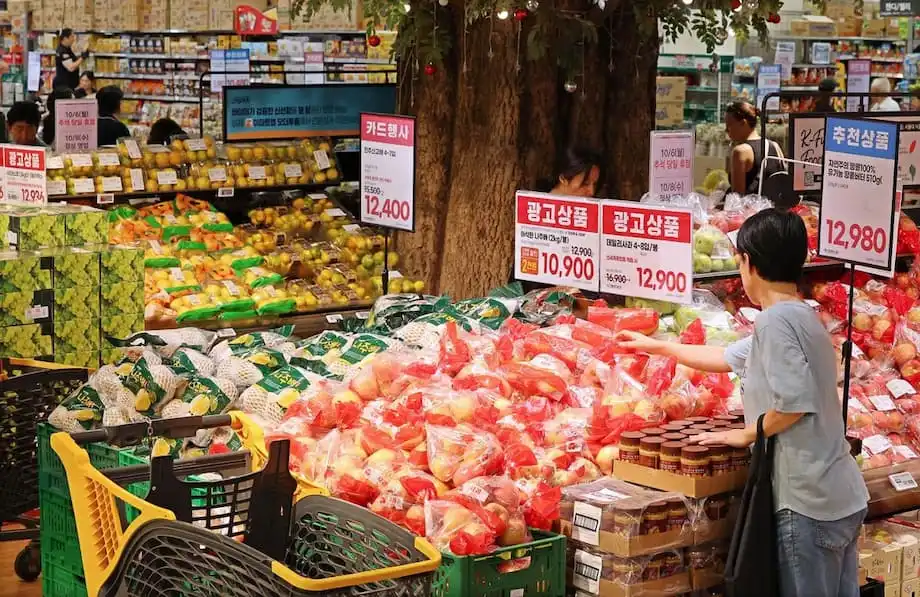
The broader discount program covers eggs, rice, fruit, beef and pork, as well as popular gift sets. Support will focus on holiday products whose prices tend to swing. The offers will run for limited periods, with the aim of spreading purchases through the shopping season instead of concentrating them on one weekend.
How additional supply can reach household budgets
Extra reserves can ease price pressure by increasing the quantity available when buyers are competing most intensely. Beef or apples released into wholesale auctions and retail depots give sellers more stock to offer during the busiest period.
Economists describe this as a change in supply. A market price reflects how much buyers want to purchase and how much sellers have available. When the amount for sale increases, buyers face less competition for each item, helping bring the price down.
Discounts work at the checkout. They can encourage shoppers to choose cheaper products and give retailers a reason to promote less expensive bundles. Combined with additional supplies, they are intended to reduce the cost of both festive purchases and daily necessities.
Targeting matters because expensive items, including hanwoo cuts and fruit of a high grade, can account for a substantial part of a family's holiday bill. Making those products more affordable can have a greater effect on that bill than a small reduction on something the household buys only sparingly.
Retailers also need to pass the support through to customers. If a seller receives a subsidy without reducing its price, the money would increase its margin rather than lower the shopper's bill. Public monitoring during the holiday window is intended to help the savings reach households.
More places to buy directly
The roughly 2,700 markets selling directly to consumers will give households another route to discounted food. Government bodies and local partners will operate them nationwide, alongside the offers available through major supermarkets and traditional markets.
Direct sales reduce the number of businesses between a producer and a customer. With fewer intermediaries charging for their part of the transaction, less of the discount support can be absorbed by distribution fees.
Access will still depend on location and the products available at each outlet. Traditional markets may have strong fruit offers, while large grocers may concentrate on gift sets and meat bundles. Comparing those choices will matter for shoppers trying to reduce the full cost of their holiday purchases.
Distribution costs are a longer lasting concern
Distribution costs accounted for about 49.2 percent of final consumer prices for agricultural products in 2023, compared with roughly 45 percent a decade earlier. That is an increase of about 4.2 percentage points, bringing the distribution share close to half of the amount consumers pay.
The measure describes the gap between what producers receive and what shoppers pay. The size of that gap is often blamed for high and unstable fresh food prices. Reducing it could help farmers and consumers by lowering the cost of moving products through the market.
Officials aim to cut agricultural distribution costs by 10 percent by 2030. Expanding online wholesale markets is central to the plan. These digital exchanges currently handle roughly 6 percent of wholesale transactions, and the target is to raise that share to 50 percent by 2030.
Online wholesale trading allows businesses to buy and sell through digital exchanges. The government's plan is to increase competition among distributors, simplify auctions and make fees easier to see. Improvements in cold chain logistics, which keep food chilled during storage and transport, and more consistent packaging are also intended to help keep prices steadier beyond the holiday season.
The figures show the scale and timing of the proposed changes:
- About a decade before 2023, distribution costs represented roughly 45 percent of final consumer prices.
- In 2023, that share reached about 49.2 percent.
- Online wholesale markets currently account for roughly 6 percent of wholesale transactions.
- By 2030, officials aim to reduce agricultural distribution costs by 10 percent and raise the online wholesale share to 50 percent.
Harvest conditions offer some reassurance
Crop conditions appear manageable heading into Chuseok. The holiday falls later than usual this year, and growers report a better match between harvest windows and seasonal demand. That timing gives producers a more favorable opportunity to bring crops to market when families need them.
Apple and pear output is expected to meet holiday needs despite earlier cold snaps and wildfires. Supplies of cabbage and radish also look stable after farmers adjusted their planting schedules.
Weather remains a risk close to the shopping peak. Agencies are watching for changes because a typhoon or a heat wave can alter supplies and prices within days. The reserve releases and discounts are being prepared against that possibility as well as the predictable holiday increase in demand.
Livestock prices remain under pressure
Cattle and pork prices remain firm because of feed and import costs. Increasing domestic supplies and supporting consumer discounts are the government's main responses to that pressure during the holiday period.
The near doubling of premium beef supply and the increase in pork distribution are aimed at products that matter both for meals and for seasonal spending. Extra egg shipments provide support for another widely purchased food.
Rice releases serve a related purpose. A household that saves on a gift set can still face a higher total bill if staple foods become more expensive. Keeping rice prices steady helps protect the value of the holiday discounts and the benefit of any increase in consumption.
The program therefore combines products bought for special occasions with foods needed for ordinary meals. Its effect on a family's budget will depend on what that family buys, the prices charged locally and which discounts are available when it shops.
How households can use the offers
Households that plan purchases early and compare retailers may be able to capture more of the available savings. Offers will vary by location and seller, so the largest advertised reduction will not apply equally to every shopping basket.
Direct sales markets may appear in schools, community centers and public plazas during the season. Shoppers can compare those outlets with traditional markets and large grocery stores, checking the price, origin and grade of products before deciding where to buy.
- Look for participating markets selling directly to consumers in the local area.
- Compare fruit offers at traditional markets with meat bundles and gift sets at larger grocers.
- Check discount coupons and card promotions, which have limited periods and may be combined with sales in stores.
- Consider less popular cuts of hanwoo or pork, which can offer the same quality at a lower price.
- Buy foods that keep well first and purchase fresh items closer to the family gathering to reduce waste.
- Check origin and grade labels so comparisons cover similar products.
Spreading purchases across the available promotion periods can also help households avoid doing all their shopping during the busiest weekend. Buying fresh food nearer the gathering, while securing longer lasting goods earlier, balances price comparisons with the need to limit waste.
Stable inflation still leaves seasonal pressure
Headline inflation has been within the Bank of Korea's 2 percent target, yet some holiday staples have risen faster in recent months. The broad inflation figure describes price changes across a wide range of purchases, while a Chuseok shopping bill is concentrated in a smaller group of foods.
The government's price officials are therefore putting more weight on seasonal measures that increase supply and temporarily subsidize purchases. Policymakers also want to support household consumption as it recovers. Retail sales in midsummer recorded their largest increase in more than two years, a sign of improving sentiment.
Transport and delivery capacity are another part of the holiday challenge. A recent outage of the national rail ticketing app disrupted bookings for several hours as many people tried to reserve seats for journeys to their hometowns.
Road congestion, narrow delivery windows and shortages of distribution workers can similarly put pressure on food supplies. Coordination among economic, agriculture and transport agencies can help prevent small disruptions from becoming price increases while households prepare for the holiday.
The immediate task is to get additional food and discounts to consumers during the shopping peak. The longer effort is to reduce the cost of distribution, so that a larger supply can reach households more efficiently throughout the year.
Key Points
- South Korea plans a record release of 172,000 tons of key food items for the Chuseok shopping season.
- About 90 billion won ($64.5 million) will support discounts, including reductions of up to 50 percent on popular gift sets.
- Supplies of major goods before the holiday will reach around 1.6 times their usual volume.
- Roughly 2,700 markets selling directly to consumers will operate nationwide, alongside participating supermarkets and traditional markets.
- Premium beef supply will be nearly double a typical Chuseok level, and pork distribution will be about 30 percent higher.
- Authorities will increase egg shipments and release 30,000 tons of rice from government stocks.
- Apple, pear, cabbage and radish supplies look stable, while weather and livestock costs remain concerns.
- Officials aim to cut agricultural distribution costs by 10 percent and expand online wholesale trading to 50 percent of transactions by 2030.
- Headline inflation has been within the Bank of Korea's 2 percent target, although some holiday staples have risen faster.