September 9 discovery brings inspections into public seating areas
A redback spider nest containing eggs was found on a table used by visitors at Osaka Kansai Expo 2025 on September 9, prompting organizers to issue a safety alert and expand inspections across the grounds on Yumeshima island in Osaka Bay. More than 70 redbacks have been detected in areas closed to the public since April.
Contents
- September 9 discovery brings inspections into public seating areas
- What organizers are asking visitors to do
- How to recognize a redback and its hiding places
- What a bite can do
- First aid starts with water, cooling and medical help
- From an Osaka port discovery to most of Japan
- How pest control teams are responding
- Practical precautions for families and other visitors
- Safety pressures extend beyond the spider alert
- What to Know
The Japan Association for the 2025 World Exposition, which runs the event, has hired exterminators to remove spiders and egg sacs. The fairgrounds remain open, with staff instructed to respond quickly when visitors report a sighting.
The discovery on a visitor table brought attention to places where people sit, rest their hands or put down their belongings. Most earlier detections had been in work areas away from guests. Contractors are now checking public seating and other sheltered spaces where spiders may settle.
Osaka Governor Hirofumi Yoshimura has urged vigilance, noting that redbacks are established across the prefecture. Organizers describe the warning as a precaution focused on preventing contact: visitors should leave spiders alone and tell staff where they have seen one.
Redbacks are venomous, but officials say they are generally timid and are unlikely to bite unless handled or accidentally pressed against the skin. Their habit of hiding beneath furniture and inside small gaps makes attention to hand placement particularly useful around outdoor tables, benches and railings.
The alert adds another operational concern for the seven month Expo, which has also faced bomb scares and brief power interruptions. For visitors, the immediate advice is simple: do not touch a spider, step away and ask a member of staff for help.
What organizers are asking visitors to do
The Japan Association for the 2025 World Exposition sets out its advice in the official Expo notice. The association asks visitors who spot a spider to avoid handling it and alert staff so that trained personnel can respond.
The association gives this instruction about direct contact:
Please do not try to catch it with your bare hands or touch it.
The same association notice explains why leaving the spiders undisturbed reduces the chance of a bite:
Their fangs are short, so it is unlikely that you will be bitten unless you catch one with your bare hands or accidentally touch it without noticing it.
Staff have been briefed to respond quickly to reports. Pest control teams have already eliminated specimens in restricted areas, and removal and spot treatments are continuing wherever spiders or egg sacs are found.
Visitors can help by giving a precise location. A pavilion entrance sign, bench number or nearby trash receptacle gives staff a fixed reference point and makes it easier to find a small spider in a large, busy venue.
How to recognize a redback and its hiding places
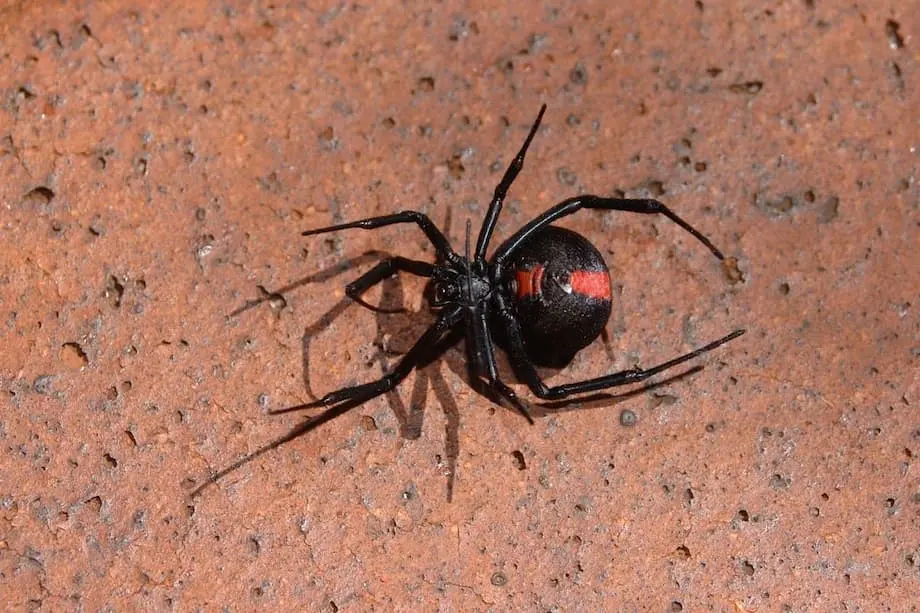
Female redbacks have a jet black body with a vivid red stripe along the abdomen. An orange or hourglass marking may also appear underneath. Males are much smaller and have a mottled appearance, making them less conspicuous.
Outdoor furniture offers the sheltered, undisturbed spaces these spiders tend to use. Likely hiding places include the undersides of tables, crevices near steps, and the edges beneath benches or railings. A person reaching into one of those spaces may accidentally make contact without first seeing the spider.
Expo contractors are surveying the bottoms and backs of tables, public seating, frames of temporary structures and gaps around utilities. Service corridors, cable runs, storage niches and the undersides of structures are also being inspected.
Visitors should watch where they place their hands and bags when sitting at outdoor tables, leaning on railings or resting on low walls. Organizers and local health officials also advise checking beneath a table edge and chair seat, where possible, before leaving a seating area, without touching any spider found there.
What a bite can do
Redbacks, whose scientific name is Latrodectus hasselti, are close relatives of black widow spiders. Their venom is neurotoxic, meaning it affects the nervous system. Osaka health officials say they are not aggressive and usually bite only when grabbed or pressed against the skin.
A bite may first feel like a sharp needle prick. Pain can then spread from the bite site through a limb or across the body. Some patients experience chills, sweating, nausea, headache or muscle aches.
Severe complications are rare. Infants, older adults and people with underlying health conditions can be more vulnerable, however, and should receive prompt medical care after a suspected bite.
On site medical teams can assess symptoms and refer patients to hospital care when needed. Spreading pain, sweating, nausea, breathing difficulty or faintness are reasons to seek help promptly rather than continue walking around the fairgrounds.
First aid starts with water, cooling and medical help
Local authorities recommend calm, basic first aid followed by medical evaluation when symptoms spread or worsen. Anyone bitten should move to a safe place, rinse the affected area with clean water and keep the affected limb as still as possible while seeking help.
A cold pack wrapped in cloth can help with pain and swelling. Ice should not be placed directly against the skin. A tight tourniquet should not be applied, and the skin should not be cut or the venom sucked out.
Children should be reassured and encouraged to stay still. At the Expo, visitors can go to the nearest medical station; away from the venue, they should seek care at a clinic or hospital. Emergency services should be contacted for severe pain, sweating, nausea, breathing difficulty or faintness.
A photograph may help medical staff identify the spider, provided it can be taken safely without approaching or touching it. Visitors should not attempt to capture the animal. Staff can handle the location while the person who was bitten receives care.
From an Osaka port discovery to most of Japan
Redbacks are native to Australia and are believed to have reached Japan during the 1990s hidden in cargo and shipping containers. The first confirmed discovery in Osaka was at the Port of Osaka in 1995.
From those early footholds around ports, the spiders spread widely. Surveys and local reports indicate detections in 45 of Japan's 47 prefectures. Osaka officials say they are present throughout the prefecture, including urban districts.
Warm, sheltered places suit redbacks. They are most active from spring through late autumn and seek protected structures for warmth during colder months. Those habits help explain why checks extend beyond exposed outdoor spaces to furniture, storage areas and small structural gaps.
Recent figures from western Japan show the scale of pest control work elsewhere. Authorities at US Marine Corps Air Station Iwakuni reported exterminating 921 venomous spiders, including redbacks, between April and July 2025. That was more than double the count during the same period a year earlier.
The Expo's figure of more than 70 concerns redbacks found in areas closed to the public since April. The Iwakuni total covers venomous spiders including redbacks. Both figures illustrate why inspections and removal form part of maintenance at public venues, particularly during hot weather when spiders are more active. Most people will never encounter a redback in daily life.
The main dates behind the alert are:
- 1995: Redbacks were first confirmed in Osaka at the Port of Osaka.
- April 2025 onward: More than 70 redbacks were detected in Expo areas closed to the public.
- April to July 2025: Authorities at Marine Corps Air Station Iwakuni exterminated 921 venomous spiders, including redbacks.
- September 9, 2025: A nest containing eggs was discovered on a table accessible to Expo visitors, prompting the public alert.
How pest control teams are responding
Expo contractors and staff are combining inspections, physical removal and targeted treatments. When they find spiders or egg sacs, they remove them and treat the surrounding area. Nighttime checks with flashlights help locate webs in places where there is less foot traffic.
Public seating receives attention because visitors may put their fingers beneath a table or bench without seeing what is there. Inspections also cover service areas and structural recesses, where webs can remain undisturbed.
Housekeeping supports that work. Teams clear clutter where possible, tidy storage areas and seal small openings where utilities pass through structures. Frequent trash collection helps limit insects that spiders feed on.
Staff and vendors receive briefings on what to look for and how to report a discovery. The checks continue after individual spiders are removed because an outdoor site can be occupied again. A treated corner may therefore need another inspection later.
Organizers are maintaining the fair's operations while carrying out this work. Visitors are being asked to report sightings, while removal and treatment remain tasks for the staff and contractors assigned to them.
Practical precautions for families and other visitors
Families can reduce accidental contact by making sure children know not to touch spiders and to call an adult or staff member when they see one. Adults should also avoid reaching into hidden spaces around outdoor seating without looking first.
Closed shoes are recommended, along with keeping clothing and towels off the ground. Bags should be placed with care, particularly beside low walls, railings or furniture with sheltered undersides.
A sighting calls for a few straightforward steps:
- Step back and do not touch or try to capture the spider.
- Tell the nearest staff member and identify the exact location.
- Use a nearby sign, bench number or trash receptacle to help staff find the spot.
- Keep children from approaching the spider while staff respond.
- If someone is bitten, rinse the area and seek help at the nearest medical station or contact emergency services.
Visitors checking a table or chair should keep their hands away from any spider they notice. The aim is to see a possible hiding place before reaching into it and to let staff deal with a discovery.
Safety pressures extend beyond the spider alert
Bomb scares and short power interruptions have already kept attention on safety and operations at the Expo. Transportation capacity, summer heat and crowd management have also drawn public discussion since before the event opened.
Osaka Metro increased train services to Yumeshima station to handle visitor flows, while buses carry people from rail hubs. Staffing and crowding remain concerns during peak hours. Teachers and parents accompanying children are being asked to keep groups together on narrow platforms.
Summer weather adds another layer of work. High temperatures, thunderstorms, outdoor queues and long walks in direct sunlight can strain visitors, especially children and older adults. Areas with water and greenery can attract mosquitoes during warm months.
Yumeshima's setting on reclaimed land amid port infrastructure also requires continuing attention to invasive species, including fire ants and redbacks. City agencies and Expo staff coordinate pest control and inspections as the season moves into autumn.
The September 9 discovery connects that wider monitoring work to an everyday part of a visit: taking a seat at a table. As of September 17, the fair remains open, inspections and removal are continuing, and visitors are being asked to avoid contact and report spiders promptly.
What to Know
- A redback spider nest containing eggs was found on a visitor table at Osaka Expo on September 9.
- More than 70 redbacks have been detected in areas closed to the public since April.
- The Expo remains open, with expanded checks and contractors removing spiders and egg sacs.
- Organizers advise visitors not to touch spiders and to report the exact location to staff.
- Redbacks are generally timid and usually bite when handled or accidentally pressed against the skin.
- Bites can cause spreading pain, chills, sweating, nausea, headache and muscle aches. Severe complications are rare.
- First aid includes rinsing with clean water, using a cold pack wrapped in cloth, keeping the affected limb still and seeking medical help.
- Redbacks were first confirmed in Osaka in 1995 and have been detected in 45 of Japan's 47 prefectures.