Sea trials move Japan's railgun closer to practical use
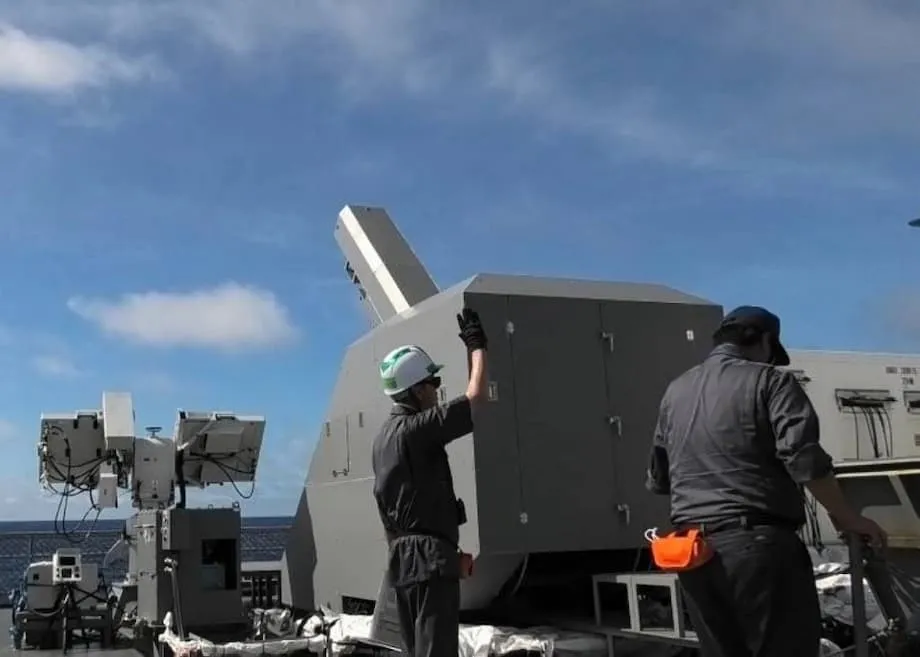
Japan's Acquisition, Technology and Logistics Agency (ATLA) has fired a prototype electromagnetic railgun from the experimental ship JS Asuka at a target vessel during trials conducted from June to early July 2025. The agency, part of the Ministry of Defense, released four photographs and described the event as the first time a railgun mounted on a ship had been fired at a real ship.
Contents
- Sea trials move Japan's railgun closer to practical use
- What Asuka carried and what it fired at
- How electricity launches a projectile
- Power, cooling and rail wear shape the design
- The milestones behind the latest firing
- From individual shots to a complete weapon
- Why navies are interested in more rounds at lower cost
- How Japan's effort compares internationally
- Funding and the next development tasks
- Accuracy and sustained firing remain demanding
- Cheaper ammunition still needs an industrial base
- At a Glance
The trials included firing over long distances and shooting at the target vessel, with support from the Japan Maritime Self Defense Force. They extend a program that moved from testing on land to firing at sea in late 2023. ATLA plans to present more technical details at a defense technology symposium in November.
Japan is pursuing railguns alongside high power microwave systems and lasers as part of a layered approach to air and missile defense. In such a system, different weapons tackle threats at different distances or stages of an attack. Tokyo's investment comes amid concern about the growing missile arsenal in the region.
A railgun launches a small metal projectile with electricity rather than chemical propellant. Its appeal is the prospect of fast shots over long distances, with each round costing much less than a guided missile. A projectile can damage a target through the energy of its impact without needing an explosive warhead, reducing ammunition storage hazards and allowing more rounds to fit aboard a ship.
ATLA's next task is to turn that promise into a complete weapon system: a gun that can fire repeatedly, work with equipment that tracks targets and aims the weapon, and launch projectiles that remain stable in flight. The Asuka trials bring those requirements into a maritime setting, where the gun, its sensors and its electrical equipment must work together.
What Asuka carried and what it fired at
JS Asuka is a research and development ship measuring 151 meters in length. Commissioned in 1995, it serves as a floating laboratory for new naval equipment. The prototype railgun sits on its stern deck, where photographs show a compact gunhouse and a nearby support mast for sensors.
ATLA fitted the installation with a radar antenna to measure muzzle velocity, the speed of a projectile as it leaves the barrel. Cameras, including one beneath the barrel, record the launch and support analysis after each shot. These instruments help engineers connect what happens inside the gun with the projectile's departure and subsequent flight.
The target was mounted on a small yard tug that sailed as a moving surface contact. Target boards are visible in the imagery. The agency did not release footage of projectile impacts or publish detailed results on range, accuracy or damage from this firing series. Those details are expected to receive further attention at the November symposium.
The maritime service's Fleet Research and Development Command supported the campaign. Senior officers visited Asuka during the spring to inspect the installation before the ship left Yokosuka for trials. Images released in April 2025 had already shown the gun fully installed aboard the vessel.
How electricity launches a projectile
A railgun uses two conductive rails and a sliding armature, a component that carries electrical current between them behind the projectile. A large pulse of current travels through this arrangement, producing a powerful magnetic field. The interaction between the current and the field creates the Lorentz force, which pushes the projectile along the rails and out of the barrel.
The electrical energy is stored in large banks of capacitors or other modules designed to deliver a pulse. Capacitors hold electrical energy until it is needed; the railgun releases that energy in milliseconds. The resulting currents and acceleration are extreme, placing heavy demands on the gun's materials and electrical equipment.
A conventional gun uses expanding gases from burning propellant to drive its ammunition forward. The railgun instead depends on electrical energy and the projectile's kinetic energy, meaning the energy it carries because it is moving. Its potential value therefore depends on both the launch system and the projectile maintaining useful speed and stability on the way to the target.
Power, cooling and rail wear shape the design
Asuka offers space for experimental equipment and large generators, making it a useful first platform. Installation on smaller combat ships would require a much more compact power supply. Engineers must fit the generator, energy storage, power electronics, cables and cooling equipment into a package that a warship can safely carry and operate.
Repeated firing requires the energy store to recharge quickly while the system removes heat. High current heats the rails and the path followed by the armature. Without adequate cooling, successive shots can lose performance. The challenge is therefore to sustain firing, rather than simply produce enough electrical energy for a single launch.
Rail life is another central issue. A railgun's wear differs from the erosion caused by blast pressure in a conventional gun, but its rails and contact surfaces still face current, heat and friction. ATLA reported that early barrels used copper rails and that later work adopted different rail materials.
The agency has set a goal of a barrel life of 120 rounds while maintaining a stable muzzle velocity. Its work includes better armatures, coatings for the rails and projectiles that remain stable as they travel through dense air at high speed. A barrel that lasts longer between replacements would also make maintenance during naval operations more manageable.
The milestones behind the latest firing
ATLA began full scale work on electromagnetic acceleration systems in 2016. Testing on land produced successive milestones before the first firing from a ship in late 2023. The current prototype has a barrel about six meters long and a bore, the opening through which the projectile travels, of around 40 millimeters.
Earlier firings achieved muzzle velocities of roughly 2,000 to more than 2,400 meters per second. Those speeds are near Mach seven at high altitude, or about seven times the local speed of sound. Flight closer to sea level depends on air density and projectile shape, so the conditions through which the projectile travels remain part of the engineering problem.
ATLA has demonstrated a shot of five megajoules and discussed raising stored energy toward 20 megajoules in future variants. A megajoule is a unit of energy. The 20 megajoule figure concerns the future energy storage ambition, while five megajoules describes the earlier shot demonstration.
The program's main dates show how it has progressed from developing the launcher to testing an integrated system at sea:
- 2016: ATLA began full scale work on electromagnetic acceleration systems.
- Late 2023: The program conducted its first firing from a ship.
- Fiscal year 2024: Japan allocated roughly $167 million to research on a future railgun capable of intercepting airborne threats.
- April 2025: Images showed the prototype fully installed on JS Asuka.
- June to early July 2025: Asuka supported firing over long distances and shots at a target vessel.
- November 2025: ATLA plans to present further technical details at a defense technology symposium.
- Through fiscal year 2026: The research program aims to develop a complete gun system.
From individual shots to a complete weapon
ATLA is moving from testing individual shots toward continuous firing. That change brings recharge time, accumulating heat and projectile stability to the center of the work. A gun intended for repeated engagements must deliver consistent shots while its electrical and mechanical components become hotter.
Asuka carried a dedicated fire control console beside the mount. Visible in the photographs, the console connects the gun with ship sensors and collects precise measurements, including muzzle velocity and the angle at which the projectile leaves the weapon. Fire control is the process of using target information to determine where and when a weapon should fire.
Japanese industry is contributing to construction and testing. Work cited by defense officials credits companies including Japan Steel Works with fabrication, while ATLA leads design and trials. The program has also explored cooperation with the French German Research Institute of Saint Louis to exchange data and testing methods.
These efforts are directed toward a system that can be manufactured, maintained and used for training on real platforms. A repeatable production design needs to bring together the launcher, ammunition, sensors, electrical supply and maintenance requirements.
Why navies are interested in more rounds at lower cost
A mature railgun could give crews another option against small boats and surface craft operated remotely, especially when firing a missile would be costly. With a suitable projectile, it could also release fragments in an airburst to engage drones and cruise missiles. Against ballistic or hypersonic threats flying high and fast, the proposed role would involve working alongside missiles and sensors within a layered defense.
Magazine capacity is a major attraction. A ship could carry hundreds of kinetic rounds and fire many shots in a short period, useful against attacks involving numerous targets. Modern warships have a fixed number of missile cells and cannot reload those cells at sea. Using an expensive interceptor against a cheap drone consumes both money and a weapon that is difficult to replace during a long patrol.
Railgun rounds are smaller, easier to store and much cheaper per shot than guided missiles. Repeated engagements in the Red Sea, where ships have fired large numbers of interceptors against drones and missiles, illustrate why ammunition supply matters during extended deployments. More rounds aboard a ship could give its crew more opportunities to respond before returning for supplies.
The same technology has possible uses on land, including firing against enemy artillery, coastal defense and attacks on fixed sites beyond the distances reached by conventional tube artillery. Those missions would place different demands on the projectile and on the equipment used to find and track targets.
Research programs have studied projectiles that release several smaller tungsten projectiles near the end of their flight to improve the chance of hitting a fast incoming target. Designers are also testing guidance aids, including simple GPS receivers for updates during flight. Electronics inside a projectile must survive the extreme acceleration of launch, making guidance another demanding part of development.
How Japan's effort compares internationally
The United States Navy suspended its railgun program in 2021 after spending hundreds of millions of dollars without fielding an operational system. Rail wear, severe heating, electrical power requirements and the difficulty of making projectiles survive launch while retaining precise guidance were among the main obstacles.
China has tested large railgun prototypes on river barges and claimed progress in guidance. No operational naval railgun system has been publicly demonstrated there. South Korea, Turkey and European research institutes also continue to investigate the technology.
Japan is at the forefront of actual sea trials with a railgun mounted on a ship. Firing at a moving target vessel with support from the maritime service takes the work beyond laboratory demonstrations and into conditions closer to naval operations. The broader Japanese plan also includes new large combat ships with substantial electrical power and the sensors needed for accurate tracking and shot control.
Funding and the next development tasks
Japan's fiscal year 2024 budget allocated roughly $167 million for research on a future railgun intended to intercept airborne threats. The research program runs through fiscal year 2026 and aims to deliver a complete gun system. The absence of a new line item in the next plan likely reflects funding approved for work spanning several years.
ATLA's near term tasks include improving projectile stability, strengthening the rails and contact surfaces so that muzzle velocity stays consistent across many shots, and refining fire control. Reducing the size of the power supply is also a priority. A compact generator and energy storage module would be needed for destroyers and future large ships equipped with Aegis.
Testing on land will continue with developmental projectiles, while Asuka supports integration aboard a ship, safety checks and the development of ways to use the weapon. Together, these activities address both the projectile's flight and the practical demands of operating the launcher at sea.
A system closer to a production design could first appear on a large hull with substantial electrical reserves if development proceeds as planned. Another possible route is a battery on land serving coastal defense missions. Either approach would aim to add the ability to send many precise rounds at high speed toward a target bearing.
Accuracy and sustained firing remain demanding
Engineers still need to demonstrate range and destructive effect at sea against realistic targets that maneuver and approach in numbers. Intercepting a cruise missile or ballistic target requires reliable tracking, accurate estimates of the projectile's travel time and ammunition that can survive launch, steer and trigger its effects at the right moment.
Heat, atmospheric drag and the formation of plasma around a projectile complicate its flight. The muzzle velocity radar and cameras fitted to Asuka provide measurements for studying these problems. Successful engagements in demanding conditions depend on connecting those measurements with dependable targeting and projectile performance.
Repeated firing also changes conditions inside the weapon. Shock and heat can alter mechanical alignment and electrical contact along the rails. Even small changes can reduce muzzle velocity or disturb projectile stability. Maintaining the same quality of shot throughout a firing sequence is therefore a central requirement.
A warship must also ensure that the large current pulse does not interfere with sensitive equipment elsewhere aboard. This is electromagnetic compatibility: electrical systems need to operate together without disrupting one another. Storing large amounts of electrical energy on a vessel carrying a crew brings additional safety requirements. Addressing these engineering issues will take repeated testing and refinement.
Cheaper ammunition still needs an industrial base
A railgun could replace some expensive missile shots with cheaper projectiles, but a fleet would still need to produce, test, transport and store large quantities of ammunition. Manufacturers would need materials that can be supplied in volume without depending on rare inputs.
Crews would also need training and clear rules for choosing a railgun rather than a missile. The weapon's usefulness would depend on matching it to the target and avoiding wasted shots or promises beyond its capabilities in complex engagements. Construction, maintenance and ammunition supply would remain part of the cost of operating the system.
For Japan, the June and July trials mark a concrete step toward those practical requirements. The November presentation is the next scheduled opportunity for ATLA to explain the test results, while research through fiscal year 2026 is directed at bringing the gun, power supply, projectiles and fire control together.
At a Glance
- ATLA fired a prototype railgun from JS Asuka at a target vessel during June to early July 2025 trials.
- The agency described the event as the first firing from a ship mounted railgun at a real ship.
- The target was carried on a moving yard tug fitted with target boards.
- Four released photographs show equipment including a compact gunhouse, muzzle velocity radar and cameras.
- Earlier testing achieved muzzle velocities of roughly 2,000 to more than 2,400 meters per second.
- ATLA demonstrated a five megajoule shot and discussed future stored energy of 20 megajoules.
- Development goals include repeated firing, stable projectile flight, integrated fire control and a barrel life of 120 rounds.
- Japan allocated roughly $167 million for future railgun research in fiscal year 2024.
- Further technical details are expected in November, with research continuing through fiscal year 2026.
- Potential missions include defense against drones and missiles, surface engagements and coastal defense.
- The United States suspended its naval railgun effort in 2021, while Japan continues testing at sea.