A Family of Stone Whales Above the Forest
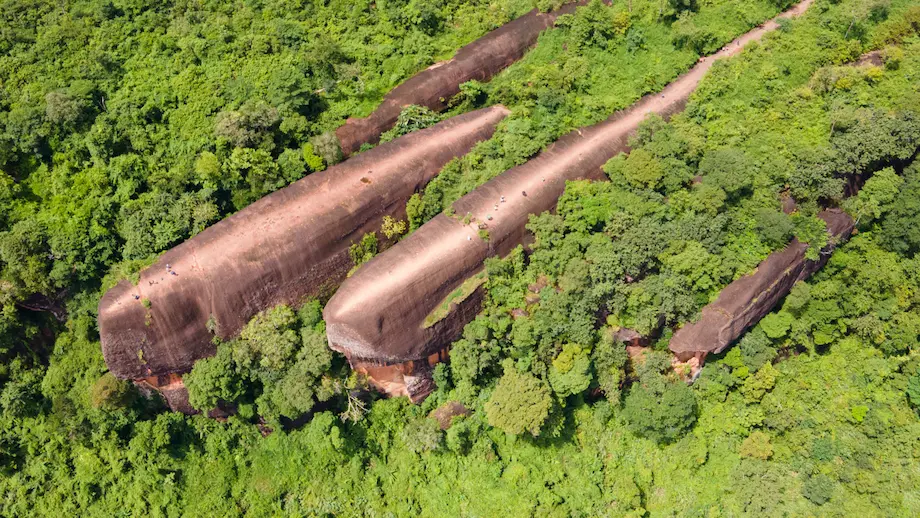
Three sandstone formations estimated to be around 75 million years old rise above the forest in Thailand's northeastern province of Bueng Kan. Known as Hin Sam Wan, or Three Whale Rock, their long, rounded shapes resemble a family of whales swimming side by side, with their backs emerging from a sea of trees.
Contents
- A Family of Stone Whales Above the Forest
- How Sand Became Sandstone
- Reaching Phu Sing From Bueng Kan
- Standing on the Father and Mother Whales
- Hours, Costs and Practical Choices
- More to Explore in the Forest Park
- Tourism Growth and the 7 Greens Initiative
- A Community Museum Rooted in Isan Life
- A Landscape With Cultural Meaning
- The Bottom Line
The formations stand in Phu Sing Forest Park, part of the Phu Sing mountain range, in a region bordering Laos and the Mekong River. Each stretches hundreds of meters along a high ridge. Their size and position above the canopy give the landscape its distinctive appearance, while their origins tell a much older story of sand, rock, uplift and erosion.
Visitors can reach the two largest formations, affectionately called the father and mother whales. The smallest, the baby whale, is closed to the public to protect its fragile surface. From the accessible rocks, views extend across the Isan countryside, toward the Mekong and into the mountains of Laos' Pakkading district.
Bueng Kan is among Thailand's most remote and least visited areas. Its appeal combines quiet forest landscapes with local culture, offering a different experience from the country's crowded tourist destinations. Three Whale Rock brings those attractions together: an unusual geological landmark within a protected landscape, reached through a visitor system intended to balance access with conservation.
The site also connects several parts of the province's tourism story. Forest trails, waterfalls and caves surround the rocks, while community projects elsewhere in Bueng Kan give visitors opportunities to encounter Isan traditions, architecture and art.
How Sand Became Sandstone
Three Whale Rock is composed primarily of sandstone, a sedimentary rock formed from sand and minerals compacted over millions of years. Sedimentary rock develops as material accumulates in layers and gradually becomes solid. At Phu Sing, those layers eventually became the stone that now projects above the trees.
The estimated age of around 75 million years places the rock in the late Cretaceous period, when dinosaurs still roamed the Earth. The formations belong to the geological landscape of the Khorat Plateau, described as one of Thailand's oldest, with fossils and evidence of prehistoric life.
Tectonic uplift raised the sedimentary layers, exposing them to weather. Uplift is the slow movement that brings rock higher as the Earth's crust changes. Once exposed, the stone faced wind, rain and changes in temperature, which gradually wore away softer material.
Cracks and fissures helped guide that process. Water and weather worked along weaknesses in the rock, shaping what survived into three elongated, rounded formations. Their smooth contours and position above the forest create the impression of whales gliding through green water.
An unnamed geology enthusiast, writing in an online forum, described the age of the formations and the gradual process that shaped them:
These magnificent structures are estimated to be over 75 million years old, a staggering age that predates the dinosaurs' final extinction. They were not created in a sudden cataclysm, but rather sculpted patiently by the elements.
The landscape combines two different timescales: the formation of sandstone over millions of years and the continuing work of erosion on exposed rock. Together, those processes account for the shapes that visitors see today.
Reaching Phu Sing From Bueng Kan
Bueng Kan is about 720 km from Bangkok. Bueng Kan City, the nearest town, is 24 km from the park entrance, with the journey taking about 30 minutes by car or scooter. The province's location near the Mekong places the visit within a wider landscape shared visually with neighboring Laos.
Visitors register at the park entrance before heading upward. They can choose a moderate hike of about 45 minutes to an hour or hire a jeep for a guided tour. The route passes through dense forest, alongside rocks shaped like animals and panoramic viewpoints, before reaching the spine of the largest whale.
That approach makes the surrounding forest part of the experience. Elephant Rock and the Hermit's Cave are among the other distinctive formations in the protected area, which also contains waterfalls and a variety of plants and animals.
Standing on the Father and Mother Whales
The father and mother whales are the two formations open to visitors. Their broad stone surfaces lead to viewpoints above the canopy, while the baby whale remains closed because of its fragile surface. The arrangement allows people onto part of the landmark while keeping the smallest formation protected.
Sheer drops on three sides make the setting dramatic. Visitors standing on the rocks can look across the forest and Isan countryside, with the Mekong River and the mountains of Pakkading district beyond. The height and exposed edges make caution part of the visit.
Marked safety zones help direct visitors, but some areas lack handrails. Staying within those zones and paying attention near cliff edges are practical requirements, even when the view draws attention outward. Jeep access reduces the amount of walking needed, while the summit itself still requires care.
Thai families, photographers and nature lovers visit the site, contributing to an atmosphere described as lively yet respectful. Many travelers regard it as a hidden gem away from Thailand's busiest tourism centers.
Sunrise and sunset are particularly attractive times for the changing light. Golden light falls across the stone and forest, accompanied by birdsong. The visual attraction is the same geological shape seen under different conditions, with the contours of the rocks standing out against the canopy.
Hours, Costs and Practical Choices
Phu Sing Forest Park is open daily from 5 AM to 5 PM. Entrance costs 100 baht per person, and jeep rides to the top cost 500 baht, which groups can share. The entrance charge is listed per visitor, while the jeep cost can be divided among those traveling together.
Facilities include toilets at the base and summit, food stalls and a coffee shop. These services support a visit that may involve an early start, a forest walk or time spent at the viewpoints. The park is described as suitable for most visitors, with jeep tours available for people who prefer not to hike.
The cool season, from November to February, offers mild weather and clear skies for hiking and photography. Visitors planning around sunrise or sunset also need to account for the stated opening hours of 5 AM to 5 PM.
Practical choices for a visit include:
- Travel from Bueng Kan City, about 24 km from the entrance.
- Allow about 45 minutes to an hour for the moderate hike, or choose a guided jeep ride.
- Budget 100 baht per person for entrance and 500 baht for a jeep ride that a group can share.
- Use marked paths and safety zones, especially near exposed edges.
- Avoid disturbing wildlife and take care not to leave litter.
More to Explore in the Forest Park
Phu Sing Forest Park has nine hiking routes, giving visitors ways to explore beyond Three Whale Rock. Waterfalls, caves, viewpoints and other rocks resembling animals are spread through the landscape, adding opportunities for walking and photography.
Elephant Rock and the Hermit's Cave are part of that wider setting. Together with the whale formations, they show how the area's rock shapes contribute to its appeal, while the forest provides a quieter setting for exploration.
Birds, butterflies and rare orchids are among the plant and animal life described in the park. Ancient trees and diverse ecosystems that have survived for millions of years make the forest a living museum alongside its geological features.
The trails allow a visit to extend beyond a single viewpoint. For travelers seeking time in nature, the combination of forest paths and scenic stops offers a break from the bustle of modern life, within a protected area that also supports wildlife.
Tourism Growth and the 7 Greens Initiative
Thailand welcomes millions of international visitors each year, creating pressure to balance tourism with environmental protection. Heavy visitor numbers can damage fragile ecosystems and disrupt local communities. Bueng Kan's quieter landscapes and cultural attractions form part of the country's movement toward more sustainable travel.
The Tourism Authority of Thailand, or TAT, launched its 7 Greens initiative in 2011. It encourages responsible travel and the protection of natural treasures such as Three Whale Rock. Visitors are urged to reduce waste, respect the environment and engage meaningfully with local culture.
Bueng Kan is presented as a model for tourism that connects environmental care with cultural life. At Three Whale Rock, the combination of protected land, visitor registration, marked safety areas and restricted access to the baby whale gives that approach a concrete form.
The story links ancient geology with a much more recent tourism effort:
- Around 75 million years ago: the estimated age of the sandstone formations, dating to the late Cretaceous period.
- 2011: the Tourism Authority of Thailand launched the 7 Greens initiative to encourage responsible travel and environmental protection.
For visitors, responsible travel means following park rules, remaining on marked paths, avoiding disturbance to wildlife and supporting local communities. Those choices connect the experience of seeing the rocks with the work of protecting the place around them.
A Community Museum Rooted in Isan Life
The Life Community Museum in Bueng Kan offers another example of the province's approach to tourism. The collaborative project showcases Isan traditions, architecture and art, extending the visitor experience beyond the forest and its viewpoints.
Local markets, live music and Buddhist handicraft exhibits are among its activities. The museum offers immersive experiences without intruding on daily life, allowing cultural heritage to remain connected to the community that maintains it.
Local families gain economic opportunities from this approach. Visitors encounter traditions and creative work, while residents have ways to earn income through cultural tourism. The project joins preservation with participation, rather than treating culture only as something to display.
The museum and Three Whale Rock represent different parts of the same provincial appeal. One centers on community life and cultural expression; the other draws people into an ancient natural landscape. Both are described as part of Bueng Kan's effort to welcome visitors while protecting what makes the province distinctive.
A Landscape With Cultural Meaning
Three Whale Rock holds cultural significance for people in Bueng Kan as well as geological interest for visitors. Local legends and spiritual practices are woven into the landscape, and the rocks are regarded as guardians and symbols of resilience.
Pilgrims and visitors ascend the formations to enjoy the views, offer prayers and connect with a sense of timelessness. The age and scale of the rocks give that experience a physical setting, with ancient stone underfoot and forest stretching toward the horizon.
The park's protected status safeguards its natural environment and cultural traditions for future generations. Local guides, artisans and rangers help manage tourism and maintain the site's integrity, making community involvement part of its conservation.
An unnamed travel writer described the personal response that standing on the rocks can inspire:
The experience of standing atop the whales transcends simple sightseeing; it's an immersion into a story written in stone, where the grandeur of nature meets the quiet reverence of human spirit.
For many visitors, the journey is as much a pilgrimage as a hike. The formations prompt reflection on the passage of time and humanity's place within nature, while their resemblance to a family of whales makes an immense geological timescale easier to imagine.
The Bottom Line
- Hin Sam Wan, or Three Whale Rock, consists of three sandstone formations estimated to be around 75 million years old.
- The landmark stands in Phu Sing Forest Park in Bueng Kan, northeastern Thailand, near Laos and the Mekong River.
- Uplift exposed the rock layers, and wind, rain, temperature changes and cracks helped shape their rounded forms.
- The father and mother whales are accessible; the baby whale is closed to protect its fragile surface.
- The park opens daily from 5 AM to 5 PM, with entrance costing 100 baht per person and jeep rides costing 500 baht to share.
- Nine hiking routes, waterfalls, caves, wildlife, Elephant Rock and the Hermit's Cave broaden the park's attractions.
- TAT's 7 Greens initiative began in 2011, while Bueng Kan's Life Community Museum connects tourism with Isan culture and local income.
- Visitors are encouraged to follow safety markings, avoid litter and wildlife disturbance, and support local communities.