A steep discount despite China's technology rally
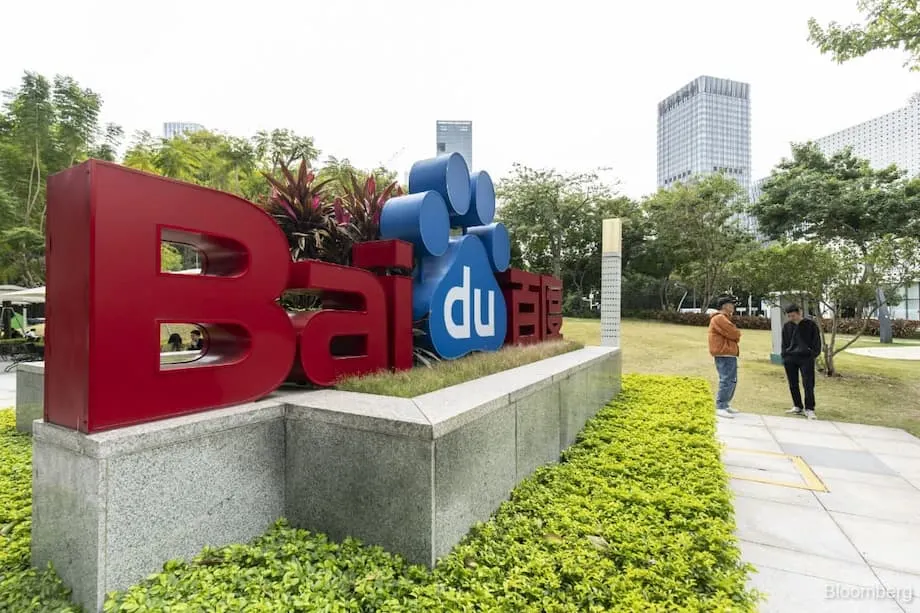
Baidu was trading at about 9.7 times estimated forward earnings as of August 24, 2025, making it the cheapest stock among profitable companies on the Hang Seng Tech Index. The company once described as China's answer to Google was valued even more cheaply on that measure than troubled property developer Longfor Group Holdings.
Contents
- A steep discount despite China's technology rally
- Search loses ground to social platforms
- An early chatbot lead meets stronger rivals
- Free access and cheaper models reshape the contest
- The main dates in Baidu's transition
- Cloud becomes a brighter source of growth
- Apollo Go expands beyond China
- Higher net income alongside falling revenue
- China's crowded race to build AI
- The startups and national platforms shaping competition
- Investors weigh a low price against continuing risks
- Key Points
Baidu's shares fell as much as 3% in Hong Kong after it recorded its largest quarterly revenue decline in more than three years. Its shares had gained only about 3% during 2025, compared with a 24% rise in the technology benchmark. That left a gap of roughly 21 percentage points during a rally driven by enthusiasm for artificial intelligence.
A forward earnings multiple compares a company's share price with the profit it is expected to earn. Baidu's multiple means investors were paying about 9.7 times its estimated earnings. The discount reflects concerns about whether its search business can withstand new competitors and whether its investment in AI can produce enough income to justify the expense.
Baidu faces pressure from two directions. Xiaohongshu and Douyin are attracting people who previously might have searched the web, while Alibaba, ByteDance and a growing group of startups are competing for users of AI chatbots and business services.
The company is responding with free access to ERNIE Bot, new AI models, cloud services and an expanding robotaxi business. Those efforts are producing growth in some areas, but advertising remains under pressure. Investors are weighing the promise of those newer businesses against the weakening operation that has long supplied much of Baidu's cash.
Search loses ground to social platforms
Baidu's search engine was once a dominant force in China's internet economy. Its advertising business depends on attracting users and giving companies a reason to pay to reach them. Competition now comes from platforms where people can find information alongside videos, recommendations and social content.
Xiaohongshu and Douyin, the Chinese version of TikTok, have built content ecosystems that encourage users to return and stay engaged. Their appeal puts pressure on Baidu's more traditional approach of directing people toward information on the web.
Eric Shen, an analyst at global research firm Third Bridge, described how those competitors are challenging Baidu's search business:
The company's search arm, once a dominant cash generator, now faces stiff competition from Xiaohongshu and Douyin. These rivals have built content ecosystems that feel livelier and stickier, drawing users away from Baidu's more static, web-based offerings.
Baidu's online advertising revenue fell 15% from a year earlier in the second quarter of 2025. Uncertainty among Chinese businesses is also weighing on advertising demand, adding an economic challenge to the competition for users.
For Baidu, restoring advertising growth means protecting the business that helps finance its expansion into AI. New products must compete for customers while the company manages a decline in an established source of revenue.
An early chatbot lead meets stronger rivals
Baidu launched its flagship ERNIE Bot in March 2023, only months after OpenAI's ChatGPT attracted worldwide attention. Millions of users joined, giving Baidu an early position in China's market for generative AI, technology that produces text, images or other content in response to instructions.
Alibaba and ByteDance subsequently strengthened their own AI products, while DeepSeek, Moonshot AI and Zhipu AI brought new competition. ByteDance's Doubao and Moonshot AI's Kimi became some of China's most popular chatbots. Alibaba's Qwen gained traction with both businesses and individual users.
DeepSeek sharpened the pressure on established companies by releasing powerful large language models at a fraction of the cost of industry leaders. A large language model, or LLM, is the underlying system that enables many chatbots to understand prompts and generate responses. DeepSeek's R1 offered performance comparable to leading US models at much lower prices.
Competition also extends beyond general conversation. Rivals are releasing models with strengths in coding, mathematics and image generation. Baidu must keep improving its technology while responding to lower prices and changing customer expectations.
Apple's choice of a Chinese AI partner added another setback. After considering Baidu for bringing AI to iPhones in China, Apple chose to collaborate with Alibaba.
Free access and cheaper models reshape the contest
Baidu announced that ERNIE Bot would become free for all users starting April 1, 2025. Reductions in inference costs made the decision possible. Inference is the process of running a trained AI model to produce an answer, and its cost affects how much a company must spend each time someone uses the service.
Baidu also introduced a free Deep Search feature with stronger reasoning capabilities and committed to making its ERNIE 4.5 model open source by the end of June 2025. Open source makes the technology available for others to use and develop, broadening access beyond a company's own products.
The decision to remove charges for ERNIE Bot escalated an industry price war. Free access can attract more users, but it also increases the pressure to find income through other services, including tools and infrastructure sold to businesses.
Baidu introduced ERNIE 4.5 Turbo and ERNIE X1 as part of its response. ERNIE X1 is a reasoning model designed for deeper thinking and is capable of AI image generation, code interpretation and complex calculations.
Baidu says ERNIE X1 matches DeepSeek R1's performance at half the price. It also claims ERNIE 4.5 outperforms OpenAI's GPT-4.5 on several benchmarks while costing just 1% of GPT-4.5's price. Benchmarks are tests used to compare how models perform on selected tasks.
Baidu is integrating these models into its search engine, cloud services and wider product ecosystem. That connects its AI development directly to the businesses where it needs to retain users and win paying customers.
The main dates in Baidu's transition
Baidu's current position follows more than two years of chatbot development and a longer national push to build China's AI industry. The main milestones show how the company moved from an early launch to a contest increasingly shaped by pricing and commercial growth.
- 2017: China launched its New Generation Artificial Intelligence Plan, aiming to become a global AI leader by 2030.
- March 2023: Baidu launched ERNIE Bot, attracting millions of users.
- Fourth quarter of 2024: Baidu's AI Cloud revenue grew 26% from a year earlier.
- April 1, 2025: The announced start date for free ERNIE Bot access.
- End of June 2025: Baidu's stated deadline for making ERNIE 4.5 open source.
- Second quarter of 2025: Total revenue fell 4%, while AI Cloud revenue grew 34% and Apollo Go provided more than 2.2 million driverless rides.
- August 2025: Apollo Go's cumulative rides passed 14 million.
Baidu's challenge by August 24 was to turn that expanding activity into a stronger financial performance while its advertising business contracted.
Cloud becomes a brighter source of growth
Baidu's AI Cloud division generated more than RMB 10 billion in revenue in the second quarter of 2025, an increase of 34% from a year earlier. Its Qianfan platform supplies AI infrastructure and tools to businesses, helping customers use the technology without building every component themselves.
Generative AI revenue nearly tripled. Baidu's ERNIE large language model was processing 1.65 billion API calls daily across sectors including education, electronic commerce, manufacturing and finance. An API call is a request made by software to another service, in this case to obtain a response from an AI model.
Baidu's customers span internet services, automotive businesses, manufacturing, energy and finance. Adoption among businesses of medium size, alongside that range of industries, has broadened its customer base.
Baidu's AI Cloud was ranked first in China's AI public cloud market, with Qianfan helping establish that position. Its cloud progress comes amid Alibaba's aggressive pricing and Tencent's integration of AI into gaming and social media.
The cloud business had already grown 26% in the fourth quarter of 2024. The 34% increase in the second quarter of 2025 shows a faster pace than that earlier period, providing one of the clearest signs of growth as Baidu shifts toward selling AI services.
Nonmarketing revenue also rose 34% in the second quarter, driven by strong demand for cloud services. Baidu's early position in AI public cloud and its alignment with China's national AI goals are part of the case for investors considering the company over the medium term.
Apollo Go expands beyond China
Baidu's Apollo Go robotaxi service provided more than 2.2 million driverless rides during the June quarter. Its cumulative total exceeded 14 million by August 2025, making autonomous driving another prominent part of the company's attempt to build businesses beyond search advertising.
Apollo Go is expanding internationally, with operations in Singapore, Malaysia, Dubai and Abu Dhabi. Baidu is also conducting trials in Hong Kong.
The service demonstrates Baidu's commitment to developing technology over a long period, but profitability remains a distant goal. Analysts expect its AI ventures to remain unprofitable for at least the next three years as spending continues on research, development and international expansion.
For investors, the ride totals show growing use of the service, while continued investment places demands on the company's finances. Baidu must fund this expansion at the same time that it is competing on AI prices and managing lower advertising revenue.
Higher net income alongside falling revenue
Baidu's total revenue declined 4% from a year earlier to RMB 32.7 billion in the second quarter of 2025. The slowdown in internet search and the 15% fall in online advertising were central reasons for the decline.
Net income nevertheless increased 33%, helped by gains from investments held over the longer term and measures to reduce costs. Revenue measures the money generated by sales, while net income is what remains after expenses and other financial items. The two can move in opposite directions when investment gains or cost reductions lift profit.
Baidu maintained a non-GAAP margin of 17%. Non-GAAP figures adjust standard accounting results by excluding selected items, giving investors another measure of financial performance. The company also returned $677 million to shareholders through share repurchases.
Baidu ended 2024 with RMB 170.5 billion in net cash and RMB 13.1 billion in free cash flow. Net cash takes account of cash holdings and debt, while free cash flow measures money left after operating costs and spending on assets. Those resources support investment and continued share buybacks.
The company's streaming subsidiary, iQiyi, added another weak point. Its revenue fell 11%, and it was seeking to raise $300 million through a Hong Kong listing.
Baidu's finances therefore show both resources and pressure. Cash, cloud growth and cost controls support the transition, while weaker advertising, the decline at iQiyi and sustained technology spending make the task more difficult.
China's crowded race to build AI
China's New Generation Artificial Intelligence Plan, launched in 2017, set a goal of global AI leadership by 2030. More than 100 large language models subsequently emerged in a contest Baidu chief executive Robin Li has called a "war of a hundred models."
China's approach resembles its push into electric vehicles: many competitors enter, strong companies emerge, and others struggle to make money. Numerous AI startups now face financial difficulties, while intense price competition has encouraged some to seek overseas markets offering higher profits and lighter regulatory burdens.
China's AI models still trail US counterparts on major benchmarks. The country nevertheless leads in generative AI patents and contributes more than 20% of global AI research.
Government subsidies support data centers and domestic chip production. China's power supply advantages for data centers, together with large investments in wind and solar energy, also support expectations that its AI industry can catch up.
The large number of competing models increases the chances of a breakthrough, while creating immediate costs through duplicated investment and fierce competition. Baidu faces those pressures even as it benefits from the national commitment to AI development.
The startups and national platforms shaping competition
Several Chinese AI startups have reached unicorn status, a term used for privately held companies valued at $1 billion or more. Their different approaches show why Baidu's competition extends beyond the country's largest internet groups.
- Zhipu AI was founded by a Tsinghua University professor and focuses on natural language AI at very large scale.
- 01-AI was launched by former Google China president Kai-Fu Lee and builds on open source models with a focus on quality control.
- DeepSeek is a spinoff from a quantitative hedge fund and uses a Mixture-of-Experts architecture to deliver strong performance with fewer resources.
- Moonshot AI developed Kimi, one of China's most visited AI chatbots.
Mixture-of-Experts divides work among specialized parts of a model, using the relevant parts for a particular request. That approach helps explain DeepSeek's focus on producing competitive results with fewer computing resources.
Baidu, Alibaba, Tencent and iFlyTek have also been tasked with building open innovation platforms for AI. These initiatives sit alongside the startup competition rather than replacing it.
Google's AlphaGo defeated leading Chinese Go players in 2017, an event seen as a "Sputnik Moment" that encouraged greater investment and urgency. The national effort that followed created opportunities for established technology companies while helping build the crowded market Baidu now faces.
Investors weigh a low price against continuing risks
Baidu's stock fell 17% over the preceding month, performing worse than both the broader internet services industry and the technology sector. US-China trade tensions, declining online marketing revenue and competition across China's digital economy contributed to the decline.
The shares were trading below their moving averages over 50 days and 200 days. A moving average smooths daily price changes to show the recent trend; trading below both measures indicated a bearish pattern.
Some analysts see an opportunity in the discounted valuation, substantial cash resources and progress in AI, cloud services and autonomous driving. Earnings estimates have been revised upward, and the consensus price target suggests substantial potential gains.
Baidu trades below its industry and historical valuation averages, carries a Value Score of A and holds a Zacks Rank of No. 1, or Strong Buy. Most analysts also rate the shares Strong Buy.
China's new requirements for AI generated content and stricter compliance standards add costs and may restrict ways to make money. Those demands come while Baidu is trying to restore confidence in advertising and fund newer businesses.
Baidu's investment case rests on concrete improvements: slowing the advertising decline, staying competitive in AI, and increasing the margins earned by AI Cloud. Its early cloud position and alignment with national goals could support a higher valuation for investors looking over the medium term, provided those improvements take place.
China's wider AI industry faces a similar balance. Heavy investment and determined competition increase the chances of technological advances, while price wars and financial strain make commercial success harder. For Baidu, the immediate task is to turn its growing AI activity into earnings that can compensate for pressure on search.
Key Points
- Baidu traded at about 9.7 times estimated forward earnings, the lowest valuation among profitable Hang Seng Tech Index companies.
- Its shares had gained about 3% in 2025 against a 24% rise in the technology benchmark, and fell 17% over the preceding month.
- Second quarter revenue fell 4% to RMB 32.7 billion, with online advertising down 15%, while net income rose 33%.
- AI Cloud revenue grew 34% to more than RMB 10 billion, and ERNIE processed 1.65 billion API calls daily.
- Baidu responded to AI competition with free ERNIE Bot access, cheaper models and a commitment to open source ERNIE 4.5.
- Apollo Go provided more than 2.2 million driverless rides in the June quarter and exceeded 14 million cumulative rides by August.
- Strong cash resources and positive analyst ratings support the investment case, while advertising weakness, AI spending and regulatory demands remain pressures.