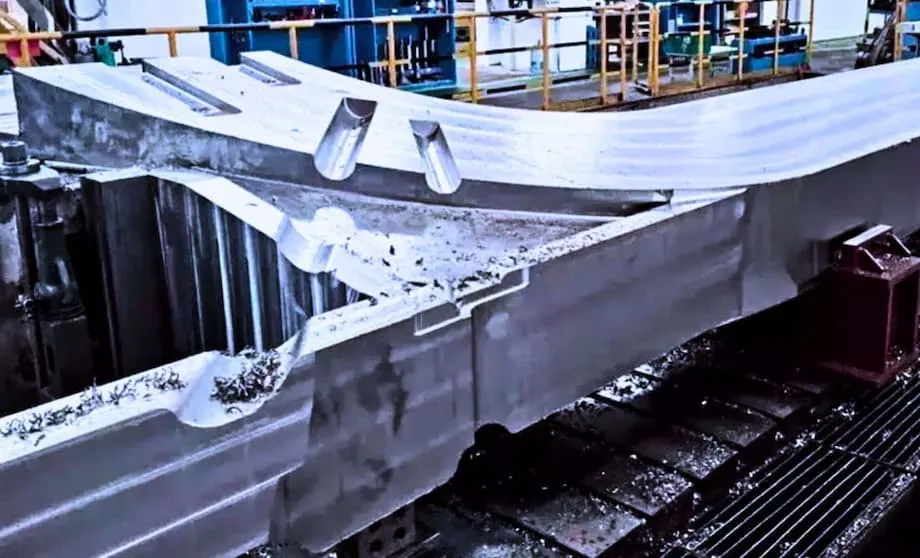
A steel built for fusion's coldest and strongest forces
China's CHSN01 steel combines a yield strength of about 1.5 gigapascals with the ability to stretch more than 30 percent before breaking at 4.2 kelvin, close to absolute zero. Developed over 12 years, the alloy is being used in the country's Burning Plasma Experiment Superconducting Tokamak (BEST), which is targeting first plasma in 2027 and a power output of 40–200 megawatts.
Contents
- A steel built for fusion's coldest and strongest forces
- Why a reactor hotter than the Sun needs extremely cold steel
- Where established fusion steels reach their limits
- How researchers changed the alloy
- A development effort shaped by scepticism and new targets
- Designing for 60,000 plasma pulses
- What stronger jackets change for BEST
- How BEST's purpose differs from ITER's
- Potential uses beyond a fusion reactor
- Key Points
By May 2023, more than 500 tonnes of CHSN01 had been installed in BEST's conductor jackets alone. These jackets surround the conductors used in the reactor's superconducting magnets. They must remain strong and resist cracking while the magnets operate in extreme cold and generate enormous mechanical forces.
CHSN01 stands for China High-Strength Low-Temperature Steel No. 1. Its development addresses a problem at the heart of more compact fusion machines: stronger magnetic fields help contain the fuel, but they also place greater stress on the structures supporting the magnets.
International experts had once described the achievement as "absolutely impossible". Chinese researchers nevertheless pursued a material that could withstand both temperatures near minus 269°C and the forces associated with magnetic fields reaching 20 tesla.
The result has potential uses beyond fusion, including medical imaging, particle accelerators, magnetic levitation transport, quantum computing refrigeration and space exploration. For BEST, however, the immediate task is specific: keep powerful superconducting magnets mechanically sound through repeated operation over the reactor's intended lifetime.
Why a reactor hotter than the Sun needs extremely cold steel
Fusion aims to reproduce the process that powers the Sun by joining hydrogen isotopes at temperatures exceeding 100 million degrees Celsius. Powerful magnetic fields contain the hot plasma, the state of matter in which the fusion reaction takes place.
The superconducting magnets operate at the opposite temperature extreme, as low as minus 269°C, just above absolute zero. The steel around their conductors therefore needs to work in intense cold while carrying the forces created by the magnets.
Many metals become brittle and lose ductility at these temperatures. Ductility is a material's ability to stretch or change shape before breaking. A steel that remains strong but cracks easily would leave a major weakness in a magnet subjected to large and repeated loads.
ITER, the large international fusion experiment in France, experienced this difficulty in 2011, when its cryogenic steel became brittle during testing. The setback illustrated the challenge of finding structural materials that can endure both extreme cold and powerful magnetic forces.
CHSN01 was developed for magnetic fields of up to 20 tesla, nearly twice the roughly 11.8 tesla benchmark associated with existing fusion magnet materials. Reaching higher fields requires more than a stronger magnet: the surrounding steel must also withstand the resulting mechanical stress.
Where established fusion steels reach their limits
Fusion projects have long relied on specialised stainless steels such as 316LN and JK2LB. These materials perform well at cryogenic temperatures, but their yield strengths reach approximately 0.9–1.1 gigapascals, with magnetic fields around 11.8 tesla.
Yield strength describes the stress at which a material begins to deform permanently. A higher value means the material can carry a greater load before it takes on a lasting change in shape. For a conductor jacket, that matters because the jacket must keep supporting the magnet through demanding operating conditions.
These material limits influence the size and cost of a fusion reactor. When the steel cannot carry greater stress, designers have less freedom to increase magnetic fields and make the machine smaller. Chinese planners wanted a material suited to reactors that could be more compact, efficient and commercially practical.
CHSN01's yield strength of about 1.5 gigapascals at 4.2 kelvin is roughly 40 percent higher than that of the 316LN jackets used in ITER, while maintaining comparable resistance to cracking. The combination matters as much as the strength figure itself: the new steel also stretches more than 30 percent before fracture.
The development programme therefore focused on several properties together. The steel needed to carry greater loads, remain ductile in extreme cold and tolerate the repeated stresses of a working fusion machine.
How researchers changed the alloy
Researchers began with Nitronic-50, a nitrogen strengthened austenitic steel, and adjusted its composition. Their approach combined very low carbon content, higher nitrogen and nickel levels, a small addition of vanadium and strict control of impurities.
Each change addressed a particular weakness that could become important in the cold environment of a superconducting magnet:
- Carbon was reduced to below 0.01 percent to prevent the formation of brittle carbides during years of service at 4 kelvin, approximately minus 269°C.
- Nitrogen was increased to about 0.30 percent, and nickel was raised slightly, helping the steel remain tough and ductile at cryogenic temperatures.
- A trace of vanadium was added to form vanadium nitride particles. These particles pin dislocations, restricting movement within the metal's structure and increasing strength without sacrificing toughness.
- Oxygen, phosphorus and sulfur were each kept below 0.02 percent to eliminate inclusions that could become starting points for cracks.
CHSN01's performance came from these adjustments working together. Strength alone would not meet the reactor's needs if the steel became too brittle. Maintaining toughness and the ability to stretch gives the material a way to endure loading without immediately fracturing.
At 4.2 kelvin, the resulting steel sustained about 1.5 gigapascals of yield stress and more than 30 percent elongation before breaking. Those results exceeded the Chinese benchmarks set in 2021 for elongation while meeting the strength target.
A development effort shaped by scepticism and new targets
Chinese researchers encountered doubts when they presented early results at international conferences. Many foreign experts questioned the need for another alloy, considering the established 316LN steel to be at the limit of what was possible.
Progress remained slow until 2020, when Zhao Zhongxian joined the project. Zhao, a specialist in cryogenic physics and a winner of China's top science award, helped reshape the team's approach to both the alloy's composition and the standards it would need to meet.
China set its own targets in 2021: a yield strength of 1,500 megapascals and elongation greater than 25 percent at cryogenic temperatures. In 2023, CHSN01 was confirmed to meet those standards. Tests also showed it could withstand magnetic fields of 20 tesla and stress of 1,300 megapascals without failure.
The main milestones span more than a decade of development:
- 2011: ITER suffered a setback when its cryogenic steel became brittle during testing.
- 2020: Zhao Zhongxian joined the Chinese steel project and helped revise its direction.
- 2021: China established targets of 1,500 megapascals yield strength and more than 25 percent elongation at cryogenic temperatures.
- 2023: CHSN01 was confirmed to meet those standards, with testing covering 20 tesla magnetic fields and 1,300 megapascals of stress.
- May 2023: More than 500 tonnes had been installed in BEST's conductor jackets.
- 2027: BEST is targeting first plasma and expected completion.
Li Laifeng, a researcher at the Chinese Academy of Sciences, described the material as ready for industrial use and connected its development directly to China's compact fusion programme:
Developing next-generation cryogenic steel is essential for the success of China's compact fusion energy experimental devices. CHSN01 is not just a laboratory curiosity—it's ready for industry.
Fusion expert Li Jiangang similarly called advanced steel development "essential" for the future of fusion power. Both assessments place the material alongside the magnets and plasma technology as a necessary part of building the next generation of machines.
Designing for 60,000 plasma pulses
BEST's magnets must endure repeated operation, rather than carry a single steady load. Fusion magnets pulse on and off tens of thousands of times during their working lives, making fatigue resistance a central requirement for the steel.
Fatigue is damage that accumulates through repeated loading. A small flaw can grow over many cycles, so engineers need to know how large an initial defect the conductor jacket can tolerate and still last for the planned operating life.
CHSN01 underwent fatigue testing at cryogenic temperatures. Researchers also used finite element models, which calculate how stresses act through a structure, and Paris-law analysis, which estimates how cracks grow under repeated loads.
The analysis indicated that CHSN01 jackets could begin with flaws covering up to 6 square millimetres and still survive 60,000 plasma pulses, BEST's expected lifetime. The testing therefore provided a practical link between the material's performance and the reactor's inspection requirements.
Flaws of that size are well above the detection limits of modern inspection techniques. Inspectors can use the findings to set criteria for nondestructive testing, checking the jackets without damaging them.
Fabricators also gain room to avoid excessive polishing or making conductors larger than necessary. That can reduce weight, cost and assembly time while preserving the ability to withstand repeated operation. The benefit is a manufacturing process guided by measured tolerance for defects and expected crack growth.
What stronger jackets change for BEST
CHSN01 gives reactor designers more freedom to pursue stronger magnetic fields. Higher fields increase the pressure available to confine the plasma, helping make more compact and efficient reactor designs possible.
The steel's strength and toughness also support the prospect of compact, modular machines. A jacket capable of carrying greater stress can reduce the amount of structural material required, lowering weight and simplifying construction and assembly.
BEST's goals make longevity especially important. The reactor is being built with commercial power production in mind, and its planned output is 40–200 megawatts. Its components are expected to handle demanding conditions repeatedly, rather than succeed in a small number of experiments.
CHSN01 addresses four connected design needs: fields of up to 20 tesla, resistance to fatigue over decades, lower material and construction costs, and greater reliability through tolerance of detectable initial flaws. Together, those properties are intended to make fusion equipment smaller, less costly and more practical.
BEST's first plasma target in 2027 will be a major stage in that programme. The steel's use in conductor jackets already takes it beyond laboratory samples and into the construction of a reactor intended to advance the production of fusion power.
How BEST's purpose differs from ITER's
ITER in France is the world's largest fusion experiment, designed for research rather than electricity generation. BEST, by contrast, is being developed with commercial power production in mind.
That difference places greater demands on the materials selected for BEST. The steel must support longer service and more challenging operating conditions as part of a machine pursuing practical power production.
The comparison between CHSN01 and ITER's 316LN conductor jackets is therefore about both material performance and design ambition. CHSN01 offers roughly 40 percent greater yield strength while retaining comparable resistance to cracking, giving designers a stronger structural material for more demanding magnets.
The alloy's successful development sets a new benchmark for fusion materials. Its role is to make the magnet system capable of supporting the higher fields and repeated operation that compact fusion designs require.
Potential uses beyond a fusion reactor
CHSN01's combination of strength, ductility and fatigue resistance at cryogenic temperatures makes it attractive for other technologies that depend on extremely cold equipment or powerful magnets.
Medical imaging is one possible application. Stronger and more reliable superconducting jackets could help reduce the size of MRI magnets and their maintenance needs. Particle accelerators could also benefit from components with greater durability under extreme conditions.
The other potential applications cover transport, computing and space:
- Maglev trains could use the material to improve the safety and efficiency of transport using magnetic levitation.
- Quantum computing refrigeration could benefit from tougher components in dilution refrigerators operating near absolute zero.
- Deep space exploration could use components capable of surviving exceptionally harsh conditions.
China's ability to manufacture CHSN01 domestically also reduces reliance on imported steels of high quality. That gives the country a strategic advantage across advanced technology sectors that require demanding material performance.
The possibilities have prompted fusion scientists internationally to reassess material choices, with some calling for renewed investment in metallurgy and materials science. The response reflects how strongly a reactor's design depends on the performance of the materials holding it together.
An unnamed fusion engineer described the place of materials development in the wider effort to build fusion power:
Fusion often grabs headlines with record plasma shots or exotic reactor concepts. Yet history shows that big energy technologies live or die on materials science. By pushing cryogenic stainless steel into the 1.5 GPa class without sacrificing toughness, Chinese researchers have supplied the mechanical keystone that high-field magnets were missing.
BEST's planned 2027 milestone will draw attention to how CHSN01 performs within the larger reactor programme. Success could make the alloy a new global standard for fusion construction and a useful option for other industries facing extreme cold and heavy mechanical stress.
Key Points
- China developed CHSN01 over 12 years for fusion magnets operating near minus 269°C and in fields of up to 20 tesla.
- The steel reaches about 1.5 gigapascals yield strength at 4.2 kelvin and stretches more than 30 percent before breaking.
- Its yield strength is roughly 40 percent higher than ITER's 316LN jackets, with comparable resistance to cracking.
- Analysis indicated that jackets with initial flaws up to 6 square millimetres could survive BEST's expected 60,000 plasma pulses.
- More than 500 tonnes had been installed in BEST's conductor jackets by May 2023.
- BEST targets first plasma and expected completion in 2027, with planned power output of 40–200 megawatts.
- Potential applications include MRI machines, particle accelerators, maglev trains, quantum computing refrigeration and space exploration.