A lower tariff leaves a million livelihoods under pressure
Cambodia enters August 1, 2025, with a 19% US tariff, reduced from an initial 49% and then 36%, but continuing uncertainty for the garment industry that supports nearly a million workers. The lower rate offers factories relief as the deadline for the new tariffs takes effect. Workers still face the prospect of fewer hours, lost overtime, mounting debt and job cuts.
Contents
- A lower tariff leaves a million livelihoods under pressure
- How the tariff changed, and why Cambodia is exposed
- Factory orders reveal the pressure on employment
- Regional rivals compete on more than tariff rates
- Women carry much of the household risk
- Returning migrants face fewer options and continuing debt
- Employment can worsen even without factory closures
- Chinese investment connects Cambodia to the trade dispute
- Negotiations buy relief, while diversification takes investment
- Labour agreements address who bears the cost
- Key Points
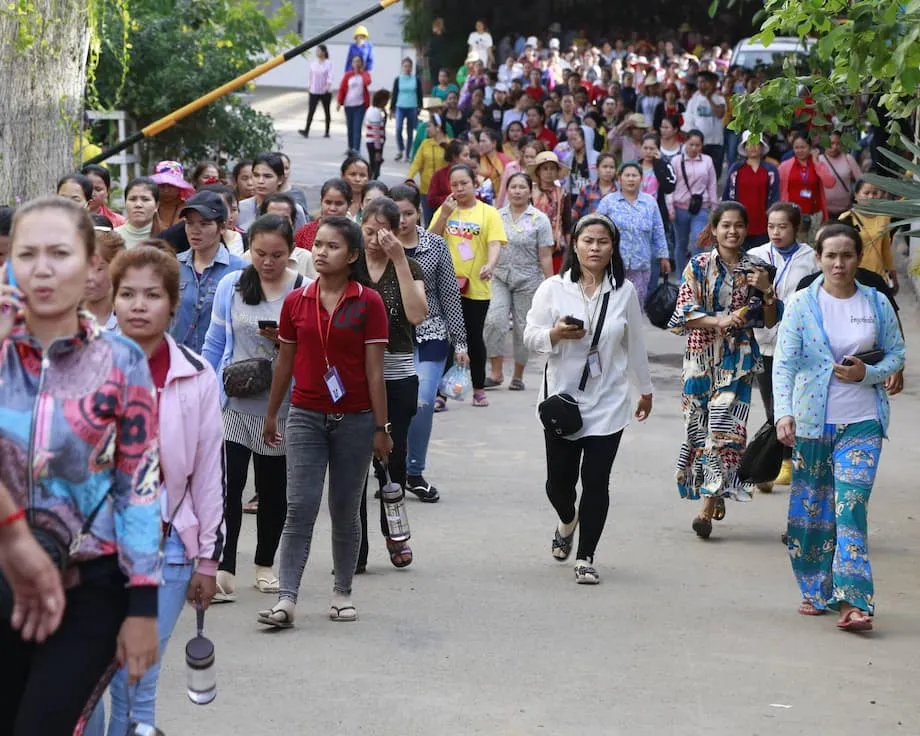
The garment, footwear and travel goods sector employs more than 900,000 Cambodians. More than 75% are women, many of them migrants from rural areas whose earnings support children, elderly parents and other relatives. A reduction in factory income can therefore reach far beyond the person operating a sewing machine.
The United States bought nearly $10 billion in Cambodian goods in 2024, almost 40% of the country's total exports. More than half of those shipments were garments, footwear and travel goods. The US is Cambodia's largest buyer in this sector among individual countries, making a change in American trade policy especially consequential for factories and households.
The tariff reduction narrows Cambodia's disadvantage against regional competitors. Indonesia's rate is also 19%, while Vietnam's is 20%. Cambodia nevertheless faces pressures that extend beyond the tariff itself: reliance on imported Chinese fabrics, uncertain factory orders, weak protections for some workers and the return of migrants from Thailand to a tightening job market.
The immediate challenge is keeping factories operating without making workers absorb the costs through lower earnings or weaker employment conditions. The broader stakes include household stability, the country's formal economy and the risk of social instability if employment and debt problems deepen together.
How the tariff changed, and why Cambodia is exposed
The US tariff on Cambodia moved through three rates: an initial 49%, a negotiated 36% and finally 19%. The reduction is substantial, but the remaining charge still adds pressure to a sector built around supplying overseas buyers at competitive prices.
Tariffs are taxes that a country imposes on imported goods. Governments use them to protect domestic industries or punish trading partners for practices they regard as unfair. They can also set off retaliation and disrupt supply chains, the network of factories, suppliers and transport services that moves a product from its materials to its final buyer.
The Trump administration's measures target countries it sees as benefiting from trade imbalances or serving as transshipment hubs for Chinese goods. Transshipment concerns arise when goods pass through another country to avoid tariffs aimed at their country of origin. US officials have accused Chinese companies, reportedly owning up to 90% of Cambodia's garment factories, of using Cambodia to sidestep existing tariffs on Chinese exports.
Cambodia's large trade surplus with the US, meaning it sells more goods to the US than it buys from it, puts that relationship at the centre of the dispute. The nearly $10 billion in exports in 2024 also shows why replacing American demand would be difficult for manufacturers whose orders depend heavily on that market.
The key dates and developments frame the current pressure:
- In 2020, Cambodia partially lost European Union trade preferences, another trade shock alongside the COVID-19 pandemic.
- In 2024, exports to the US reached nearly $10 billion, almost 40% of Cambodia's total exports.
- Before the August 1 deadline, the proposed US tariff moved from 49% to 36% and then 19% through negotiations.
- On August 1, 2025, the deadline for the new tariffs takes effect, with factories and workers facing continuing uncertainty.
Factory orders reveal the pressure on employment
Massimiliano Tropeano, a garment sector consultant and member of EuroCham Cambodia, warned about the strain on manufacturers when the tariff stood at 36%. He described the limited capacity of factories supplying American brands to carry the extra expense.
Factories supplying American brands will be substantially affected, with very little room to absorb the 36% added costs.
Tropeano estimated that up to 150,000 jobs could be lost if those tariffs remained in place. That estimate concerned the higher tariff scenario discussed before the reduction to 19%. The eventual employment outcome under the lower rate is not yet known.
A recent Better Factories Cambodia survey found that nearly half of 203 factories faced uncertainty about orders beyond the next three months. Some 15% reported having no confirmed orders at all. For a factory, an order provides the work needed to schedule production and pay staff. When buyers have not committed, managers have less certainty about how many workers and working hours they will need.
Larger factories have already begun reducing hours and eliminating overtime. Those changes can squeeze household income even while a worker retains a job. Smaller factories working as subcontractors continue to hire, but their employment conditions are often more precarious and their worker protections weaker.
Subcontracting means that one factory passes some production work to another. In the present climate, that creates an uneven employment picture: hiring can continue in smaller operations while workers in larger factories lose hours. The quality and security of the available jobs matter alongside the number of people employed.
Regional rivals compete on more than tariff rates
Vietnam's 20% tariff and Indonesia's 19% rate give Cambodia a much closer comparison with its neighbours than the earlier 36% rate did. At 19%, Cambodia matches Indonesia and sits one percentage point below Vietnam. The negotiated reduction therefore removes much of the tariff disadvantage described during the earlier stage of the dispute.
Vietnam and Indonesia also have domestic textile mills, reducing their dependence on fabrics imported from China. Cambodia's reliance on those imports leaves its manufacturers exposed to pressures elsewhere in the supply chain, even when the tax on finished exports is similar to a competitor's.
Jason Judd, executive director of the Global Labor Institute at Cornell University's School of Industrial and Labor Relations, explained that manufacturers can relocate some types of production much faster than others.
Simple garment production can move from Cambodia to the Philippines in weeks, but footwear cannot jump from Vietnam to India in weeks.
Basic garment production is highly mobile. Buyers and manufacturers can move work quickly toward lower costs or more favourable trade terms. Footwear production is less easily shifted on the same timetable. For Cambodian garment workers, the speed at which orders can leave adds pressure to wages and job security.
Competition consequently reaches beyond the headline tariff. A factory must also consider its access to materials, production costs and the ability to meet buyers' requirements. Countries competing for the same orders can find that the pressure to keep prices low falls on employment conditions.
Women carry much of the household risk
Women account for roughly 75% to 80% of Cambodia's garment workforce. Their jobs are often poorly paid and insecure, yet their wages provide essential support for children, elderly parents and entire households. Factory closures or reductions in hours can affect school expenses, access to healthcare and basic household needs.
Yang Sophorn, president of the Cambodian Alliance of Trade Unions (CATU), described why women are particularly exposed when factories come under financial pressure.
When costs rise or sales decline, women are often the first to lose their jobs due to their precarious status. Their lower wages also make them less able to withstand income shocks, and their job losses have ripple effects on households and communities.
Many women workers have borrowed money to support their families. A fall in wages leaves them trying to meet the same loan repayments with less income. Losing overtime can therefore become a financial emergency before a household experiences a complete loss of employment.
The garment sector has helped reduce poverty and expand women's economic opportunities. It also supports millions of dependents and forms a central part of Cambodia's formal economy. The current pressure reaches both those gains and the everyday decisions families make about food, education and medical care.
Returning migrants face fewer options and continuing debt
Cambodian migrants who previously sought better wages in Thailand are returning because of border tensions and violence. Their return coincides with uncertainty in factory employment at home, leaving some people searching for work while already carrying debt.
That Sopring, a returning migrant aged 25, described the immediate financial problem facing workers who come home without employment.
There's no work now, just debt,
Cambodia is one of the region's countries with the widest use of credit. More than half of households owe money to formal lenders. For returning migrants and factory workers alike, that means an interruption in earnings can quickly become a struggle to keep up with repayments.
Prime Minister Hun Manet has urged banks and microfinance institutions to ease loan repayments for returning migrants. Microfinance institutions provide loans and other financial services, often to people with limited access to conventional banking. Repayment relief can give borrowers more time, while their need for a reliable income continues.
The combination of returning workers, reduced factory hours and household borrowing makes employment security particularly urgent. Migrants seeking a new job enter the same labour market as factory employees trying to preserve their wages, with families depending on both groups.
Employment can worsen even without factory closures
Informal workers, including those without contracts or legal protections, are especially exposed to the tariff pressure. Their situation can deteriorate through changes in benefits and employment status as well as through outright dismissal.
During earlier shocks, including the COVID-19 pandemic and the partial loss of EU trade preferences in 2020, factories cut benefits, moved permanent workers into temporary employment and reduced real wages. Real wages describe how much a worker's earnings can buy, rather than simply the amount printed on a payslip.
This weakening of pay, security and protections is known as social downgrading. Similar responses are a risk as factories seek to absorb the new tariffs. A worker might remain employed while losing benefits, predictable hours or the security of a permanent position.
A union leader described workers' fear that employers would pass the financial pressure down to them.
If factory owners don't get the benefits, and if we can't produce much for them, they will take it out on us.
Smaller subcontracted factories deserve particular attention because their protections are often weaker. Continuing recruitment in those factories may provide income, but the conditions attached to the work shape whether a household gains lasting stability or remains vulnerable to the next reduction in orders.
Chinese investment connects Cambodia to the trade dispute
Chinese investment plays a major role in Cambodia's garment sector, while China accounts for nearly half of all foreign investment in the country. The Sihanoukville Special Economic Zone and infrastructure upgrades are among the projects reshaping Cambodia's economy.
The US-China trade rivalry has encouraged some manufacturers to relocate production to Southeast Asia, including Cambodia, to avoid tariffs. Those shifts have also brought closer US scrutiny of transshipment and the origin of exported goods.
Cambodia must balance its economic relationships with China and the US while meeting international trade regulations. China supplies capital and materials that support manufacturing. The US provides a large export market. Pressure affecting either relationship can reach the same Cambodian factory and its workforce.
Heavy dependence on Chinese capital and supply chains also leaves Cambodia vulnerable to external shocks and accusations that it serves as a route for Chinese goods. The concern about where goods originate therefore sits alongside the practical challenge of keeping production and exports moving.
Negotiations buy relief, while diversification takes investment
Deputy Prime Minister Sun Chanthol presented the reduction from 49% to 19% as a major breakthrough, saying the lower tariff allows Cambodia to remain competitive with regional peers and maintain factory operations. The negotiated rate averts the immediate threat of collapse described under the higher tariffs.
Economist Dr. Penghuy Ngov has stressed the need to diversify into ASEAN and EU markets. Cambodia can draw on its membership in the Regional Comprehensive Economic Partnership (RCEP) and its free trade agreement with China to pursue preferential access to large markets.
Preferential access means that trade agreements give participating countries more favourable conditions for selling goods. Turning that access into dependable orders requires investment in logistics, technology and compliance with labour standards. Logistics covers the organisation of transport, storage and delivery, all of which affect the cost and reliability of exports.
Industry leaders are also pushing for greater use of automation and digital management of supply chains to improve competitiveness. Those changes concern how factories organise production and track materials and orders, alongside the task of finding buyers beyond the US.
The China-Cambodia Joint Committee on Science, Technology, and Innovation is helping drive digital infrastructure development. The Belt and Road Initiative (BRI) is funding major transportation projects. Both form part of the investment picture as Cambodia seeks to strengthen the systems supporting its export industries.
Labour agreements address who bears the cost
Some global brands have refused to sign collective bargaining agreements, leaving workers exposed to arbitrary layoffs and benefit cuts. Collective bargaining allows workers, usually through their unions, to negotiate employment conditions with employers rather than leaving each employee to bargain alone.
The Cambodia Agreements offer a legally binding framework for standardised collective bargaining. Broader industry adoption would be needed for that model to provide protections across more of the sector.
Jason Judd described how financial pressure travels through the production chain and how weak enforcement can affect workers.
Risk and cost in supply chains are pushed down from investors and buyers to manufacturers to workers. In countries where worker organizing is suppressed or workers otherwise struggle to win enforcement of basic standards, those standards will slide to protect employers' margins and jobs.
International organisations and labour advocates are calling for trade arrangements that account for employment quality, gender equity and economic justice. For Cambodia, those concerns are concrete: maintaining wages, protecting benefits and ensuring that workers can defend the standards attached to their jobs.
The 19% rate provides breathing room, but Cambodia's reliance on one major export market continues to expose its economy to changes in US policy. Diversifying buyers, investing in production and transport, and strengthening labour protections address different parts of the same problem. Keeping factories open matters most to households when the work also provides dependable income and security.
Key Points
- Cambodia's US tariff fell from 49% to 36% and then 19% as the August 1, 2025, deadline took effect.
- The garment, footwear and travel goods sector employs more than 900,000 people, roughly 75% to 80% of them women.
- Cambodia exported nearly $10 billion in goods to the US in 2024, almost 40% of its total exports.
- A survey of 203 factories found nearly half uncertain about orders beyond three months and 15% with no confirmed orders.
- The estimate of up to 150,000 lost jobs concerned the earlier 36% tariff scenario.
- Cambodia's 19% rate matches Indonesia's and is one percentage point below Vietnam's 20%.
- Reduced hours, household debt and returning migrants deepen the pressure on workers and families.
- Government and industry responses include trade negotiations, market diversification, technology investment and proposals for stronger collective bargaining.