A seaside showcase closes its doors to foreigners
North Korea has temporarily barred foreign visitors from its Wonsan-Kalma Coastal Tourist Zone, a resort built to accommodate as many as 20,000 guests, less than three weeks after it opened to domestic tourists on July 1, 2025. A July 18 notice on the official DPR Korea Tour website announced the restriction without explaining the decision or giving a date for foreign visits to resume.
Contents
- A seaside showcase closes its doors to foreigners
- What Kim Jong Un built in Wonsan
- Years of delays before a July opening
- Why foreign visitors matter to the project
- What may have prompted the restriction?
- Russia's support meets practical limits
- China's absence leaves a larger gap
- Can domestic tourism sustain the resort?
- Workers and living conditions behind the showcase
- A temporary ban with lasting economic pressures
- Key Points
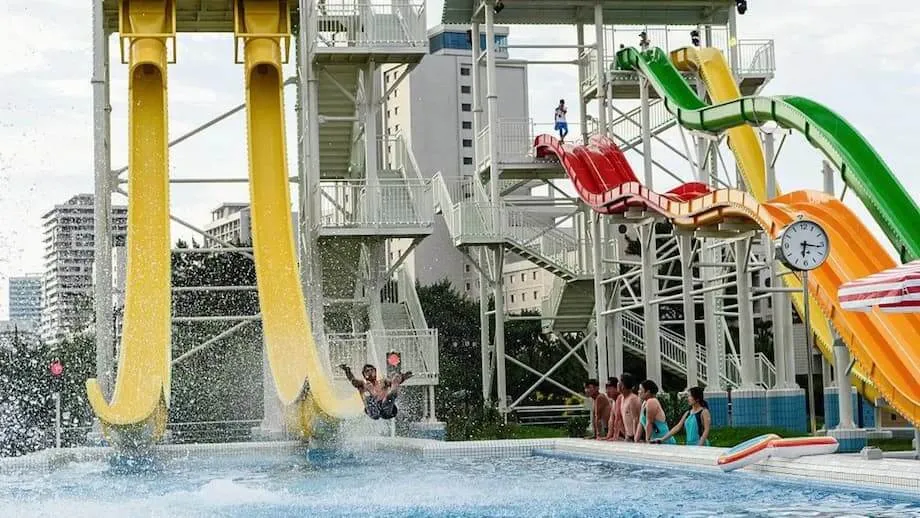
The resort stretches along approximately 4 kilometers, or 2.5 miles, of white sand beachfront in Wonsan, Kangwon province, on the country's east coast. Hotels, restaurants, shopping malls and a water park were intended to help turn the development into a destination for North Koreans and international travelers alike.
Russian tourists had already arrived in early July. Russian Foreign Minister Sergei Lavrov then visited the resort, met North Korean leader Kim Jong Un and praised its potential as a holiday destination for Russians. Tour operators had scheduled further Russian trips in the coming months.
By July 20, the development had become a striking example of the tension within North Korea's tourism ambitions. The government wants visitors who bring foreign currency, while maintaining tight control over their movements and what they see. Its decision also interrupts an effort to present a modern, prosperous image abroad after years of pandemic isolation.
The reason for the ban remains unexplained. Suggestions involving critical coverage, unfinished facilities, security and travel difficulties are theories offered by observers, rather than reasons announced by the authorities. The immediate consequence is straightforward: a resort promoted to international customers is now closed to them, while domestic tourism continues to be publicized.
What Kim Jong Un built in Wonsan
Wonsan-Kalma was conceived as much more than a beach lined with hotels. The development includes dozens of hotels, restaurants, shopping malls, a water park, guesthouses on an artificial lake and campgrounds. Its reported capacity of up to 20,000 guests makes attracting a substantial number of visitors central to its ambitions.
North Korean state media has described the development as a "national treasure-level tourism city." Kim has called it one of his government's greatest successes of the year. Those descriptions place the project within a wider effort to show that North Korea can build modern leisure facilities despite its isolation and economic difficulties.
Kim also has a reported personal connection to Wonsan. He is said to have spent much of his youth among the holiday villas used by the country's elite there. Building a major resort in the same city gives the project a personal significance alongside its economic and political purpose.
The resort was presented as a "world-class" seaside destination and a rare glimpse of leisure and luxury in one of the world's most isolated countries. Its intended audience included domestic holidaymakers and visitors from abroad, particularly neighboring China and Russia. The government hoped it would help establish North Korea as a participant in international tourism.
Years of delays before a July opening
Construction began in 2018, with an opening originally planned for April 2019 to coincide with the birthday of North Korea's founder, Kim Il Sung. The project instead faced years of delays linked to international sanctions, shortages of materials and the COVID-19 pandemic.
North Korea's strict border closures during the pandemic added to the difficulties. When the resort finally opened to domestic visitors on July 1, 2025, the launch included a ribbon cutting ceremony attended by Kim and his family. The main events unfolded as follows:
- 2018: Construction of the Wonsan-Kalma Coastal Tourist Zone began.
- April 2019: The resort was originally intended to open around Kim Il Sung's birthday, but the project was delayed.
- July 1, 2025: The resort opened to domestic visitors.
- Early July 2025: The first group of Russian tourists visited.
- Days before July 18: Lavrov visited Wonsan-Kalma and met Kim.
- July 18, 2025: The official tourism website announced a temporary restriction on foreign visitors.
The shift from opening celebrations to restricted access took just 17 days. For operators arranging future visits, it introduced uncertainty into a destination that had already spent several years waiting to receive guests.
Why foreign visitors matter to the project
Tourism offers North Korea a way to earn foreign currency while international sanctions targeting its nuclear and missile programs restrict its economy. Foreign currency means money from other countries, such as Russian rubles, Chinese yuan and US dollars, which can help pay for purchases abroad.
North Korea has sought to develop special tourist zones where visitors can spend money while remaining apart from much of the country. Wonsan-Kalma was intended to be a centerpiece of that approach: an attractive destination that could welcome outsiders within a controlled setting.
China was the dominant source of foreign tourists before the pandemic, accounting for more than 90% of international visitors to North Korea. Chinese group tours have yet to resume, leaving the country without the return of what had been by far its largest tourism market.
Russian travelers were seen as a promising new market, particularly as relations between Moscow and Pyongyang grew closer. Yet the resort's size presents a practical challenge. Hotels, restaurants, shops and recreational facilities need customers, and the initial number of Russians visiting remained small.
Domestic guests can keep facilities in use, but foreign visitors serve a different economic purpose by bringing money from outside the country. The resort's prospects therefore depend on more than photographs of busy beaches or occupied hotel rooms. They also depend on who can travel there, how much visitors spend and whether international access is reliable.
What may have prompted the restriction?
A Russian journalist's account has become one focus of speculation about the ban. The article suggested that North Korean visitors at the resort had been mobilized by state authorities rather than arriving as ordinary holidaymakers. Some analysts believe that coverage could have embarrassed a government highly sensitive to its international image.
Questions about the readiness of the development offer another possible explanation. Satellite imagery and visitor accounts indicate that some areas may still be under construction or not fully operational. Observers have suggested that foreign access might have been restricted while work continued or until facilities were ready to meet international expectations.
Wonsan's military importance also features in the discussion. The city contains missile facilities and military complexes, while foreign tourists in North Korea are closely monitored and face restrictions on their movements. Security concerns, foreign influence and unwanted scrutiny could have influenced the decision.
Economic and logistical difficulties are another possibility. High travel costs, distance and continuing border restrictions may make it harder to attract large numbers of Russian or Chinese tourists than the scale of the project requires. Limited demand would put pressure on the finances of such a large development.
North Korea rarely explains abrupt policy changes and tightly controls information. That leaves travelers and operators with a temporary restriction to navigate, but little guidance about the conditions under which access could resume.
Russia's support meets practical limits
Lavrov's visit gave Wonsan-Kalma diplomatic attention just before the foreign visitor ban. His meeting with Kim and praise for the resort were seen as gestures of goodwill, while Russian officials have expressed interest in expanding tourism and economic cooperation with North Korea.
Moscow and Pyongyang have deepened their diplomatic and military relationship in recent years. North Korea has reportedly supplied weapons and troops to support Russia's war in Ukraine. Tourism forms another part of that closer relationship, offering a civilian activity that both governments have shown interest in developing.
The timing of the restriction, immediately after Lavrov's prominent visit, has encouraged speculation about the political considerations behind it. Russian tourists had been the first foreign guests at the resort, making the interruption especially awkward for efforts to promote travel between the two countries.
Russian interest also faces ordinary travel constraints. Wonsan is a distant holiday destination for people living in Moscow, and the cost of reaching North Korea can limit the potential market. Direct flights between Moscow and Pyongyang are expected to begin soon, offering another travel connection, although the resulting number of tourists is uncertain.
North Korea had cautiously begun reopening after years of pandemic border restrictions, allowing limited numbers of Russian and Western tourists to visit other parts of the country earlier in 2025. Wonsan-Kalma's closure to foreigners interrupts that tentative expansion of access at one of its most heavily promoted destinations.
China's absence leaves a larger gap
China remains North Korea's most important economic partner as well as its principal source of foreign tourists before the pandemic. The continued absence of Chinese group tours removes a crucial source of potential customers and foreign currency for Wonsan-Kalma.
The scale of that gap is visible in the earlier visitor figures. With Chinese travelers accounting for more than 90% of foreign arrivals before the pandemic, all other nationalities combined accounted for less than 10%. A modest flow of Russian visitors would therefore have to expand substantially to replace the earlier Chinese market.
North Korea's investment in hotels, shops and leisure facilities was intended to draw international spending. Without Chinese or Russian visitors, the resort is unlikely to generate enough revenue to justify the enormous investment described in the project.
The current restriction adds another obstacle to the continuing absence of Chinese group travel. Even travelers who are interested, able to pay and prepared to accept North Korea's controls cannot visit Wonsan-Kalma while the ban applies.
Can domestic tourism sustain the resort?
North Korean authorities have turned their promotional attention toward domestic visitors. State media describes the resort as crowded with local holidaymakers, although independent verification is difficult. Some analysts suggest that people may have been mobilized by the government to create an appearance of success.
The country's limited purchasing power and lack of a sizable middle class constrain how much domestic tourism can contribute. A large resort needs continuing spending across accommodation, food, shopping and recreation. Many North Koreans face economic hardship, limiting the number who can afford such a holiday.
Ahn Chan-il, head of the World Institute for North Korean Studies, described the resort's dependence on foreign spending in stark terms:
If foreign tourists aren't allowed to the site, no Russian rubles, Chinese yuan and dollars will come in. Then, North Korea can't break even and it has to shut down the resort.
Breaking even means taking in enough money to cover costs. Ahn's warning captures the economic dilemma facing the project: North Korea wants the income international guests can bring, while remaining wary of the scrutiny and unpredictability that accompany their presence.
Workers and living conditions behind the showcase
Human rights groups have raised concerns about the treatment of people who built Wonsan-Kalma. Reports cited by those groups describe forced labor, long hours, harsh working conditions and inadequate compensation.
North Korea often mobilizes citizens for major construction projects under the language of patriotic duty. The concerns surrounding Wonsan-Kalma place the labor used to create the resort alongside the government's public celebration of its completion.
The new facilities also contrast with widespread poverty and food insecurity described by international observers across North Korea. State media presents the resort as a busy center of leisure and prosperity, while much of the population continues to face serious economic difficulties.
Images accompanying the opening showed Kim relaxing beside a pool with his daughter, Kim Ju Ae. Those scenes brought the lifestyle of the leadership into the same story as the country's new tourism showcase and the hardships experienced by many ordinary citizens.
A temporary ban with lasting economic pressures
Experts believe the foreign visitor restriction may be brief because North Korea cannot afford to waste such a major investment. Restoring access would allow the government to pursue the foreign spending for which the resort was designed.
The pressures surrounding the project extend beyond the current ban. Sanctions, border controls, security concerns and sensitivity to negative publicity all affect North Korea's ability to develop international tourism. The government also has to attract enough paying guests to support a destination built for thousands of people.
For travelers and tour operators, reliable entry is a basic requirement for planning a holiday. For North Korea, international tourism remains both a possible source of income and an activity that brings outsiders into a tightly controlled country. Wonsan-Kalma now brings those competing priorities into sharp focus.
As of July 20, 2025, the resort remains a showcase of North Korea's ambition to appear modern, prosperous and connected to the world. Its abrupt restriction on foreign guests also exposes the practical difficulty of earning money from international tourism while keeping a close grip on access and information.
Key Points
- Wonsan-Kalma opened to domestic visitors on July 1, 2025, after years of construction delays.
- The resort stretches along about 4 kilometers of beachfront and has a reported capacity of 20,000 guests.
- A July 18 notice temporarily barred foreign visitors without giving a reason or a reopening date.
- The restriction followed the arrival of Russian tourists and a visit by Russian Foreign Minister Sergei Lavrov.
- Chinese travelers accounted for more than 90% of foreign visitors before the pandemic, but Chinese group tours have not resumed.
- Possible explanations include critical coverage, unfinished facilities, security concerns and travel difficulties.
- Human rights groups have raised concerns about forced labor and conditions during construction.
- The project's financial prospects depend heavily on attracting foreign visitors and their spending.