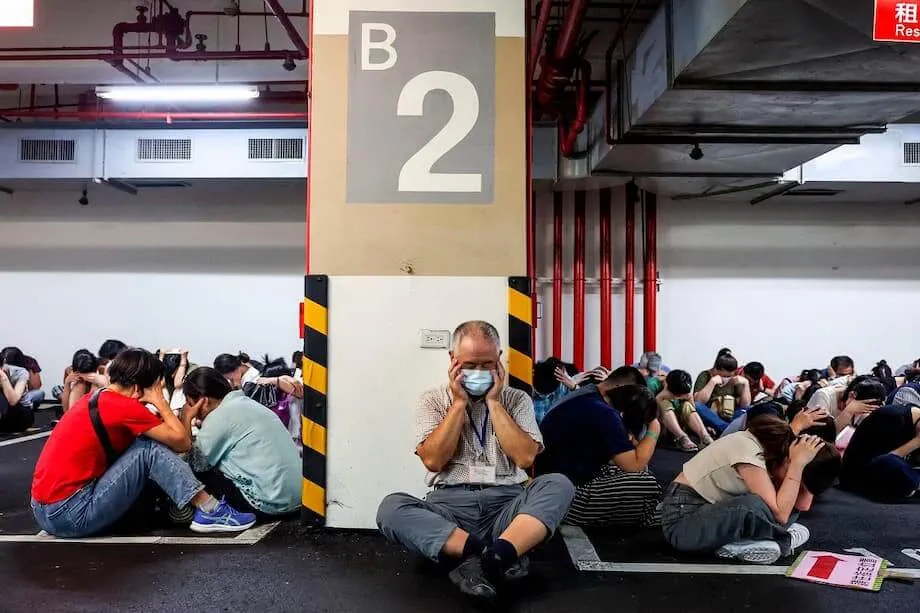
Sirens Bring Taiwan's Capital to a Halt
Taipei's busy streets fell silent on Thursday as air raid sirens sounded, traffic stopped and residents in designated areas moved indoors during Taiwan's largest civil defence exercise. Emergency workers rehearsed rescuing people from buildings struck by missiles or bombs, while soldiers elsewhere practised resisting a possible Chinese invasion.
Contents
- Sirens Bring Taiwan's Capital to a Halt
- Why Taiwan Expanded Its Preparations
- What Residents and Emergency Workers Practised
- Military Units Rehearse Fighting and Repairs
- How Ukraine Shaped the Exercises
- Civilian Groups Build Their Own Readiness
- Public Opinion Mixes Doubt With Support for Drills
- Beijing Dismisses the Drills While Keeping Up Pressure
- Why Other Countries Are Watching
- Key Points
The civilian preparations formed part of a broader programme alongside the annual Han Kuang military exercises. The Urban Resilience exercise ran from Tuesday to Friday across Taiwan, bringing government agencies, emergency services, volunteers and ordinary residents into preparations for an attack.
For people in the affected areas, the rehearsal meant a temporary interruption to daily life. Shops and restaurants paused operations, drivers pulled over and people sought shelter. In Taipei, temple squares, schools, subway stations and highways became settings for evacuation and emergency response drills.
Taiwan's government sees those practical tasks as part of its defence: soldiers would need to protect the island while civilian services rescued the injured, distributed supplies and helped communities function. The exercise tested how those responsibilities could fit together under pressure.
President William Lai attended alongside government officials and foreign dignitaries. He presented preparation as a way to discourage war and stressed the importance of unity and resilience.
Lai, Taiwan's president, explained the purpose of the exercise:
We hope by preparing for war, we can avoid war, to achieve the goal of peace. With preparation, we have strength.
His argument was that a population and military ready to respond would help deter an attack. Many Taiwanese remain doubtful that an invasion will happen soon, yet the government is making its preparations larger and more visible as China increases military pressure.
Why Taiwan Expanded Its Preparations
China claims Taiwan as part of its territory and has not ruled out using force to achieve unification. In recent years, Beijing has increased air and naval patrols near the island and held large military exercises simulating blockades and amphibious assaults.
A blockade would seek to restrict movement to and from Taiwan, while an amphibious assault would involve troops approaching from the sea and landing ashore. Taiwan's preparations address both the pressure surrounding the island and the possibility of fighting on it.
Lai's election has further heightened tensions. Beijing labels him a separatist and accuses his ruling Democratic Progressive Party of pursuing an agenda of independence. Taiwan's government has sought to demonstrate its readiness and determination in response.
Han Kuang has taken place annually for decades. This year's exercises grew in scale and complexity, combining military operations with the sweeping Urban Resilience programme. The aim was to prepare both soldiers and civilians for a crisis, rather than leave public protection entirely to emergency services.
The programme brought several activities together during the same period:
- From Tuesday to Friday, the Urban Resilience exercise ran across Taiwan alongside the Han Kuang military drills.
- Each day, air raid sirens sounded for half an hour in several cities, with shelter requirements in designated zones.
- On Thursday, Taipei stopped traffic and rehearsed evacuations, rescues and responses to large numbers of casualties.
The scale of those preparations reflected greater urgency in Taiwan's defence planning. Authorities were testing how quickly everyday places could shift from serving commuters, students and customers to protecting people during an attack.
What Residents and Emergency Workers Practised
Residents in designated zones were required to shelter indoors during the air raid exercises or risk fines. Businesses paused operations and road traffic stopped, with drivers instructed to pull over and seek cover.
Hundreds of emergency workers and volunteers took part in Taipei. Their tasks included moving people away from exposed areas, carrying out rescues, treating injuries and distributing emergency supplies. Exercises at busy public locations tested whether instructions could reach people where they normally gather or travel.
A simulated incident involving many casualties recreated the aftermath of missile or bomb strikes on buildings. Emergency personnel practised finding survivors and providing care while other participants worked through the movement of people and supplies.
Such an incident places several demands on responders at once. Injured people need treatment, rescuers need access to damaged buildings and residents need directions about where to go. The drill brought those tasks into the same exercise so authorities could test their readiness together.
The public also had a role. Residents needed to recognise the warning, follow instructions and shelter during the designated period. The exercise therefore tested public awareness as well as the capabilities of professional responders.
Schools, subway stations, temple squares and highways each presented a different setting. By rehearsing across these locations, authorities could practise responses in the places where large numbers of people would need help during a real emergency.
Military Units Rehearse Fighting and Repairs
Taiwanese troops conducted military drills in parallel with the civilian exercise. They practised defending key infrastructure, repelling assaults from the sea and fighting in urban settings, including exhibition centres and the subway.
At a riverside park in a Taipei suburb, soldiers rehearsed refuelling and rearming Black Hawk and Apache helicopters. The preparations included Hellfire and Stinger missiles supplied by the United States.
Taichung hosted a simulation in which the military pushed back enemy troops. In Taoyuan, a high school was turned into a station for repairing battle tanks. These activities tested the support work needed to keep military equipment operating alongside the units practising combat.
The exercises also included live simulations of an invasion, operations around the clock and drills to stop enemy forces landing. A total of 22,000 reservists were mobilised, the largest number to date.
Reservists provide additional personnel when called up. Bringing 22,000 into the exercise allowed the military to practise using that larger force during an extended emergency, alongside its regular units.
Weapons used during the drills included Abrams tanks and HIMARS rocket systems supplied by the United States. Both have been used effectively by Ukraine, whose resistance to Russia's invasion has helped shape Taiwan's preparations.
How Ukraine Shaped the Exercises
Taiwanese military leaders have acknowledged the need to adapt to lessons from Ukraine. Those lessons extend beyond weapons to communication, public protection and the ability to continue operating when normal systems are disrupted.
One focus was decentralised command. This means allowing units to keep functioning when they cannot rely on constant instructions from a central headquarters. The drills tested operations with disrupted central communications, drawing on Ukraine's experience of maintaining coordination under Russian cyberattacks and missile barrages.
Cyberattacks target computer systems and communications. Disinformation campaigns spread misleading information. Both can disrupt a response even when the immediate damage is away from a battlefield, which is why Taiwan's preparations also addressed information and public messaging.
The exercises included responses to Chinese Coast Guard and maritime militia harassment. These were examples of what military planners call "grey zone" tactics: actions that fall short of open conflict while still putting pressure on an opponent and weakening security.
Taiwan's approach drew on several parts of Ukraine's experience:
- Testing whether military units could keep operating after central communications were disrupted.
- Improving air raid shelters, issuing new civil defence guidance and holding public air defence exercises.
- Preparing for harassment by coast guard vessels and maritime militia alongside conventional military threats.
- Warning residents about possible disruptions and urging vigilance against misinformation.
The central concern was continuity. Military units needed to remain capable of acting, while civilians needed shelter, reliable instructions and access to help. Ukraine's experience showed why those tasks belong in the same preparations.
Civilian Groups Build Their Own Readiness
Kuma Academy and the Hemlock Civil Defence group are among the organisations offering civilians training in first aid, disaster response and countering online disinformation. Their work reflects growing awareness that communities would have responsibilities alongside the armed forces during a conflict.
Some participants have been motivated by events in Hong Kong and by the war in Ukraine. They have begun stockpiling supplies and regularly training in first aid and physical fitness.
American filmmaker Bryan Hopkins has stressed community resilience, drawing lessons from Ukraine's experience. The practical idea is that people who can help one another, treat injuries and maintain local support would be better placed to cope with disruption.
Jack Yao and Tobie Openshaw are among those who have taken personal steps to prepare, including setting up supply depots and emergency plans. Such preparations turn concern about a possible conflict into decisions about where supplies would be kept and how people would respond.
Some people are ready to leave if fighting begins. Others are determined to stay and help, convinced that the Taiwanese population would resist an invasion.
Civil defence initiatives also face opposition. Some Taiwanese worry that the activities could provoke China, while others doubt their effectiveness. Political parties disagree over the best approach to national defence, making civilian preparation part of a wider political debate.
The government has released a civil defence handbook and increased military spending, yet many people believe more preparation is needed. The growth of volunteer groups and personal emergency plans shows how some residents are acting on that concern themselves.
Public Opinion Mixes Doubt With Support for Drills
More than 60% of Taiwanese did not believe China would invade within the next five years, according to a government backed poll conducted last October by the Institute for National Defence and Security Research. Only about half expressed confidence in the armed forces' ability to defend the island.
The two findings capture different concerns. Many respondents saw an invasion as unlikely within that period, while confidence in Taiwan's ability to withstand one was limited. The disparity in military strength between China and Taiwan contributes to some people's pessimism about resisting an assault.
An unnamed Taipei resident described both doubt about an imminent invasion and support for practising defence:
The chances of China invading are low. If they really wanted to invade us, they would have done it long ago. But I do believe we need these drills, every country needs it and you need to practise your defence… I believe there is still a threat from China.
That combination of scepticism and concern helps explain why highly visible exercises can take place in a society where many people expect daily life to continue without war. Residents can regard an attack as unlikely while still supporting preparation for its consequences.
Taiwan's government has responded to defence concerns by strengthening the military, expanding Han Kuang and extending mandatory military service from four months to one year. The longer service requirement sits alongside the mobilisation of reservists and the broader civilian exercises.
No timetable for an actual attack was identified. The exercises were preparations for a possible conflict, while the poll measured public expectations about the next five years.
Beijing Dismisses the Drills While Keeping Up Pressure
China has dismissed Taiwan's drills as a "bluff" and accused Lai and the Democratic Progressive Party of advancing an agenda of independence. Chinese officials have also reiterated their opposition to military ties between the United States and Taiwan.
Beijing has responded to the exercises with further displays of force, including increased air and naval patrols, as well as targeted economic measures against Taiwanese companies. The pressure therefore extends beyond military activity to businesses.
China's Taiwan Affairs Office did not immediately respond to requests for comment. Chinese state media portrayed the drills as futile against China's much larger military.
Taiwanese officials maintain that the exercises are necessary to demonstrate determination and deter aggression. Their position is that preparing the military and the public makes clear that an invasion would meet resistance.
Why Other Countries Are Watching
The Taiwan Strait remains one of the world's most dangerous flashpoints. A conflict could draw in the United States, Japan and other regional powers, with severe consequences for international security and the world economy.
Taiwan's role as a leading producer of semiconductors adds to its strategic importance. These components are used in products ranging from smartphones to fighter jets, connecting the island's security to industries and users far beyond its shores.
The United States maintains close unofficial ties with Taiwan and supplies much of the weaponry used in Han Kuang, while not formally recognising Taiwan as a sovereign state. Those military links are a continuing point of dispute with Beijing.
Other countries, including Canada, have signalled support by sailing naval vessels through the Taiwan Strait. Beijing claims the strait as its own, while many regard it as international waters.
Military attachés and analysts are watching the exercises to assess improvements in Taiwan's resilience and China's response. The civilian drills are part of that assessment because a defence effort would depend on communities and essential services as well as combat units.
Taiwan's approach places information, morale and the ability of society to function under stress alongside tanks and missiles. The integration of military and civilian exercises reflects the government's expectation that the whole society would have a role in resisting an attack.
Lai's message connects those practical preparations to deterrence. By rehearsing resistance publicly and on a larger scale, Taiwan aims to persuade Beijing that an invasion would face determined opposition and an uncertain outcome. Ukraine's experience has reinforced Taiwan's focus on the ability to adapt and the willingness to resist a stronger opponent.
Key Points
- Taipei halted traffic and rehearsed sheltering, evacuations and rescues during Taiwan's largest civil defence exercise.
- The Urban Resilience programme ran from Tuesday to Friday alongside the annual Han Kuang military drills.
- Military preparations included operations around the clock, defence against landings and a record mobilisation of 22,000 reservists.
- Lessons from Ukraine shaped communication drills, civilian protection and preparations for cyberattacks, disinformation and harassment.
- Volunteer groups and individual residents are preparing supplies and training, while public opinion remains divided.
- An October poll found that more than 60% expected no invasion within five years, while about half trusted the military's ability to defend Taiwan.
- China dismissed the exercises as a bluff. Taiwan's government described preparation as a means of deterring war.