Emergency Crews Move Into Incheon's Outbreak Center
South Korea's Environment Ministry deployed 37 ministry personnel and 10 local officials to Gyeyang Mountain in Incheon on July 4, 2025, as an unprecedented summer outbreak of lovebugs overwhelmed hiking trails, public walkways and nearby communities. Equipped with blowers, insect nets and water sprayers, crews began removing insects and collecting their remains while authorities faced thousands of complaints.
Contents
- Emergency Crews Move Into Incheon's Outbreak Center
- What Lovebugs Are and How They Reached Korea
- Why Warmer Cities Help the Swarms Grow
- From First Detection to a Possible Wider Range
- How the Emergency Operation Works
- Residents Demand Relief as Officials Limit Pesticides
- Ecological Benefits Come With Urban Disruption
- Legal Changes and New Control Tools Under Review
- A Local Outbreak Within a Wider Climate Trend
- Key Points
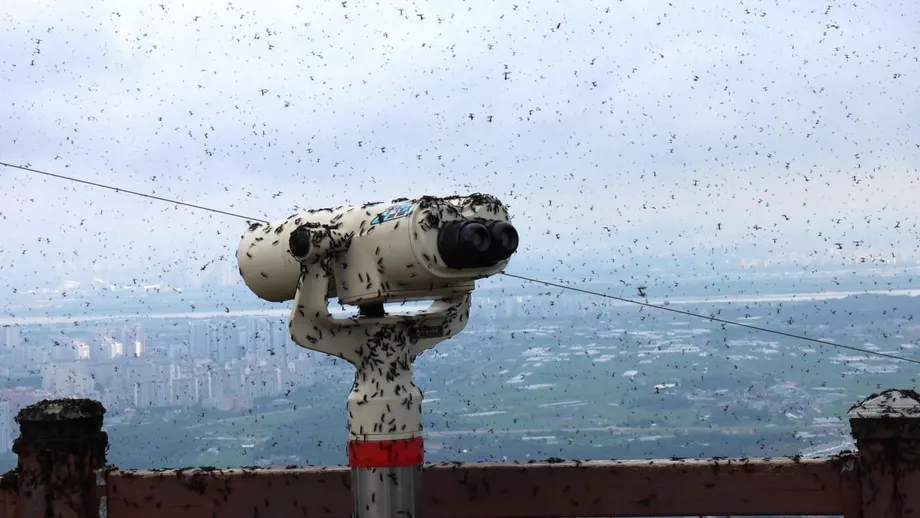
By July 5, the outbreak had become a pressing problem across parts of Incheon and the greater Seoul metropolitan region. Small flies with black wings, often flying attached in mating pairs, had turned urban and suburban spaces into corridors of swarming insects. Residents and visitors faced clouds of bugs outdoors and accumulations of dead insects around buildings and streets.
Videos and images circulating on social media showed hikers moving through dense swarms, storefronts covered in insect carcasses and municipal workers shoveling piles of dead bugs from public walkways. For residents and businesses, the immediate concerns included discomfort, disrupted daily routines and foul odors as the insects decomposed.
Lovebugs do not bite, sting or transmit diseases. Their larvae also help break down decaying material and improve soil. Those benefits have complicated the response: residents want rapid relief, while authorities are trying to control the swarms without damaging other insects and the surrounding ecosystem.
The ministry has activated an emergency response team operating around the clock and brought together entomologists and ecologists to advise the operation. Entomologists study insects; ecologists examine how living things interact with their surroundings. Their involvement is intended to bring current scientific findings into decisions about where and how to intervene.
What Lovebugs Are and How They Reached Korea
Lovebugs, identified in descriptions of the outbreak as Plecia nearctica or Plecia longiforceps, get their common name from their mating behavior. Pairs remain attached while flying, making them especially conspicuous when large numbers emerge together.
These small flies come from subtropical regions, including parts of the southeastern United States, southern China, Taiwan and Japan's Ryukyu Islands. They were first detected in South Korea in 2015. Their arrival is believed to have been connected to trade from southern China, likely through the port city of Incheon.
Genetic analysis suggests a route from southern China to the Shandong Peninsula, followed by introduction to Korea through trade. Since their first appearance in Incheon, lovebugs have established themselves in the Seoul metropolitan area, where major outbreaks have occurred annually since 2022.
The larvae feed on decaying organic matter, helping return nutrients to the soil. This useful ecological role explains why officials describe lovebugs as beneficial insects even as their numbers create serious inconvenience. During mass outbreaks, their presence can also disrupt local biodiversity, affect urban ecosystems and contribute to ecological imbalances.
Why Warmer Cities Help the Swarms Grow
Rising temperatures and longer, hotter summers are helping subtropical insects expand northward. Seoul is experiencing rapid warming, compounded by the urban heat island effect. Concrete and asphalt hold heat, making built areas warmer and creating small pockets of conditions that can help insects survive.
Shin Seung-kwan, a professor of biological sciences at Seoul National University, explained how city lighting and retained warmth can work together:
They're attracted to light, so they often enter cities. And due to the urban heat island effect, the larvae may survive the winter more easily.
Artificial lighting draws lovebugs into densely populated places, bringing the insects into closer contact with residents. Moist, sheltered breeding grounds in urban environments also support them. Their ability to thrive in warmer, wetter conditions helps explain why modern cities can become suitable places for large populations.
Global trade adds another route for expansion. The movement of goods and people can carry non-native species into places where they may lack natural predators. For lovebugs in South Korea, trade, urban development and a warming climate are all part of the explanation for their arrival and spread.
From First Detection to a Possible Wider Range
South Korea's experience with lovebugs now spans a decade, from their first detection in 2015 to the emergency operation in July 2025. The repeated outbreaks since 2022 have made the insects a recurring problem rather than a single summer event.
The main dates trace both the growing response and the longer concern about their spread:
- 2015: Lovebugs were first detected in South Korea, with their initial appearance recorded in Incheon.
- 2022: Major annual outbreaks began in the Seoul metropolitan area.
- 2023: Authorities established a collaborative response system that the Environment Ministry is now expanding.
- July 4, 2025: The ministry launched an urgent control operation at Gyeyang Mountain.
- July 5, 2025: Authorities continued confronting widespread swarms and public complaints.
- Mid-July 2025: A researcher at the National Institute of Biological Resources expects the current situation to stabilize.
- 2070: Researchers warn that lovebugs could spread across the entire Korean Peninsula if current trends continue.
Park Sun-jae, an environmental researcher at the National Institute of Biological Resources, described the expected course of the current emergence:
About a week to ten days after their explosive emergence, the population tends to decline. We expect the situation to stabilize by mid-July.
A decline in the current swarms would bring relief to affected neighborhoods and trails. Researchers nevertheless warn that intensifying climate change could make outbreaks an annual nuisance across a wider area. The expectation for mid-July concerns the present surge, while the projection for 2070 concerns how far the insects may eventually spread.
How the Emergency Operation Works
The July 4 operation focused on Gyeyang Mountain, the center of the outbreak. Crews were assigned to physically remove swarms from public areas and collect insect carcasses to reduce odors. Blowers, nets and water sprayers formed the core of this immediate response.
Authorities are also installing traps that use light to attract the insects. Developed by the National Institute of Biological Resources, the traps have proved effective at luring and capturing lovebugs. They use the same attraction to artificial light that brings the insects into cities.
The Environment Ministry is expanding the collaborative response system established in 2023 to include Incheon, Gyeonggi Province and other nearby municipalities. The aim is to improve coordination and the allocation of resources when outbreaks occur, alongside the emergency team and scientific advisory panel.
Kim Tae-oh, director general of the ministry's Nature Conservation Bureau, described the scale of concern and the support being offered to local governments:
The situation this year is particularly serious, and climate change is intensifying ecosystem volatility. We will closely monitor outbreaks and act swiftly in coordination with local governments, while offering full support with manpower, equipment, and emergency budgets.
Residents Demand Relief as Officials Limit Pesticides
Residents have continued to express frustration despite the removal work. Some want chemical pesticides used to eradicate the bugs, while others are concerned about the damage those chemicals could cause to beneficial insects and the wider ecosystem.
Seoul authorities have largely discouraged pesticide use. Instead, they have advised residents to spray lovebugs with water, use sticky pads and avoid brightly colored clothing. They have also recommended avoiding time near lights at night because the insects are drawn to them.
Baek Eun-sil, director of the Gyeyang district's infectious disease prevention team, described how the volume and intensity of complaints strained the local response:
We couldn't handle the volume of complaints. People said they were too disgusting, scary, and uncomfortable to live with if we didn't kill them.
Yoon Hwan, head of the Gyeyang District Office, said during a press briefing that the insects' ecological role had limited aggressive action:
If they were harmful pests, we would carry out disinfection, but they are beneficial insects that improve soil quality, so we couldn't respond aggressively. In situations like this, I think the public needs to learn a bit of patience.
His remarks fueled frustration among residents who felt their concerns were being dismissed in favor of ecological considerations. The disagreement centers on an immediate practical problem: insects that improve soil can still make public places and everyday activities uncomfortable when they appear in overwhelming numbers.
Ecological Benefits Come With Urban Disruption
Lovebugs present authorities with two tasks at once. Their larvae contribute to soil quality by consuming decaying material, while mass emergences require cleanup, removal and attention to affected public spaces. Their lack of a direct health threat has shaped the decision to favor physical controls over widespread spraying.
Researchers from Pusan National University and the Seoul Institute warn that the infestation signals broader environmental changes and ecological disruption. They have called for greater awareness and research to help manage a growing problem.
Large concentrations of lovebugs can affect biodiversity and the balance of urban ecosystems even though the insects do not sting, bite or spread disease. Their bodies also accumulate in public areas, creating odors and additional work for municipal crews as they decompose.
Natural population control may eventually contribute to the response. Birds, including sparrows and magpies, are beginning to prey on lovebugs and could help regulate their numbers in the future. For now, authorities are relying on removal, trapping, monitoring and the expected decline after the current emergence.
Legal Changes and New Control Tools Under Review
South Korea's current legal and institutional arrangements leave gaps in the management of non-native insects that become a public nuisance. Lovebugs are not officially classified as pests under national regulations, limiting funding, coordination and the ability to deploy rapid response measures.
The Environment Ministry is reviewing legal reforms that would designate such insects as managed species. The proposed approach would make it easier to support local governments and intervene more quickly when populations surge. As of July 5, the review had not produced a final decision, and no completion date had been given.
Officials are also investing in measures intended to improve preparation and reduce the environmental cost of control:
- Forecasting tools powered by artificial intelligence to predict and monitor insect outbreaks.
- Research and development of environmentally friendly control technologies that target particular species.
- A national pest management manual and response protocols for emerging threats.
- Public education and awareness campaigns promoting environmentally responsible pest control.
These measures address different parts of the same problem. Forecasting is intended to help authorities anticipate outbreaks, while targeted controls aim to reduce unwanted insects with less damage to other species. A national manual would give responding agencies a common set of procedures, and public education would explain the choices available to residents.
A Local Outbreak Within a Wider Climate Trend
South Korea's lovebug outbreak fits a broader pattern in which rising temperatures and changing weather allow invasive species to spread into new regions. Comparable examples include the northward expansion of the tiger mosquito in Europe and the southern pine beetle in the United States.
Such movements can affect local ecosystems, agriculture, public health and urban infrastructure. In South Korea, the immediate effects are visible in crowded trails, insect-covered storefronts, persistent complaints and the deployment of cleanup crews. The longer concern is the ability of warmer cities and changing seasons to support recurring outbreaks across more places.
Researchers warn that South Korea and other countries will need to adapt pest management strategies, invest in monitoring and research, and strengthen international cooperation as the climate warms. The current response brings those needs into practical focus: local governments need staff and equipment now, while national agencies are considering legal authority, forecasting and more selective control methods.
For communities around Gyeyang Mountain and across the Seoul metropolitan region, the nearest expected turning point is the predicted easing of swarms by mid-July. Beyond this summer, annual outbreaks since 2022 and the warning of a possible peninsula-wide range by 2070 are driving efforts to prepare for repeated disruption.
Key Points
- The Environment Ministry sent 37 ministry personnel and 10 local officials to Gyeyang Mountain on July 4, 2025.
- Lovebugs do not bite, sting or transmit diseases, and their larvae help break down decaying material and improve soil.
- Mass swarms have disrupted public spaces in Incheon and the Seoul metropolitan region, generating thousands of complaints.
- Authorities are using physical removal, water sprayers and light traps while largely discouraging pesticides to protect other insects and ecosystems.
- Warmer conditions, urban heat, artificial lighting and trade are contributing to the insects' establishment and spread.
- A National Institute of Biological Resources researcher expects the current situation to stabilize by mid-July.
- The government is reviewing a managed species designation and investing in forecasting, targeted controls and response planning.
- Researchers warn that lovebugs could spread across the Korean Peninsula by 2070 if current trends continue.