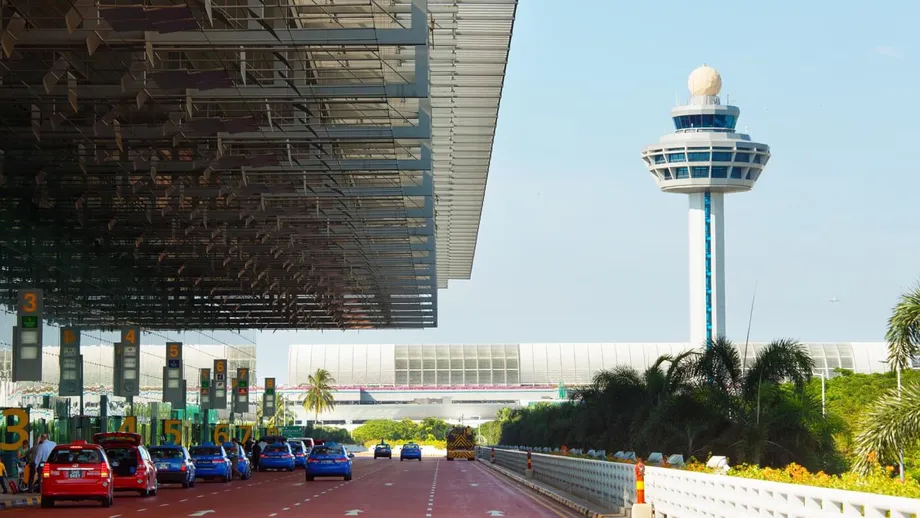
A Bigger Airport With National Stakes
Singapore broke ground on Changi Airport's Terminal 5 in May 2025, beginning an expansion intended to raise the airport's annual passenger capacity from 90 million to 140 million. Scheduled for completion in the mid-2030s, the terminal will initially accommodate 50 million passengers a year, with room for further growth.
Contents
- A Bigger Airport With National Stakes
- The Pandemic Showed What Was at Risk
- Asia's Passenger Growth Drives the Expansion
- What Changi East Will Contain
- A Terminal Designed to Adapt
- Energy, Water and Sustainability
- How the Expansion Is Being Funded
- Passengers Have More Hubs to Choose From
- Costs and New Aircraft Create Risks
- The Gains Singapore Wants Beyond Aviation
- Key Points
T5 is the centrepiece of the 1,080-hectare Changi East development, the largest expansion in the airport's history. Alongside the terminal, Singapore is developing runway capacity, underground connections and facilities for cargo and aircraft services. The aim is to secure more flights, business and visitors as demand for air travel grows across Asia.
Changi's importance reaches far beyond departure gates. The airport supports about 200,000 jobs and contributes roughly 5% of Singapore's gross domestic product, a measure of the value produced by the economy. Tourism, manufacturing, logistics and advanced services all depend on its connections.
Singapore has little land and a small domestic market. Its airport helps businesses reach customers abroad and brings international travellers into the country. Shukor Yusof, an aviation analyst at Endau Analytics, described that dependence in stark terms:
Changi is the lifeline of Singapore. Without a thriving, competitive airport, Singapore will collapse. The importance of Changi to Singapore's existence can never be underestimated.
The project is therefore both an airport expansion and an economic investment. Singapore is counting on a larger, more adaptable Changi to sustain its position as a global gateway while competing airports increase their own capacity.
The Pandemic Showed What Was at Risk
Changi handled 68.3 million passengers in 2019. By 2021, border closures during COVID-19 had reduced that figure to 3.1 million. With no domestic routes to cushion the loss of international travel, Singapore's airport was especially exposed.
Changi Airport Group, or CAG, recorded a 78% fall in revenue in the year ending March 2021. Singapore's economy contracted by 3.8% during the pandemic, its worst recession since independence. Those experiences showed how closely the country's prosperity is connected to movement across its borders.
COVID-19 delayed T5 but did not end the project. Singapore is proceeding on the expectation that disruption can interrupt aviation's growth without removing the demand for travel over the coming decades.
Prime Minister Lawrence Wong set out that reasoning at the groundbreaking ceremony:
Over the longer term, air travel is on a rising trajectory, and the bulk of the growth will take place here in the Asia-Pacific region.
The terminal's design also reflects the pandemic experience. Its layout will allow operations to be divided into smaller sections during a health crisis, giving the airport more flexibility to adjust how much space it uses.
Asia's Passenger Growth Drives the Expansion
Asia-Pacific airports handled 3.4 billion passengers in 2024, an increase of 13% from the previous year, according to figures attributed to Airports Council International, or ACI, and the International Air Transport Association, or IATA. The region accounts for about 36% of global air traffic.
Passenger numbers are expected to double by 2043. Rising incomes, expanding cities and a growing middle class in China, India, Vietnam and Indonesia are among the forces behind that forecast. More households with money to travel create opportunities for airlines and the airports serving them.
Stefano Baronci, director general of ACI Asia-Pacific and Middle East, described the region's room for growth:
The epicentre... of aviation is Asia. There is a huge margin for growth, and the region still has a huge margin for growth, meaning saturation will only be a problem for the next generation, not within the next 20 to 30 years.
Airports across Asia and the Middle East are investing to capture that demand. Hong Kong, Bangkok, Seoul and Kuala Lumpur are expanding their facilities, with some projects scheduled to finish before T5.
Singapore's response serves two purposes: creating space for additional traffic and protecting Changi's existing position. A growing regional market offers more potential passengers, while larger competing airports give airlines more choices about where to route them.
What Changi East Will Contain
T5's initial capacity of 50 million passengers a year will add more than half of Changi's current capacity of 90 million. Together, the existing airport and the new terminal are intended to accommodate 140 million passengers annually.
The wider Changi East development combines several connected projects:
- A new terminal with initial annual capacity for 50 million passengers and provision for further expansion.
- A third runway, currently reserved for military use, scheduled to open for commercial operations by 2027.
- Underground transport links, including tunnels for passengers and baggage moving between terminals.
- Smart utility and logistics zones supporting cargo and aircraft maintenance, repair and overhaul, commonly called MRO.
Aircraft maintenance, repair and overhaul covers the work needed to keep planes operating safely and reliably. Placing those services alongside cargo and passenger facilities connects several parts of the aviation business within the expanded airport area.
The project stretches across several stages, from construction to the eventual growth in routes and traffic:
- May 2025: Singapore broke ground on Terminal 5.
- 2027: The third runway is scheduled to begin commercial operations.
- Mid-2030s: T5 is scheduled for completion, raising Changi's annual passenger capacity to 140 million.
- Mid-2030s: Singapore aims to connect Changi to more than 200 cities, up from 170.
The completion timetable is given as the mid-2030s, without a specific opening date. The terminal is being planned with space to accommodate demand beyond its initial capacity.
A Terminal Designed to Adapt
T5 will be able to operate as smaller sub-terminals, allowing sections to be used separately when circumstances require it. During a health emergency, that flexibility would let the airport reduce operations without treating the whole building as a single operating space.
Touchless technology, biometric systems and robotic baggage handling are intended to form part of its daily operations. Biometric systems use physical features, such as a person's face, to confirm identity. Automated baggage systems move some of the handling work from people to machines.
Changi is already rolling out immigration clearance using facial recognition without requiring passengers to present a passport at the clearance point. It is also automating baggage handling and using artificial intelligence to predict flight delays and improve the organisation of airport operations.
Singapore Airlines and its budget arm, Scoot, are to operate under one roof at T5. Bringing them together is intended to improve efficiency and make transfers easier for passengers moving between their flights.
CAG executive vice-president for air hub and cargo development Lim Ching Kiat said technology would be central to keeping travellers interested in Changi:
To keep passengers coming back, we need to differentiate ourselves from other air hubs. In the next 10 years we believe technology will transform air travel and the way we run airports.
Energy, Water and Sustainability
T5's environmental plans include smart energy and ventilation systems, district cooling, rainwater harvesting and solar panels. These features are intended to reduce the resources required to operate a much larger airport.
District cooling provides cooling through a shared system rather than relying entirely on separate equipment in individual buildings. Rainwater harvesting collects rainfall for use, while solar panels provide a source of renewable electricity.
The government's S$50 million Aviation Sustainability Programme is intended to finance green initiatives. Those efforts sit alongside Singapore's goal of reaching net zero emissions by 2050, meaning that remaining emissions would need to be balanced by removals.
The ambition extends beyond the terminal itself. Singapore wants the expansion to encourage sustainability and green innovation in infrastructure, creating practices that can inform future projects. Flexible design, advanced technology and environmental measures are intended to help T5 adapt as operating requirements change.
How the Expansion Is Being Funded
Contracts worth S$4.75 billion, or US$3.6 billion, have been awarded, with further contracts expected as construction progresses. Budget 2025 also allocated an additional S$5 billion to the Changi Airport Development Fund.
The financing model combines government support, CAG surpluses and borrowing, and limited charges to airport users. The intention is to provide sufficient resources for the expansion while avoiding an excessive burden on taxpayers.
The Ministry of Transport describes T5 as both a transport hub and an economic engine supporting Singapore's resilience and competitiveness over the coming decades. Its value is expected to come from the activity it supports, including tourism, logistics, retail and advanced construction, as well as airport operations.
The Construction Industry Development Board forecasts S$47 billion to S$53 billion in construction contracts in 2025, driven by T5 and other infrastructure projects. Local businesses specialising in major infrastructure, sustainability and automation are positioned to compete for that work.
T5 is expected to create tens of thousands of jobs across construction, engineering, technology and services. The development also represents investment in the skills, equipment and coordination needed to build and operate infrastructure on this scale.
Passengers Have More Hubs to Choose From
Hong Kong International Airport has added a third runway and is expanding Terminal 2, with a target of serving 120 million passengers by the mid-2030s. Bangkok's Suvarnabhumi Airport is developing a third runway and a new terminal, targeting total capacity of 130 million passengers.
Seoul's Incheon International Airport has completed a fourth runway and expanded Terminal 2, bringing its annual capacity to 106 million passengers. Kuala Lumpur is also among the regional airports expanding its facilities.
ACI data identifies 10 cities with mega airports handling more than 100 million passengers a year, including three in Asia: Beijing, Tokyo and Shanghai. T5 is intended to bring Changi into that group, with planned capacity of 140 million.
Singapore is pursuing a wider route network alongside the extra terminal space. Its target of more than 200 connected cities by the mid-2030s compares with 170 today. More destinations would give passengers additional options and help businesses reach a broader range of markets.
Changi also competes through the experience it offers on the ground. Its shopping, dining, entertainment and nature attractions, including Jewel's indoor waterfall and forest, make the airport a destination as well as a place to board a plane. Singapore is relying on that combination of service, connections and innovation to retain passengers.
Costs and New Aircraft Create Risks
Airlines have raised concerns about the cost of operating at Changi, particularly for budget carriers. Those concerns became more immediate when Jetstar Asia, which accounted for 3% of Changi's traffic, announced that it would cease operations in July 2025, citing high costs.
The closure was still ahead as of June 26, 2025. It underlines a practical challenge for the expansion: airlines must be willing and able to use the capacity Singapore is building. Maintaining competitive costs will matter alongside service quality and additional facilities.
Trade wars, regional conflicts and shifting alliances present other risks. Tariffs can affect trade flows, while airspace restrictions can force airlines onto more expensive routes. Both can weaken demand or increase the cost of carrying passengers and cargo.
Aircraft capable of flying very long distances also allow airlines to connect distant cities directly, bypassing a traditional transfer airport. This trend, sometimes called hub-busting, could reduce some of the traffic that would otherwise pass through Changi.
Hub airports still serve a useful purpose by bringing passengers from many places together for onward flights. That pooling of demand helps sustain connections. Changi's challenge is to keep its network attractive as airlines gain more options for direct services and competing airports expand.
Mabel Kwan, managing director at Alton Aviation Consultancy, pointed to Singapore's strengths and the prospect of a larger regional market:
Singapore stands apart because of its focus on innovation, talent, and the strong collaboration between the Government and the aviation community. With Asia set to be the dominant force behind air traffic growth in the next decade, a rising tide actually lifts all ships.
The Gains Singapore Wants Beyond Aviation
Singapore aims to increase annual tourism receipts from S$29.8 billion in 2024 to between S$47 billion and S$50 billion by 2040. A larger airport and more international connections are intended to support that ambition by making room for more visitors.
The expected benefits extend to finance, technology and advanced manufacturing, alongside tourism and logistics. International connections help those industries move people and goods and maintain relationships across borders.
Changi East also reflects a broader move towards airport led urban zones, sometimes called aerotropolises. These developments bring transport, business and lifestyle activities together around an airport. At Changi, the combination of passenger facilities, cargo operations, maintenance services and commercial activity gives the expansion a role beyond aviation alone.
T5 is intended to support economic change, infrastructure that can withstand disruption, and cultural exchange across borders. Its success will depend on continued innovation, careful financial management and an ability to respond to changes in travel, trade and technology.
Singapore's approach combines strategic investment, cooperation between government and industry, and a focus on quality. The national bet is that these strengths, together with more capacity, will allow Changi to remain a leading gateway as Asia's aviation market grows.
Key Points
- Singapore broke ground on Terminal 5 in May 2025, with completion scheduled for the mid-2030s.
- T5 will initially handle 50 million passengers annually, raising Changi's total annual capacity from 90 million to 140 million.
- The 1,080-hectare Changi East development includes underground links, logistics facilities and a third runway scheduled for commercial operations in 2027.
- Asia-Pacific handled 3.4 billion passengers in 2024, and passenger numbers are expected to double by 2043.
- T5 will combine flexible operating sections, biometric systems, automation and environmental measures.
- Contracts worth S$4.75 billion have been awarded, while Budget 2025 added S$5 billion to the Changi Airport Development Fund.
- Singapore aims to connect Changi to more than 200 cities by the mid-2030s, up from 170.
- Airline costs, competing airports, geopolitical disruption and more direct flights are central risks to the expansion's success.