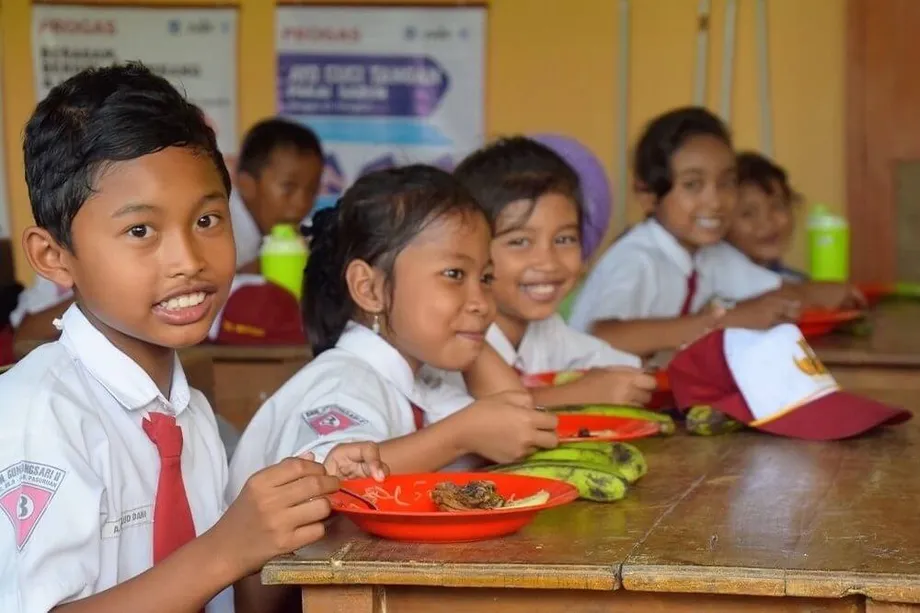
A promise to feed 83 million people faces growing pressure
Indonesia has reduced planned spending on President Prabowo Subianto's free meals program for 2026 by 22%, from as much as 450 trillion rupiah to 350 trillion rupiah, while pursuing a rapid expansion to reach 83 million people by the end of 2025. The initiative promises better nutrition for schoolchildren, young children, and pregnant or breastfeeding women. Its costs, food safety problems and competition with other public services have made it a major political test.
Contents
- A promise to feed 83 million people faces growing pressure
- What the meals are intended to achieve
- A smaller spending plan still carries a large bill
- Public works, health and education absorb cuts
- Growth hopes meet pressure on the deficit
- Students challenge the government's priorities
- Thousands of kitchens are still needed
- Local food supply faces a sharp rise in demand
- Food poisoning puts safety at the center
- Payment disputes and corruption concerns grow
- Would more targeted nutrition support work better?
- Key Points
As of June 26, 2025, the Free Nutritious Meal program, known in Indonesian as Makan Bergizi Gratis, or MBG, serves about 5 million people. Reaching its intended population would mean expanding to more than 16 times that number within the year, across a country of more than 17,000 islands.
The government presents the program as an investment in healthier children and a more productive population. Critics question whether its pace and design can deliver those benefits while ministries, regional governments and public institutions absorb sweeping spending cuts.
The debate reaches beyond the price of lunch. Students are protesting reductions affecting education and public services, investors are weighing the risks of financing kitchens, and families are confronting reports of children becoming ill after eating program meals.
What the meals are intended to achieve
Launched in early 2025, MBG is intended to provide five meals a week to students, children under five, and expectant or nursing mothers. It is a signature policy of Prabowo's administration and part of his ambition for Indonesia to become a developed country by 2045.
About one in five Indonesian children under five is affected by stunting, a condition caused by chronic malnutrition that impairs physical and cognitive development. The government hopes nutritious meals will help children grow taller, learn better and eventually contribute more to the economy.
Supporters describe this as improving Indonesia's human capital: the health, knowledge and abilities that allow people to work and participate in society. The promised benefits therefore extend from a child's immediate diet to the country's future workforce.
The scale puts MBG among the world's largest and most expensive social initiatives. At its initial projected annual cost of 450 trillion rupiah, about US$28 billion, it would rank as the second most expensive free meals initiative after the United States.
A smaller spending plan still carries a large bill
The government announced the reduction in planned spending for 2026 in mid-2025, after revising ingredient cost estimates and recalibrating the rollout. The revised allocation of 350 trillion rupiah is worth about US$21.4 billion.
Expenditure in 2025 is expected to total about US$7.5 billion, a 29% reduction from earlier plans. The lower figures leave the program with a substantial funding requirement even as the government adjusts how quickly and cheaply it can deliver meals.
The schedule combines an immediate expansion with spending plans extending into the following year:
- Early 2025: Indonesia launched the Free Nutritious Meal program.
- Mid-2025: The government announced a 22% reduction in planned spending for 2026.
- End of 2025: The government aims to reach all 83 million intended recipients, up from about 5 million.
- 2026: Planned program spending stands at 350 trillion rupiah, down from as much as 450 trillion rupiah.
President Prabowo ordered cuts totaling 306.7 trillion rupiah, about US$19.5 billion, across government ministries and regional allocations to help finance the initiative. Those reductions have made the choices behind the meals program visible in other parts of everyday life.
Public works, health and education absorb cuts
The Ministry of Public Works saw an 80% budget cut, while the Health Ministry lost 18.56% of its funding. The Ministry of Higher Education, Science, and Technology redirected research funds to support the meals program, and the National Library reduced its operating hours.
Finance Minister Sri Mulyani Indrawati said the cuts were intended to prioritize programs with direct public benefits, including free meals. The reallocation has nevertheless prompted concern about essential services, government operations and the health of public finances.
The austerity measures have also brought reduced government services, cancelled scholarships, and restrictions on air conditioning and lighting in public offices. For students and researchers, the debate therefore concerns both the benefits of better nutrition and the resources available for learning and scientific work.
Critics argue that cuts to education, research and public services could weaken Indonesia's prospects over time, even as the government pursues prominent projects. Their concerns extend to an US$80 billion sea wall off Java's coast, another major ambition being discussed alongside the meals program.
Growth hopes meet pressure on the deficit
Supporters expect MBG to stimulate demand for food from local producers, create jobs and improve the health and productivity of future generations. A presidential adviser has argued that additional spending on free meals could add nearly two percentage points to Indonesia's GDP growth in 2025, helping the country reach its 5.2% growth target.
GDP measures the value of goods and services produced in an economy. The government's argument is that buying ingredients, preparing meals and employing workers can support economic activity now, while better childhood nutrition can support productivity later.
Financial markets and analysts are concerned about the program's cost and Indonesia's reputation for fiscal prudence. Nomura Holdings forecasts a fiscal deficit of 2.9% of GDP in 2025, close to the legal limit of 3%, citing weak economic growth, low commodity prices and accelerated spending on free meals.
A fiscal deficit occurs when government spending exceeds its income. Nomura's forecast leaves a gap of just 0.1 percentage point below the legal ceiling, illustrating the limited room available if revenue disappoints or spending rises.
The government is expected to announce a wider deficit outlook in its midyear budget review. The revised outlook will be another measure of how the administration is balancing its meal commitments with weaker economic conditions and other spending needs.
Students challenge the government's priorities
University students have led the Indonesia Gelap, or Dark Indonesia, movement, staging demonstrations in major cities against cuts to education, scholarships and public services. Civil society groups have also joined the opposition to the austerity measures.
Protesters argue that free meals for children come alongside job losses, reduced social support and a dimmer future for the broader population. The demonstrations have become the first major political challenge for Prabowo's administration, and some have turned violent.
Prabowo remains popular, with approval ratings near 80%. Even so, the protests have opened a national debate about which public needs should receive money first and who bears the cost when funds are moved between programs.
Analysts warn that worsening economic conditions or rising living costs could deepen public discontent and challenge the government's stability and reform agenda. Past movements led by Indonesian students suggest that sustained demonstrations can have a substantial political impact when their concerns connect with wider sections of society.
Thousands of kitchens are still needed
The government estimates that 32,000 kitchens are needed to prepare and distribute meals, yet fewer than 1,900 are operating. That is less than 6% of the intended total, showing the size of the construction and operating effort required alongside the expansion in recipients.
Private investment is crucial, but a kitchen can cost up to US$183,000 and may take two years to break even. Breaking even means recovering the money spent, a long wait for investors facing uncertainty about how the program will operate.
Aditya Perdana, a political lecturer at the University of Indonesia, described the hesitation among potential investors:
People aren't convinced with the investment model and prefer to just wait and see the progress.
The government plans to deploy 30,000 university graduates as kitchen managers to accelerate the rollout. Staffing kitchens is only part of the task: food must also reach remote communities, remain fresh during delivery and arrive in time to be eaten.
Indonesia's geography makes each of those requirements demanding. Expanding from about 5 million recipients to 83 million means building food supply chains and distribution networks as well as places to cook.
Local food supply faces a sharp rise in demand
MBG relies on domestic producers for eggs, chicken, fish, vegetables and fruit. Supporters see those purchases as a way to channel public spending into local economies while improving the diets of children and mothers.
Milk presents a particular challenge because demand is expected to exceed domestic supply. Plans call for importing up to 1.5 million dairy cows from countries including Australia, New Zealand, Brazil, the United States and countries in Europe, potentially tripling Indonesia's existing herd.
Officials acknowledge that increasing local production will take time, although they say there are no immediate shortages. The challenge is to expand supply alongside a program that is itself trying to grow rapidly.
The milk plans also face concern about high rates of lactose intolerance, which makes milk difficult for some people to digest. Critics question whether a uniform approach can match regional food availability, dietary habits and nutritional needs.
Centralized kitchens have drawn similar scrutiny. Critics worry that relying on them rather than empowering local small businesses could weaken the program's intended economic benefits and its ability to adapt to different communities.
Food poisoning puts safety at the center
Nearly 80 students in Cianjur, south of Jakarta, were hospitalized after eating meals with an unpleasant odor. Investigations pointed to negligent food preparation, and authorities pledged to improve safety protocols.
At least eight incidents of food poisoning have been reported since MBG began, affecting students and staff. The cases have made safe preparation and delivery an immediate concern for a program intended to improve health.
Some students have described meals as bland, stale or unfit to eat. Reports have also described teachers confiscating student phones to prevent photographs of the food from being shared online, while some caterers have withdrawn because of delayed payments and cash flow problems.
Experts and analysts have criticized the speed of implementation and the lack of detailed standards covering cleanliness, nutrition and food safety. Kitchens need to deliver meals that are nutritious as well as safe, while distribution arrangements must preserve their quality until they reach recipients.
The Center for Indonesia's Strategic Development Initiatives, known as CISDI, says the National Nutrition Agency has limited authority to coordinate with local governments, hampering effective oversight. Nutritionist Tan Shot Yen has warned that moving too quickly without adequate engagement at the community level risks food waste and poor results.
Payment disputes and corruption concerns grow
A meal provider in South Jakarta accused authorities of failing to reimburse nearly a billion rupiah spent on school lunches, prompting a police investigation. Allegations of embezzlement, missed vendor payments and a lack of transparency have also surfaced around the program.
Delayed payments can leave a caterer unable to cover the next round of ingredients and other expenses. The withdrawal of some providers over cash flow problems adds another challenge to the government's effort to expand its network of kitchens.
Indonesia's large social assistance programs have historically been vulnerable to corruption. The National Anti-Corruption Bureau has flagged the "real possibility" of fraud in MBG because of its enormous budget.
Prabowo has vowed to address these problems and safeguard public funds, although skepticism persists. Muhammad Rafi Bakri, a research analyst at Indonesia's audit board, described the scale of the risk:
Given the sheer size of the budget, this program is a goldmine for corrupt officials.
The government's expansion plans place payment systems, oversight and public trust alongside the practical work of buying food and preparing meals. Problems in any of those areas can affect whether providers continue participating and whether meals reach children reliably.
Would more targeted nutrition support work better?
Indonesia already has programs intended to address malnutrition, including Posyandu community health posts, the Family Welfare Card, known as KKS, cash transfer program, and the Complementary Food Program, or PMT. These initiatives have achieved varying degrees of success.
Some experts argue that expanding those existing programs would be more prudent than building an expensive new initiative. Their criticism focuses on how best to improve nutrition, rather than on whether healthier children and mothers are worthwhile goals.
National surveys indicate that about 1% of Indonesian households experienced a day without meals during the previous year, while less than 8% reported lacking access to nutritious food because of financial constraints. Those figures place the quality of diets at the center of the debate, alongside the quantity of food available.
Stunting affects about one fifth of children under five, while the share of households reporting a day without meals is much smaller. The government's task therefore includes improving what children eat, with attention to their nutritional needs, rather than simply distributing more food.
Critics of the program's universal approach argue that it may give too little attention to local needs and differences in food supply and eating habits. The combination of existing community programs, regional variation and the milk supply challenge has strengthened calls for a more targeted design.
As of June 26, the government is pursuing its target of reaching 83 million people by the end of 2025 while revising spending plans and confronting safety, financing and oversight problems. For families, the practical test is whether that expansion delivers nutritious meals consistently while other essential services remain available.
Key Points
- Indonesia's Free Nutritious Meal program aims to reach 83 million people by the end of 2025, up from about 5 million.
- Planned spending for 2026 has fallen 22% to 350 trillion rupiah, about US$21.4 billion. Expected spending in 2025 is about US$7.5 billion.
- Government cuts totaling 306.7 trillion rupiah have affected ministries and regional allocations, fueling student protests over education and public services.
- Fewer than 1,900 of an estimated 32,000 required kitchens are operating, while investors face high initial costs and uncertainty.
- At least eight food poisoning incidents, delayed payments and corruption concerns have added pressure to improve implementation and oversight.
- Critics favor closer attention to diet quality, local needs and existing nutrition programs as the government expands the initiative.