A Journey of Sacred Timber Toward 2033
Logs more than six meters long and weighing about 1.5 metric tons each are part of preparations for the next renewal of Ise Jingu, scheduled for 2033. Their ceremonial journey from forests in Nagano and Gifu prefectures to Ise, in Japan's Mie Prefecture, connects the practical work of rebuilding with a religious tradition that has continued unbroken for more than 1,300 years.
Contents
- A Journey of Sacred Timber Toward 2033
- What Happens During Shikinen Sengu?
- From Forests to the Streets of Ise
- The Milestones Leading to Renewal
- Why the Work Returns Every 20 Years
- A Community Pulls Together
- Two Main Shrines Within a Forested Complex
- Forests Supply the Wood, Old Buildings Find New Uses
- A Living Heritage With National Reach
- Key Points
Ise Jingu, considered the spiritual heart of Shintoism, undergoes this renewal every 20 years. Known as Shikinen Sengu, the ceremony involves rebuilding the main shrine buildings, renewing sacred treasures and transferring the deity's spirit from the old sanctuary to the new one.
The preparations take nearly a decade and involve far more than construction. Priests conduct purification ceremonies, craftspeople pass on ancient techniques, and residents help move the timber through streets and along a river. The work brings religious practice, forestry and community life into the same undertaking.
Ceremonies in June 2024 marked an early milestone in preparations for 2033. The sacred logs, intended for pillars and beams in the new buildings, were ceremonially cut, transported by truck and welcomed into the shrine complex through processions involving hundreds of people.
For participants, the logs carry responsibilities as well as building material. Each renewal depends on people learning the skills and customs needed to carry out the next one. Children who join a procession today may be among the adults responsible for a later ceremony.
Ise Jingu preserves its identity through this repeated act of rebuilding. Its buildings are renewed, while their religious purpose, architectural form and the knowledge required to make them continue across generations.
What Happens During Shikinen Sengu?
Shikinen Sengu is a Shinto ceremony in which Ise Jingu's main buildings and sacred treasures are renewed every 20 years. Shinto is the religious tradition at the heart of the shrine's worship, and the renewal expresses beliefs about purity, nature and the relationship between people and the divine.
The practice dates to the late seventh century, during the reign of Emperor Tenmu. It was established to keep sacred structures made from natural materials, including Japanese cypress, from succumbing to decay. Rebuilding allows the sanctuary to remain a living place of worship while its physical materials change.
Japanese cypress is vulnerable to deterioration over time, especially in Japan's humid climate. Regular reconstruction maintains the buildings' structural integrity and aesthetic purity. The religious meaning reaches further: renewal purifies the sacred space and symbolizes the eternal youth of the deities worshipped there.
Japan for Sustainability, an organization that has explained the tradition's underlying philosophy, describes how continuity can come through reconstruction:
repeated rebuilding renders sanctuaries eternal.
The approach contrasts with Western traditions of building monuments from stone or concrete to endure over time. At Ise Jingu, continuity rests in the recurring work of renewal, including the ceremonies and skills that give the buildings their meaning.
From Forests to the Streets of Ise
The journey of the sacred logs began with ceremonial cutting in Agematsu, Nagano Prefecture, on June 3. Timber for the renewal came from forests in Nagano and Gifu prefectures, linking distant woodland communities with the shrine in Mie.
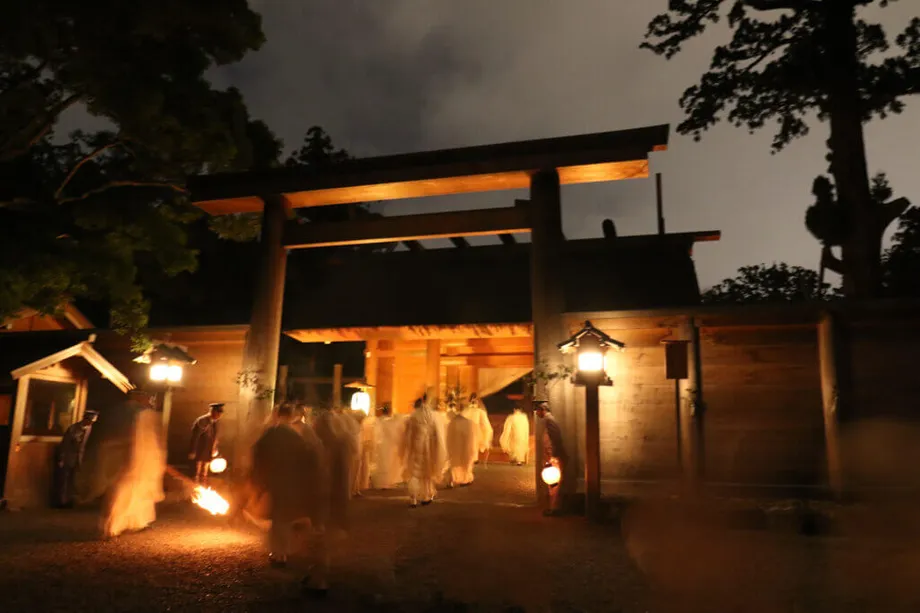
Each of the large logs measured more than six meters and weighed approximately 1.5 metric tons. After cutting, trucks decorated with red and white curtains carried them to Ise. Shrine priests performed a purification ritual when they arrived, treating the timber as sacred material from the start of its life at the shrine.
Hundreds of residents, students and shrine staff then took part in the ceremonial procession. Wearing traditional black-dyed coats and hinoki cypress hats, participants pulled the logs on wooden carts or river sleds. Hinoki is Japanese cypress, the timber central to the shrine's construction.
Chants of "Enya, enya!" helped give the work a shared rhythm, while participants sang the Ise Ondo, a traditional folk song. Spectators lined the route, offering encouragement and joining the communal celebration.
The timber followed different routes according to its destination. Logs for Naiku, the Inner Shrine, were hauled upstream along the Isuzu River on Monday. Another set, destined for Geku, the Outer Shrine, was pulled through Ise's streets on Tuesday over a distance of about two kilometers.
Chief Priest Asataka Kuni welcomed the logs when they reached the shrine precincts. Following a final purification ritual, they were placed in the Gojoden house.
The Milestones Leading to Renewal
The movement of the logs is one stage in a process that unfolds over years. Ceremonial cutting, transport, preparation of materials, construction and the eventual transfer of the deity's spirit all belong to the same renewal.
The dates and stages described for this cycle place the June 2024 ceremonies within the longer preparations for 2033:
- Late seventh century: The renewal tradition began during Emperor Tenmu's reign.
- June 3, during the June 2024 preparations: Sacred logs were ceremonially cut in Agematsu, Nagano Prefecture.
- Monday during the procession: Logs for Naiku were hauled upstream along the Isuzu River.
- Tuesday during the procession: Logs for Geku traveled about two kilometers through Ise's streets.
- 2033: The next Shikinen Sengu is scheduled to take place.
The precise calendar dates for the Monday and Tuesday processions were not specified. Their place in the ceremony is clear: they brought sacred building material into the shrine community before the years of preparation still required for renewal.
Why the Work Returns Every 20 Years
The interval between renewals serves both the buildings and the people who make them. Cypress structures need care in a humid environment, while traditional construction skills need regular practice and new learners.
Highly skilled carpenters, artisans and other craftspeople use techniques passed down through generations. Each rebuilding cycle brings apprentices into the work, giving them an opportunity to learn directly from experienced practitioners rather than relying only on descriptions or records.
The ceremony also gives physical form to beliefs about impermanence and the cycles of nature. Wood grows, is shaped into a sanctuary and eventually gives way to new material. The repeated work honors the deities, expresses gratitude for nature's blessings and renews the sacred space.
For worshippers, the central moment is the solemn transfer of the deity's spirit from the old shrine to the new one. Construction prepares a place for that religious act, which reaffirms Ise Jingu's role as a living center of faith.
A Community Pulls Together
Okihiki, the ceremonial transportation of the sacred logs, brings people of different ages into the preparations. Residents, students and children help pull heavy carts, sing work songs and share the effort of moving timber toward its destination.
Neighborhood associations provide refreshments and entertainment along the route. The procession becomes a local celebration as well as a demanding task, creating opportunities for people to work together and renew their connection with the shrine.
Junko Edahiro of Japan for Sustainability has described the processions as "full of laughter" and explained their role in sustaining community traditions:
device to preserve the foundations of traditions that contribute to happiness in people's lives.
Older participants also pass responsibilities to younger people. The learning includes songs, customs and the practical duties needed to organize and carry out the ceremony. One local participant expressed that handover directly:
I will leave these duties to you next time,
Children encounter the tradition through participation, while adults prepare them to take greater responsibility in another cycle. The shared work builds belonging, solidarity and pride alongside the religious observance.
Two Main Shrines Within a Forested Complex
Ise Jingu has two main shrines. Naiku, the Inner Shrine, is dedicated to Amaterasu-Omikami, the sun goddess and mythological ancestor of Japan's imperial family. Geku, the Outer Shrine, is dedicated to Toyouke-Omikami, the deity of agriculture, food and industry.
The complex also includes 125 smaller shrines scattered across the forests of Ise. Their woodland setting expresses the connection between nature and spirituality that runs through the renewal ceremony.
The buildings follow the Yuiitsu-Shinmei-zukuri architectural style, with thatched roofs, elevated structures and little ornamentation. Their simplicity, natural materials and traditional construction methods reflect Shinto principles of purity and naturalism.
Purity shapes the experience of worship as well as the rebuilding process. Visitors take part in purification rituals before approaching the main shrine, while the renewal itself is understood as spiritual cleansing. The handling and purification of the logs belong to that same religious framework.
Forests Supply the Wood, Old Buildings Find New Uses
A renewal cycle can require up to 10,000 Japanese cypress trees. Supplying that quantity of timber depends on forest management extending far beyond the days when crowds gather to pull the logs.
Ise Jingu owns a large tract of forest land known as Misoma-yama, cultivated over centuries to provide a sustainable supply of wood. Timber also comes from national forests in Nagano and Gifu prefectures.
Selection and preparation take time. Logs are carefully chosen and felled, then soaked in ponds for two years before being dried in the air. This curing process prepares the timber for use and supports its strength and durability.
The same attention to materials continues after old buildings are dismantled. Large pillars are reused for torii gates, the gateways associated with Shinto shrines. Other components go to shrines elsewhere in Japan for their renovation work.
Reusing the wood gives parts of the old sanctuary a continuing purpose. It also maintains ties between Ise Jingu and other Shinto shrines, connecting the renewal in Ise with religious communities across the country.
A Living Heritage With National Reach
Shikinen Sengu preserves intangible cultural heritage: the knowledge, skills, rituals and customs carried by people. Its songs and festivals help sustain social bonds, while carpentry and other crafts continue through repeated use and teaching.
Ise Jingu is not registered as a UNESCO World Heritage site. The explanation given for its absence centers on the periodic reconstruction of the buildings rather than the preservation of historical structures in an unchanged state. Renewal is also the feature that gives this living tradition its distinctive character.
Millions of Japanese pilgrims visit Ise Jingu to pay their respects, seek blessings and take part in rituals. The shrine's connection to the imperial family and its role in national ceremonies make it a symbol of continuity within Japan's national identity.
The renewal also draws international visitors, scholars and people interested in cultural traditions. The preparations show how a community can preserve its heritage through shared work while the world around it changes.
A visitor from Hiroshima Prefecture, watching the log procession, expressed admiration for the tradition's longevity:
It is amazing that the tradition has continued for 1,300 years.
Another local spectator hoped that the ceremony would continue into a future generation, explaining the wish in personal terms:
my grandchildren could see it.
For those watching and taking part, the preparations for 2033 join a major religious ceremony with a family and community responsibility. The buildings will be new, while their construction depends on knowledge, faith and participation carried forward from earlier generations.
Key Points
- Ise Jingu's Shikinen Sengu renews its main shrine buildings and sacred treasures every 20 years, with the next ceremony scheduled for 2033.
- The tradition began in the late seventh century during Emperor Tenmu's reign and has continued unbroken for more than 1,300 years.
- June 2024 ceremonies included the movement of sacred logs from Nagano and Gifu prefectures to Ise.
- Logs more than six meters long and weighing about 1.5 metric tons each traveled by truck, street procession and river.
- Okihiki brings residents, students, children and shrine staff into the ceremonial transportation of timber.
- Each renewal can require up to 10,000 cypress trees, with wood from dismantled buildings reused at Ise and other shrines.
- The renewal preserves religious customs, traditional craftsmanship and community ties through participation across generations.