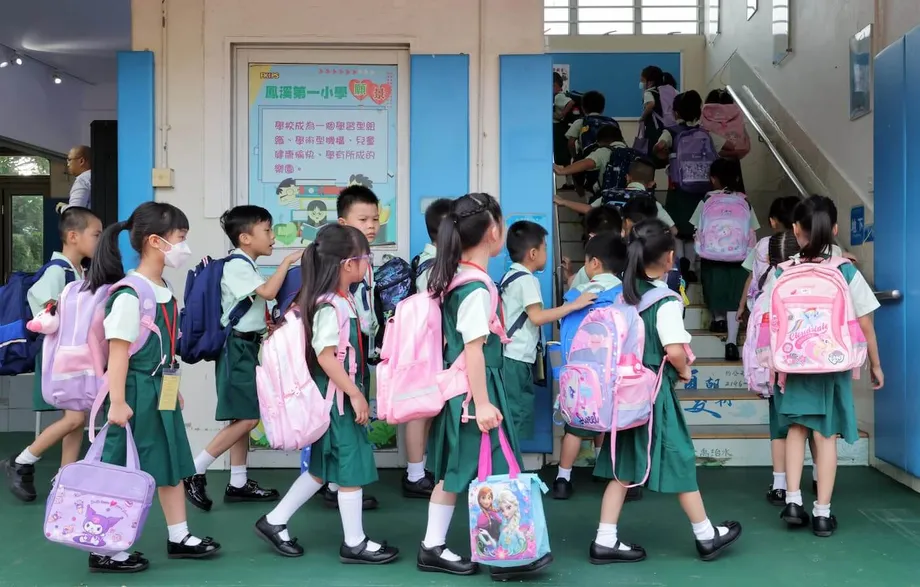
English Lessons Carry a Wider National Mission
Hong Kong's revised English curriculum for Primary One to Primary Six brings national security and patriotism into language lessons, while removing explicit references to human rights and equal opportunities from its examples of values education. Released by the Education Bureau in 2024, the guide gives primary schools a dedicated framework to replace the previous 2017 edition.
Contents
- English Lessons Carry a Wider National Mission
- What Has Changed in Values Education?
- How the Policy Developed
- From Rice and Wildlife to Outer Space
- Teachers Seek Help Turning Policy Into Lessons
- Different Views on the New Priorities
- Changes Extend Beyond Primary English
- Inspections Point to Implementation Problems
- Identity and Language Skills Share the Classroom
- Key Points
The basic structure of English language education remains intact. The changes concentrate on four areas: values education, assessment literacy, electronic learning and information literacy, and reading. Within that framework, teachers are expected to help children develop their English alongside a stronger sense of national identity and responsibility for safeguarding national security.
Classroom materials show how that policy can reach young pupils. Reading about rice scientist Yuan Longping, exploring the folk dances of China's ethnic groups and learning about the country's aerospace achievements can become English activities linked to national security. Food supplies, wildlife conservation and cultural traditions are presented as subjects through which children can understand their relationship with the country.
The revision forms part of a wider change in Hong Kong education following the 2019 social unrest and Beijing's subsequent implementation of the National Security Law. Secondary school subjects, expectations for teachers and the time devoted to Chinese culture and constitutional education have also changed.
For schools, the immediate task is practical: turn a broad political and educational objective into lessons children can understand, while continuing to teach language skills. Veteran English teacher Pauline Chow Lo-sai has called for more support and sample materials, particularly for schools that depend heavily on textbooks.
What Has Changed in Values Education?
The 2017 guide encouraged teachers to introduce topics involving human rights, equal opportunities, sustainability and responsibilities. The revised guide instead lists themes including respect for others, animal rights and protection, and environmental protection.
Explicit mentions of human rights and equal opportunities have been removed. Earlier references to the rule of law, cultural inclusion, respect for pluralism, mutual respect and acceptance are also absent from the corresponding discussion. Respect for pluralism means recognising that people in a society can hold different beliefs and views.
The rule of law nevertheless appears in the revised guide's stated national education objective. The change therefore concerns both the examples teachers are given and the context in which legal responsibility is presented.
The Education Bureau's revised guide describes the intended outcome for pupils in these terms:
good nationals who have a sense of national identity, respect the rule of law and abide by the law, hence safeguarding national security.
National education, education about the constitution and the Basic Law, and national security education now receive particular attention. The Basic Law is Hong Kong's constitutional framework. In classroom terms, the guide connects learning about national identity with understanding legal duties and obeying the law.
How the Policy Developed
The Education Bureau presents safeguarding national security as a constitutional duty of the Hong Kong Special Administrative Region. Its national security curriculum documents set out the framework for bringing that duty into education across subjects, including English.
The bureau has promoted national security education to strengthen awareness of safeguarding national security and abiding by the law. The English revision sits within a sequence of political events and curriculum changes:
- 2017: The earlier English curriculum guide was issued.
- 2019: Social unrest in Hong Kong preceded the subsequent implementation of the National Security Law by Beijing.
- 2021: The Curriculum Framework of National Security Education in Hong Kong was released.
- 2024: The revised guide for English teaching in Primary One to Primary Six was released.
- 2025: Updates to the national security education framework provided further foundations for work across school subjects.
Authorities have sought to reinforce patriotism and national identity among young people since the unrest. The English guide brings those priorities into a subject whose main purpose remains language learning.
From Rice and Wildlife to Outer Space
The Education Bureau has developed specialised English resource kits for primary and secondary schools to support national security teaching. Its primary English resource kit organises activities around four topics: cultural security, ecological security, food security and outer space security.
These terms connect national security to subjects beyond policing or the military. In the kit, cultural security involves learning about the folk dances of different ethnic groups in China. Ecological security is connected with conserving endangered wildlife, while food security concerns maintaining a stable food supply. Outer space security is introduced through the country's aerospace technology achievements.
Pupils encounter the topics through reading, viewing and other English activities. The materials also ask them to consider ways they can contribute to national security in daily life. The stated educational purpose is to build a sense of belonging to the country and awareness of safeguarding its security.
One activity centres on Yuan Longping, described as the "father of hybrid rice". Children read about his contributions to food security and national development. The example connects a named person's scientific work with the wider question of how a country maintains its food supply.
Teachers must also pay attention to national symbols in their materials. They are reminded to use official photographs, rather than drawings, of the national and Hong Kong flags and emblems. That instruction makes accuracy and respect for those symbols part of preparing classroom resources.
Teachers Seek Help Turning Policy Into Lessons
Pauline Chow Lo-sai, a veteran English teacher, has identified the breadth of the subject as a challenge for schools. Describing the scale of what teachers are being asked to address, she said:
national security is a big topic
Chow suggested that schools may need more Education Bureau support to design effective learning materials. Many schools still rely heavily on textbooks, she noted, making additional examples useful for teachers trying to build national security awareness through English.
The resource kits provide a starting point, but teachers still have to connect their subject matter with reading, viewing and language activities that pupils can manage. A lesson about aerospace achievements or food supplies must serve the English curriculum as well as its values education goals.
Different Views on the New Priorities
Some educators and parents have expressed concern about the narrower range of values named in the revised guide, particularly the removal of human rights and equal opportunities. Their concern is that pupils may have fewer opportunities to encounter different perspectives and practise the critical thinking encouraged under the earlier curriculum.
Supporters argue that national identity and respect for the law are essential to social stability and Hong Kong's future. They see national security education as a necessary part of bringing schools into line with national priorities.
The disagreement concerns what children should learn alongside English. The revised guide gives teachers a stronger national focus, while critics want room for the diversity of values and perspectives named in the earlier version.
For pupils, those choices affect the topics they read about, the examples used in activities and the values discussed in class. English lessons remain language lessons, but the content selected for them also carries messages about belonging, citizenship and responsibility.
Changes Extend Beyond Primary English
Hong Kong's secondary schools have already undergone related changes. Liberal studies has been replaced by citizenship and social development, a subject centred on lawfulness, patriotism and understanding China's national security.
The replacement subject omits previous content on democracy, integrity and social justice, placing its focus instead on the legal framework of the National Security Law and the Basic Law. The change shifts the subjects and values through which pupils are asked to understand public life.
Life and society, which covered socioeconomic development and political systems, is also being phased out in favour of new courses that give greater attention to national identity and security. These changes place the primary English revision within a much wider restructuring of what schools teach about society.
The Education Bureau has increased the share of teaching time devoted to Chinese culture and the constitution. A quarter of primary school teaching time is now allocated to those topics.
Many view the reforms as a response to accusations that the former curriculum contributed to youth radicalisation and participation in the 2019 protests. The government has also revised the teachers' code of conduct, requiring educators to advance national education and report illegal activities or activities described as "morally deviant".
Inspections Point to Implementation Problems
An inspection covering 169 of Hong Kong's 1,160 schools in the 2021-22 academic year found efforts to incorporate national security education unsatisfactory. The inspected schools represented about 15 per cent of the total, calculated from those two figures.
The findings prompted the Education Bureau to provide more comprehensive guidelines, resource kits and sample teaching materials. Those measures address the practical work between setting a curriculum objective and delivering it in a classroom.
The bureau describes its approach as "organic integration" and "natural connection" with existing subjects. In plain terms, teachers are encouraged to connect national security themes with relevant lesson content and activities.
Schools are also encouraged to involve the whole school and organise learning both inside and outside the classroom. Parents are invited to use recommended texts and videos with their children, extending values education into the home through cooperation between families and schools.
The revised primary English guide was released in 2024, but no separate implementation deadline is specified here. The practical demands on schools include choosing suitable materials, supporting teachers and maintaining the development of English skills alongside the new priorities.
Identity and Language Skills Share the Classroom
Academic observers describe the curriculum's direction as an effort to cultivate national belonging and responsibility, contrasting it with the earlier attention to critical thinking and tolerance of different values. The change reaches beyond the choice of reading passage to the kind of civic identity schools are expected to encourage.
Some fear the reforms may weaken Hong Kong's distinct cultural identity and its traditions of openness and pluralism. Those concerns are linked to the approach of 2047, the endpoint cited for the city's autonomy under the "one country, two systems" framework. Others see stronger national education as necessary for social cohesion and stability during rapid political change.
Teachers face the task of promoting national identity while developing language skills and critical thinking. Suitable materials and professional support will be central to that work, particularly where schools depend on textbooks to structure their lessons.
By June 11, 2025, the policy direction was established: national security and patriotic education had become central priorities in the revised primary English guide. Its classroom effect would depend on how schools translated those priorities into reading, discussion and other English activities for children.
Key Points
- Hong Kong released a revised English curriculum guide for Primary One to Primary Six in 2024, replacing the 2017 edition.
- The guide gives greater attention to national identity, the constitution, the Basic Law and national security.
- Explicit references to human rights and equal opportunities were removed from the values education examples.
- Primary English resources cover cultural, ecological, food and outer space security through reading, viewing and other activities.
- Teacher Pauline Chow Lo-sai called for more support and sample materials to help schools teach the broad subject.
- The revision accompanies changes to secondary subjects, teaching time and the teachers' code of conduct.
- Inspections covering 169 of 1,160 schools in 2021-22 found shortcomings in national security education, prompting further guidance and resources.