A Synthetic Replacement for Worn-Out Chromosomal Cohesion
Women often face a steep decline in fertility starting around age 35. A major reason for this is the slow failure of a natural protein complex called cohesin. This complex acts like a molecular glue that holds the two identical halves of a chromosome, known as sister chromatids, together. In young women, cohesin levels remain high enough to ensure chromosomes separate cleanly during cell division. But as a woman ages, the eggs she was born with begin to lose this glue. The chromatids drift apart too early, leading to aneuploidy, a condition where an egg has too many or too few chromosomes. This genetic error is the leading cause of age-related infertility, failed IVF cycles, and early miscarriage. A new study published in Science offers a synthetic solution to this mechanical problem.
Contents
Nature article on molecular glue details the development of an artificial protein system called TALhesin. Researchers at the Max Planck Institute for Multidisciplinary Sciences in Germany designed this system to replace the missing cohesin. In experiments with older mice, the artificial glue raised the proportion of eggs with correctly connected chromosomes from 46.7 percent to 74.1 percent. This figure closely matches the 74.7 percent success rate seen in young animals. The findings suggest that the biological clock inside older eggs can be turned back to restore youthful chromosome stability.
How the Engineered Protein System Works
TALhesin is built from a programmable DNA-binding protein called a TAL effector. The researchers aimed this protein at a region near the centromere, the pinched middle of each chromosome where natural cohesin normally clamps the sisters together. They equipped two of these proteins with chemical coupling sites that lock onto each other. When two TALhesins bind the DNA and then bind one another, they form a synthetic stand-in for the missing ring. This creates a tether across the gap, holding the chromatids together.
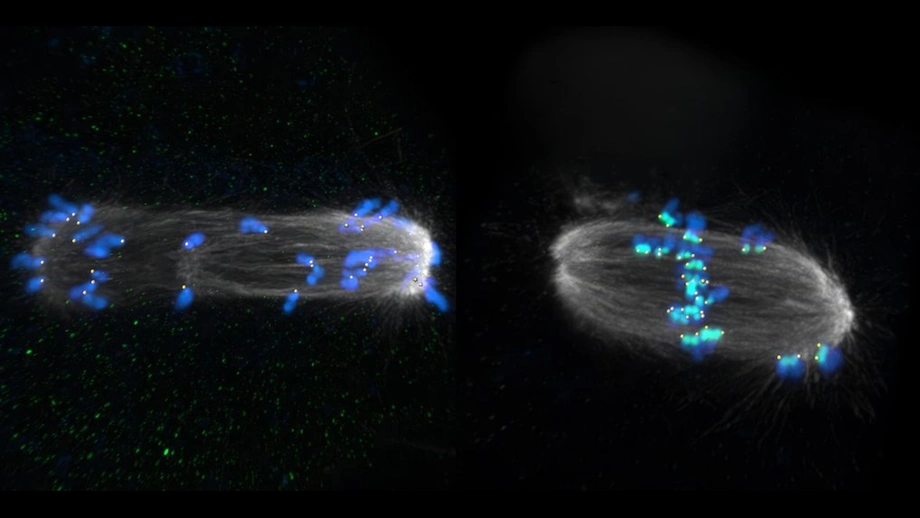
Researchers injected messenger RNA encoding these engineered proteins into immature mouse eggs. The eggs then produced the proteins themselves. Using fluorescence microscopy, the team confirmed that the TALhesin proteins attached to the chromosome regions where natural cohesin is typically lost. The artificial system reduced the frequency of premature chromosome segregation in mice aged 13, 17, and 20 months. The intervention targets the specific root cause of chromosomal missegregation rather than just treating symptoms.
"Can we replace cohesin?" asks Melina Schuh, a biochemist and director at the Max Planck Institute. "We aimed to develop an artificial glue that could take over the role of cohesin and be applied to chromosomes. The results prove that chromosomal cohesion in mammalian oocytes can be achieved through artificial engineering. The artificial glue can effectively turn back the biological clock inside older eggs.
A potential downside of artificial glue is that it might hold things together too tightly, preventing necessary separation. To solve this, the researchers incorporated a built-in molecular scissor. An enzyme called separase acts as this scissor, cutting the cohesin at a precise moment during cell division. The researchers copied this trick into TALhesin. When they triggered the final division artificially, separase cut the artificial tether on cue, and the chromatids parted normally.
Translating Results from Mice to Human Eggs
The critical question for patients is whether these results apply to humans. The research team adapted TALhesin to bind to a target sequence on human chromosomes and tested it in donated human eggs. The sources for these human samples included the Göttingen Fertility Center, the Bourn Hall Fertility Clinic in Cambridgeshire, England, and the Fertility Center Berlin. The proteins bound where they were meant to without visibly disturbing the first round of division.
Chromosomes loaded with higher levels of TALhesin sat with their chromatids held closer together. This observation is the signature of a working tether. The cleavage switch also worked in human eggs. Without the molecular scissor site, chromosomes with the most TALhesin stayed linked when they should have separated. With the site included, the chromatids separated normally. These initial signs indicate a positive effect on cohesion, though the team has not yet shown that TALhesin actually lowers the error rate in human eggs to improve pregnancy outcomes.
Experts note that the design is highly successful as a proof of concept. Rajiv McCoy, a biologist at Johns Hopkins University, called the stakes very high. He noted that roughly half of all human conceptions are thought to end before birth, with aneuploidy being the leading cause. Eva Hoffman, a molecular geneticist at the University of Copenhagen, emphasized that cohesion is set up in fetal life and must last for decades. She stated that its depletion over time was thought to be irreversible, so the main reason this kind of error was long treated as impossible to fix. Whether TALhesin becomes a therapy depends on regulatory aspects, including safety studies for embryonic development.
Timeline of Key Developments
The road from concept to clinical application involves several milestones. The groundwork began in 2015 when the team first showed how the structures holding chromosomes together fall apart in human eggs as they age.
- 2015: Groundwork established on the loss of chromosome cohesion in aging human eggs.
- 2025: Melina Schuh co-founded Ovo Labs in Munich and London to develop treatments.
- November 2026: The study on TALhesin is published in Science.
- December 2026: Schuh is due to present findings at the ASCB-EMBO meeting in San Diego.
- Future: Safety and toxicity studies must be completed before clinical trials begin.
The commercial race is already underway. Schuh has co-founded a startup called Ovo Labs, which has licensed TALhesin from the Max Planck Institute. A rival company, U-Ploid, was co-founded by her Max Planck colleague and study co-author Alexandre Webster. U-Ploid uses a different approach to preserve an egg's own cohesion machinery. At a reproductive medicine meeting, U-Ploid reported that 65.5 percent of treated immature donor eggs matured without detectable chromosome errors, compared to 35.7 percent of untreated ones.
Clinical Challenges and Future Steps
Adapting TALhesin for routine use presents several challenges. A major timing problem exists because most eggs collected during a standard IVF cycle have already finished their first division. If cohesion loss was going to scramble the chromosomes, it has already happened. To intervene in time, a clinic would have to retrieve eggs while they are still immature and mature them in the lab. This is a step that is not widely used, and many eggs fail to survive the process.
Schuh hopes a method can be found to treat eggs earlier, during the first phase of maturation. This would require fewer steps and potentially make the treatment more viable for patients. The next test is to determine whether TALhesin can lower chromosome errors in eggs donated by older women, which is the case that matters most. The current study has not yet answered this question definitively.
Safety remains a priority. Researchers must verify whether treated eggs can be fertilized safely and develop into healthy embryos without unintended side effects. Potential risks include chromosomal clumping or spindle damage at high doses. Dosing questions also remain unresolved. Long follow-up on embryo development and offspring health is required to ensure the artificial glue does not cause problems later in life.
What to Know
- A synthetic protein called TALhesin can replace worn-out cohesin in aging eggs.
- In older mice, the treatment raised error-free eggs from 46.7 percent to 74.1 percent.
- Experiments on donated human eggs show the protein binds correctly and releases on cue.
- Timing is a key challenge, as most IVF eggs have already completed division before treatment.
- Safety studies and clinical trials are needed before the treatment becomes available to patients.