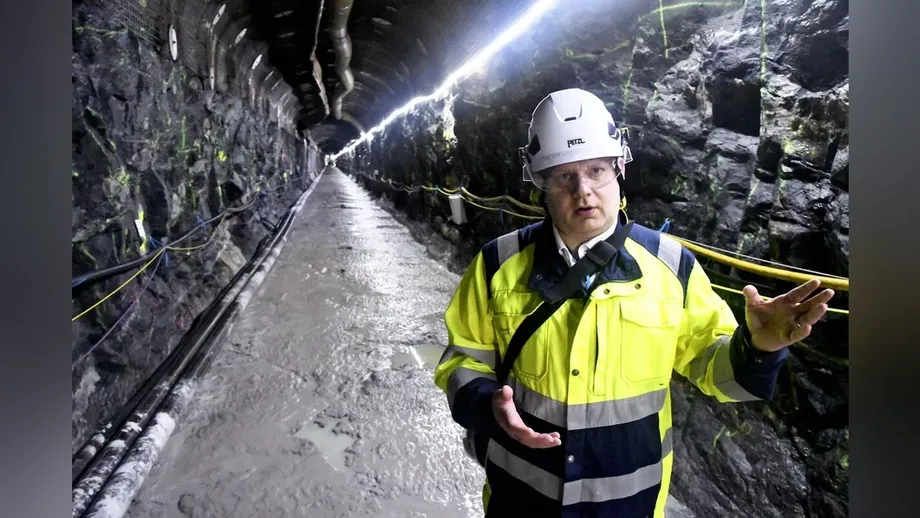
Inside the world's first permanent store for spent nuclear fuel
On the island of Olkiluoto, about 220 kilometres northwest of Helsinki, a spiral access tunnel cuts down through granite formed 1.9 billion years ago. It ends roughly 430 metres below the surface in a grid of chambers where Finland intends to leave its spent nuclear fuel for good. The facility is called Onkalo, Finnish for cave, and no other country has one.
Contents
- Inside the world's first permanent store for spent nuclear fuel
- How the barrier system is meant to work
- Four decades of digging toward a licence
- The first cask makes the full journey
- Why the rock matters more than the machinery
- What it costs, and who pays
- Finland's wider nuclear bet
- Where the rest of the world stands
- What is still unfinished
- Key Points
Posiva, the company that built and will operate the repository, plans to begin burying fuel in the first half of 2027. The Finnish government granted the operating licence in October, valid until 2070, and the steps that remain are final commissioning checks and a last inspection by the Radiation and Nuclear Safety Authority, known as STUK. Disposal campaigns will then run for about a century. After that the tunnels are backfilled and sealed with concrete plugs, and the fuel stays where it is for at least 100,000 years.
The numbers attached to the project have no precedent in civil engineering. Onkalo will hold up to 6,500 tonnes of uranium in spent fuel, packed into about 3,300 disposal canisters. Fully excavated, the repository will spread across an underground area of about 2 square kilometres and contain roughly 50 kilometres of tunnels. Its safety case has been assessed over a horizon of up to one million years, far longer than Homo sapiens has existed.
Finland's five reactors supply about 40 percent of the country's electricity. Nuclear plants generated 31,133 gigawatt hours in 2024, and wind covers close to 30 percent of demand. The waste that keeps those reactors running has been piling up in interim stores since the 1980s, a few hundred metres from where the permanent facility now stands.
How the barrier system is meant to work
The design is called KBS-3, a method developed in Sweden by SKB and adapted for Finnish rock. It stacks barriers so that no single failure decides the outcome. Fuel assemblies are left to cool in reactor pools for 20 to 50 years, then dried at the encapsulation plant on the surface at Olkiluoto and sealed inside a cast iron insert, which is itself enclosed in a copper canister. Twelve assemblies go into a single canister.
Each canister is lowered into its own vertical hole in the floor of a deposition tunnel and packed around with bentonite clay, a material that swells as it takes up water and holds the copper away from moving groundwater. Automated vehicles handle the descent. When a tunnel is full it is backfilled with clay and closed with a concrete plug. The granite is the final barrier, and the one that has to keep working longest.
Reporters were taken down on 24 November, riding an elevator to about 430 metres and walking for tens of minutes along winding passages where pipes and cables run over bare rock. The air underground measured 14 degrees Celsius, warmer than the freezing surface. A geologist on the facility's staff described the bedrock as stable, with no risk of a major earthquake and no volcanic influence. The deposition tunnels the visitors reached run more than 300 metres long.
Posiva's chief executive, Ilkka Poikolainen, told the group that the time scale is the hard part. He said guaranteeing safety across 100,000 years is difficult, that the company has carried out meticulous research, and that it will put safety first.
Four decades of digging toward a licence
Finland did not stumble into this. The site came out of a national screening and a long argument about consent, and the dates matter for any country trying to copy the result.
- 1983: Finland begins screening its entire territory for a disposal site.
- 1994: Parliament amends the Nuclear Energy Act to require that all nuclear waste produced in Finland be disposed of inside Finland.
- 1993 to 2000: Four candidate sites are studied, at Romuvaara in Kuhmo, Kivetty in Aanekoski, Olkiluoto in Eurajoki and Hastholmen in Loviisa.
- 1999: Posiva proposes Olkiluoto, which had the strongest local support and the more favourable geology.
- 2000: The municipality of Eurajoki approves. In May 2001 the national government ratifies the choice.
- August 2003: Eurajoki issues the building permit. Excavation starts in 2004.
- 2004 to 2011: The access tunnel spirals down to 420 metres, then to its final depth, while engineers study the bedrock to fit the layout to it.
- 2012: Posiva applies for a construction licence. On 12 November 2015 the government grants the world's first construction licence for a spent fuel repository.
- Late 2016: Underground construction begins. 2019: work starts on the surface encapsulation plant.
- August 2024: Full scale trials begin, with empty canisters placed in the burial chambers.
- August 2026: STUK delivers a favourable safety assessment, and drilling of the deposition holes starts.
- October 2026: The government grants the operating licence, valid to 2070.
- 19 November 2026: The first transfer cask travels the full three kilometres to the encapsulation plant.
- First half of 2027: Disposal is due to begin after the final STUK inspection.
Posiva itself is a joint venture set up in 1995 by the two companies that produce nuclear power in Finland, Fortum and TVO. Fennovoima, which once planned its own reactor, holds no stake.
The first cask makes the full journey
On 19 November an empty transfer cask, the shielded steel and cast iron container used to move fuel, travelled about three kilometres from the Olkiluoto power plant to the encapsulation plant. The same type of cask has for years covered only the few hundred metres between the reactors and the interim store. This time it was loaded onto Posiva's own transfer trolley on arrival and docked directly to the handling cell where used fuel will eventually be packed.
A team of about 10 specialists from Posiva and TVO handled the transport, with dozens more coordinating radiation protection, facility reservations and the cordoning of the route. Posiva published its account of the run on 26 November. Its operations manager, Pasi Rantamaki, described a clean exercise and said the company would make small changes to its equipment before the next one.
Everything went well and there were no surprises. For the first time, the transfer cask was transported to the encapsulation plant, loaded to our own transfer trolley and handled with Posiva's equipment. Cooperation with TVO was also very efficient.
Karri Osara, Posiva's director of production, said the test measured people as much as machinery.
We managed to verify the operability of the systems, but it was just as important, if not more so, to see how well cooperation between the different organisations of the two companies worked in practice.
A second run is planned, this time testing the fuel transfer machine against the fuel positions of a real cask and switching on the procedures used in the controlled area. Osara framed the pace of the work plainly: the company will not rush, he said, but it will not get stuck on anything either.
Why the rock matters more than the machinery
Dr Thomas D Krom, director for the environment at the geoscience software firm Seequent, argues that the decisive risk in any repository is water, because groundwater is what carries radionuclides away if a canister ever fails. Sites are therefore judged on how slowly water moves through the rock and how few paths it has.
Water is the villain we are protecting against, more or less.
Finland's advantage was time spent reading its own ground. Krom points out that geologists cannot know what lies beneath a site until they drill, and that every core sample or survey can overturn the model built before it. Digital tools have changed the cost of keeping those models current. Seequent's Leapfrog Geo software, which records the rules behind each model so that other users can review and reproduce the analysis, cut the time Posiva needs to update its geological models by as much as 90 percent.
So they're only using 10% as much time as they would have before. That's a cost saving.
Krom also described how the work itself has changed. Four decades ago a drilled core had to be examined by hand by someone with deep expertise; today scanners and computers pull far more information from the same rock. That shift, he said, is why a country starting late does not have to spend 40 years learning what Finland learned.
What it costs, and who pays
Construction has cost about 1 billion euros so far. Operating the site for 100 years and then closing it is estimated at a further 4 billion euros. Set against the electricity Finland's reactors produce at current rates, the whole programme comes to roughly 0.0016 euros per kilowatt hour.
The money is being collected in advance. The State Nuclear Waste Management Fund already holds about 1.4 billion euros, raised through charges levied on nuclear electricity as it is generated. That arrangement, written into Finnish law, is the reason the bill for closure does not land on a future generation that never used the power.
Finland is not treating the repository as a single build. The encapsulation plant and the underground tunnels are being brought into service in stages, with the first deposition holes drilled only after regulators signed off on safety last summer.
Finland's wider nuclear bet
Minister of Climate and Environment Sari Multala said in an interview published on 11 November that her government had just approved the operational authorisation for the Olkiluoto repository, and that the facility would show the world a safe solution for nuclear waste is possible.
Nuclear supplies about 40 percent of Finnish electricity, and a new reactor that started at Olkiluoto in 2023 allowed the country to push fossil fuels almost out of its power mix. Wind now covers nearly 30 percent of demand. Multala said the government is planning small modular reactors for the Helsinki area, built underground so they are invisible from the surface and wrapped in protection systems. She cited a personal visit to Chernobyl as the contrast that explains why so many Finns back nuclear power: they trust the authorities, she said, and those authorities are well regarded abroad.
Security is part of the calculation. Asked about plants in the east near the Russian border, Multala said the government is still working out drone detection and defence, weighing both the technology available and what it costs. She also called on other European countries to produce more of their energy inside Europe.
Where the rest of the world stands
Japan has narrowed its list of candidate sites but has not settled on one, and construction is not in sight. Residents in several countries have organised against proposals, uneasy about a plan meant to outlast every institution that would supervise it. Finland's answer has been to win a municipality over first, which is why Eurajoki's approval in 2000 came before the government's ratification in 2001.
Australia carries a different obligation. Under the AUKUS partnership with Britain and the United States, radioactive material from its future nuclear powered submarines, including spent fuel, will have to be stored and disposed of at home. No site has been chosen and no geological programme has been completed. Krom's advice to Australian planners is blunt.
Start now.
He adds that Australia should not simply copy Finnish rock, since other formations may serve equally well, and that the first task is mapping what the continent already has before narrowing the search.
Australia can, pun intended, leapfrog upon the gains of the Finns.
What is still unfinished
No date has been set for STUK's final commissioning inspection, and Posiva has not said when the second cask test will take place. Live radioactive fuel has not yet been encapsulated at Onkalo; every trial so far has used empty or dummy canisters.
The licence runs to 2070, while the disposal campaigns are planned to run for around a century from the 2027 start. The repository has room for about 6,500 tonnes of uranium, and the tunnels that will eventually total some 50 kilometres are still being excavated in step with demand for space.
What Finland has proved is narrower and more useful than the headlines suggest. A country can decide where its most dangerous industrial waste will end up, win the consent of the people living above it, and build the machinery to put it there. The fuel itself will do the rest of the waiting.
Key Points
- Finland will start disposing of spent nuclear fuel at Onkalo in the first half of 2027, after a final inspection by the Radiation and Nuclear Safety Authority.
- The repository sits about 430 metres down in granite formed 1.9 billion years ago on Olkiluoto island, roughly 220 kilometres northwest of Helsinki.
- It will hold up to 6,500 tonnes of uranium in about 3,300 copper canisters, across some 50 kilometres of tunnels and an underground area of 2 square kilometres.
- The government granted the operating licence in October, valid to 2070, after STUK issued a favourable safety assessment in August.
- Construction has cost about 1 billion euros, with a further 4 billion euros estimated for a century of operation and final closure.
- The State Nuclear Waste Management Fund holds about 1.4 billion euros collected through charges on nuclear electricity.
- On 19 November an empty transfer cask covered the full three kilometres to the encapsulation plant, the first run of its kind; a second test is planned without a fixed date.
- Nuclear provides about 40 percent of Finland's electricity, and wind nearly 30 percent.
- Japan has not chosen a site, and Australia faces its own disposal obligation under AUKUS with no geology settled.