A gold hunt uncovered something far older
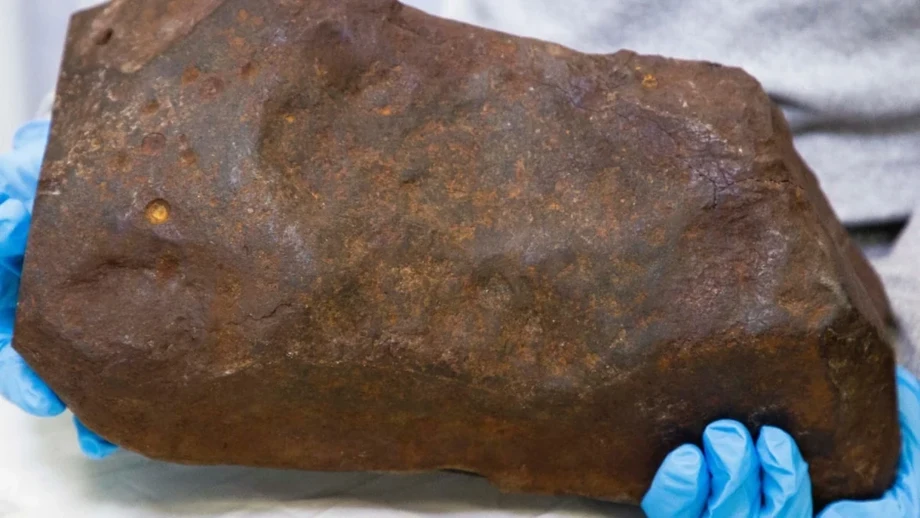
David Hole was searching for gold with a metal detector in Maryborough Regional Park, in central Victoria, Australia, in May 2015. About 2 kilometres south of the town of Maryborough, the detector led him to an unusually heavy, reddish rock buried in yellow clay. It weighed 17 kilograms, or 37.5 pounds, and Hole suspected that a large gold nugget might be hidden inside.
Contents
- A gold hunt uncovered something far older
- Why would the stone not break?
- The clues museum geologists recognised
- What H5 ordinary chondrite actually means
- Three different dates tell three different stories
- Where did Maryborough come from?
- Why scientists value it more than gold
- From yellow clay to the state collection
- What to Know
Hole kept the stone for roughly three years and repeatedly tried to open it. When every attempt failed, he took it to Melbourne Museum in 2018. Geologists there recognised features associated with a meteorite, and a laboratory examination confirmed that his supposed gold rock was a piece of material formed about 4.6 billion years ago, around the birth of the Solar System.
William D. Birch, Dermot A. Henry and Andrew G. Tomkins published the formal description in July 2019 in the Proceedings of the Royal Society of Victoria. Their paper, Maryborough, a new H5 meteorite find from Victoria, Australia, named the object after the nearby town. It recorded a single stone measuring about 39 by 14 by 14 centimetres and explained why this seemingly ordinary-looking lump was an exceptional addition to Victoria's geological collection.
Why would the stone not break?
Maryborough's history made Hole's initial conclusion understandable. The district lies within the Goldfields region, where rich deposits drew thousands of prospectors during the Australian gold rush of the 19th century. Amateur searches have continued long after that boom. A detector signalling a dense object in such a landscape could easily raise hopes of a valuable nugget.
At home, Hole tried a rock saw, an angle grinder and a drill. He also doused the object in acid and struck it with a sledgehammer. None of these methods opened it, and the sledgehammer did not even leave a crack. Gold is comparatively soft and workable; this object was neither. Its resistance did not reveal its identity by itself, but it eventually persuaded Hole to seek a museum assessment rather than abandon the mystery.
The clues museum geologists recognised
Melbourne Museum geologists Dermot Henry and Bill Birch suspected a meteorite almost immediately. Two features stood out: the stone was much denser than an Earth rock of comparable size, and shallow depressions covered its exterior. Confirmation would still require cutting away a small sample and examining its minerals.
Henry said the surface provided a visible record of the object's fiery passage through the atmosphere. As a meteoroid descends, its outside melts and the rushing air shapes it, producing the sculpted appearance he noticed.
It had this sculpted, dimpled look to it. That's formed when they come through the atmosphere; they are melting on the outside, and the atmosphere sculpts them.
Birch, a Melbourne Museum geologist who is now curator emeritus, concentrated on the weight. Dense metal inside the stone helped explain why lifting it felt so different from lifting an ordinary local rock.
If you saw a rock on Earth like this, and you picked it up, it shouldn't be that heavy.
Henry's experience shows how rarely public suspicions are confirmed. By that point he had worked at the museum for 37 years and had examined thousands of rocks brought in by people who believed they had found meteorites. Only two had proved genuine. Hole's stone was one of those two, making the quick suspicion unusual as well as exciting.
What H5 ordinary chondrite actually means
A diamond saw finally succeeded where Hole's tools had failed. Researchers removed a thin slice, revealing dense material rich in iron and nickel, interspersed with small rounded grains. The results allowed the team to classify Maryborough as an H5 ordinary chondrite, a precise scientific description rather than simply a space rock.
A chondrite is a stony meteorite containing chondrules, small rounded mineral structures formed from molten or partly molten droplets in the early Solar System. In Maryborough, these spherical silicate grains measure up to about one millimetre across. They preserve material from a time when dust and young mineral matter were still being assembled into larger bodies.
The letter H denotes the group with a high iron content. H type ordinary chondrites account for about 40 percent of catalogued meteorite finds. The number 5 describes the heating the rock later experienced inside its parent asteroid. That heating recrystallised its surrounding mineral matrix and blurred the outlines of some chondrules. It does not refer to the stone's age or to the number of fragments discovered.
The examination identified the iron and nickel alloys kamacite, taenite and tetrataenite, often found alongside an iron sulfide called troilite. It also recorded silicate minerals including olivine and orthopyroxene. Researchers saw no evidence that the specimen had experienced a violent shock in space. Thin layers of iron oxide around some metal grains indicated limited weathering, consistent with a comparatively short period exposed at Earth's surface.
Three different dates tell three different stories
The age of 4.6 billion years describes when Maryborough's source material formed, not when it landed in Australia. That makes it slightly older than Earth and places its origin near the formation of the Solar System. Its arrival on Earth and Hole's discovery in 2015 are separate events separated by vastly different stretches of time.
Carbon 14 dating carried out at the University of Arizona gave the stone a terrestrial age, meaning the time since its arrival, of less than 1,000 years. The estimate has also been expressed as a fall roughly 100 to 1,000 years ago. Neither version supplies an exact year. The limited weathering encouraged researchers to consider the younger end of the range, raising the possibility that someone could have witnessed its descent.
Historical newspapers provided several candidates. Researchers examined meteor reports from the Maryborough district dating from 1889 to 1951. In June 1923, Harry E. Hallett described a meteor so brilliant that it nearly dazzled him. A bright fireball was also reported in the region in June 1951. None of these sightings could be connected securely to the place where Hole found the stone.
No impact crater has been found, and the research team reported no sign of an impact or additional fragments near the recovery site. Maryborough is therefore classified as a find rather than an observed fall. Scientists know what the object is and approximately how long it has been on Earth, but they cannot name the fireball that delivered it.
Where did Maryborough come from?
The asteroid belt between Mars and Jupiter is the most likely broad starting point. The early Solar System contained dust and rocky material that gravity gradually gathered into planets. Much of the remaining material survived in the asteroid belt, where collisions can break objects apart and alter the paths of fragments.
Henry described a probable sequence in which asteroids struck one another, knocked Maryborough's precursor out of its earlier orbit and eventually sent a fragment towards Earth. Its iron and nickel, silicate minerals and chondrules then remained available for direct examination after Hole dug it up. The precise parent body has not been established.
H type chondrites as a group have been linked to Hebe, a dense asteroid in the belt, but Maryborough itself has no confirmed cosmic address. Wider research is rapidly improving that kind of detective work. Three papers published in 2024 proposed origin stories for more than 90 percent of meteorites, demonstrating how observations of asteroids and laboratory studies can be combined. For this specimen, the defensible conclusion remains the broad asteroid belt origin rather than a named source.
Why scientists value it more than gold
Victoria's figures make the rarity easy to grasp. At the time of the scientific paper, Maryborough was only the 17th meteorite recorded in the state, where prospectors had found thousands of gold nuggets. It was also Victoria's ninth chondrite and its third H5 ordinary chondrite, alongside the Dimboola and Pigick finds.
Size adds another distinction. Maryborough is the second largest single chondritic mass recorded in Victoria, behind the 55 kilogram Kulnine meteorite identified in 2003. Kulnine, at 55 kilograms, is more than three times as massive as the 17 kilogram Maryborough stone. The word ordinary in the classification is a group name, not a judgement that an individual specimen has little scientific worth.
Henry contrasted the small number of Victorian meteorites with the state's long history of gold discoveries and reflected on the unlikely sequence that brought this one from space to a detectorist and then to museum scientists.
This is only the 17th meteorite found in Victoria, whereas there's been thousands of gold nuggets found. Looking at the chain of events, it's quite, you might say, astronomical it being discovered at all.
Henry also explained why such an object can be scientifically valuable without researchers assigning it a headline cash price. A meteorite delivers extraterrestrial material directly to a laboratory, allowing measurements that would otherwise require a spacecraft to obtain.
Meteorites provide the cheapest form of space exploration. They transport us back in time, providing clues to the age, formation, and chemistry of our Solar System (including Earth).
Henry added that some meteorites offer a glimpse of Earth's deep interior. Others contain stardust older than the Solar System, preserving evidence of how stars form, evolve and create elements. Rare specimens can also contain organic molecules such as amino acids, the building blocks of life. For Maryborough, the documented value lies especially in its ancient material, measured minerals and textures, which let scientists compare conditions in its parent asteroid with those recorded by other meteorites.
From yellow clay to the state collection
The route from discovery to scientific recognition unfolded over several years:
- May 2015: Hole found the reddish, 17 kilogram stone while prospecting in Maryborough Regional Park.
- 2015 to 2018: He kept it and made repeated unsuccessful attempts to saw, grind, drill, dissolve or smash it open.
- 2018: Hole took the object to Melbourne Museum, where Henry and Birch recognised features worth investigating.
- July 2019: Birch, Henry and Tomkins published its formal description as an H5 ordinary chondrite.
- After the identification: Museums Victoria bought the meteorite from Hole and added it to the state collection. The acquisition date and purchase price were not given.
The museum catalogue distinguishes between a main specimen weighing 15.9 kilograms and a total mass of 17 kilograms, accounting for the catalogued principal piece and the total material. Melbourne Museum holds Victoria's State Collections, administered by Museums Victoria, which contain more than 17 million items across fields including geology, palaeontology and zoology.
The collection record currently describes Maryborough as being in storage rather than on public display. No date for a future display has been announced, so anyone planning a museum visit specifically to see it should check its status first.
The authors also noted that relatively few meteorites have emerged from central Victoria despite the growth of metal detecting for gold since the 1970s. The museum encourages prospectors to bring unusual rocks forward for identification. Hole's experience shows why weight and a sculpted surface can justify an expert look, while the diamond saw and mineral analysis demonstrate why appearance alone cannot settle the question.
What to Know
- David Hole found the 17 kilogram rock near Maryborough, Victoria, in May 2015 while searching for gold.
- Saws, a grinder, a drill, acid and a sledgehammer all failed to open it before he took it to Melbourne Museum in 2018.
- Scientists identified it as the Maryborough meteorite, an H5 ordinary chondrite formed about 4.6 billion years ago.
- Its iron and nickel content explains its unusual weight, while chondrules up to one millimetre across preserve material from the early Solar System.
- Carbon 14 dating placed its arrival on Earth within the last 1,000 years, but no historical fireball has been securely matched to it.
- It was Victoria's 17th recorded meteorite and its second largest single chondritic mass, after the 55 kilogram Kulnine specimen.
- Museums Victoria acquired the meteorite from Hole; its collection record lists it in storage and not on display.