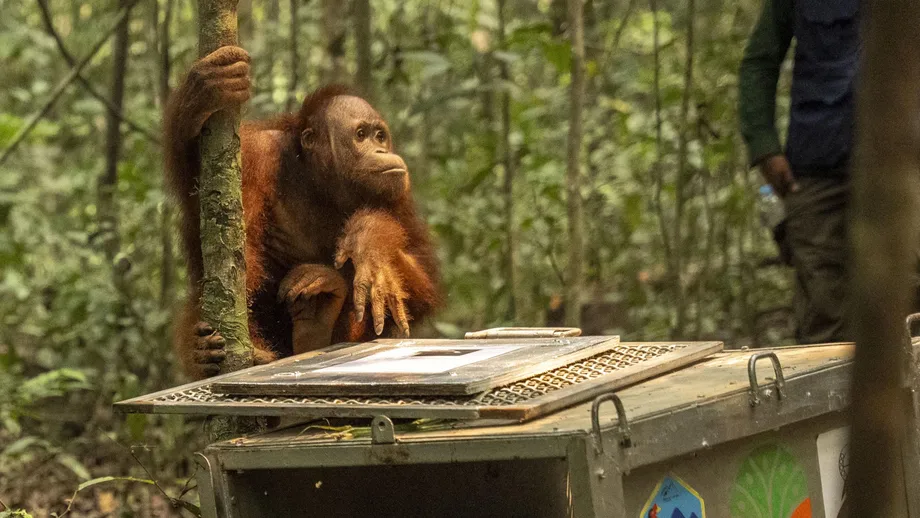
A return to the forest in two stages
Yutris, Meki, Langit and Inggrid went first. The four orangutans were carried into the rainforest of Bukit Baka Bukit Raya National Park on Thursday, November 26, in the opening stage of a release organised in two parts, with Josh, Beni and Dinda following afterwards.
Contents
- A return to the forest in two stages
- What it takes to make an orangutan ready for the wild
- Habitat, not the release itself, decides survival
- Hashim Djojohadikusumo's extinction warning
- A clinic built for a population, not for one release
- Why Central Kalimantan's governor tied the release to Asta Cita
- The other side of the ledger: 72 orangutans pulled from burned land
- Replanting what burned takes longer than putting out the fire
- 70,000 more forest rangers and the money to pay for them
- Key Points
All seven had spent years at the Nyaru Menteng Orangutan Rehabilitation Centre outside Palangka Raya, run by the Borneo Orangutan Survival Foundation, known in Indonesia as Yayasan BOS. The operation was the 48th release from the centre and lifted the foundation's total to 571 orangutans returned to the wild since it was set up 35 years ago.
The same morning brought a ribbon cutting at the Nyaru Menteng 2 complex, where a new orangutan clinic and operational offices opened, and marked three and a half decades of the foundation's rescue and release work.
Bukit Baka Bukit Raya straddles the border of Central Kalimantan and West Kalimantan, and accounts of the ceremony placed the release in both provinces. News of the event circulated on November 27, the day after officials gathered in the park, and some coverage dated the release to that Friday.
What it takes to make an orangutan ready for the wild
Five of the seven were rescued as infants or young juveniles, about one to four years old, from villages and plantations in Central Kalimantan: Beni, Josh, Meki, Langit and Yutris. Dinda and Inggrid never lived free in the forest at all. Both were born on islands where the foundation prepares release candidates, and grew up learning forest skills beside their mothers.
Before any of them entered a transport cage, Nyaru Menteng staff spent years watching how they moved through trees, whether they could recognise and find natural food, whether they avoided people, and whether they could build a sleeping nest out of branches. An orangutan that fails those tests stays behind.
Jamartin Sihite, the foundation's chief executive and board chair, said the new clinic sits at the centre of that process.
This facility will support rescue efforts, health services, rehabilitation and operational management that form an important part of an orangutan's journey before it returns to its natural habitat.
Andi Muhammad Kadhafi, head of the Central Kalimantan Natural Resources Conservation Agency (BKSDA), the provincial wildlife authority, called the release evidence that the rehabilitation worked.
The release of these seven orangutans is a positive signal of the success of the rehabilitation process carried out by the Yayasan BOS Nyaru Menteng team. Orangutans that previously needed care and handling can now return to their natural habitat and have the chance to live free in the wild.
Kadhafi also argued that education has to improve so that fewer orangutans end up in cages at all, because animals kept as pets usually have to be confiscated and rehabilitated later.
Habitat, not the release itself, decides survival
Rohmat Marzuki, the deputy forestry minister, used the event to argue that putting orangutans back in the forest means little without securing the forest itself.
The orangutan release process does not run on its own. It runs alongside the protection of its natural habitat, the forest area. The President's commitment is very strong to protect and secure Indonesia's forests, especially the habitat of biodiversity species such as orangutans, rhinos, elephants, tigers and other animals.
The ministry and the foundation work together from rescue through rehabilitation to the moment an animal is judged ready to go, Rohmat said, and the effort has to continue after the cage door opens.
Conservation efforts do not stop at rehabilitation and release. Both must go hand in hand with habitat protection.
He described the new clinic and offices as a way to raise the quality of health care and staff, and to tighten coordination between the central government, the provincial administration and conservation partners.
Hashim Djojohadikusumo's extinction warning
Hashim Djojohadikusumo attended as chair of the task force on innovative financing and national park management, a body created to find money and better management for Indonesia's protected areas. He said watching the cages open affected him.
I felt moved seeing the orangutans return to their natural habitat. There is a happiness of its own in seeing animals that have been cared for and raised go back to their true home, the forest, where they should live.
He pointed to two species Indonesia has already lost, the Javan tiger and the Javan elephant, and said the same should not happen to the Sumatran tiger, the Javan rhino or the orangutan.
The orangutan is an endangered species, so the government, and I believe the NGOs, intend to increase the orangutan population in the wild.
Why is it important to me? Because I have always loved wildlife, I love animals, but I am concerned about the state of wildlife in Indonesia. I do not want the Sumatran tiger to go extinct, the Javan rhino to go extinct, the orangutan to go extinct.
Hashim said he had worked with and supported the foundation for close to two decades, and described its record as serious.
What Yayasan BOS does is extraordinary. I see that Yayasan BOS really carries out its mission in earnest. I will keep working as hard as I can to help wildlife conservation.
A clinic built for a population, not for one release
Nyaru Menteng 2 is meant to handle far more than the seven animals that left on November 26. Jamartin said success is measured not by the number of orangutans carried into the forest but by how many stay alive and breed there, which is why the foundation and the ministry watch adaptation, food finding and habitat use after every release.
Our goal does not stop at releasing individuals. Together with the Forestry Ministry, Yayasan BOS seeks to support the building of an orangutan metapopulation across the release landscape, a population able to survive, reproduce and remain connected through protected habitat.
A metapopulation is a set of groups living in separate patches of forest that occasionally mix, so that a disease outbreak, a fire or a bad fruiting year in one patch does not wipe the species out across a region. For orangutans, which breed slowly and travel short distances, connected forest is what makes that possible.
Mochamad Satori, head of the national park, framed the seven new arrivals as long term residents rather than a single day's event.
The seven orangutans released today will become part of the forest ecosystem that we protect together. Protection of the conservation area therefore needs to be strengthened through cooperation across sectors and community support.
Why Central Kalimantan's governor tied the release to Asta Cita
Governor Agustiar Sabran put the provincial government behind the programme and linked it to President Prabowo Subianto's Asta Cita, the eight point development agenda his administration uses to frame policy.
The Central Kalimantan provincial government is committed to fully supporting conservation efforts like this, in the framework of environmental preservation and wildlife protection, as part of the grand vision of sustainable development in line with the President's Asta Cita.
Agustiar argued that protecting endemic animals has to be part of regional development rather than something kept separate from it. His administration said it wants cooperation across sectors to raise orangutan numbers while keeping the province's forests intact.
The other side of the ledger: 72 orangutans pulled from burned land
News of seven animals going back to the forest arrived in the same season that another province was taking orangutans out of land that had burned. The West Kalimantan conservation agency and the Indonesian Nature Rehabilitation Initiative Foundation, known as YIARI, evacuated 72 orangutans from areas hit by fire in Ketapang and Kayong Utara districts between August and the end of November 2026. Those animals came from a different operation to the seven released from Nyaru Menteng.
Argitoe Ranting, YIARI's program operations director, said the figure shows how much damage the fires did to wild populations and their habitat. In one area alone, teams pulled out nine orangutans in about two months, and during an evacuation on October 28, 2026, a joint team found three skeletons believed to be orangutan remains.
A total of 72 orangutans were rescued in Ketapang and North Kayong districts because of forest and land fires. That figure illustrates the massive impact of the fires on wild orangutan populations and their habitats in West Kalimantan.
Without serious efforts to prevent fires, protect remaining forests and restore degraded areas, threats to the survival of the orangutan population in this region will continue.
Murlan Dameria Pane, head of the West Kalimantan conservation agency, said the rescues form part of the agency's conservation work and thanked YIARI and the other partners involved, from the rescue stage through to eventual release. Habitat loss, the agency said, also raises the risk of conflict between people and wildlife.
Ranting made the same point about the limits of rescue.
Rescues are an important step to reduce the risks they face, but protecting the remaining habitat and investigating the various threats in the area must also be a shared priority.
Replanting what burned takes longer than putting out the fire
Further south in Central Kalimantan, the conservation platform LindungiHutan is preparing to replant part of Sungai Sintuk in Kumai, in Kotawaringin Barat district, where 43 hectares of peatland burned in 2019 and destroyed trees that villagers had planted. District government figures record 1,409.26 hectares affected by fire in Kumai up to mid October 2026, including incidents around Sungai Sintuk.
Miftachur Robani, known as Ben, the platform's chief executive, said the area is home to orangutans and proboscis monkeys, the long nosed primates known locally as bekantan, and that fire removes their living space along with the trees.
In Sungai Sintuk, Kotawaringin Barat, Central Kalimantan, the forest is home to orangutans, proboscis monkeys and many other animals. When fire damages this area, their living space is disturbed too.
Planting is planned for late 2026 or early 2027, depending on ground conditions and the local farming calendar, under a campaign the platform calls Tanam Setelah Padam, or planting after the fire has gone out. A donation window runs from November 11 to December 12, 2026, in which each successful donation of at least 25,000 rupiah using the voucher TANAMSETELAHPADAM adds 5,000 rupiah to the Kalimantan restoration fund.
What is hard after forest and land fires is starting the recovery. There is land that has to be made green again, trees that have to be planted and cared for, and then a long wait until everything grows.
70,000 more forest rangers and the money to pay for them
Rohmat said the ministry plans to strengthen forest protection by adding 70,000 forest police, and by recruiting trainers and animal keepers, veterinary staff and Manggala Agni personnel, the crews that fight land and forest fires. No timetable or budget for the expansion was given.
Hashim's task force is the government's answer to the financing question, and he argued that better governance and new sources of money are needed if wildlife and environmental protection are to hold up over time.
The seven orangutans now in Bukit Baka Bukit Raya enter a park where the pressure is measured in lost canopy. Estimates of the Bornean orangutan population fell from about 288,500 in 1973 to about 57,350 in 2010, a drop of roughly 80 percent, which is why each release is counted, numbered and named.
What happens to Yutris, Meki, Langit, Inggrid, Josh, Beni and Dinda will be tracked by foundation and ministry teams. Officials did not say how many orangutans the park can hold, and no date was given for the next release from Nyaru Menteng.
Key Points
- Seven rehabilitated orangutans were released into Bukit Baka Bukit Raya National Park in an operation beginning Thursday, November 26, 2026, with four going first and three following.
- The animals are Yutris, Meki, Langit, Inggrid, Josh, Beni and Dinda. Five were rescued as young animals in Central Kalimantan, and two were born on islands used to prepare release candidates.
- The release was the 48th from the Nyaru Menteng centre and took the foundation's total to 571 orangutans returned to the wild, in its 35th year.
- A new orangutan clinic and operational offices opened at the Nyaru Menteng 2 complex in Palangka Raya on the same day.
- Deputy Forestry Minister Rohmat Marzuki said release must go together with habitat protection, and the ministry plans to add 70,000 forest police plus veterinary and firefighting staff.
- Hashim Djojohadikusumo, who chairs the task force on innovative financing and national park management, said Indonesia must not lose more species after the Javan tiger and Javan elephant.
- In West Kalimantan, the conservation agency and YIARI evacuated 72 orangutans from fire affected parts of Ketapang and Kayong Utara between August and late November 2026.
- LindungiHutan plans to replant burned peatland at Sungai Sintuk in Kumai, where 1,409.26 hectares of the district were affected by fire up to mid October 2026.