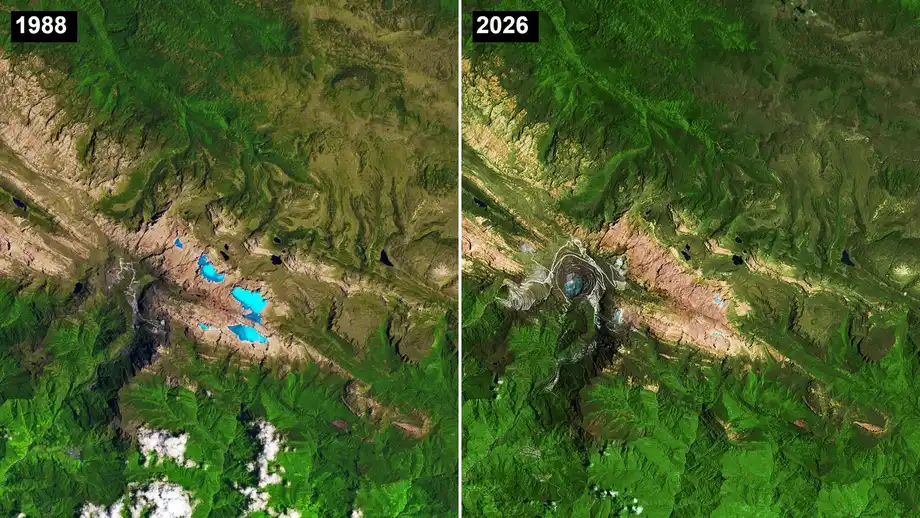
The Disappearing Snowcaps of Puncak Jaya
In 1988, thick blankets of white ice covered 1.66 square miles near the rugged summit of Indonesia's Puncak Jaya on the island of New Guinea. Today, what remains of those towering glaciers would fit comfortably on about a dozen soccer fields. Recent satellite images released by the NASA Earth Observatory reveal that the ice has shrunk to small, fractured patches that no longer flow downhill. Scientists warn that these fragile remnants have effectively lost their status as active glaciers, marking a profound environmental turning point in the heart of the tropics.
Contents
Puncak Jaya stands proudly in the Sudirman Range, reaching an altitude of 4,884 meters above sea level. This towering limestone massif, also historically known as the Carstensz Pyramid, is the highest island peak on Earth. Very few locations this close to the equator manage to hold ice throughout the entire year. Yet these glacial patches sit directly adjacent to the largest stretch of warm ocean water on the planet, existing near the absolute thermal limit where year-round ice can possibly survive. Researchers frequently describe these equatorial ice fields as high-altitude canaries in the coal mine because they serve as sensitive, early indicators of global climate disruption.
The rapid decline of Puncak Jaya forms part of a dwindling global club of tropical ice formations. Similar vanishing acts are underway at the Humboldt Glacier in Venezuela, the shrinking ice cap of Mount Kilimanjaro in Tanzania, and the Quelccaya Ice Cap in Peru. Each of these distant locations shares a vulnerability to rising global temperatures, yet the retreat in Indonesia has unfolded with startling speed.
Decades of Retreat Tracked From Space
Satellite technology provides a stark window into how quickly the landscape has transformed. NASA scientists compared false-color imagery captured by Landsat 5 on November 3, 1988, with newer pictures taken by Landsat 9 on October 19, 2026. In the older images, bright light blue caps crown several of the highest mountain ridges. In the modern photographs, those blue zones have nearly vanished, replaced almost entirely by bare, brown rock.
Data compiled by researchers shows that the total glaciated area plummeted from 19.3 square kilometers in the year 1850 down to approximately 0.165 square kilometers by 2024. This represents a loss of more than 99 percent over roughly a century and a half. The rate of loss accelerated sharply in recent decades, shrinking by about 65 percent just between 2018 and 2024. The remaining ice has retreated into the highest possible crevices near the mountain summits of Carstensz Timur and Ngga Pulu.
Experts explain that glaciers require specific conditions to survive and move. A body of ice must be thick enough to creep downhill under its own immense weight, and it needs a stable high-altitude zone where fresh winter snow accumulates faster than summer melting occurs. On Puncak Jaya, the ice has become so thin and broken into isolated fragments that it has completely stopped flowing. The remaining ice patches are stagnant, leaving exposed rock to absorb solar radiation and drive further melting.
The Thinning Ice and the House of Cards Problem
The vertical depth of the ice has collapsed just as dramatically as its surface area. At the primary scientific monitoring site on the East Northwall Firn, ice thickness was measured at 32 meters in 2010. By 2023, that thickness had plummeted to just 4 meters, and measurements confirmed that the ice at that specific monitoring point had disappeared entirely. The rapid thinning creates a compounding physical problem for the mountain.
When ice thins out, it cracks apart into smaller pieces, exposing fresh edges where melting can happen even faster from all sides. Scientists often refer to this dynamic as a house of cards problem because once the physical retreat reaches a certain velocity, the remaining ice cannot stabilize itself. Fresh snow continues to fall on the mountain during storms, but temperatures are now too warm and air conditions too dry for that snow to linger on the bare rock long enough to compress into new glacial ice.
Climatologists note that the historical ice record spans thousands of years. Ice cores drilled from the glacier by international and local scientific teams in 2010 revealed layers indicating the ice had existed continuously for at least 5,000 years. Those same ice cores contained trapped traces of human-made pollutants, such as lead and sulfur, demonstrating how far-reaching industrial activity has impacted even the most remote equatorial peaks.
How El Niño Drives Accelerated Melting
Natural climate cycles play a major role in pushing the Puncak Jaya glaciers closer to total extinction. The El Niño southern oscillation brings warmer air and drier conditions to the Indonesian region, frequently pushing the freezing level far above the mountain summit. When this happens, warm rain falls instead of protecting snow.
Fresh snow is naturally bright white, bouncing harsh sunlight away and insulating the colder ice beneath it. When rain falls instead of snow, the dark, exposed rock and wet ice absorb solar heat rapidly, accelerating the melt rate. During the particularly powerful El Niño event of 2015 and 2016, the glacier thinned roughly five times faster than normal, losing about 17 feet of thickness in a single year. A subsequent strong El Niño cycle in 2023 and 2024 triggered another surge in melting, thinning the remaining ice by several additional meters annually.
Researchers studying the region note that local temperature trends are outpacing global averages in certain areas. According to regional climate data, global temperatures have risen about 1.4 degrees Celsius above preindustrial levels, while average temperatures across Indonesia have climbed by approximately 0.15 degrees Celsius every decade. This persistent warming ensures that even outside of El Niño years, the environmental baseline remains hostile to ice survival.
Scientific Projections and the 2030 Timeline
Different scientific teams and meteorological bodies have monitored the shrinking ice using various remote sensing tools, drone expeditions, and ground stakes. Recent peer-reviewed research published in academic literature suggests that if the current annual area retreat rate persists, the last remaining Puncak Jaya glaciers will likely disappear completely around 2030.
Other government agencies and researchers monitoring the conditions on the ground suggest the end could arrive even sooner, driven by severe weather anomalies and warming ocean currents. An expedition conducted by researchers and environmental charities utilized high-resolution drones and satellite positioning systems to map the rugged topography, capturing detailed 3D models intended to serve as a digital archive before the physical ice vanishes forever.
The impending disappearance carries profound implications for the surrounding environment. The melting ice contributes fractionally to global sea level rise, which threatens low-lying coastal communities worldwide. Locally, the loss of permanent ice alters the delicate high-altitude ecosystem, with researchers noting that certain native species, such as specific high-altitude frog populations, have already disappeared as their icy habitats warmed and dried out.
Cultural and Ecological Repercussions for Papua
Beyond the physical and scientific measurements, the death of the tropical glacier represents a heavy cultural loss for the indigenous communities of the Papua region. For generations, local traditional landowners have held a deep spiritual reverence for Puncak Jaya. Indigenous populations view the mountain as a sacred entity, where the rocky ridges and valleys represent the limbs of a deity and the permanent snowcap serves as the head.
The loss of the snow strips away an iconic landscape feature that has inspired artists, explorers, and climbers for centuries. Expedition leaders who witnessed the final stages of the melt described the experience as watching planetary destruction unfold on fast-forward. The transition from permanent ice to bare, water-repelling rock permanently alters the hydrology of the mountain slopes, shifting ecological balances that took millennia to establish.
At a Glance
- Ice on Puncak Jaya covered 1.66 square miles in 1988 but shrank to roughly 2 percent of that area by late 2025.
- Ice thickness at the primary monitoring site dropped from 32 meters in 2010 to just 4 meters in 2023, before disappearing entirely at that location.
- Strong El Niño cycles, such as the 2015-2016 and 2023-2024 events, drastically accelerated the annual thinning and melting rates.
- Scientific modeling indicates that the remaining ice patches are stagnant and expected to vanish entirely around 2030.