A President Ties His Career to a Chip Plant
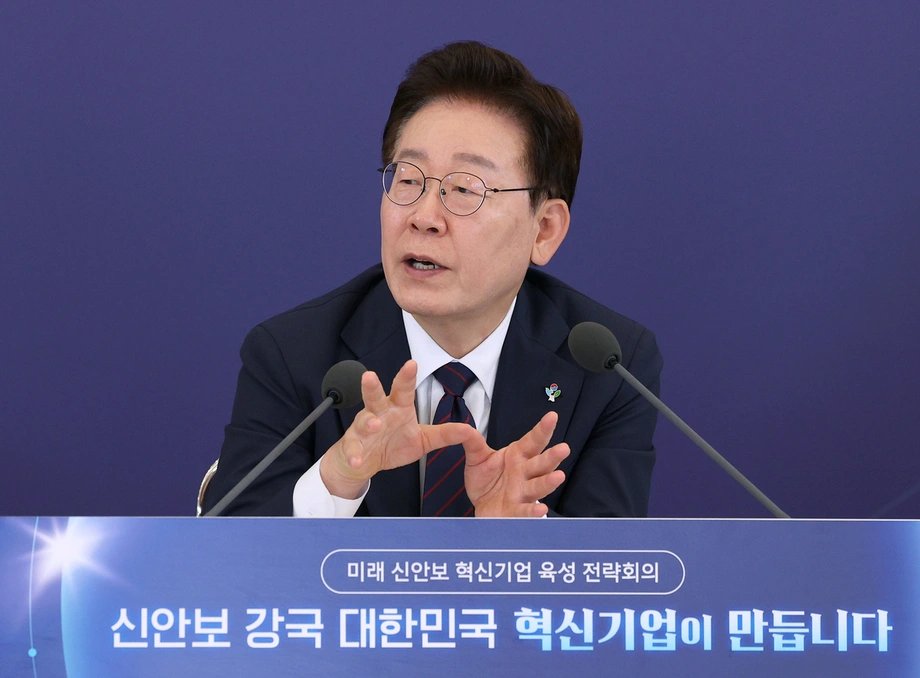
Lee Jae-myung hiked Bugaksan with the reporters who cover the presidential office on Saturday, November 29, then sat down with them in the press hall at Chunchugwan in Seoul. In that room he tied the largest industrial project of his term to his own future.
Contents
- A President Ties His Career to a Chip Plant
- Why the Government Now Says It Has to Lead
- The Doubt About Yongin and Pyeongtaek
- What Gwangju Would Have to Build
- Washington Reads the Same Plan Differently
- Underproduction, Not Overproduction
- The Deadlines in Washington
- More Reactors Than the Plan Allows?
- Speed, Decentralisation and a Lesson From Mexico
- Key Points
The project is a semiconductor cluster in Honam, the southwestern region that takes in Gwangju and South Jeolla Province. The government announced it on June 29: four fabs, the plants where silicon wafers are turned into memory chips, to be built by Samsung Electronics and SK Hynix, with the first mass production set for 2030. Seoul has budgeted 30 trillion won over 15 years to build the industry network, shorten permits and extend electricity and water lines. Officials in the region put the whole cluster at 800 trillion won. It is the centrepiece of what the government calls its three major megaprojects, alongside AI data centres.
A fab is not a shed full of machines. It runs around the clock and draws power and ultrapure water in quantities that decide whether a site can host one at all. The people who work inside it need homes, schools, hospitals and somewhere to spend a weekend. Lee answered all of that in a single breath.
"We can secure 3.5 million pyeong of land, including the surrounding farmland," he said of a site near an airfield. A pyeong is 3.3 square metres, the unit Koreans still use for property, so 3.5 million pyeong is about 11.6 square kilometres. "We will solve water and electricity for you. We will give you universities, research institutes, housing, cultural facilities, educational facilities and medical facilities. Go there, is what we are saying."
The promise came with a stake attached. He would push the project through, he said, even if he had to put his political fate on the line.
Why the Government Now Says It Has to Lead
Lee told the reporters that his own thinking had moved. He once held that business people should run the economy through markets while the government coordinated and stepped in to limit the side effects. "These days my thinking about future advanced industries has changed completely," he said.
It is no longer an era of competition between companies, it is an era of national competition, an era in which the state puts companies forward as its players.
Countries now compete over where a plant sits and over where its output is sold, he argued, so the decision cannot belong to a single boardroom. "Advanced industries are national strategy itself," he said. A government that is incompetent or short of judgement, he added, will collapse in an instant, and he said the corrupt relationship of bribes and favours that once joined Seoul to business is not what is at work now.
The Doubt About Yongin and Pyeongtaek
Gyeonggi Province already hosts the country's biggest chip complex, spread across Yongin and Pyeongtaek, and it is being expanded. Lee said he doubts the power and water can be found for the long run. "Can we really secure them? I do not think we can," he said. "This is work after my term. It is work far off, 10 years away. I am told we must prepare our minds and make practical plans."
Building a few plants now poses no immediate problem in his account. The trouble arrives with a large expansion. He pointed to the Han River basin, the source of water for the Seoul region, and to the resistance that transmission towers meet from residents along their routes. Lines to carry power from generating regions to the capital region, and the plants to fill them, take years to build.
He ruled out revisiting approvals already granted. "How can I change a project once it has been decided?" he asked. His answer is to send the next wave of investment to places that already have the pipes and wires, or can lay them quickly. "I asked the companies, why go to the capital region? Expand fast and go to Gwangju, to a province where the infrastructure is in place, is that not fine? They said OK, and that is how Gwangju happened," he said.
What Gwangju Would Have to Build
Housing comes first, because a plant that starts in 2030 needs families living near it before then. The Jeonnam-Gwangju Special City, the merged authority for the region, plans 55,000 households within a drive of 10 minutes from the production site, enough for families of four, with work starting next year on land around Gwangju Airport. The schedule depends on development districts near Gwangju Songjeong Station, where KTX high speed trains stop, and in the Sanjeong and Sangmu areas, and on how much housing can be added later for supplier firms.
Trains and roads already reach the area. Gwangju Songjeong Station carries the KTX, and the airport station sits on subway Line 1. New access roads would connect the industrial park to nearby expressways and the second ring road, mostly for freight. For workers, the harder question is whether buses and trains run early and late enough for shift changes.
Schools and universities are in place, with 34 universities and 117,409 students enrolled last year. Graduates tend to stay put: 22 percent of students at those universities come from the region, against a national figure of 8 percent. Five regional universities take part in the Glocal University 30 programme and are building courses around AI, energy and aerospace. Chonnam National University was picked in September for the government project it calls ten Seoul National Universities, with education and research support running to 2030.
Health care reaches specialist level. Three hospitals able to treat serious illness sit within an hour: Chonnam National University Hospital and Chosun University Hospital in Gwangju, and Chonnam National University Hwasun Hospital in Hwasun. A national hospital with 500 beds is planned for the southwest of the province, and a national medical school is under discussion for the east. The region already counts 48 general hospitals with at least 100 beds and seven or more departments, 151 hospitals with 30 or more beds and a specialist on staff, 135 nursing hospitals and 116 hospitals practising Korean medicine.
Three large shopping complexes are due to open in stages from 2030. The National Asian Culture Center, exhibition halls, a media art complex and a hall for traditional music all sit within an hour of the site.
An official at the special city authority said the site itself explains the choice. "The reason Samsung and SK picked the Gwangju Airport site is that it has the living conditions, housing, transport, education, medical care and culture, for workers to stay," the official said, adding that the authority is running improvement projects shaped by what companies ask for.
Numbers for the future population vary with the method. The authority estimates that 100,000 to 160,000 people will live in the area once all four fabs run in the mid to late 2030s, counting direct and indirect jobs and their households. The same official put the total at up to 200,000, which he called the size of a city.
Washington Reads the Same Plan Differently
Four days before the press conference, on November 25, the Office of the United States Trade Representative published the results of an investigation under Section 301 of the Trade Act of 1974, a law that lets Washington retaliate against foreign trade practices it judges a burden on American commerce. The case covered 16 economies and the subject was overcapacity, meaning production capacity larger than the world needs, with the surplus pushed onto export markets.
The report listed automobiles, petrochemicals and semiconductors as areas of structural overcapacity in South Korea, and for chips it named the Honam cluster. What it questioned was the package around the plants: 30 trillion won across 15 years, faster permits, and new power and water infrastructure for a region the government had chosen.
Jamieson Greer, the US trade representative, described the objection in an interview with CNBC.
South Korea announced a series of government support and infrastructure-related plans this summer. This does not correspond to actual demand. It is government intervention, and they are actually increasing supply to overseas markets without boosting actual overseas demand.
For Seoul, that turns an argument about exports into an argument about domestic policy, because the part Washington objects to is the decision to build the cluster at all.
Underproduction, Not Overproduction
Lee's reply was brief. "Well, I suppose that is how it is," he said of the finding. "Do we need to react sensitively because the United States said something about one of our policies? We just do what we have to do. Domestic politics operate over there too, so we should listen with proper understanding."
His economic case is that the world has too few chips rather than too many. "Is the problem not that we are underproducing, so prices are soaring?" he said. "They would not have said it without knowing. Do you not need a justification to carry out a policy?"
The tariff arithmetic is where the money sits. The trade representative proposed 15 percent for economies holding trade agreements with Washington, which covers South Korea, Japan and the European Union. South Korea already pays a 12.5 percent forced labor tariff imposed in July, so holding the combined rate at 15 percent counted in Seoul as a result worth having. Washington also left 25 percent open for South Korea should consultations or existing promises fall short, and put Japan at 20 percent, the European Union at 20 percent, China at 40 percent and Taiwan at 25 percent.
Trade Minister Kim Jeong-kwan met reporters on November 25 and called the defence of the ceiling an achievement in itself. "If we had faced the situation where our surplus with the United States doubled compared with last year without the investment framework, it would have been an unimaginably heavy burden," he said.
That surplus is the figure that worries Seoul. South Korea sold $102.3 billion more to the United States than it bought in the first 10 months of 2026, more than twice the $49.5 billion surplus recorded for the whole of 2025, a jump driven by the chip boom around artificial intelligence. The 15 percent ceiling rests on a bilateral investment agreement worth $350 billion reached last year.
The Deadlines in Washington
The trade representative will take written comments until January 5 and hold a public hearing on January 25 before fixing final rates. A second front is opening at the same time. Members of Congress have raised South Korea's digital rules as a barrier that is not a tariff, and the agency could open a Section 301 case on digital trade.
Kim said no specific demands on the digital rules have arrived yet and his ministry is watching closely. Jang Sang-shik, who leads the International Trade Research Institute at the Korea International Trade Association, said the condition attached to the 15 percent rate will shape how Seoul designs industrial policy, and named a digital investigation and the chip tariff as the two variables to watch.
- June 29, 2026: the government announces the Honam cluster, with four fabs and a first production target of 2030.
- July 2026: the United States adds a 12.5 percent forced labor tariff on South Korean goods.
- November 25, 2026: the trade representative publishes the overcapacity report, proposes 15 percent and holds 25 percent in reserve.
- November 29, 2026: Lee stakes his political fate on the Honam fab in Seoul.
- January 5, 2027: deadline for written comments.
- January 25, 2027: public hearing, before final rates are set.
More Reactors Than the Plan Allows?
Electricity ran through the whole conversation. Lee said the nuclear plants written into the Basic Plan for Electricity Supply and Demand, the document that sets out how the country will meet demand over the next 15 years, will be built, and he referred to the two additional reactors it contains. More may follow. "If we cannot cover electricity demand, it becomes impossible to attract and develop future advanced industries," he said. "If we have the capacity, should we not consider doing more?"
He kept a transition centred on renewable energy and said public opinion should be gathered through deliberation. A public deliberation committee the government set up recently on nuclear power has run into confusion. Lee said he did not know the details, and that the panel should not settle its conclusion in advance but work "in an open way."
Speed, Decentralisation and a Lesson From Mexico
The day before the press conference, Lee attended the groundbreaking for the GS AI Data Center in Donghae, Gangwon Province, and brought it up as an example of what a government can do when it moves. Permits that normally take between 18 months and two years were finished in four to five months, which let the project meet a customer condition to start supply within two years.
Two Saturdays in a row went to such ceremonies, first in Ulsan and then in Gangwon, where he pressed the companies to move fast. He also described a lesson picked up abroad. He met President Claudia Sheinbaum of Mexico during a visit in September, and noted that she stays in Mexico City until Thursday, tours the provinces at weekends, and briefs reporters and posts on social media often. "I reflected that I have not done enough of what I should do," he said.
On where state bodies sit, Lee put the weight on concentrating public institutions in a few regional centres rather than spreading them across every province. On the mountain in the morning he spoke of a "one nation, two capitals" idea, with Seoul as the economic capital and Sejong as the administrative one. In the afternoon he said he would move institutions out "in a concentrated way according to principle, even if I take some criticism."
Key Points
- President Lee Jae-myung said on November 29 that he would stake his political fate on building a semiconductor cluster in Honam, with 3.5 million pyeong of land secured near an airfield.
- The cluster announced on June 29 covers four fabs by Samsung Electronics and SK Hynix, a first production target of 2030 and 30 trillion won of support over 15 years.
- Lee said he doubts Yongin and Pyeongtaek can secure enough power and water once their clusters grow, citing the Han River basin and opposition to transmission towers.
- The US Trade Representative named the Honam cluster in a November 25 report on structural overcapacity and proposed a 15 percent tariff, keeping 25 percent in reserve.
- South Korea's surplus with the United States reached $102.3 billion in January to October 2026, against $49.5 billion for all of 2025.
- Lee said the world is underproducing chips rather than overproducing them, and called the government's role in advanced industry larger than that of companies.
- He left open building more nuclear reactors than the two additional units in the current electricity plan.
- Written comments on the US tariff proposal close on January 5, with a public hearing on January 25.